Essential Services and Support for Moving to London Neighbourhoods
By Housey · Last reviewed 7th of May 2026
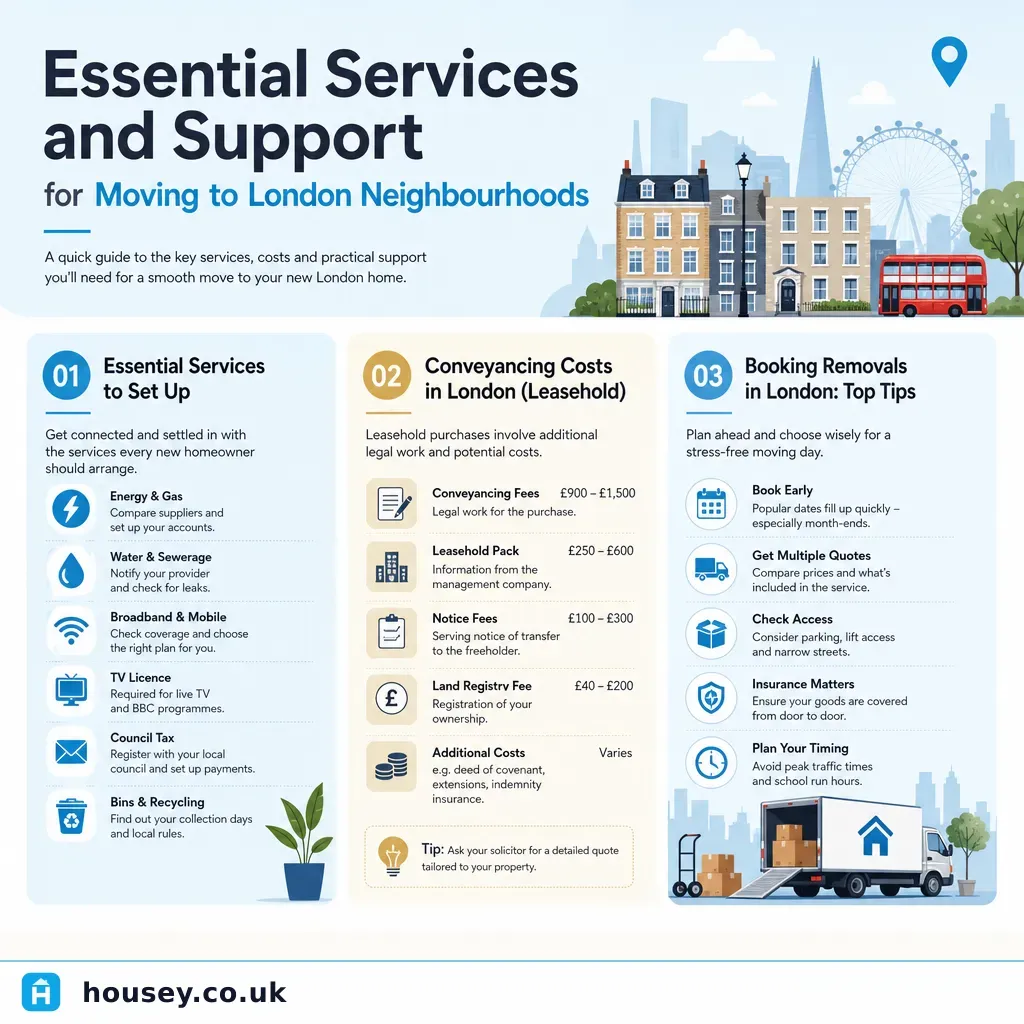
Essential Services and Support for Moving to London Neighbourhoods
Moving to London involves logistical, legal, and practical decisions that are more complex than relocating to most other UK cities. From navigating leasehold-heavy flat stock and highly competitive property markets to managing removal vehicles in the Congestion Charge Zone, each London neighbourhood presents its own particular demands. Whether you are buying your first London flat, upsizing within a borough, or relocating from elsewhere in the UK, knowing which services you need — and when to arrange them — has a direct bearing on whether the move goes smoothly or becomes an expensive source of stress.
Key points
- The majority of London flats are sold leasehold: your conveyancer must review the lease term, service charge history, and any pending major works notices in addition to standard searches.
- The London Congestion Charge Zone applies Monday to Friday 7am–6pm and at weekends 12pm–6pm; most large removal vehicles are also subject to the Ultra Low Emission Zone (ULEZ) daily charge.
- Parking suspension applications must be made to your destination borough council — allow at least 2–3 weeks, as processing times vary significantly between boroughs.
- Stamp Duty Land Tax (SDLT) applies at 10% on the portion of a purchase price above £925,000; London's higher average prices mean most buyers pay more in SDLT than equivalent buyers elsewhere in England.
- Conveyancing for a leasehold London flat typically costs £1,200–£3,000+, more than a comparable freehold transaction — Indicative UK costs, last reviewed 2026-05-07.
What makes moving to London different
London's property market differs from the rest of the UK in ways that directly affect the services you need and the timelines you should expect.
Leasehold complexity: Most flats — and some houses — in London are leasehold. Your conveyancer will need to review the lease term (anything under 80 years begins to affect mortgageability and value), the annual service charge and ground rent, the building's insurance, and whether planned major works could trigger a large special assessment. Leasehold conveyancing typically takes longer and costs more than a freehold purchase.
Density and logistics: Inner London streets are often narrow, permit-holder only for parking, and covered by the Congestion Charge or the ULEZ. These factors directly affect removal firm availability, pricing, and how your move is structured on the day. Book and plan early.
Competitive market: In popular Zone 2 areas such as Hackney, Clapham, and Richmond, properties can sell within days and sealed-bid situations are common. Having a conveyancer instructed in advance and a survey firm identified before offer acceptance can prevent delays that cost purchases in a fast-moving market.
Choosing the right London neighbourhood: key service considerations
No single neighbourhood suits every buyer or renter. The table below gives a practical overview of characteristics that affect which services you will need and how you will need to plan your move.
Neighbourhood type | Typical property stock | Key conveyancing considerations | Removal logistics |
|---|---|---|---|
Inner Zone 1–2 (e.g. Islington, Hackney, Lambeth) | Victorian terraces, mansion flats, converted period buildings | Leasehold issues common; service charges and lease terms vary widely | Congestion Charge likely; parking suspension essential; narrow streets |
Outer Zone 3–4 (e.g. Bromley, Ealing, Walthamstow) | 1930s–50s semis, Edwardian terraces, some new-build | More freehold stock; standard conveyancing often simpler | Easier vehicle access; fewer Congestion Charge or ULEZ issues |
New-build developments (various boroughs) | Leasehold flats, managed estates | Developer care packs, 10-year NHBC warranty; Community Infrastructure Levy may apply | Often managed with designated move-in slots and lift bookings |
Conservation areas (e.g. Hampstead, Dulwich) | Listed buildings, restricted permitted development rights | Listed building status limits alterations; check EPC and insulation obligations | Access issues; some streets are weight-restricted |
A worked example: buying a leasehold flat in Zone 2
Sara is buying a two-bedroom leasehold flat in Peckham, Southwark, at £485,000. Here is how the key services play out:
- Conveyancer: Instructed immediately on offer accepted. Reviews the 82-year lease (adequate for mortgage purposes), service charge of £2,900 per year, and confirms no outstanding major works notices. Estimated timeline to exchange: 10–12 weeks.
- RICS Level 2 Home Survey: Commissioned for approximately £550–£700 (indicative, 2026). The surveyor flags potential damp at a bay window; Sara requests an investigation by the seller before exchange.
- Removal firm: Booked 6 weeks ahead. Her Peckham street requires a parking suspension from Southwark Council, applied 3 weeks ahead and granted within 10 working days. The removal firm confirms the vehicle is ULEZ-compliant.
- Completion day: Keys collected from the estate agent at 1.30pm; move completed by 5pm. Sara registers for council tax with Southwark within a week and updates her GP registration.
Indicative costs, last reviewed 2026-05-07. Actual costs vary by property, conveyancer, and circumstances.
Moving to London: a practical checklist
Before exchange:
4–8 weeks before move:
2 weeks before move:
Move day:
After move:
Conveyancing in London: what to budget for
London conveyancing fees are broadly similar to the rest of England for freehold transactions, but leasehold purchases — the majority of London flat sales — incur additional charges that are worth understanding before you instruct:
- Leasehold supplement: £200–£500
- Notice of transfer or charge to the freeholder: £50–£300
- Management pack (requested from the freeholder or managing agent): £200–£500
- Deed of Covenant: £100–£300 where required by the lease
A total budget of £1,500–£3,000+ for a leasehold flat purchase is realistic in most London boroughs. Always ask for a full itemised breakdown — including third-party disbursements and VAT — before instructing a conveyancer. Indicative UK costs, last reviewed 2026-05-07.
When to get professional help
Instruct a conveyancer the moment an offer is accepted — do not wait for the survey. In a competitive London market, delays at the legal stage can cost you a purchase. If your survey reveals structural concerns, significant damp, or indicators of subsidence, instruct a specialist immediately rather than proceeding on the general survey alone. For listed buildings or properties in conservation areas, check with the local planning authority before arranging any alteration work, including internal changes that might affect listed features.
How Housey can help
Housey can help you compare quotes from qualified providers for the key services you will need when moving to London. Whether you need a conveyancer experienced with London leasehold property, a property photography and floorplan service to market your current home effectively before the move, or a reliable house removals firm familiar with London's parking permit requirements and ULEZ restrictions, Housey connects you with local providers so you can compare and choose with confidence.
Frequently asked questions
How far ahead should I book a removal firm for a London move?
Book 4–8 weeks ahead for an inner London move, particularly if your move date falls on a Friday or at the end of the month — both common completion days. Demand is consistently high in popular boroughs, and ULEZ-compliant vehicles with appropriate lift equipment are in shorter supply than in other UK cities. Last-minute bookings during peak periods are often unavailable or significantly more expensive.
What is a parking suspension and do I need one in London?
A parking suspension is a formal application to your borough council to temporarily reserve on-street parking outside your new home on moving day, so the removal vehicle can load and unload lawfully. Most London boroughs require 7–14 working days' notice; some take longer. Without one, removal vehicles may have to park further away — adding time and cost — or risk a penalty charge notice.
How long does conveyancing take in London?
A typical London purchase takes 10–16 weeks from offer to exchange, with a further 1–4 weeks to completion. Leasehold transactions often take longer because of the time needed to obtain the management pack from the freeholder or managing agent and resolve any outstanding queries. Instructing a proactive conveyancer early and responding promptly to their queries are the most effective ways to keep the process on track.
Do I need a survey when buying in London?
Yes. Even for properties that appear in good condition, a RICS Level 2 Home Survey is advisable for most London purchases. Older Victorian and Edwardian stock — a large proportion of London's housing — can have issues with damp, subsidence, and outdated electrics that are not visible at a viewing. For flats in older mansion blocks or extensively converted buildings, a RICS Level 3 Building Survey may be worth commissioning.
Which London boroughs tend to have the lowest property prices?
As of 2026, Havering, Barking and Dagenham, Bexley, and Croydon have typically offered the lowest average prices in Greater London. Prices change constantly — check HM Land Registry's Price Paid Data for current figures and use Rightmove or Zoopla sold prices to compare recent transactions in specific streets before making an offer.
Sources and further reading
- Stamp Duty Land Tax calculator — GOV.UK: calculate your SDLT liability for any London purchase
- HM Land Registry Price Paid Data — HM Land Registry: current and historical sold prices by area
- Congestion Charge and ULEZ guidance — Transport for London: zones, charges, and exemptions
- Leasehold property: your rights — GOV.UK: guide to leasehold ownership in England
- Moving home checklist — Citizens Advice: practical steps for buyers and renters
Useful next reads
 Buying & Moving
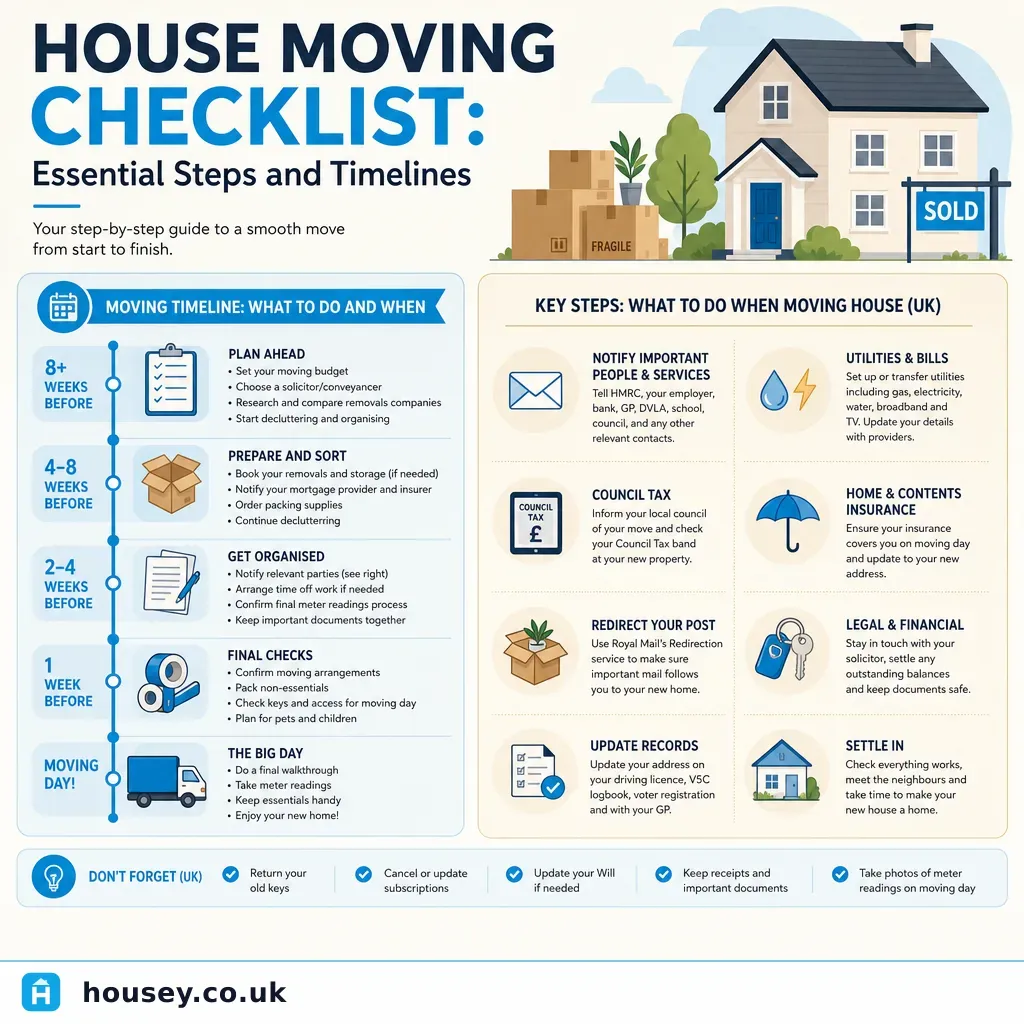
House Moving Checklist: Essential Steps and Timelines
A UK house move typically spans 8–12 weeks of preparation: book removals 4–6 weeks out, notify the DVLA, HMRC, and utilities as exchange approaches, take meter readings on moving day, and update Council Tax and the electoral register on arrival.
 Buying & Moving
Moving to Harrogate: Location Guide and Property Information
Harrogate is a North Yorkshire spa town approximately 21 miles from Leeds, with direct rail links to Leeds (30–45 mins) and York.
 Buying & Moving
Properties and Relocation Guide for the Home Counties Region
The Home Counties — Surrey, Hertfordshire, Kent, Essex, Berkshire, Buckinghamshire, and East and West Sussex — offer a wide range of property types, with rail connections to London typically taking 20–60 minutes.
 Buying & Moving
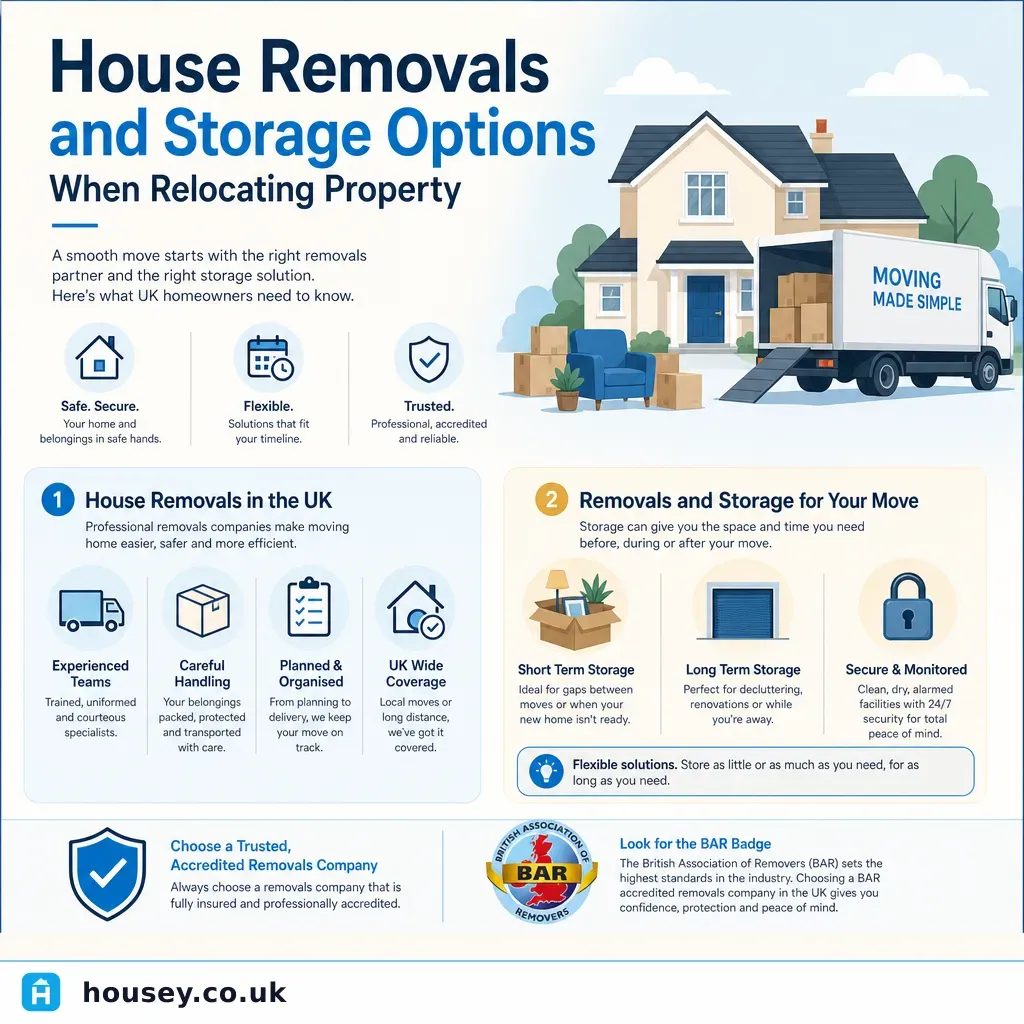
House Removals and Storage Options When Relocating Property
Choosing the right combination of removals service and storage depends on move size, timeline, and budget.
 Buying & Moving
Moving to Taunton: location guide and property overview
Taunton is Somerset's county town with direct rail links to London Paddington in under two hours, M5 motorway access, and property prices below the South West regional average.