House Removals and Storage Options When Relocating Property
By Housey · Last reviewed 1st of June 2026
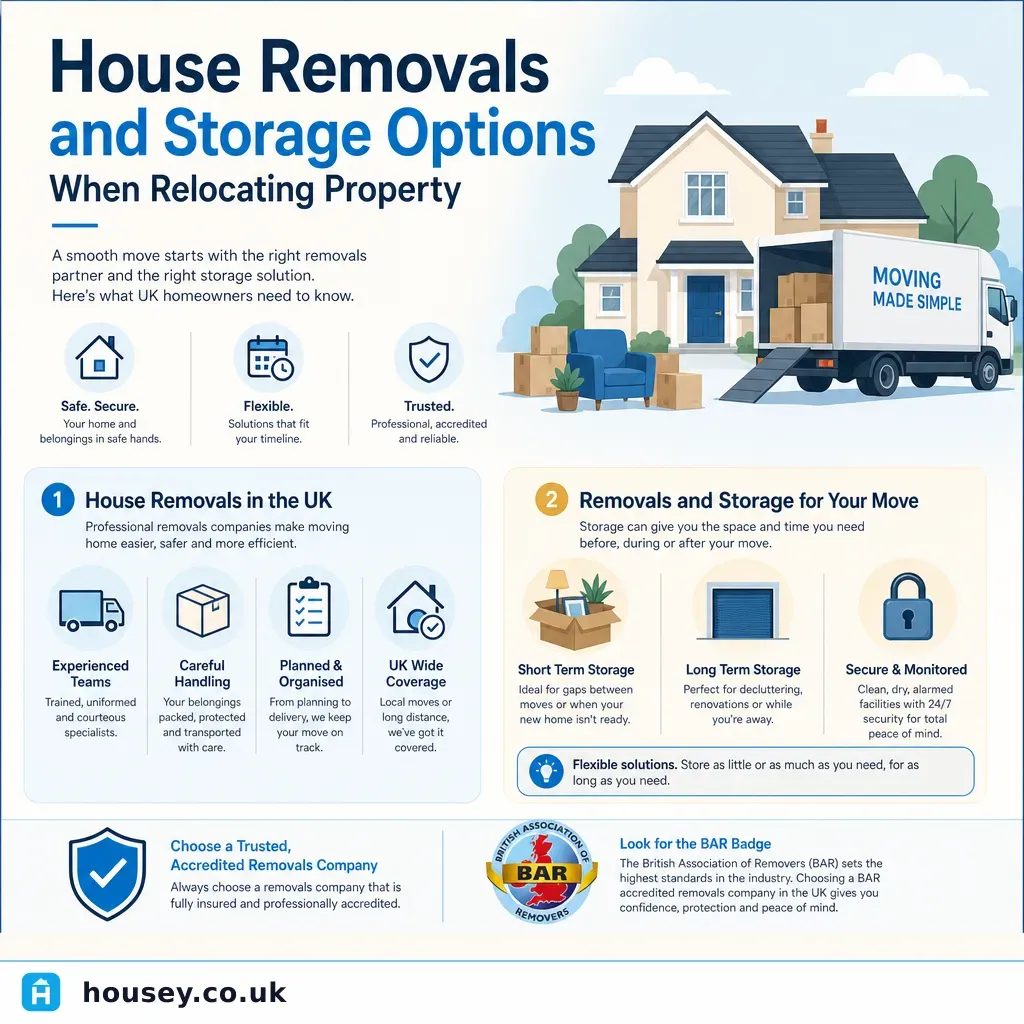
House Removals and Storage Options When Relocating Property
Organising house removals and storage is one of the most practically demanding parts of any property transaction. Whether you are moving to a neighbouring street or across the country, decisions about which removal service to use, how much to budget, and whether you need interim storage typically arise once an offer has been accepted and a completion date is being confirmed. Getting the logistics right — and booking in the right order — can reduce stress considerably on moving day.
Key points
- The British Association of Removers (BAR) and the National Guild of Removers and Storers (NGRS) are the main UK trade accreditations for removals firms — both operate consumer financial protection schemes and formal complaints procedures.
- Most professional removals firms carry Goods in Transit insurance as standard, but cover limits, excesses, and exclusions vary — self-packed boxes are often excluded or subject to reduced cover.
- Self-storage units in the UK are typically rented on a rolling weekly or monthly basis with no minimum period, making them flexible for uncertain or shifting completion timelines.
- Booking a full-service removals firm 4–8 weeks in advance is advisable during busy periods such as end-of-month completions, school holiday windows, and spring and summer peak months.
- A parking bay suspension from your local council is often needed on moving day — most councils require at least 5–10 working days' notice, and fees vary by authority.
Full-service, part-service, or self-move: choosing the right approach
The right removals arrangement depends on how much you want to handle yourself, your budget, the size of your move, and the fragility or value of your belongings.
Comparison table: removals options
Option | Best for | Not ideal for | Typical inclusions | Main risk |
|---|---|---|---|---|
Full-service removals | Large families; valuable or fragile furniture; limited time | Tight budgets; small simple moves | Packing, loading, transport, unloading; optional unpacking | Higher cost; careful vetting required |
Part-service removals | Those who can pack but need transport help | Very large volumes; fragile items | Loading, transport, unloading | Self-packing may limit or void goods cover |
Self-hire van | Studio or 1-bed moves; flexible timing; tight budget | Large homes; long distances; limited experience | Van hire, fuel | No goods cover; physical demands; access challenges |
Man-and-van | Small 1–2 bed moves; local distance | Large families; long distance; high-value items | One or two persons plus transit van | Variable quality and insurance cover |
Containerised storage-and-move | Long gap between completion dates; rural addresses | Urgent same-day turnarounds | Delivery, collection, warehouse storage | Longer lead times for delivery and retrieval |
Storage options explained
Storage is often needed when your sale and purchase completion dates do not align, when you are renovating before moving in, or when downsizing requires temporary overflow space.
Self-storage facilities
Self-storage units are individually lockable rooms in a managed facility, typically accessible during staffed hours or around the clock. You load and unload yourself, which keeps costs down but requires your own transport and effort. Unit sizes commonly range from a small locker (around 25 sq ft) to the equivalent of a double garage (200 sq ft or more). UK prices vary considerably — central city rates can be three or four times those of rural facilities.
Removals company storage
Many full-service removal firms offer containerised storage as part of the same booking: your belongings are packed into numbered storage containers, sealed, and held in a warehouse until your new property is ready. You do not access them between move-out and move-in. This is often the most practical option when combined with a house move, as it reduces the number of separate providers to manage.
Portable storage containers
Some providers deliver a portable storage unit directly to your property, allowing you to load at your own pace before it is collected and held at a secure facility — or transported directly to your new address. This approach suits sellers who want to declutter and stage the property before listing, as well as those with flexible timelines between exchange and completion.
Moving checklist for UK homeowners
Use this checklist to prepare for your moving day:
What to ask before accepting a removals quote
- What does the quote include and exclude — packing materials, furniture dismantling, re-assembly at the new address?
- What Goods in Transit insurance is provided, and what are the cover limits, excess, and exclusions?
- Do you hold BAR, NGRS, or equivalent trade accreditation?
- What happens if completion is delayed on the day — is a waiting charge applied, and how is it calculated?
- Is VAT included in the quoted price?
- What is your postponement or cancellation policy if our completion date changes?
- For storage: how are items inventoried, how is the facility secured, and what notice is required to retrieve belongings?
International removals: additional considerations
If you are relocating outside the UK, requirements extend well beyond a standard domestic move:
- Customs declarations and import documentation for the destination country
- Full container load versus groupage (shared container) shipping options, and their respective cost and timeline trade-offs
- Pet travel regulations — DEFRA requirements apply for bringing pets back into the UK from abroad
- Some household items — certain plants, foodstuffs, or treated wood products — may be restricted or prohibited at the destination
Specialist international removals firms handle customs paperwork and can advise on country-specific import rules. BAR members operating internationally may also hold FIDI accreditation (Federation of International Furniture Removers), which indicates compliance with global standards for cross-border household moves.
When to get professional help
Most domestic moves do not require specialist input beyond a properly accredited removals firm. Seek additional professional guidance if:
- You are moving antiques, fine art, a wine collection, or other high-value specialist items — these may require specialist insurers or dedicated handlers
- You are relocating internationally with a vehicle, pet, or goods subject to import restrictions
- Completion delays mean you need open-ended or long-term storage — review contract notice periods and cost implications carefully before committing
- Access at either property is restricted — narrow lanes, no nearby parking, or a listed building with access conditions
How Housey can help
Housey can connect you with accredited house removals companies, storage providers, and international removals specialists in your area. Get multiple quotes and compare scope, insurance cover, and trade accreditations before you commit to any booking.
Frequently asked questions
How far in advance should I book a removals company in the UK?
For moves during busy periods — end-of-month completions, school holidays, and spring and early summer — booking 4–8 weeks in advance is advisable. For quieter periods such as January or midweek moves, two to three weeks may be sufficient. Popular BAR-accredited firms fill quickly around peak completion dates, so confirm your date with your solicitor before booking.
Do I need separate insurance for my belongings during a house move?
Most professional removals firms carry Goods in Transit insurance as standard, but cover limits, excesses, and exclusions — particularly for self-packed boxes — vary widely. Check the level of cover before booking, and review your home contents policy, as some extend cover during a move while others exclude transit risks. High-value items such as jewellery or artwork may need separate specialist cover.
What is the difference between BAR and NGRS accreditation?
Both the British Association of Removers (BAR) and the National Guild of Removers and Storers (NGRS) set standards for UK removal companies, including financial protection schemes and formal complaints procedures. BAR is the better-known body; NGRS covers a wider range of smaller and independent operators. Either accreditation provides a meaningful level of consumer protection beyond an unaccredited firm.
What size storage unit do I need for a two-bedroom house?
As a rough guide, the contents of a two-bedroom house typically fill a 50–75 sq ft self-storage unit, roughly equivalent to a small garage. If you are storing large furniture such as a wardrobe or sofa, a 75–100 sq ft unit may be more practical. Most providers allow you to transfer to a different unit size if your initial estimate proves incorrect.
Sources and further reading
- British Association of Removers (BAR) — find an accredited mover — British Association of Removers
- National Guild of Removers and Storers (NGRS) — National Guild of Removers and Storers
- GOV.UK — tell DVLA you have changed address — GOV.UK
- Royal Mail — address redirection service — Royal Mail
- Citizens Advice — moving home checklist — Citizens Advice
Useful next reads
 Buying & Moving
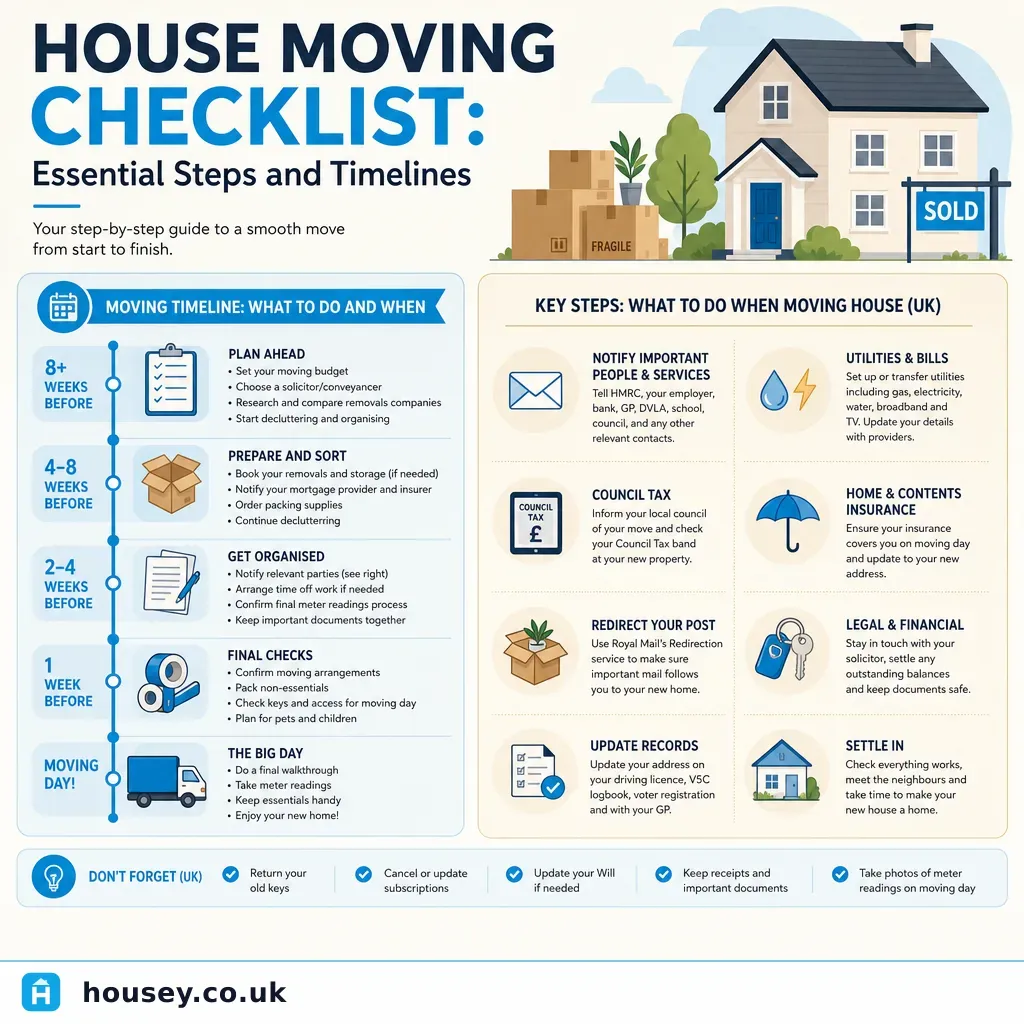
House Moving Checklist: Essential Steps and Timelines
A UK house move typically spans 8–12 weeks of preparation: book removals 4–6 weeks out, notify the DVLA, HMRC, and utilities as exchange approaches, take meter readings on moving day, and update Council Tax and the electoral register on arrival.
 Buying & Moving
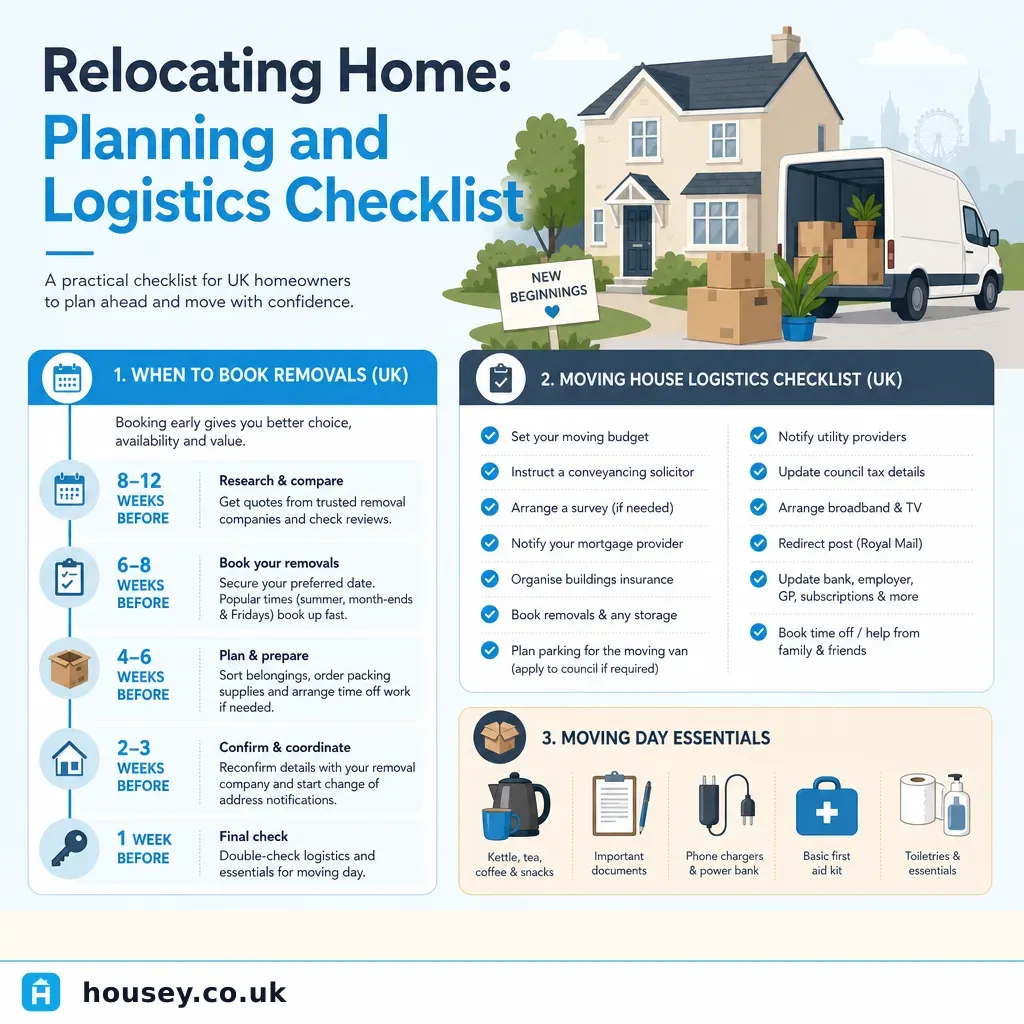
Relocating Home: Planning and Logistics Checklist
Successful home relocation in the UK typically requires 8–12 weeks of advance planning.
 Buying & Moving
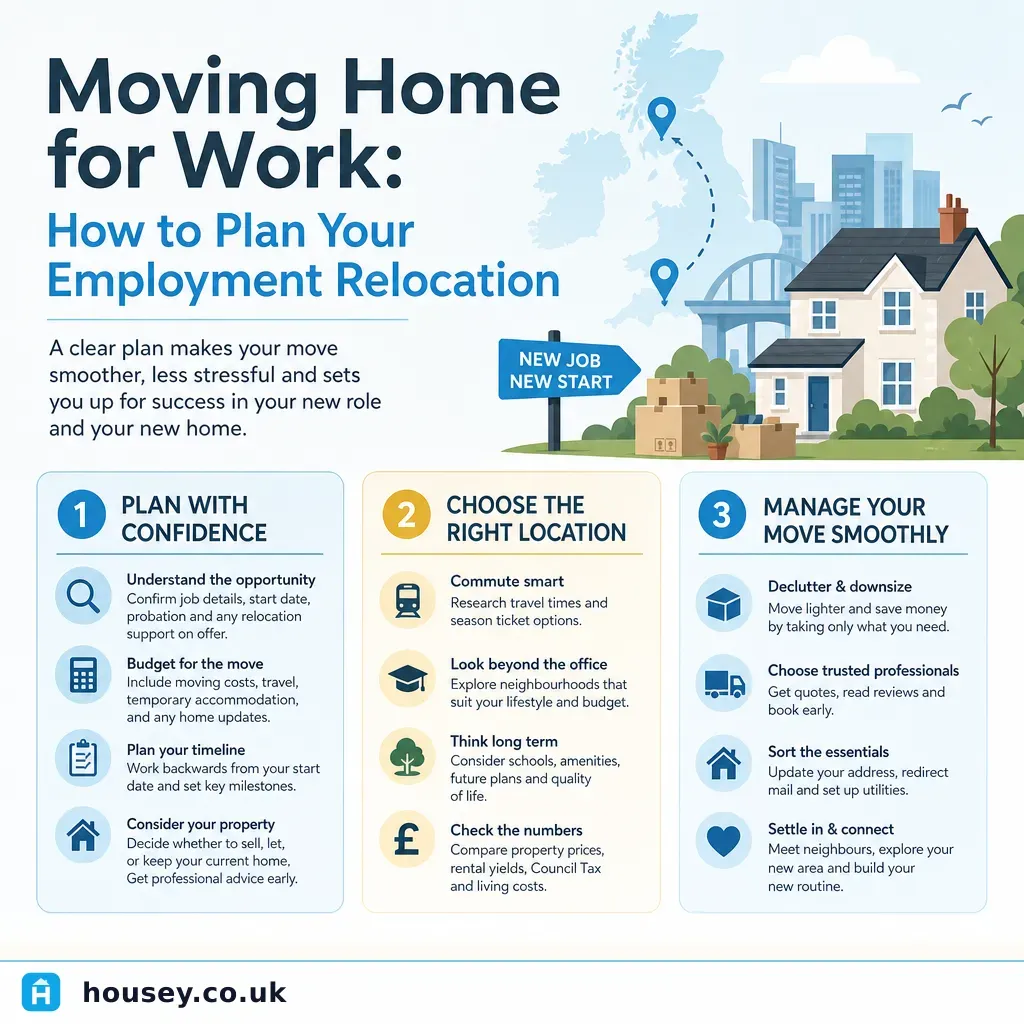
Moving Home for Work: How to Plan Your Employment Relocation
Moving home for a new job requires coordinating property timelines, removal logistics, and employer reimbursement simultaneously.
 Buying & Moving
Essential Services and Support for Moving to London Neighbourhoods
Moving to London requires coordinating conveyancing, surveys, and removal logistics within tight timeframes.
 Buying & Moving
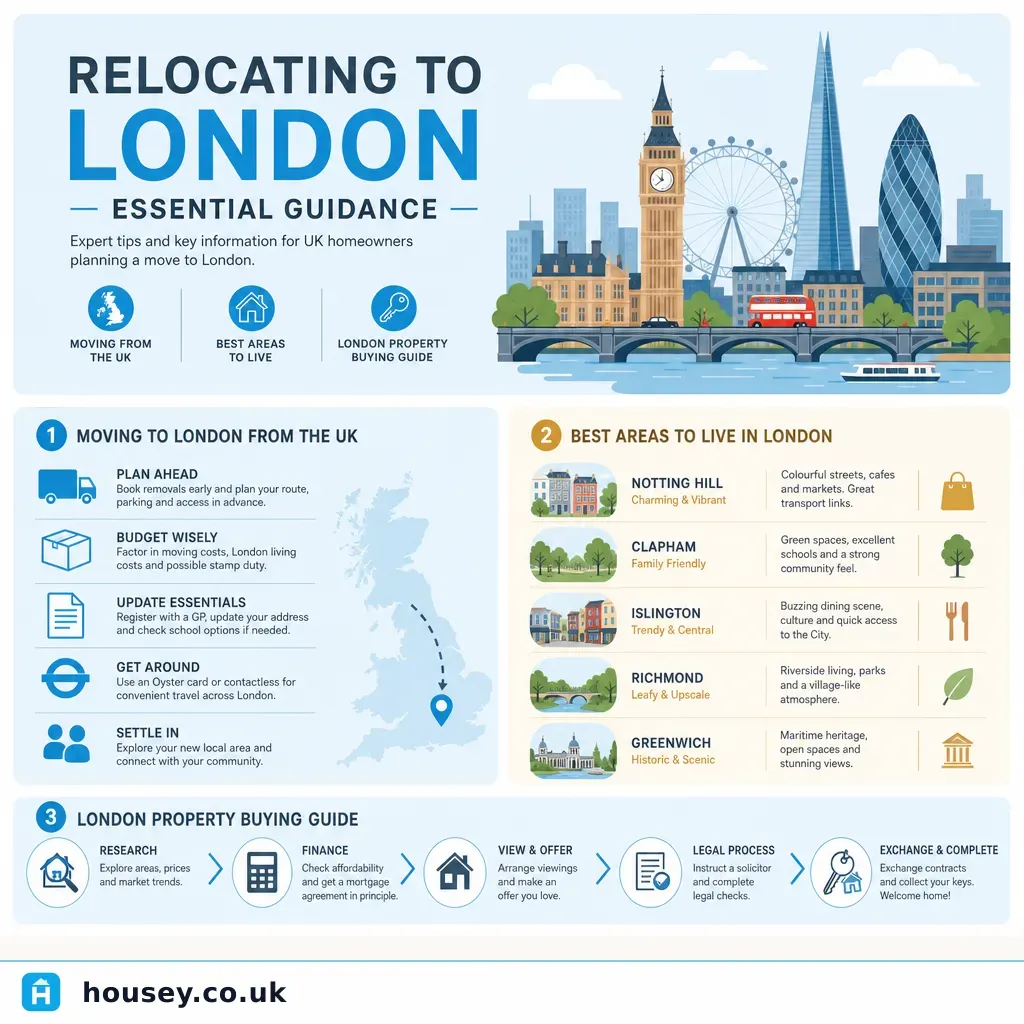
Relocating to London: Essential Guidance
Relocating to London involves choosing a borough and zone that match your commute, budget, and lifestyle, then navigating conveyancing, Stamp Duty Land Tax, and removals logistics.