Moving to Harrogate: Location Guide and Property Information
By Housey · Last reviewed 30th of May 2026
Moving to Harrogate: Location Guide and Property Information
Harrogate has been drawing buyers, professionals, and families from across the UK for decades — but the town's well-documented appeal can mask a competitive property market and significant variation between its neighbourhoods. Whether you are relocating from within Yorkshire, from London, or from further afield, understanding what different parts of town actually offer before you begin your search will save time, focus your viewings, and help you make more confident decisions before exchange of contracts.
Key points
- Harrogate is approximately 21 miles north of Leeds and 14 miles west of York, with direct rail services to Leeds (typically 30–45 minutes) on the Harrogate Line operated by Northern Rail, and connections to York and London King's Cross via York.
- Local government reorganisation in April 2023 replaced Harrogate Borough Council with North Yorkshire Council as the single unitary authority responsible for planning, building control, highways, and local services across the district.
- Based on HM Land Registry data reviewed in 2026, average house prices across all property types in the Harrogate district have typically ranged from around £280,000 to £380,000 — consistently above both the national and Yorkshire regional averages.
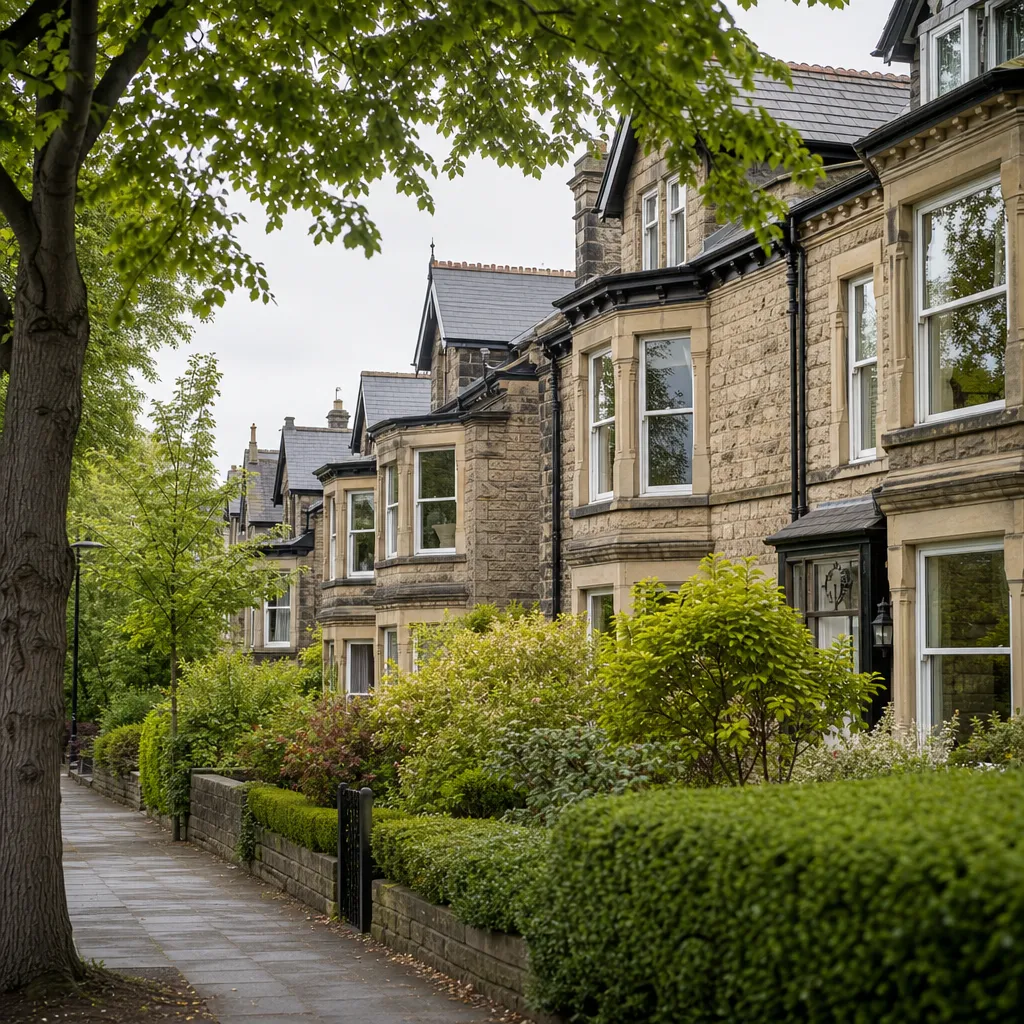
- A significant portion of Harrogate's central housing stock is Victorian and Edwardian in character, with terraces, semi-detached villas, and substantial detached properties; modern estate housing predominates on the outer edges of the town.
- North Yorkshire operates a fully comprehensive state secondary school system — there are no state grammar schools — and the independent sector is well represented, including Harrogate Ladies' College and Ashville College.
What is Harrogate like to live in?
Harrogate has a character that is notably prosperous and well-maintained for a North Yorkshire market town. Its Montpellier and town centre streets are lined with independent shops, restaurants, and cafés, and the town hosts the annual Theakston Old Peculier Crime Writing Festival and the RHS Flower Show Harrogate.
The Stray — a 200-acre protected grassland running through the heart of the town — gives Harrogate a distinctly green feel, and the Valley Gardens and Harlow Carr (an RHS garden approximately four miles from the centre) add to the appeal for those who value outdoor space close to home. Crime rates compare favourably with other North Yorkshire settlements and with similarly sized market towns nationally.
The town has a relatively high proportion of owner-occupied housing compared with the UK average. The rental market is active, particularly at the professional end, but stock is more limited than in nearby Leeds or York. Competition for desirable properties — especially family homes in catchment for the most popular primary schools — can be significant, and sales often proceed quickly once a listing appears.
Harrogate neighbourhoods: a comparison
The Harrogate district covers the town itself and a number of surrounding villages and market towns, including Knaresborough, Ripon, and Pateley Bridge. The table below covers the main residential areas within and immediately adjacent to Harrogate town.
Area | Character | Property types | Approximate price range | Best for |
|---|---|---|---|---|
Duchy Estate | Leafy, quiet, close to The Stray and Harlow Carr | Large Edwardian detached and semi-detached | £500,000–£1.5m+ | Families wanting space; buyers seeking Edwardian architecture |
Oakdale | Popular family suburb, well-served by local schools | 1930s–1970s semi-detached and detached | £350,000–£700,000 | Families, Leeds commuters |
Starbeck | More affordable, east of town centre, good rail access | Victorian terraces, inter-war semis | £200,000–£400,000 | First-time buyers, investors, buy-to-let |
Pannal | Village feel 3 miles south, excellent station for Leeds | Mix of period and modern detached | £400,000–£900,000 | Professionals, retirees seeking village setting |
Knaresborough Road corridor | Close to town centre, established mixed residential | Victorian and Edwardian terraces and villas | £280,000–£600,000 | Young professionals, families |
Bilton | Northern suburb, established community character | Post-war and modern estate housing | £200,000–£450,000 | Families, first-time buyers |
Approximate price ranges are indicative based on publicly available HM Land Registry data and major property portals, reviewed May 2026. Figures represent a typical range for each area and vary significantly by property size, condition, and specification.
Transport and commuting
Harrogate is well-connected for a North Yorkshire market town, but does not have direct motorway access:
- Rail: Harrogate station is on the Harrogate Line with regular services to Leeds (typically 30–45 minutes) and Knaresborough (approximately 5 minutes). Check current Northern Rail timetables before making commuting assumptions, as journey times and frequency are subject to change.
- Road: The A61 provides road access south towards Leeds; the A59 connects westward to Skipton and the Yorkshire Dales. The A61 corridor can be slow at peak times, and car commutes of over an hour to Leeds city centre are common during busy periods.
- Bus: Local bus services connect Harrogate to surrounding villages. North Yorkshire Council publishes current routes and operator information on its transport pages.
- Cycling: The town centre is relatively flat and well-suited to cycling for shorter journeys; National Cycle Network Route 67 passes through the area.
Harrogate works best for buyers commuting primarily by rail to Leeds or York, or working locally. Those requiring frequent access to motorway networks (the M1 or M62) may find road connections more limiting than towns further to the south or east.
Schools and education
Harrogate and the surrounding district have a strong reputation for primary and secondary education, with several schools holding Ofsted Outstanding ratings. The independent sector is well represented: Harrogate Ladies' College, Ashville College, and a number of preparatory schools serve the area.
North Yorkshire operates a fully comprehensive state secondary system. Catchment areas for the most popular schools are competitive and can shift from year to year. Verify current catchment boundaries directly with North Yorkshire Council's school admissions team before committing to a purchase — estate agent representations about school catchments are not always reliable and should not be treated as definitive. The GOV.UK school performance data service allows comparison of Ofsted ratings and results by postcode.
Buying property in Harrogate: what to expect
The standard England and Wales conveyancing process — offer accepted, solicitor instructed, local searches, exchange, and completion — applies in Harrogate as elsewhere, but several local factors are worth building into your due diligence:
Conservation area: Much of Harrogate's central Victorian streetscape falls within a conservation area. If you plan external alterations after purchase — changing windows, adding a porch, altering the roof line — check with North Yorkshire Council whether planning permission is required. Conservation area designation may affect what you can do without consent and is relevant to future plans as well as current condition.
The Stray: Properties adjacent to or overlooking The Stray benefit from the 200-acre protected grassland, but the Stray Act 1985 prevents any development or enclosure of the land. Some properties immediately adjacent have historic rights or covenants linked to The Stray; your conveyancer's local authority searches will reveal any registered constraints that apply to a specific address.
Leasehold and freehold: Harrogate has a mix of tenures. Victorian conversions to flats and many newer apartments are sold leasehold. Check tenure at the outset of your search and ask your conveyancer to review the lease length (anything below 80 years can affect mortgage availability and future saleability), service charge structure, and any known major works planned by the freeholder.
Surveys: Given the proportion of Victorian and Edwardian housing stock in the town, a RICS Level 2 or Level 3 building survey is strongly recommended for older properties. A mortgage valuation is not a substitute and does not assess condition in detail. RICS Level 3 is appropriate where visible signs of damp, past alterations, or structural movement are present.
Using conveyancers experienced in North Yorkshire property is advisable — particularly for older properties or those in or near the conservation area where local search results and land charges can raise specific questions.
Property purchase costs in Harrogate
Beyond the purchase price, budget for:
- Stamp Duty Land Tax (SDLT): the GOV.UK SDLT calculator gives the current charge based on purchase price, first-time buyer status, and whether you are buying an additional property
- Conveyancing fees: typically £1,000–£2,500 plus disbursements (searches, Land Registry fees, electronic transfer fees) — ask for a full itemised quote
- Survey fees: RICS Level 2 approximately £500–£800; RICS Level 3 approximately £800–£1,500 depending on property size — indicative figures, last reviewed 2026-05-30; obtain quotes from RICS-regulated surveyors
- Mortgage arrangement and valuation fees if applicable
- Removal costs: these vary significantly by volume and distance; obtain at least three quotes from BAR-registered removal firms
When to get professional help
- Identify and instruct a solicitor or licensed conveyancer before making an offer where possible, so you can move quickly once a sale is agreed — chains in Harrogate can move fast when demand is high.
- Commission a RICS Level 2 or Level 3 building survey for any property built before the 1980s, or for any property showing visible signs of damp, structural movement, or significant alteration.
- Consult North Yorkshire Council's planning team or a planning consultant before exchange if you plan any external alterations to a property in or near the conservation area.
How Housey can help
Housey connects buyers moving to Harrogate with conveyancers experienced in North Yorkshire property who understand local authority searches, conservation area designations, and North Yorkshire land charges. Sellers preparing to market their Harrogate home can find property photography and floorplan services to present their property to its best advantage. Request quotes from professionals matched to your transaction and postcode.
Frequently asked questions
Is Harrogate a good place to live?
Harrogate consistently performs strongly in quality-of-life rankings, with low crime rates, well-regarded schools, good rail connections to Leeds and York, and an attractive Victorian town centre with a strong independent retail and restaurant offer. The relatively high property prices reflect sustained demand from families, professionals, and retirees. It is particularly popular with buyers who want a quieter pace of life within commuting distance of Leeds.
How far is Harrogate from Leeds?
Harrogate is approximately 21 miles north of Leeds. Direct rail services on the Harrogate Line typically take 30 to 45 minutes to Leeds city centre. By car via the A61, journey times range from around 45 minutes to over an hour depending on traffic conditions. The A61 corridor experiences significant congestion during morning and evening peak periods, which is worth factoring into any commuting assessment.
What are property prices like in Harrogate?
Property prices in Harrogate are above the national average and above the Yorkshire regional average. Based on HM Land Registry data reviewed in 2026, average prices across all property types in the Harrogate district have typically ranged from around £280,000 to £380,000. Prices vary considerably by neighbourhood, property type, and condition; detached homes in sought-after areas such as the Duchy Estate frequently exceed £600,000.
Do I need a survey when buying in Harrogate?
A mortgage valuation is not a building survey and should not be relied on to identify defects. Given Harrogate's substantial stock of Victorian and Edwardian housing, a RICS Level 2 or Level 3 building survey is strongly recommended for older properties. A RICS Level 3 survey is appropriate where visible defects, unusual construction, or significant prior alteration is present, or where you want maximum detail before exchange of contracts.
Sources and further reading
- UK House Price Index — HM Land Registry
- North Yorkshire Council — Planning and environment — North Yorkshire Council
- Stamp Duty Land Tax calculator — GOV.UK
- School and college performance data — GOV.UK / Department for Education
- Find an Ofsted inspection report — Ofsted
- Leasehold property — GOV.UK
Useful next reads
 Buying & Moving
Moving to Taunton: location guide and property overview
Taunton is Somerset's county town with direct rail links to London Paddington in under two hours, M5 motorway access, and property prices below the South West regional average.
 Buying & Moving
Moving to Stockport: Location Guide and Property Information
Stockport is a well-connected Greater Manchester town around 7–8 miles south-east of Manchester city centre, with direct trains to Piccadilly in 8–15 minutes and to London Euston in under two hours.
 Buying & Moving
Moving to Glastonbury: Location Guide and Property Overview
Glastonbury is a small Somerset market town of around 9,000 people, offering Victorian terraces, stone cottages, and modern homes at prices typically below the national average.
 Buying & Moving
Properties and Relocation Guide for the Home Counties Region
The Home Counties — Surrey, Hertfordshire, Kent, Essex, Berkshire, Buckinghamshire, and East and West Sussex — offer a wide range of property types, with rail connections to London typically taking 20–60 minutes.
 Buying & Moving
Essential Services and Support for Moving to London Neighbourhoods
Moving to London requires coordinating conveyancing, surveys, and removal logistics within tight timeframes.