Planning a Flat-Roof Extension: What Costs to Budget
By Housey · Last reviewed 7th of May 2026
Planning a Flat-Roof Extension: What Costs to Budget
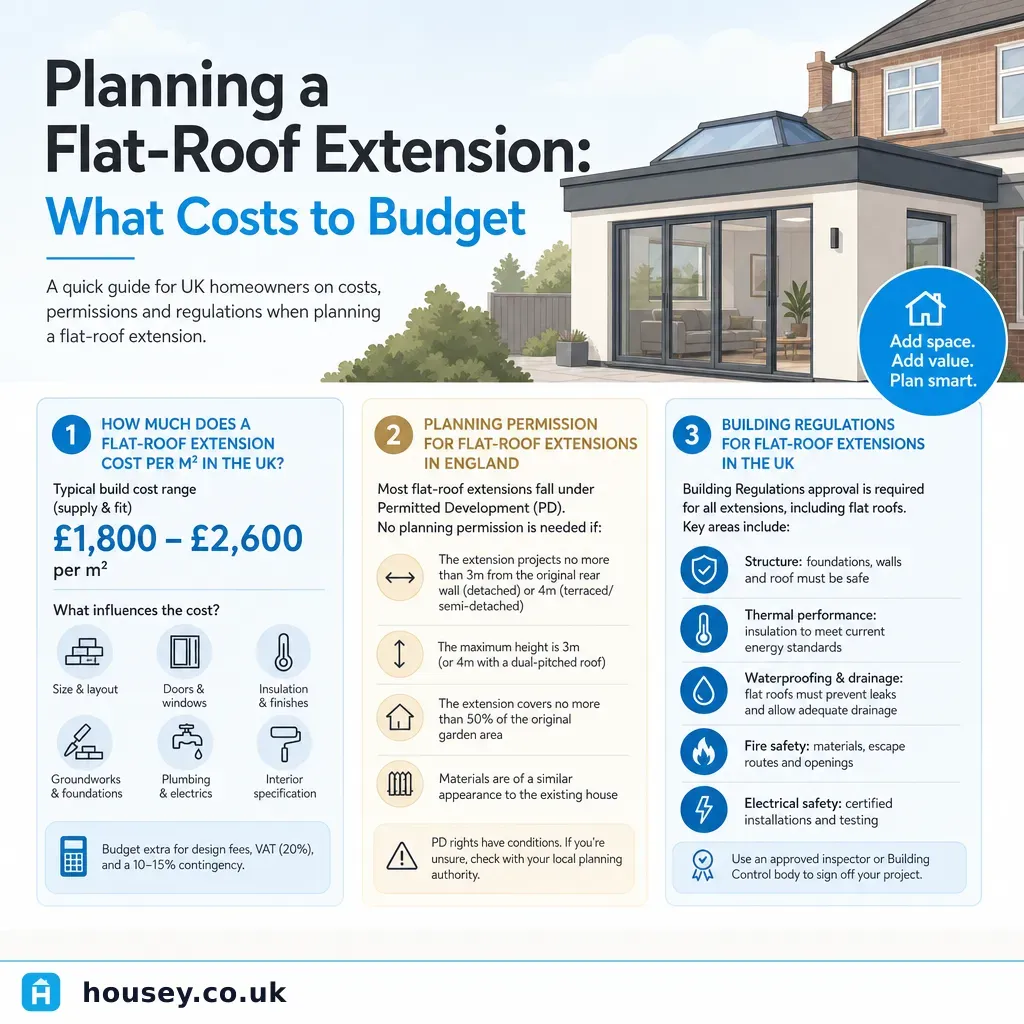
Flat-roof extensions are one of the most popular ways UK homeowners add space — the low-profile roof suits modern open-plan living and can be easier to accommodate within permitted development height limits than a pitched alternative. Whether you are extending a 1970s semi in the East Midlands or a Victorian terrace in South London, the cost variables are substantial and easy to underestimate. Getting a realistic budget in place before approaching contractors protects you at every stage, from first quotes through to building control sign-off.
Key points
- Single-storey rear flat-roof extensions in England may qualify as permitted development if they do not exceed 4 m in height (or 3 m eaves height within 2 m of a boundary), but confirmation from your local planning authority is essential before work starts.
- Building Regulations approval is required for all extensions regardless of planning permission status, covering Part A (structure), Part C (moisture), Part L (energy efficiency), and Part F (ventilation).
- Indicative build costs range from approximately £1,500–£2,500 per m² for a basic specification, rising to £2,500–£3,500+ per m² in London and the South East (Indicative UK costs, last reviewed 2026-05-07).
- The flat-roof membrane system — EPDM rubber, GRP fibreglass, or liquid-applied — materially affects both upfront cost and maintenance liability over a 20–25-year design life.
- Professional fees (architect or architectural technologist, structural engineer, and building control) typically add 10–20% to construction costs and should be costed before committing to a builder.
What does a flat-roof extension typically cost?
Location is the single biggest variable: labour rates in London and the South East run 25–40% higher than in the North of England, Wales, or Scotland. Build specification — standard brick-and-block versus steel frame, glazing quality, underfloor heating — also moves costs significantly.
Specification | Indicative cost per m² | Typical total for 20 m² |
|---|---|---|
Basic build, standard fit-out, EPDM flat roof | £1,500–£2,000 | £30,000–£40,000 |
Mid-range build, bi-fold doors, quality insulation | £2,000–£2,800 | £40,000–£56,000 |
High-spec build, rooflights, premium glazing | £2,800–£3,500+ | £56,000–£70,000+ |
London / South East premium (add approx. 25–40%) | — | — |
Indicative UK costs, last reviewed 2026-05-07. Figures exclude VAT, professional fees, party wall costs, and abnormal ground conditions. Obtain at least three itemised quotes.
What drives costs up?
Ground conditions. Clay soils (common in much of southern England), tree proximity, and existing drainage runs can require deeper foundations, adding £3,000–£10,000 or more to groundworks.
Structural requirements. Creating a wide open-plan opening into the existing house usually needs a steel beam. A structural engineer's fees for a domestic extension typically run £800–£2,500 depending on complexity.
Roof membrane. GRP fibreglass costs more upfront than EPDM but carries a longer manufacturer warranty (typically 25 years). Liquid-applied systems suit complex geometries with multiple penetrations.
Services. A kitchen, WC, or underfloor heating adds £3,000–£8,000 or more in plumbing and electrical first-fix costs.
Party wall. If the extension adjoins a shared boundary, the Party Wall etc. Act 1996 may apply. Surveyor costs depend on whether your neighbour consents or dissents.
Planning permission and permitted development
In England, most single-storey rear extensions qualify as permitted development under Class A of the Town and Country Planning (General Permitted Development) (England) Order 2015, provided:
- The extension does not exceed 4 m in total height (3 m eaves height within 2 m of a boundary).
- For detached houses, the extension does not project more than 8 m from the original rear wall; for semi-detached and terraced houses, the limit is 6 m (both larger depths need prior approval under the Larger Home Extension scheme).
- The extension covers no more than half the total area of land around the original house.
- Materials closely match the existing property.
Permitted development rights are removed in conservation areas, national parks, and for listed buildings, and may have been removed by an Article 4 Direction or a prior planning condition. Always use the Planning Portal and confirm with your LPA before starting.
If planning permission is required, the householder application fee in England is currently £258 (check GOV.UK for the current fee). Decisions typically take 8 weeks from valid submission.
Building Regulations: what approval covers
Building Regulations approval is separate from planning and applies regardless. Key Approved Documents for a flat-roof extension:
- Part A — structural integrity of walls, foundations, and the roof.
- Part C — resistance to moisture, including the waterproofing system and its junction detailing.
- Part L — minimum thermal performance; confirm the required flat-roof U-value with your designer or building control officer under the current Approved Document L.
- Part F — ventilation of any new habitable room.
- Part O — overheating mitigation, particularly relevant where the extension is heavily glazed.
Building control fees typically run £500–£1,500 for a standard single-storey extension. A completion certificate from building control is important for future property sales.
Worked example: a 25 m² kitchen extension on a 1960s semi-detached in Leicester
This project falls within permitted development — rear of a semi, under 4 m height, materials matched — so no planning application is required. Building Regulations approval is still needed.
Item | Estimated cost |
|---|---|
Architectural technologist (drawings + building regs spec) | £1,800 |
Structural engineer (beam and foundation design) | £1,200 |
Building control (LPA) | £900 |
Groundworks and foundations | £6,500 |
External walls and superstructure | £12,000 |
GRP fibreglass flat roof (25 m²) | £4,500 |
Bi-fold doors and rooflight glazing | £7,500 |
Internal fit-out (plastering, flooring, decoration) | £5,500 |
Plumbing and electrical first fix | £4,000 |
Subtotal | £43,900 |
Contingency (10%) | £4,390 |
Total (exc. VAT and kitchen installation) | approx. £48,300 |
Indicative UK costs, last reviewed 2026-05-07. For illustration only — actual costs vary by contractor, location, and specification.
Before you accept a quote: homeowner checklist
Important limitations
The cost ranges and regulatory information in this article are general guidance only, reflecting conditions as of the review date. Planning rules, permitted development thresholds, and Building Regulations requirements can vary significantly by property type, location, and history of previous works. Rules in Scotland, Wales, and Northern Ireland differ from those in England. Do not rely on this article as a substitute for professional advice specific to your property and project.
What to ask a qualified professional
Before appointing an extension builder, structural engineer, or building control consultant:
- Can you confirm whether my project qualifies as permitted development, or does it need full planning permission?
- Which Building Regulations Approved Documents apply, and how will compliance be demonstrated to building control?
- What foundation type are you proposing, and on what basis?
- Which flat-roof membrane system do you recommend, and what warranty does the manufacturer provide?
- Do you carry professional indemnity insurance (design professionals) or public liability and employer's liability cover (contractors)?
- Will you manage building regulations applications, or should I appoint a building control consultant separately?
- What happens if ground conditions differ from those assumed in the design?
When to get professional help
Appoint a structural engineering specialist before your builder begins if the extension requires removal of a load-bearing wall, installation of a steel beam, or if the project sits on a sloped site or near trees on clay soil.
Engage a planning consultant if your permitted development rights may have been removed, if the property is in a conservation area or AONB, or if a previous application for similar works has been refused.
How Housey can help
Housey helps you request quotes from vetted extension builders, structural engineering specialists, and building control consultants across the UK, so you can compare credentials and costs before committing to anyone.
Frequently asked questions
Does a flat-roof extension need planning permission in England?
Not always. Most single-storey rear extensions qualify as permitted development under the Town and Country Planning (GPDO) Order 2015, provided they meet size, height, and material conditions. However, permitted development rights can be removed by planning conditions, Article 4 Directions, or conservation area status. Always confirm with your local planning authority before work begins.
How long does a flat-roof extension take to build?
A typical single-storey flat-roof extension of 20–30 m² takes around 10–16 weeks on site from groundworks to completion, assuming no significant delays. Planning and design work beforehand typically adds 3–6 months, depending on whether a planning application is required and how quickly building regulations approval is granted.
Which flat-roof membrane system is best for a UK domestic extension?
GRP fibreglass, EPDM rubber, and liquid-applied systems are all widely used. GRP offers seamless coverage and a typical 25-year manufacturer warranty; EPDM is flexible, durable, and suited to most roof geometries; liquid-applied systems work well on complex shapes. Avoid traditional mineral felt on new extensions — it has the shortest design life of the common options.
Do I need a structural engineer for a flat-roof extension?
Almost certainly yes for beam and foundation design. A structural engineer calculates loads on any new or modified beams, specifies the foundation type, and provides calculations that building control requires. For projects involving large open-plan openings, difficult ground, or proximity to trees on clay soil, the engineer's role is especially important.
Can I convert a flat-roof extension to a pitched roof later?
It is possible but requires a structural assessment — existing walls may not be designed for the additional load of a pitched roof. Planning permission is also likely to be required because altering the roof form changes the height and volume of the building. Always take professional advice before assuming this is a simple retrofit.
Sources and further reading
- Householder permitted development: Extensions — Planning Portal
- Building Regulations Approved Documents — GOV.UK
- The Party Wall etc. Act 1996: explanatory booklet — GOV.UK
- Building regulations approval — GOV.UK
- RICS homeowner consumer resources — Royal Institution of Chartered Surveyors
Useful next reads
 Improvement & Build
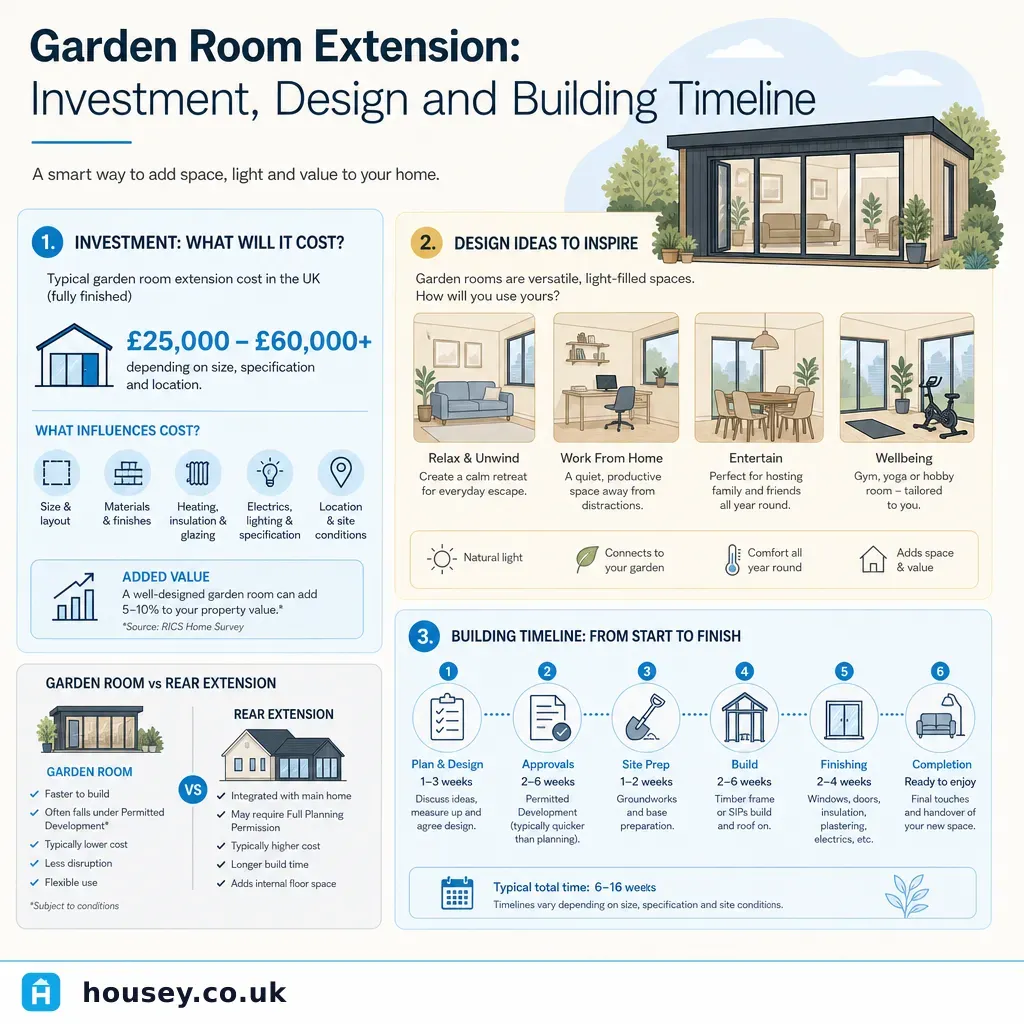
Garden Room Extension: Investment, Design and Building Timeline
A garden room or garden extension can add usable year-round space without always requiring planning permission.
 Improvement & Build
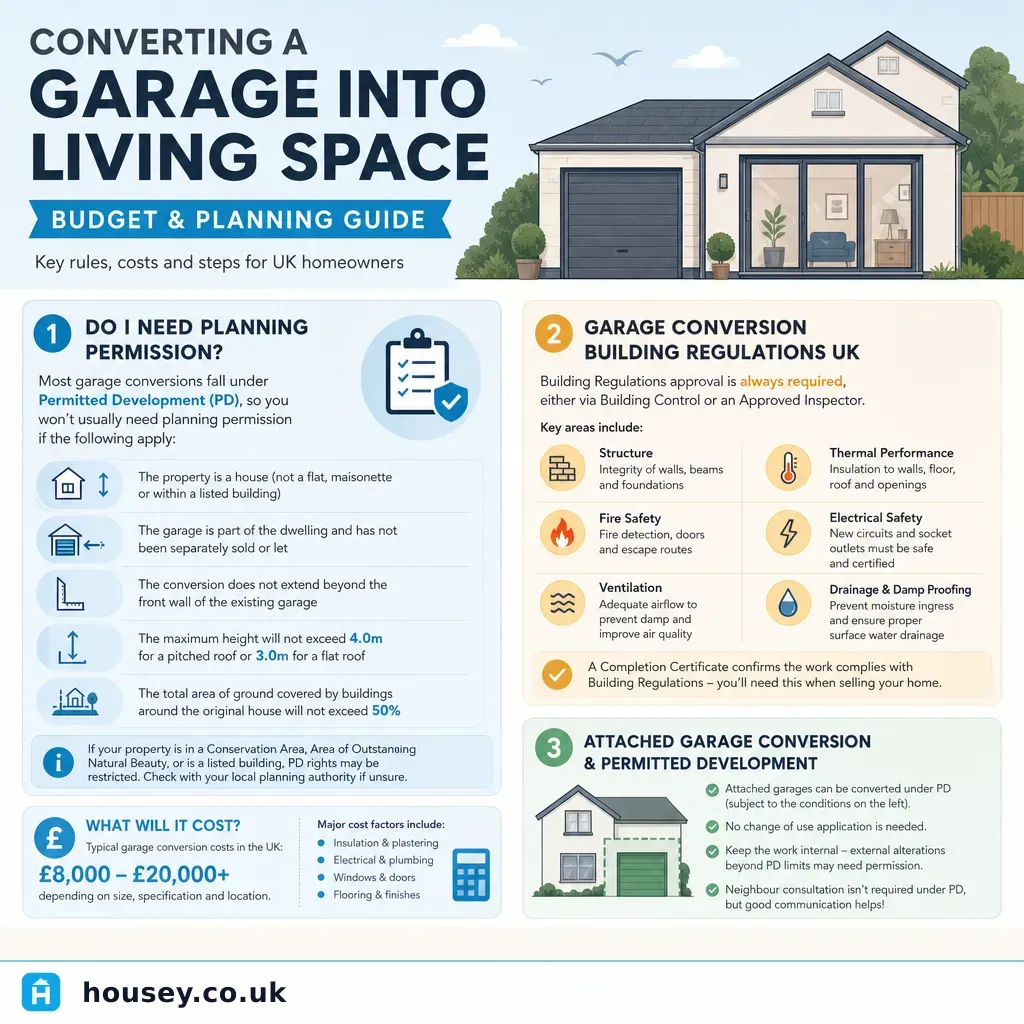
Converting a Garage into Living Space: Budget and Planning Guide
A single-garage conversion typically costs £8,000–£20,000 in the UK.
 Improvement & Build
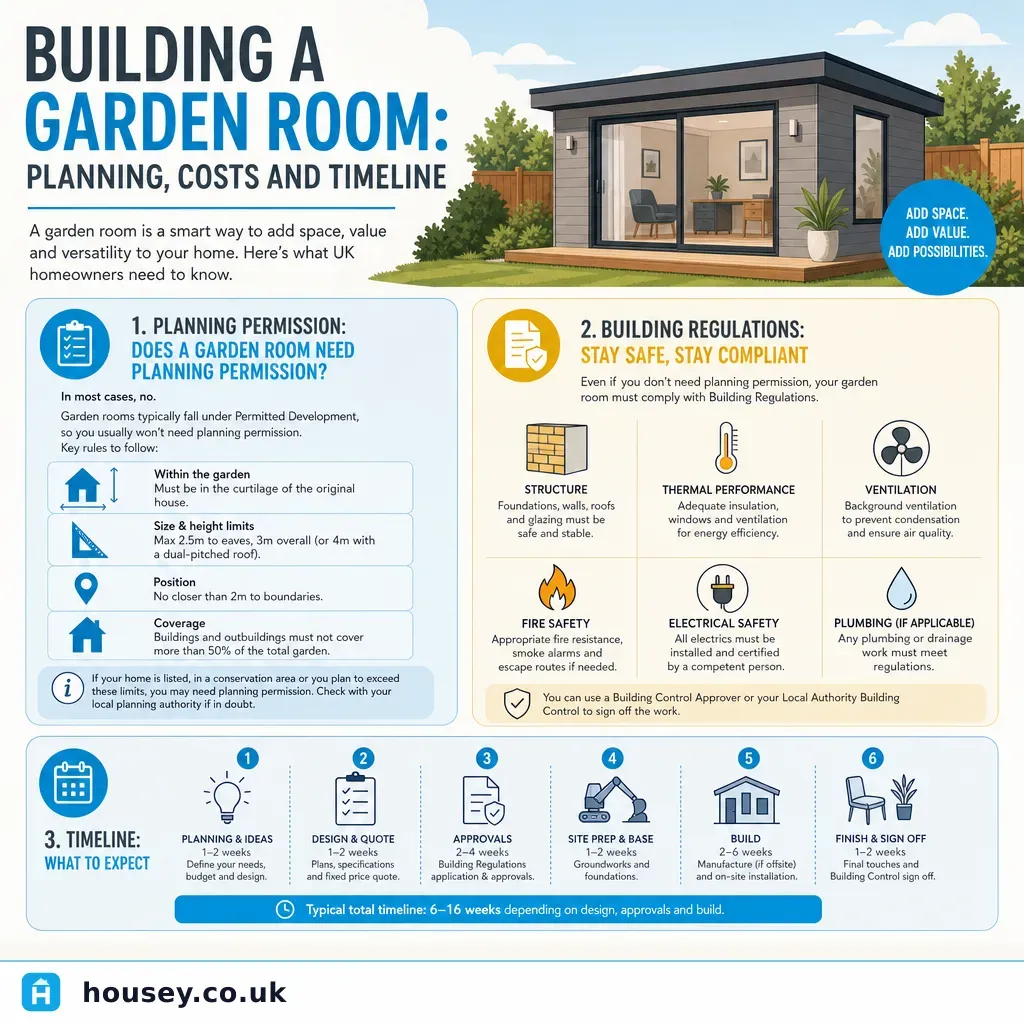
Building a Garden Room: Planning, Costs and Timeline
Most garden rooms in England fall under permitted development and don't need planning permission, provided the structure meets height, coverage, and boundary conditions.
 Improvement & Build
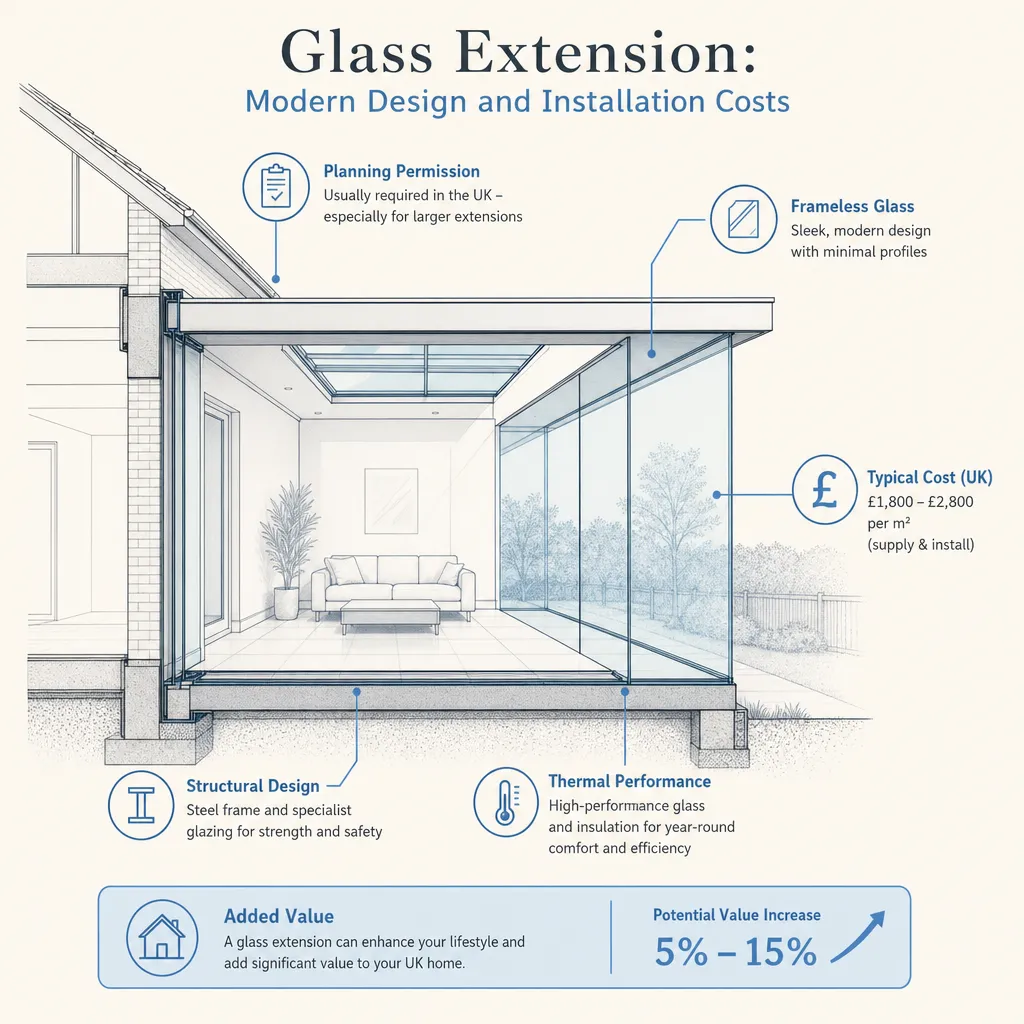
Glass Extension: Modern Design and Installation Costs
A glass extension in the UK typically costs £3,500–£6,500 per square metre fully installed for a bespoke structural glass system.
 Improvement & Build
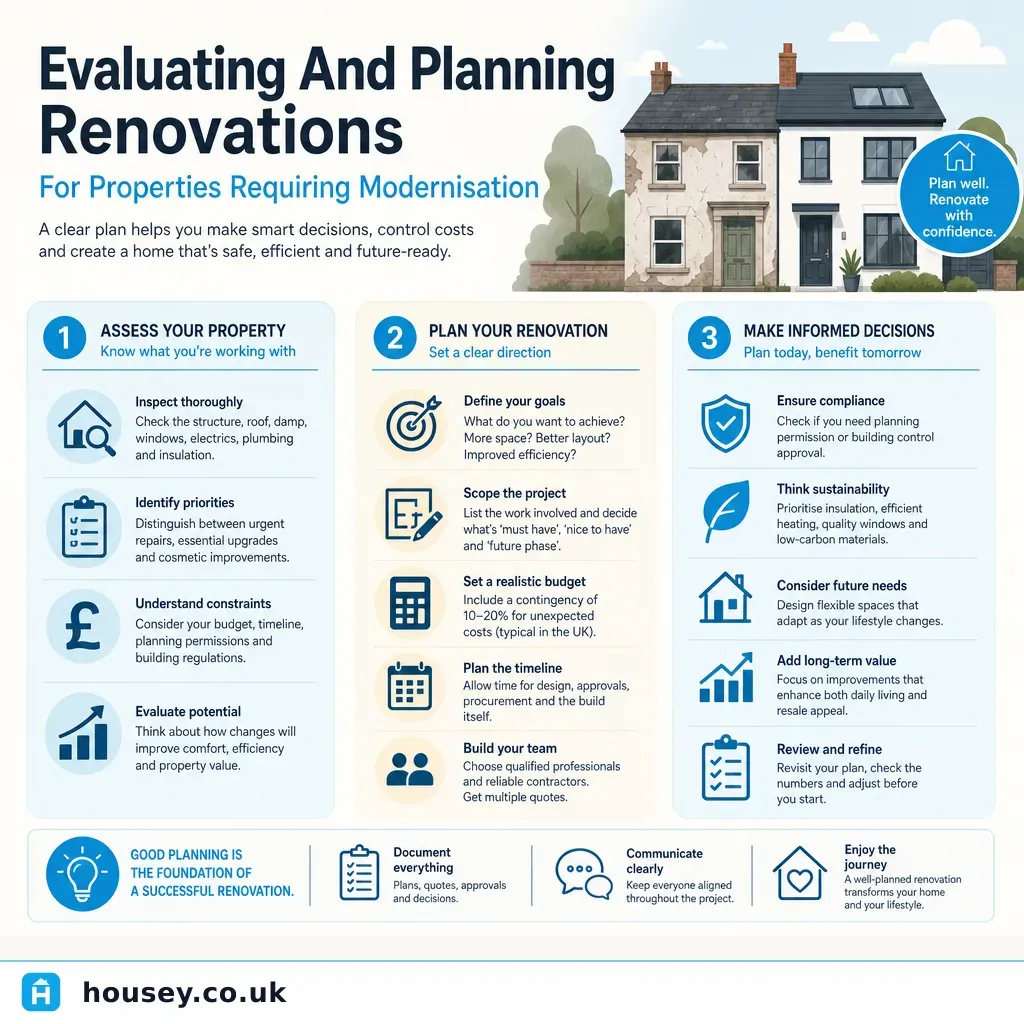
Evaluating And Planning Renovations For Properties Requiring Modernisation
Start by commissioning a condition survey — RICS Level 3 for pre-1919 properties — to identify structural defects, damp, and services issues before finalising a budget.