What to budget for modifying drainage systems for an extension
By Housey · Last reviewed 6th of May 2026
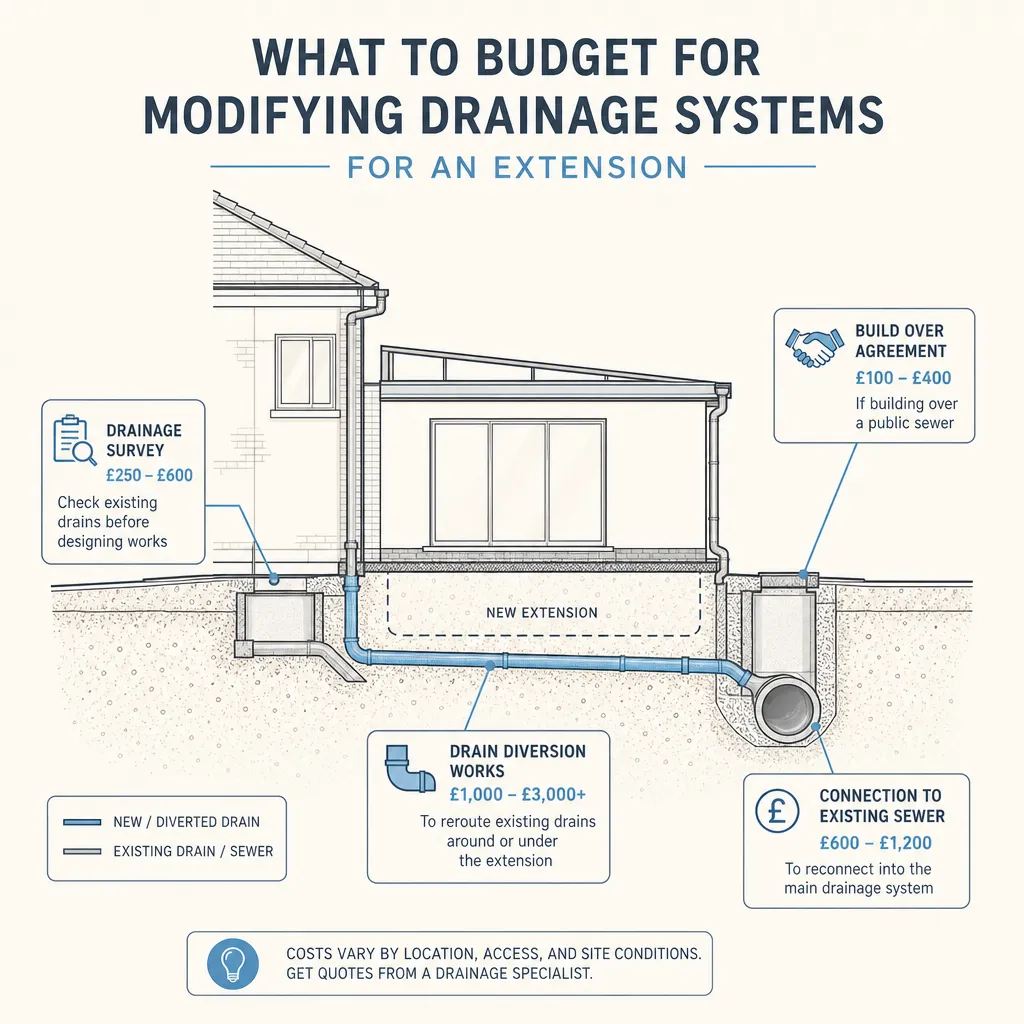
What to budget for modifying drainage systems for an extension
Drainage is one of the least glamorous aspects of planning a house extension — and one of the most consequential if overlooked. When a proposed extension footprint crosses existing drain runs, sits near a public sewer, or increases the volume of rainwater leaving your plot, the costs and approvals involved can range from modest application fees to five-figure diversions that reshape the entire project budget.
Key points
- Building Regulations Part H (Drainage and Waste Disposal) applies to all drainage work connected to an extension; building control will not issue a completion certificate without compliance.
- Any extension within 3 metres of a public sewer requires a Build Over Agreement from the relevant water company before building control sign-off.
- A pre-design CCTV drainage survey (typically £150–£400) should be commissioned before finalising the extension layout to map existing drain routes accurately.
- Diverting a private drain typically costs £1,500–£8,000+ depending on run length, depth, and access; diverting a public sewer can cost £10,000–£40,000 or more and must use the water company's approved contractor.
- Many previously private drains were adopted by water companies in October 2011 under the Water Industry (Schemes for Adoption of Private Sewers) Regulations 2011 — always check water company records before assuming a drain is private.
Indicative UK costs, last reviewed 2026-05-06. Costs vary significantly by site conditions, region, and water company. Obtain formal quotes from qualified drainage contractors.
Which drainage work might your extension require?
The scope depends on what is in the ground and where your extension sits relative to existing infrastructure.
Decision tree: what drainage work do you need?
- Check first: commission a CCTV drainage survey and request water company drainage records before fixing the extension layout.
- Divert a private drain if the extension footprint will build over or within 1 metre of an existing private drainage run.
- Apply for a Build Over Agreement if any part of the extension foundations will come within 3 metres of a public sewer shown on water company records.
- Provide new surface-water drainage if the extension adds significant impermeable area; Part H and the Flood and Water Management Act 2010 may require a sustainable drainage (SuDS) solution.
- Consult a structural engineer if deep drainage diversion is needed close to new foundations, as sewer depth and proximity can affect foundation design and cost.
- Contact the water company directly if any work may affect a public sewer; diversion requires the water company's approved contractor and formal approval under the Water Industry Act 1991.
Cost breakdown by drainage work type
Work type | Typical cost range | Key variables | Who to appoint |
|---|---|---|---|
CCTV drainage survey (pre-design) | £150–£400 | Property size, access points | Drainage contractor |
Drainage design drawings | £300–£800 | Complexity, Part H requirements | Drainage contractor or civil engineer |
Build Over Agreement application fee | £300–£500 | Water company; rates vary | Applied direct to water company |
Private drain diversion (up to 6 m run) | £1,500–£4,000 | Depth, pipe material, access | Drainage contractor |
Private drain diversion (longer or deep runs) | £4,000–£8,000+ | Soil type, excavation required | Drainage contractor and structural engineer |
Public sewer diversion | £10,000–£40,000+ | Water company rates, complexity | Water company's approved contractor |
New soakaway (surface water) | £500–£2,500 | Ground permeability, required capacity | Drainage contractor |
Connection to existing surface-water drain | £500–£1,500 | Distance, access, pipe diameter | Drainage contractor |
Indicative UK costs, last reviewed 2026-05-06. Approximate and exclusive of VAT unless stated.
Build Over Agreements explained
A Build Over Agreement is a formal arrangement with your water company permitting building over or close to a public sewer. Without one, building control will not issue a completion certificate, and buildings insurance may not cover related defects.
Most water companies in England and Wales charge approximately £300–£500 for a standard application. Where the sewer is deep or carries significant flows, the water company's engineer may need to inspect at additional cost. Processing typically takes 4–8 weeks.
Under the Water Industry (Schemes for Adoption of Private Sewers) Regulations 2011, lateral drains and private sewers serving multiple properties were transferred to water company ownership in October 2011. A drain you believed was private may now be a public asset. Check using a CON29DW drainage search (available during conveyancing) or by contacting the water company directly.
Surface-water and SuDS requirements
Extensions that add impermeable surfaces — a concrete floor slab, pitched or flat roof, or connected hardstanding — increase the volume of rainwater requiring management. Building Regulations Part H requires all new drainage to be properly designed, and the Flood and Water Management Act 2010 places additional duties around sustainable drainage.
A soakaway is often the most practical solution where ground conditions allow. A percolation test (approximately £200–£400) is typically needed to confirm suitability and size the soakaway per BRE Digest 365.
In Wales, Schedule 3 of the Flood and Water Management Act 2010 is in force: new drainage must receive approval from the Sustainable Drainage Approving Body (SAB), operated by the local authority separately from building control.
Important limitations
This article provides general guidance only. Drainage regulations, water company requirements, and site conditions vary considerably across the UK. The costs quoted are indicative — actual costs may differ significantly depending on sewer depth, ground conditions, access, and current contractor rates. Do not rely on this article as a substitute for a professional CCTV survey, formal drainage design, or written approval from your water company. A qualified drainage contractor or civil engineer must assess your specific site before design decisions are made.
When this becomes urgent
Seek professional drainage advice before proceeding if:
- The extension footprint sits over or close to visible drainage infrastructure such as inspection chambers, gullies, or manholes.
- Pre-application enquiry documents or planning responses flag drainage constraints or sewer proximity.
- A structural engineer's report identifies drainage proximity as a foundation risk.
- Ground investigations reveal drain routes not shown on water company records.
- The water company has raised concerns during pre-application consultation.
What to ask a qualified professional
Before instructing a drainage contractor or submitting a Build Over Agreement application:
- Can you provide a CCTV survey to map existing drainage accurately before the foundation design is fixed?
- Are the drains on my property private, or were they adopted by the water company in 2011?
- Will my extension footprint trigger a Build Over Agreement requirement?
- What drainage design will satisfy Building Regulations Part H for this project?
- Is a percolation test needed to design a compliant soakaway for surface water?
- What risks does existing drainage depth pose for the proposed foundation design?
- Which water company approvals are required, and what is a realistic timeline?
- At what stage will building control need to inspect the drainage?
Red flags to watch for
- An architect or builder proposing an extension layout without first checking drainage records.
- A quote that excludes drainage from scope with no clear explanation of why.
- A contractor who says a Build Over Agreement is unnecessary without written evidence from the water company.
- No consideration of surface-water management in the drainage design.
- A drainage contractor who cannot confirm appropriate insurance or registration with a relevant competent-person scheme.
How Housey can help
Drainage design for extensions sits at the intersection of structural engineering, planning, and building regulations compliance. Housey can connect you with vetted drainage contractors for CCTV surveys and drainage design, structural engineers where foundation proximity to sewers requires specialist assessment, and building control consultants who can advise on Part H compliance and manage the inspection process.
Frequently asked questions
Do I always need a drainage survey before planning an extension?
It is not a legal requirement before applying for planning permission, but it is strongly recommended before finalising the design. Discovering an unexpected drain run after foundations are designed — or after work has started — is far more costly than a CCTV survey at £150–£400. Water company drainage records should also be requested early in the design process.
How long does a Build Over Agreement take to obtain?
Standard applications with most UK water companies take 4–8 weeks. Complex cases involving deep sewers or sensitive infrastructure may require the water company's own engineer to inspect, extending the process to several months. Factor this into your construction programme early to avoid delays to building control sign-off.
Can I divert a drain to avoid needing a Build Over Agreement?
You can divert a private drain to move it away from the extension footprint, but the new route must comply with Part H and be inspected by building control. You cannot move a public sewer yourself — any diversion requires the water company's approved contractor and formal approval under the Water Industry Act 1991.
Who is liable if drainage work causes problems later?
If drainage work proceeds without required building regulations approval or water company agreements, the property owner is liable. This can result in enforcement action, a requirement to undo completed work, and difficulties when selling. Always ensure all approvals are in place and retain copies of completion certificates and Build Over Agreement documentation.
Is drainage modification work subject to VAT?
Drainage work forming part of a house extension is typically subject to VAT at the standard rate of 20%. Some specific circumstances — such as work on a zero-rated new-build — may differ. Confirm the VAT treatment with your contractor and refer to HMRC guidance on VAT for construction and building services if in doubt.
Sources and further reading
- Approved Document H: Drainage and waste disposal — GOV.UK
- Flood and Water Management Act 2010 — legislation.gov.uk
- Water Industry Act 1991 — legislation.gov.uk
- Water Industry (Schemes for Adoption of Private Sewers) Regulations 2011 — legislation.gov.uk
- VAT for builders: construction and building services — GOV.UK
- CIRIA SuDS Manual C753 — CIRIA
Useful next reads
 Planning & Pre-Build
Costs for removing a non-load-bearing partition wall
Removing a non-load-bearing partition wall in a UK home typically costs £300–£1,500 in labour, plus £200–£600 or more for replastering and making good.
 Planning & Pre-Build
What to Budget When Removing a Structural Load-Bearing Wall
Removing a load-bearing wall in a typical UK home costs £2,500–£8,000 or more in total, covering a structural engineer's calculations, Building Regulations approval, the steel beam, builder's labour, and replastering.
 Planning & Pre-Build
Planning Permission and Building Regulations for Extensions
UK home extensions usually require both planning permission and Building Regulations approval, though most smaller rear extensions qualify as Permitted Development under the GPDO 2015 and need no planning application.
 Planning & Pre-Build
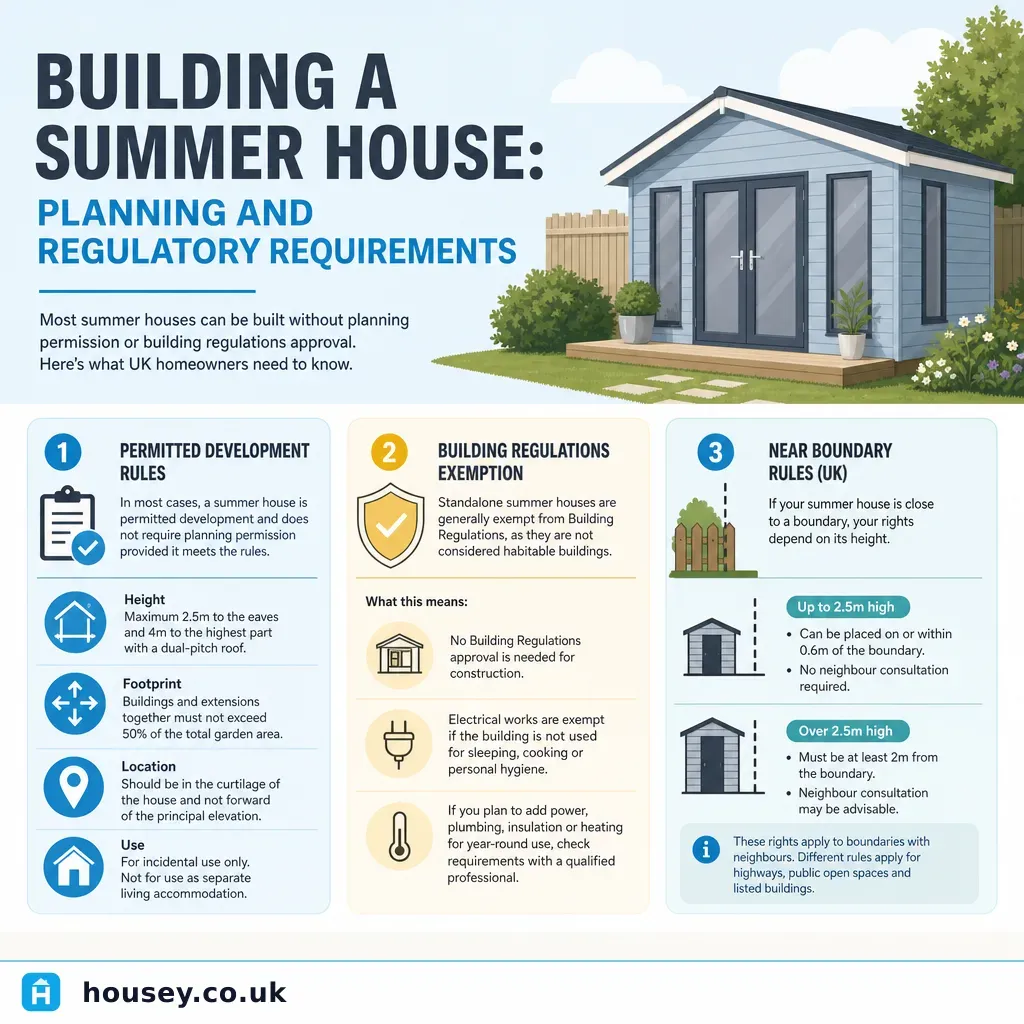
Building a Summer House: Planning and Regulatory Requirements
Most garden summer houses in England fall under Class E permitted development and need no planning permission, provided they are single-storey, within height limits, and not used for sleeping.
 Planning & Pre-Build
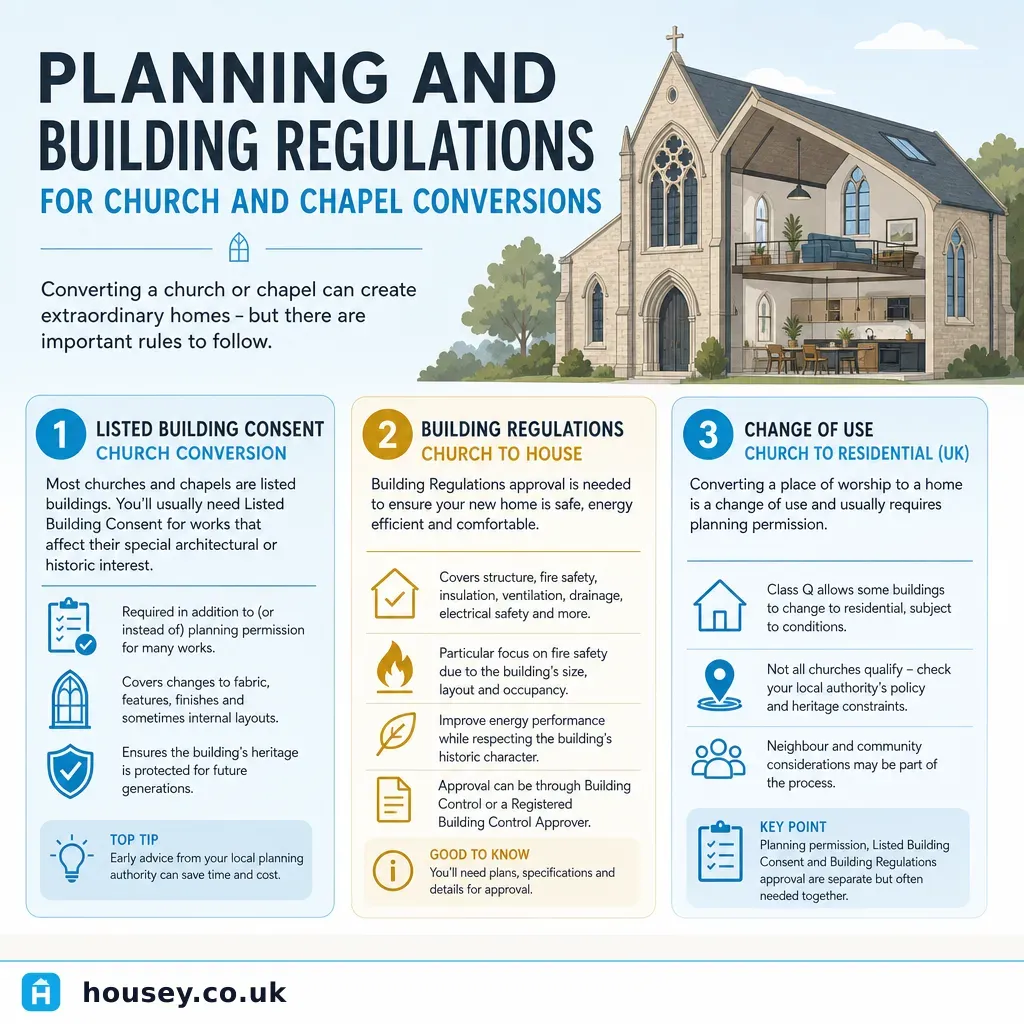
Planning and Building Regulations for Church and Chapel Conversions
Converting a church or chapel to residential use requires planning permission for change of use from Class F1 to Class C3, and listed building consent if the building is listed.