Fan-Assisted Radiator Installation and Heating System Costs
By Housey · Last reviewed 6th of May 2026
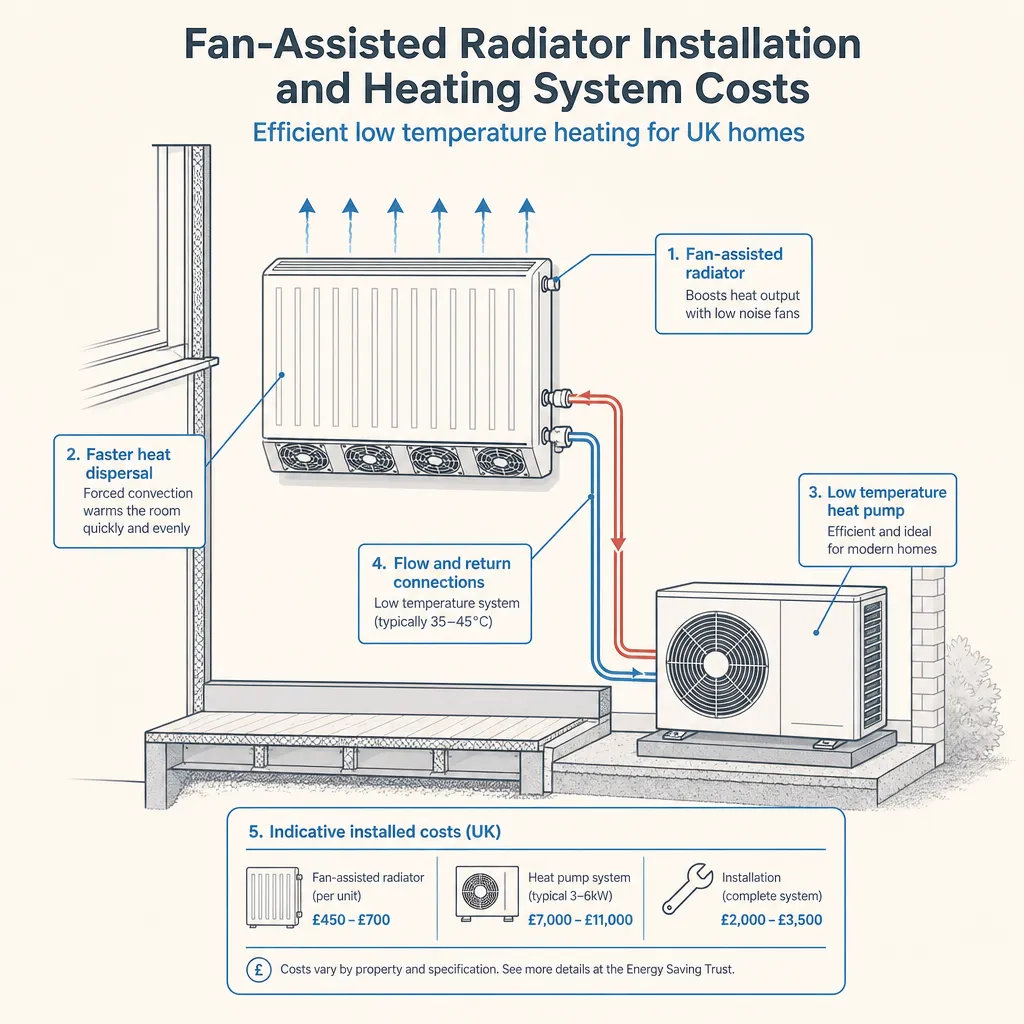
Fan-Assisted Radiator Installation and Heating System Costs
Fan-assisted radiators are growing in popularity across UK homes as more households switch from gas boilers to heat pumps, which operate most efficiently at lower water flow temperatures than conventional heating systems. A standard panel radiator often cannot deliver adequate heat output at 40–50°C flow temperature, whereas fan-assisted radiators — which use a small integral fan to force air across the heated element — provide substantially higher outputs from a similar footprint. Understanding costs, compatibility, and installation requirements before instructing a contractor helps prevent costly rework and ongoing system underperformance.
Key points
- Fan-assisted radiators deliver approximately 2–3 times the heat output of a comparable standard panel radiator at the same low flow temperature, making them well-suited to heat pump installations.
- Each unit requires both a plumbing connection to the heating circuit and a 230 V electrical supply — typically a 3 A fused spur — so a qualified heating engineer and a Part P-registered electrician are usually both needed.
- MCS 021 (the Microgeneration Certification Scheme standard for heat pump systems) recognises fan-assisted emitters as a compatible low-temperature heat emitter type alongside underfloor heating and oversized panel radiators.
- Indicative supply-only costs run £250–£900 per unit; installed costs including labour typically run £500–£1,400 per unit depending on output and system complexity (Indicative UK costs, last reviewed 2026-05-06).
- Fan-assisted radiators are wet-system heat emitters connected to a hydronic heating circuit — they are not standalone electric fan heaters.
How fan-assisted radiators work
A fan-assisted radiator — also called a fan convector radiator or low-temperature fan emitter — houses an electrically powered fan within a body that broadly resembles a standard panel radiator. When the room thermostat calls for heat, the fan draws room-temperature air across the water-heated element and discharges warmed air at a much higher rate than natural convection alone achieves.
This forced convection effect allows the unit to meet a given heat demand at a lower water supply temperature. For heat pump systems, where the coefficient of performance (CoP) improves as flow temperature decreases, this makes a meaningful difference to running costs. A fan radiator achieving the required output at 45°C allows the heat pump to operate considerably more efficiently than one forced to run at 65°C to compensate for undersized standard radiators.
Fan-assisted versus standard radiator: a direct comparison
Feature | Standard panel radiator | Fan-assisted radiator |
|---|---|---|
Best suited to | Gas boiler systems (70–80°C flow) | Heat pumps, condensing boilers at low flow temps |
Output at equivalent footprint | Baseline | Approximately 2–3× higher at same low flow temp |
Electrical connection required | No | Yes — 230 V spur typically |
Noise when operating | Silent | Low to moderate fan hum |
Heat-up response speed | Slower (natural convection) | Faster (forced air) |
Supply-only unit cost | £50–£250 | £250–£900 |
Typical installed cost per unit | £200–£600 | £500–£1,400 |
Suitable for listed properties | Usually | Check electrical routing requirements |
Indicative UK costs, last reviewed 2026-05-06. Prices vary by output, brand, property type, and location.
What drives fan-assisted radiator installation costs
Heat loss calculations: Each room requires a design heat loss figure in Watts so the fan radiator is correctly sized at the system's design flow temperature. Under-specifying is a common and costly mistake — a unit that cannot meet the room's heat load forces the system to run hotter, reducing heat pump efficiency and increasing running costs.
Pipework compatibility: Older microbore systems (8–10 mm pipe) may restrict flow rates to fan-assisted emitters. A heating engineer should verify bore and flow capacity before specifying units.
Electrical supply: A permanent 230 V supply is required per unit. Where new wiring is needed, costs add £80–£250 per unit and Part P notification requirements apply if new circuit work is involved.
Commissioning: A well-specified installation includes hydraulic balancing across all emitters. Where fan radiators form part of a heat pump installation, MCS 021 commissioning should confirm design temperatures and flow rates are achieved across the system.
Which heating emitter approach suits your home?
- Choose fan-assisted radiators if you are installing a heat pump and need high heat output without enlarging all radiators, or where space constraints prevent fitting a larger panel radiator in a specific room.
- Choose oversized standard radiators if budget is the priority and your heating engineer confirms that larger panel radiators can achieve the required output at the system's design flow temperature without occupying excessive wall space.
- Consider underfloor heating if you are undertaking a major renovation with floor construction access — underfloor heating is the most efficient low-temperature heat emitter and produces no fan noise.
- Ask a heating engineer for a room-by-room heat loss assessment if you are unsure which emitter type suits your property's construction, existing pipework, or heat pump model. An incorrectly specified system will either fail to heat rooms adequately or force higher flow temperatures, increasing running costs.
What to ask before accepting a quote
- What is the calculated design heat loss for each room (in Watts), and does the specified fan radiator meet that output at the system's design flow temperature?
- Is the existing pipework bore compatible with the flow and return requirements of the specified units?
- Who carries out the electrical connection, and are they Part P-registered (NICEIC, NAPIT, or equivalent)?
- Does the quote include hydraulic balancing of the full system after installation?
- What controls govern the fan — room thermostat, built-in controller, or the heat pump's own controls?
- Is VAT included, and is the installer MCS-accredited if this installation forms part of a Boiler Upgrade Scheme application?
When to get professional help
Fan-assisted radiator installation involves both wet plumbing connections and 230 V electrical wiring and is not appropriate as a DIY project. Incorrect plumbing can cause leaks or airlocks; non-compliant electrical work may breach Part P, invalidate heat pump warranties, or affect Boiler Upgrade Scheme eligibility.
Seek professional advice if:
- You are combining fan radiators with a new heat pump — a full system design under MCS 021 is required to protect the manufacturer warranty and any applicable grant funding.
- Existing radiators are underperforming following a heat pump installation — design flow temperatures may be too low for current emitters, and heat loss calculations should be revisited.
- Your property is listed or in a conservation area, where electrical routing or any external penetrations may require consent from the local planning authority.
How Housey can help
Fan-assisted radiators are one part of a broader heating system design decision. Whether you are planning a heat pump installation or retrofitting an existing system to operate at lower flow temperatures, Housey connects you with qualified heating engineers and retrofit professionals who can carry out heat loss calculations, specify the right emitters for your property, and commission the system correctly.
Frequently asked questions
Are fan-assisted radiators noisy?
Most modern units run quietly at low fan speed — typically 25–35 dB(A), similar to a quiet office background hum. Noise increases at maximum speed and varies by brand and model. For bedrooms, specify units with a low-speed or night-mode setting and check the manufacturer's declared noise level at the operating speed most likely to be used in practice.
Do fan-assisted radiators work well with heat pumps?
Yes — they are particularly well-suited to heat pumps because they deliver higher heat outputs at the low flow temperatures (35–55°C) at which heat pumps operate most efficiently. MCS guidance and most heat pump manufacturers recognise them as a compatible emitter type. Correct sizing to each room's design heat load at the system's design flow temperature is essential for the system to perform as intended.
Do fan-assisted radiators need a separate electrical circuit?
Each unit needs a 230 V supply, typically a 3 A fused spur from an existing ring main rather than a dedicated circuit. If multiple units are being installed and ring main capacity is uncertain, an electrician should assess the additional load first. New circuit work is notifiable under Part P of the Building Regulations and must be certified by a registered electrician.
Can I install a fan-assisted radiator myself?
The plumbing involves draining or isolating the heating circuit on a pressurised system — errors cause leaks or airlocks across the whole circuit. The electrical connection must comply with BS 7671 and is notifiable if new circuit work is required. Both aspects are best handled by a qualified heating engineer and electrician. DIY installation may also invalidate the heat pump manufacturer's warranty or affect Boiler Upgrade Scheme eligibility.
Sources and further reading
- MCS 021: Heat Pump Systems Standard — Microgeneration Certification Scheme
- Boiler Upgrade Scheme: eligibility and conditions — GOV.UK
- Approved Document L: Conservation of Fuel and Power — Ministry of Housing, Communities and Local Government
- Approved Document P: Electrical Safety in Dwellings — Ministry of Housing, Communities and Local Government
- Energy Saving Trust: Air source heat pumps — Energy Saving Trust
Useful next reads
 Energy & Retrofit
Choosing Between Oil and Gas Heating Systems for Your Home
Oil central heating suits rural UK properties without mains gas access, while gas remains the default for connected homes.
 Energy & Retrofit
Heat Pump Servicing and Maintenance: Regular Care and Costs
Heat pumps should be serviced by a qualified engineer once a year; most manufacturers require this to keep the warranty valid.
 Energy & Retrofit
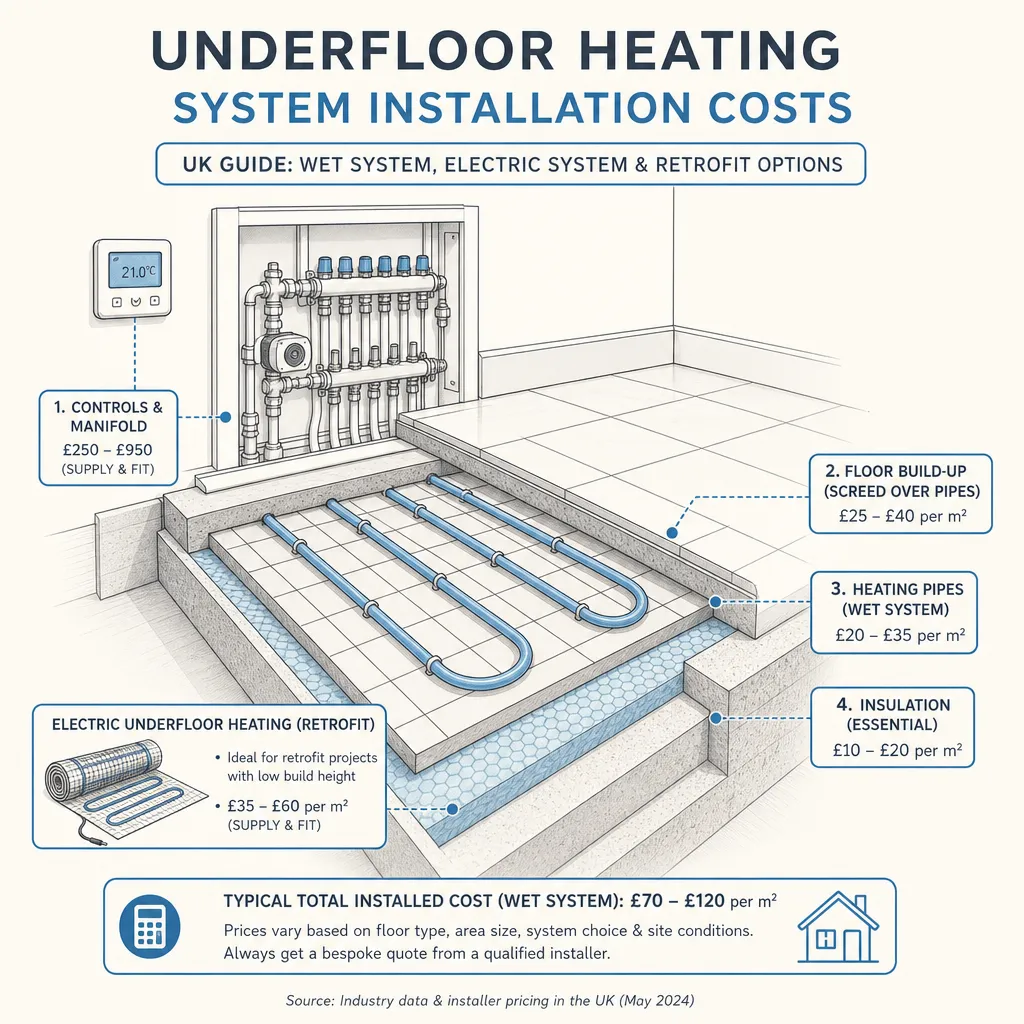
Underfloor Heating System Installation Costs
Underfloor heating installation in the UK typically costs £20–£50 per m² for electric mat or foil systems and £50–£150 per m² for wet (hydronic) systems, including labour.
 Energy & Retrofit
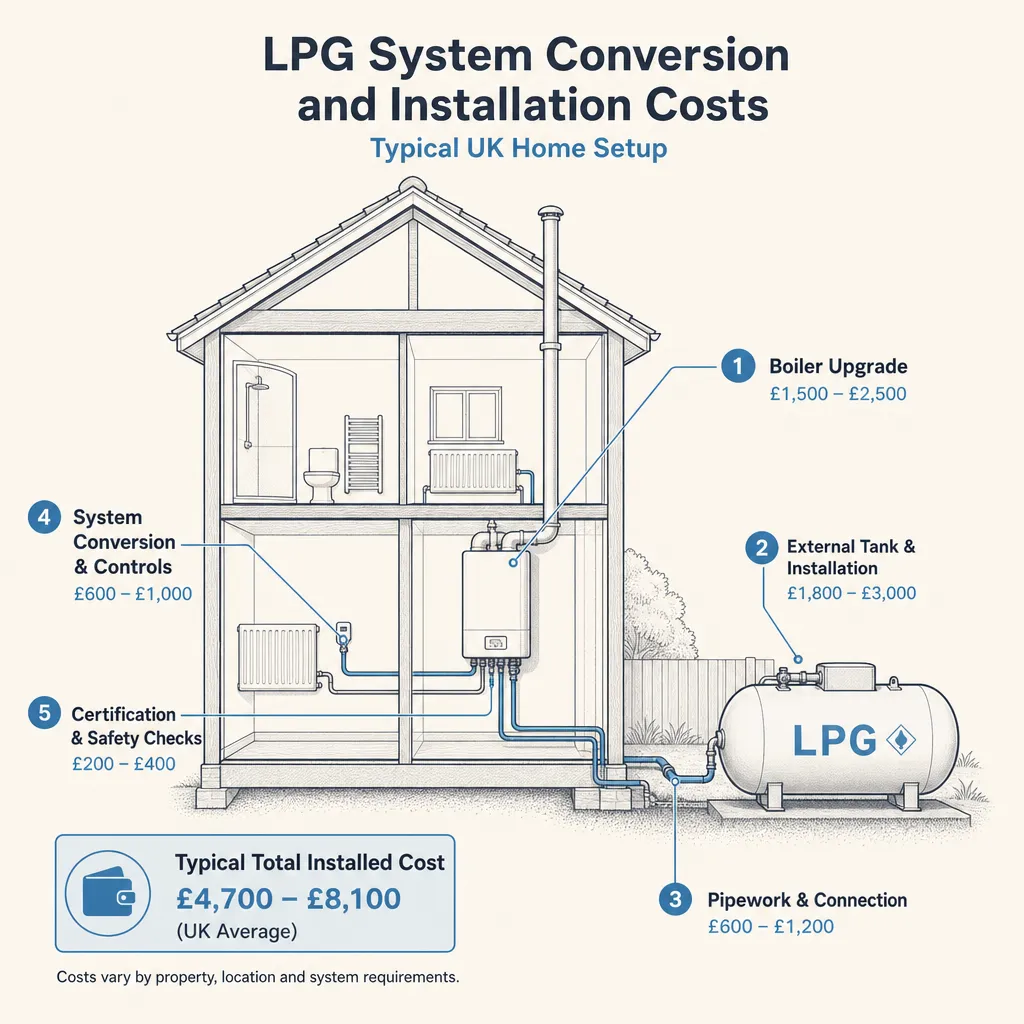
LPG System Conversion and Installation Costs
Converting a UK property to LPG typically costs £3,500–£10,000, covering a new LPG-compatible boiler, pipework, and tank installation.
 Energy & Retrofit
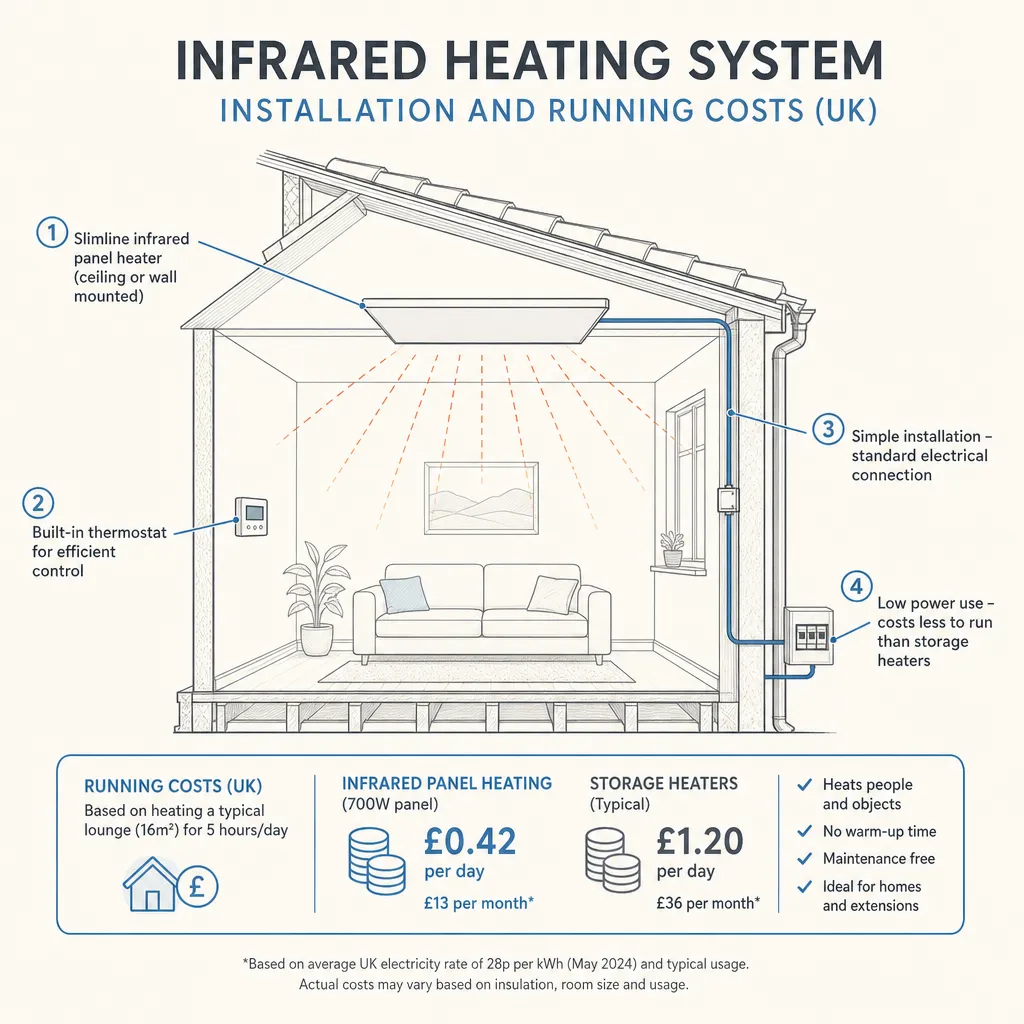
Infrared Heating System Installation and Running Costs
Infrared heating panels supply heat through radiant energy rather than warming air, making them efficient in well-insulated spaces.