Choosing Between Oil and Gas Heating Systems for Your Home
By Housey · Last reviewed 1st of June 2026
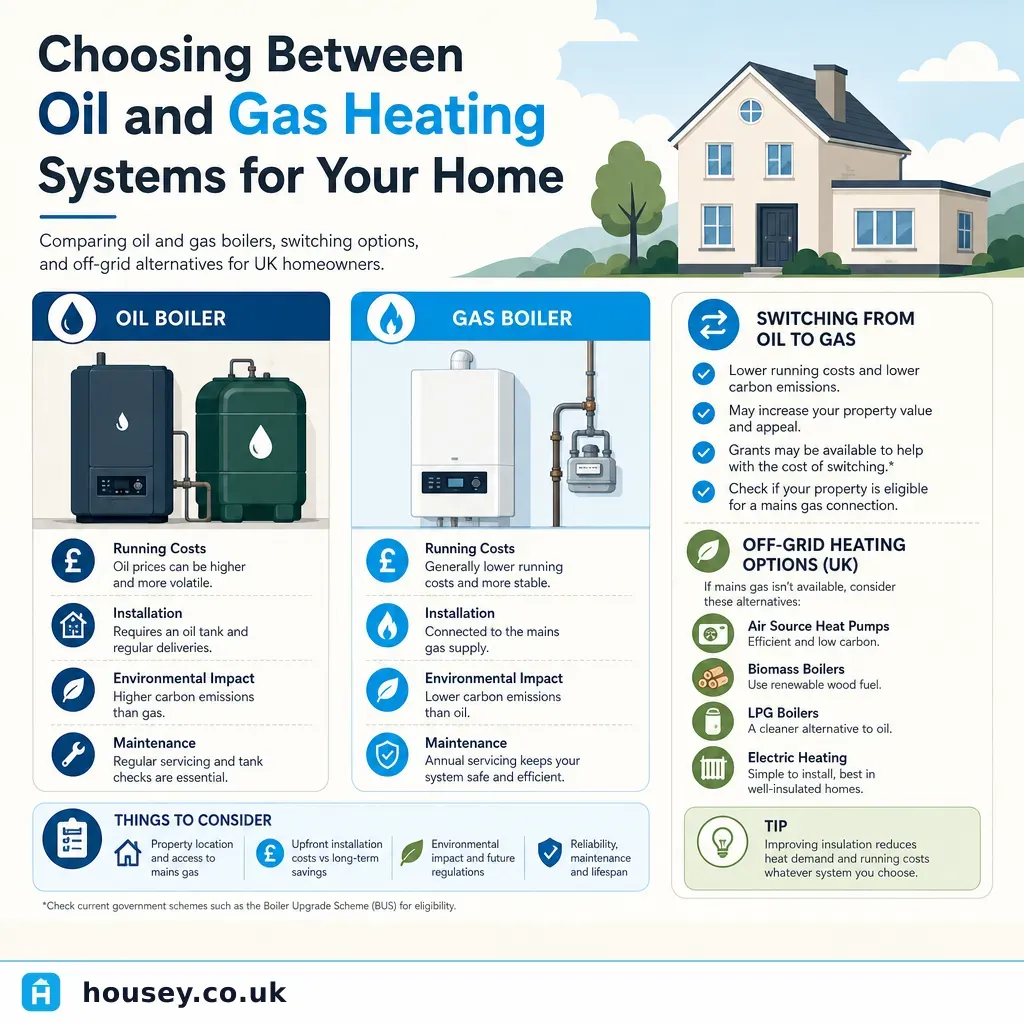
Choosing Between Oil and Gas Heating Systems for Your Home
Whether you are replacing a failing boiler, buying a rural property, or planning a major energy upgrade, the choice between oil and mains gas central heating shapes your running costs, maintenance obligations, and future retrofit options for decades. This decision depends on your location, the infrastructure available nearby, fuel price trends, and whether low-carbon alternatives such as heat pumps might suit your situation better.
Key points
- Around 4 million UK homes sit beyond the mains gas network and rely on oil or other off-grid heating, particularly in rural England, Wales, and Scotland (Ofgem).
- Gas boilers must be installed and serviced by a Gas Safe registered engineer under the Gas Safety (Installation and Use) Regulations 1998; oil boilers require an OFTEC-registered technician.
- Building Regulations Approved Document L (2021 edition) requires replacement boilers to be high-efficiency condensing models meeting a minimum ErP A energy label.
- The Boiler Upgrade Scheme (BUS), administered by Ofgem, currently offers £7,500 grants for air source and ground source heat pumps — a funded alternative worth considering before committing to another fossil fuel boiler.
- Connecting a property to the mains gas network where the main runs within 23 metres typically costs £1,000–£3,500; greater distances attract significantly higher charges (National Gas Transmission guidance).
Which properties can access mains gas?
The UK mains gas network serves most urban and suburban properties, but coverage falls sharply in rural postcodes — particularly across Wales, Scotland, and parts of the South West and East of England. Before assuming oil is your only option, check whether a gas main runs near your property. The local Gas Distribution Network (GDN) can confirm availability and provide a connection quotation.
If a main runs within 23 metres, a standard service connection may be relatively affordable. Properties further away face the cost of network extension, which can quickly outweigh long-term fuel savings. Gas Distribution Networks operating in England, Wales, and Scotland include Cadent, SGN, Northern Gas Networks, and Wales & West Utilities.
Running costs: oil versus gas
Both oil and gas costs fluctuate with energy markets. As a broad guide:
- Mains gas is priced per kilowatt-hour (kWh) and subject to Ofgem's quarterly price cap. Typical gas unit rates in early 2026 are around 5–7p/kWh, excluding the standing charge.
- Heating oil (kerosene, Class C2) is purchased in bulk — typically 500–1,000 litres — at commodity prices. Prices have ranged from approximately 45p to over 90p per litre in recent years, equating to roughly 5–10p/kWh depending on boiler efficiency.
Indicative UK costs, last reviewed 2026-06-01. Prices vary by region, supplier, and market conditions.
Oil prices are not capped and can spike during supply disruptions. Households on oil must hold a buffer stock, tying up capital. Gas bills are smoother month-to-month and can be spread via direct debit.
Storage, delivery, and practical considerations for oil heating
An oil central heating system requires a storage tank — typically a minimum of 1,200 litres for a family home. Tanks must comply with OFTEC guidance and Building Regulations requirements on bunding (secondary containment), siting distances from buildings and drains, and fire separation.
Practical points:
- Fuel deliveries must be booked in advance; tanker access is required. Rural properties sometimes face delivery premiums or seasonal shortages.
- Annual service by an OFTEC-registered engineer is strongly recommended and often required by home insurers.
- Tank condition: above-ground steel tanks have a typical service life of 20–30 years. An aged or leaking tank can cause costly environmental remediation for which the property owner bears legal liability.
Oil vs mains gas central heating: comparison table
Factor | Oil central heating | Mains gas central heating |
|---|---|---|
Rural availability | Yes — off-grid properties | Only where network exists |
Fuel storage | Tank required (1,200+ litres typical) | None — piped on demand |
Price volatility | High — commodity, no price cap | Moderate — Ofgem cap applies |
Engineer requirement | OFTEC-registered technician | Gas Safe registered engineer |
Annual service | Strongly recommended | Required by law in rented homes |
CO₂ per kWh | Higher than natural gas | Lower than oil; still fossil fuel |
Heat pump retrofit | Feasible with wet radiator system | Feasible with wet radiator system |
New boiler ban | From 2035 | From 2035 |
Switching from oil to gas: what is involved
If mains gas is available nearby, switching is technically straightforward but involves several steps:
- Gas network connection — Contact the local GDN for a quotation. Standard connections typically take 6–12 weeks to complete.
- Internal pipework — A Gas Safe registered engineer installs the gas supply pipe from the meter to the boiler location.
- New condensing gas boiler — The oil boiler is decommissioned. The new boiler must meet Approved Document L efficiency requirements.
- Oil tank decommissioning — The tank must be drained, cleaned, and properly disposed of. OFTEC provides guidance on safe removal.
Total indicative costs for connection, pipework, boiler, and tank removal: £5,000–£12,000+, depending on property size and network extension length. Obtain at least three independent quotes.
Which heating system should you choose?
- Choose mains gas if a connection is available within a reasonable distance and connection costs are proportionate to projected long-term savings.
- Remain on oil if you are in a rural location where the gas main is distant and a like-for-like oil boiler replacement is significantly cheaper than a full conversion.
- Consider an air source heat pump if you are replacing any fossil fuel heating system and have suitable insulation and outdoor space — the Boiler Upgrade Scheme grant (£7,500 as of 2026) may significantly offset the cost.
- Ask an energy-efficiency consultant before committing if you are unsure whether your property's insulation and radiator sizing support a heat pump.
- Check BUS eligibility first: the grant must be applied for by your MCS-certified installer before installation begins.
Important limitations
This article provides general information about oil and gas central heating choices in the UK. Actual costs, grant eligibility, and technical suitability depend on your specific property, location, and circumstances. Gas and oil systems involve combustion appliances and carry carbon monoxide risk. All installation, service, and repair work must be carried out by suitably registered engineers — Gas Safe for gas, OFTEC for oil. Do not attempt to service or modify boilers yourself.
When to get professional help
Contact a qualified engineer or energy specialist if:
- Your boiler is over 15 years old, showing signs of inefficiency, or producing unusual smells or sounds
- You smell gas in your home — leave immediately and call the National Gas Emergency Service on 0800 111 999
- You suspect a carbon monoxide leak — a working audible CO alarm is strongly recommended in all homes with combustion appliances
- You are considering switching fuel types or connecting to mains gas for the first time
- You want to apply for the Boiler Upgrade Scheme — the application must precede installation and the installer must be MCS-certified
What to ask a qualified professional
When consulting a Gas Safe registered engineer, OFTEC technician, or MCS-certified installer:
- Is my property's existing wet system (radiators and pipework) compatible with a heat pump, or would I need to upsize radiators?
- What does the heat loss calculation for my property suggest about the required boiler or heat pump output?
- Am I eligible for the Boiler Upgrade Scheme, ECO4, or any other current grant scheme?
- What is the projected annual running cost at current tariffs, compared to my existing system?
- What documentation — commissioning certificate, Building Regulations notice, warranty — will I receive on completion?
How Housey can help
Housey connects UK homeowners with vetted energy-efficiency consultants who can assess your property's heat loss, compare fuel options, and advise on the most cost-effective upgrade path — whether that is a new condensing boiler, a mains gas connection, or an air source heat pump under the Boiler Upgrade Scheme.
Frequently asked questions
Can I switch from oil to gas heating myself?
No. All gas installation work in the UK must be carried out by a Gas Safe registered engineer. It is illegal for an unregistered person to install, service, or repair gas appliances under the Gas Safety (Installation and Use) Regulations 1998. The mains connection is managed by the Gas Distribution Network and then handed to a registered engineer for internal pipework and boiler installation.
Does the Boiler Upgrade Scheme fund oil boiler replacements?
No. The BUS does not provide grants for new oil or gas boilers. As of 2026, it funds air source heat pumps (£7,500), ground source heat pumps (£7,500), and biomass boilers in limited eligible cases (£5,000). Oil-to-heat-pump conversions qualify where property conditions are met and an MCS-certified installer carries out the work.
Is oil heating being phased out in the UK?
The UK Government has announced that the sale of new gas and oil boilers will end from 2035. Existing systems can continue to be serviced and replaced like-for-like until then, but long-term policy points toward low-carbon heating. If you are planning a full system replacement, factoring in a heat pump is worth the investment of a professional consultation.
Do I need planning permission to install a heat pump instead of a boiler?
Air source heat pumps benefit from permitted development rights in most circumstances in England, meaning planning permission is not usually required. Conditions apply for listed buildings, flats, and properties in conservation areas. Always check with your local planning authority before instructing an installer.
Sources and further reading
- Gas Safe Register — Gas Safe Register
- OFTEC — OFTEC
- Apply for the Boiler Upgrade Scheme — GOV.UK
- Approved Document L (2021) — GOV.UK
- Central heating systems — Energy Saving Trust
- Energy price cap — Ofgem
Useful next reads
 Energy & Retrofit
The Value of an Energy Performance Audit for Your Home
A home energy performance audit is a detailed, site-specific assessment of a property's fabric, heating, ventilation, and controls.
 Energy & Retrofit
Heat Pump Servicing and Maintenance: Regular Care and Costs
Heat pumps should be serviced by a qualified engineer once a year; most manufacturers require this to keep the warranty valid.
 Energy & Retrofit
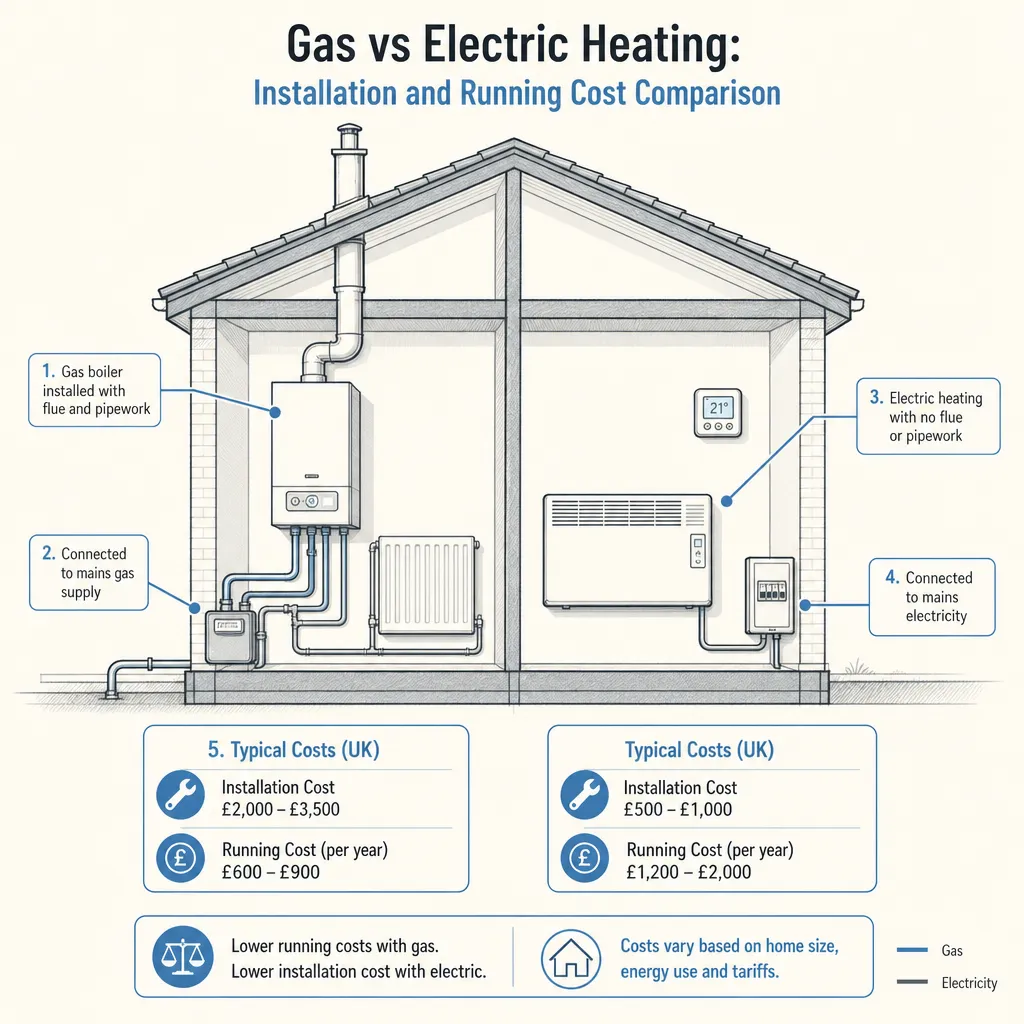
Gas vs Electric Heating: Installation and Running Cost Comparison
Gas central heating usually has lower running costs per kWh than direct electric heating in the UK, though heat pumps can change that equation.
 Energy & Retrofit
Underfloor Heating System Installation Costs
Underfloor heating installation in the UK typically costs £20–£50 per m² for electric mat or foil systems and £50–£150 per m² for wet (hydronic) systems, including labour.
 Energy & Retrofit
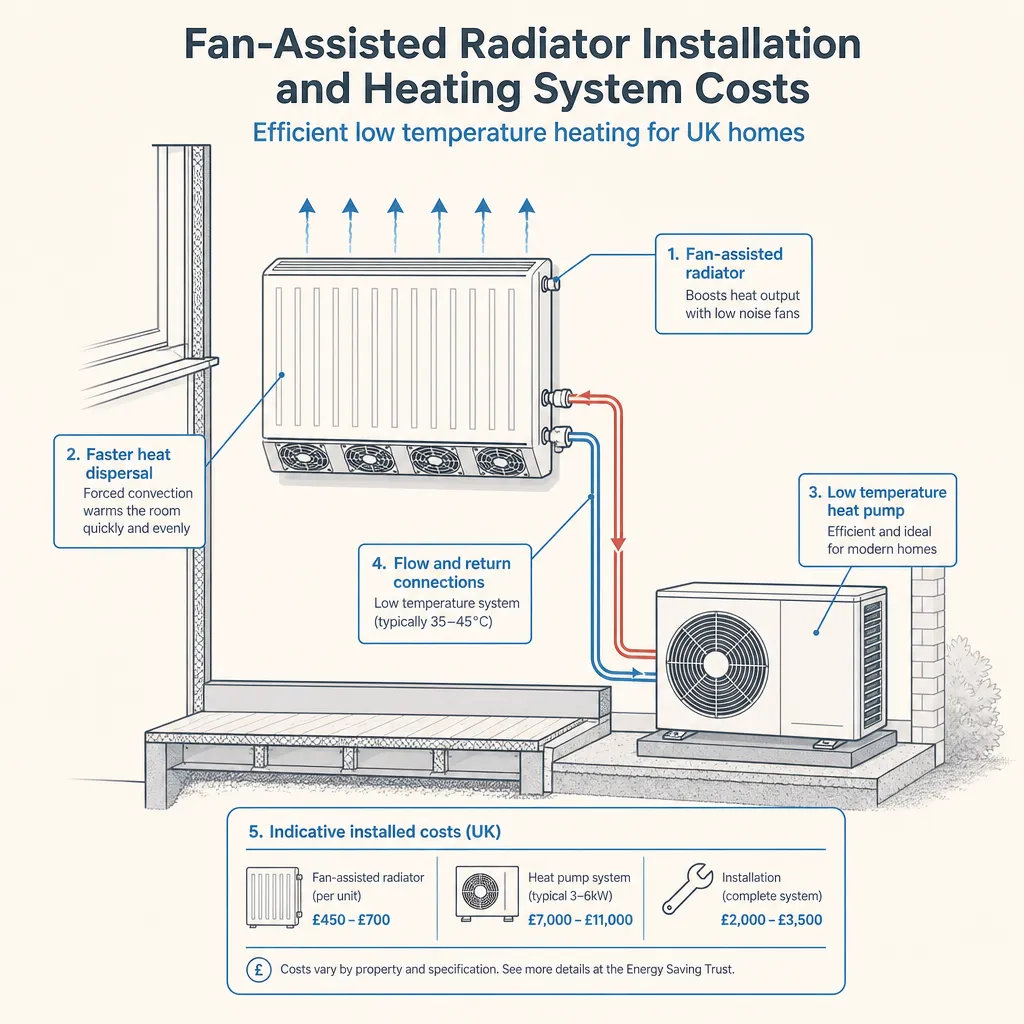
Fan-Assisted Radiator Installation and Heating System Costs
Fan-assisted radiators use an integral fan to force air across a water-heated element, delivering roughly 2–3 times more heat than a standard panel radiator at the same low flow temperature.