Underfloor Heating System Installation Costs
By Housey · Last reviewed 11th of May 2026
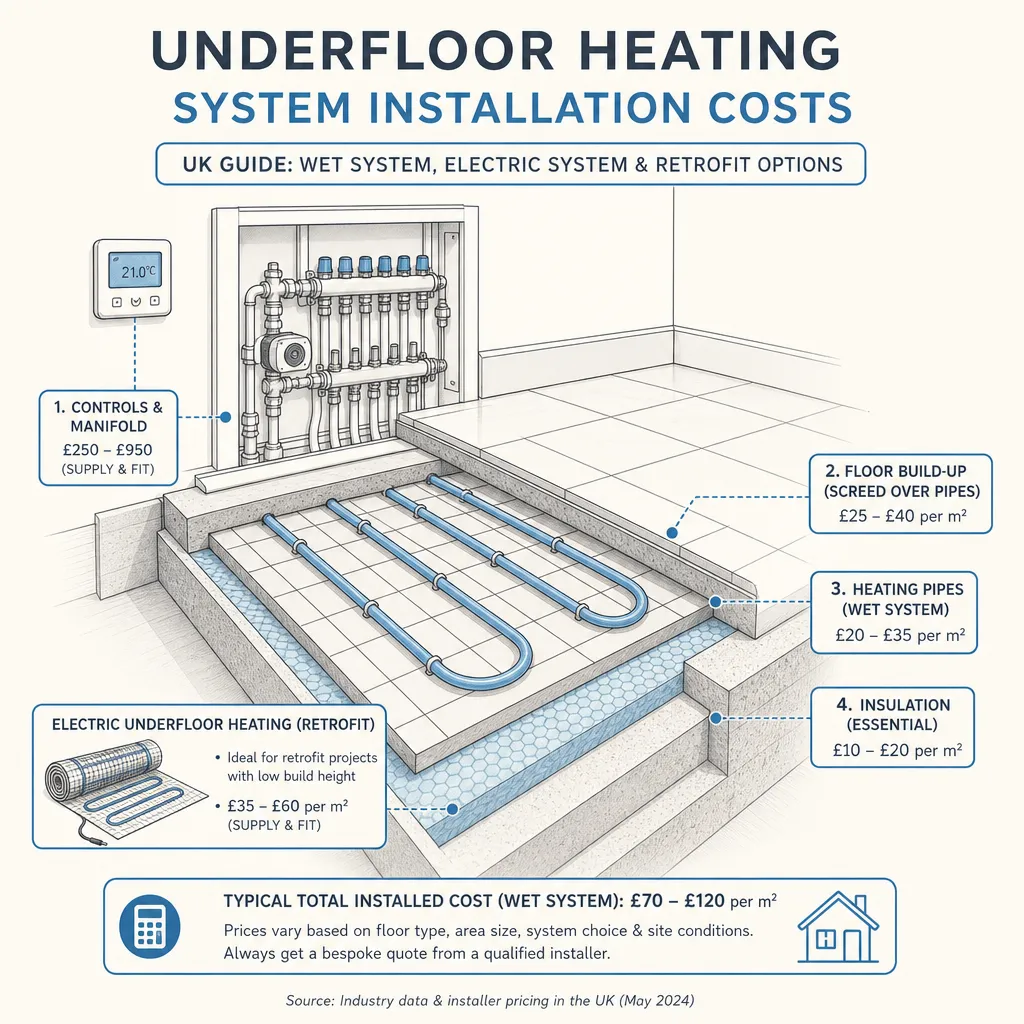
Underfloor Heating System Installation Costs
Underfloor heating (UFH) often comes up when homeowners are planning a kitchen or bathroom renovation, fitting out a new extension, or switching to a heat pump as part of a whole-house energy upgrade. Because costs vary substantially between electric and wet (hydronic) systems — and between new-build and retrofit situations — knowing the key variables before you approach installers helps you compare quotes accurately and avoid surprises.
Key points
- Electric mat and foil UFH systems typically cost £20–£50 per m² installed; wet (hydronic) systems range from £50–£150 per m², before screeding costs. Indicative UK costs, last reviewed 2026-05-11.
- Wet UFH requires a compatible heat source — a condensing boiler or heat pump — plus zone controls (manifolds, actuators, thermostats) that typically add £300–£800 per manifold to the project.
- MCS-certified installers are required where UFH is connected to an MCS-certified heat pump; the combination must also be specified together for Boiler Upgrade Scheme eligibility.
- Underfloor heating performs best with thin, dense floor finishes (tiles, stone, engineered wood under 18 mm); deep-pile carpet can reduce heat output by 50% or more.
- Retrofit installations typically require lifting existing floor finishes and, for wet systems, pouring a new screed — which must cure for four to six weeks before floor coverings are laid.
Wet vs electric underfloor heating
The two main UFH types differ significantly in installation complexity, running cost, and compatibility with different heat sources. The table below summarises the key differences for UK homeowners.
System type | Typical installed cost | Best suited for | Running cost indicator | Key limitation |
|---|---|---|---|---|
Electric mat | £20–£50/m² | Bathrooms, small rooms | Higher per kWh — suits low-use areas | Expensive to run in large areas |
Electric foil (under laminate) | £15–£40/m² | Living rooms, bedrooms under engineered wood | Similar to mat; thermostat essential | Not suitable under tiles |
Wet screed system | £50–£130/m² (excl. screed) | Whole-ground-floor, extensions, heat pump pairing | Low per kWh with heat pump (COP 2.5–4.0) | Disruptive; screed adds 4–6 weeks cure time |
Wet low-profile overlay | £70–£180/m² | Retrofit without lifting existing floor | As wet screed | Raises floor by 15–22 mm; higher materials cost |
Indicative UK costs, last reviewed 2026-05-11. Costs vary by region, floor area, and installer. Always request itemised quotes.
Which system should you choose?
- Choose electric mat or foil if the area is under 20 m², it is a bathroom or single room, or there is no central heating pipework nearby.
- Choose wet screed UFH if you are building an extension, replacing a ground-floor screed, or pairing UFH with a new heat pump.
- Choose wet low-profile overlay if you want wet-system efficiency in a retrofit without significantly raising the floor height.
- Consult an MCS-certified installer if you are integrating UFH with a heat pump — the two systems must be sized together for optimum efficiency and Boiler Upgrade Scheme eligibility.
What drives the cost of UFH installation?
Floor area: Most installers quote per m², so larger areas cost more in total but often attract a lower per-m² rate. A 60 m² ground floor will generally carry a lower per-m² cost than a 15 m² bathroom.
Floor construction: Solid concrete ground floors are the most straightforward base for wet UFH. Suspended timber floors require between-joist pipe installation or overlay boards — adding cost and complexity.
Screeding: A new liquid anhydrite or sand-and-cement screed adds approximately £15–£30 per m². Screed must cure for four to six weeks before floor finishes can be laid.
Underfloor insulation: Rigid polystyrene or phenolic insulation boards must be installed beneath the pipe system to direct heat upwards. Expect to add £5–£15 per m² for materials.
Zone controls and manifolds: Each heating zone needs a manifold, actuators, and a room thermostat. A two-zone installation typically adds £600–£1,600 in materials, not including smart thermostat upgrades.
Heat source compatibility: If your existing boiler runs at 70°C+ flow temperatures, it may not be optimised for wet UFH's preferred 35–45°C range. A heat pump replacement or buffer tank may be advisable, adding significant cost.
Access and reinstatement: Removing and relaying existing tiles, engineered wood, or carpet adds labour and materials cost. Tile breakage during lifting is common and should be budgeted for.
Running costs and energy performance
Electric UFH running costs depend on tariff and usage pattern. At around 24–25p/kWh (a typical 2026 UK rate), a 10 m² electric mat running four hours daily in winter adds roughly £1.50–£2.50 per day — manageable for a bathroom, but costly scaled to a large living room.
Wet UFH paired with an air source heat pump typically achieves a Coefficient of Performance (COP) of 2.5–4.0, meaning each unit of electricity generates 2.5–4 units of heat. Because UFH operates at lower flow temperatures than radiators, it is more compatible with heat pump output — a point highlighted in GOV.UK's heat pump guidance and by the Energy Saving Trust.
PAS 2035, the specification for whole-house retrofit, frequently identifies UFH as appropriate when a heat pump is included in a retrofit plan. A qualified Retrofit Coordinator should assess the full interaction of measures — including ventilation and airtightness — before specifying UFH within a wider retrofit.
Homeowner checklist before requesting UFH quotes
When to get professional help
UFH installation always requires a competent person. Electric systems must comply with Building Regulations Part P and be installed by a Part P registered electrician or notified to building control. Wet systems connected to a gas boiler should be installed by a Gas Safe registered engineer. Heat pump-linked UFH must be installed by an MCS-certified installer for the system to qualify for the Boiler Upgrade Scheme.
Seek professional guidance if:
- Your property has suspended timber floors and you are unsure of joist depth or condition
- You are integrating UFH with a new heat pump and need the systems sized correctly together
- Your building is listed or in a conservation area, where permitted development rules may restrict the heat source
- The floor height leaves little margin for additional build-up
How Housey can help
Housey connects homeowners with vetted heating and energy retrofit installers across the UK. Use the Housey quote request tool to receive itemised quotes for electric or wet underfloor heating installations from local specialists who are qualified for your project type.
Frequently asked questions
How long does underfloor heating take to install?
A single-room electric mat typically takes one to two days. A full ground-floor wet system — pipe laying, screed, and controls — usually takes three to seven days on site. Screed then needs four to six weeks to cure fully before floor finishes are laid, so allow around two months from start to a finished, usable floor.
Can underfloor heating be retrofitted into an existing home?
Yes, though cost and disruption depend on floor type. Solid concrete floors can accept wet UFH with new screed or low-profile overlay boards. Suspended timber floors can have pipes installed between joists. A qualified installer should survey the property and confirm compatibility before quoting.
Does underfloor heating add value to a house?
RICS does not publish a fixed price premium for UFH, and estate agent feedback varies by property type and location. UFH is generally viewed positively in premium homes and kitchen extensions. It is unlikely to recover its full installation cost on resale in isolation, but it may support an improved EPC rating when paired with an efficient heat source.
Does UFH installation require planning permission?
In most cases, no. UFH itself is not notifiable under planning law. However, the work must comply with Building Regulations Part P (electrical) and Part L (energy efficiency). Heat pump installation may require permitted development compliance or planning permission. Check with your local planning authority if the property is listed or in a conservation area.
Sources and further reading
- Heat pump guidance — GOV.UK
- Boiler Upgrade Scheme — GOV.UK
- Energy Saving Trust: Heat pumps — Energy Saving Trust
- Building Regulations Approved Document L — GOV.UK
- Building Regulations Approved Document P — GOV.UK
Useful next reads
 Energy & Retrofit
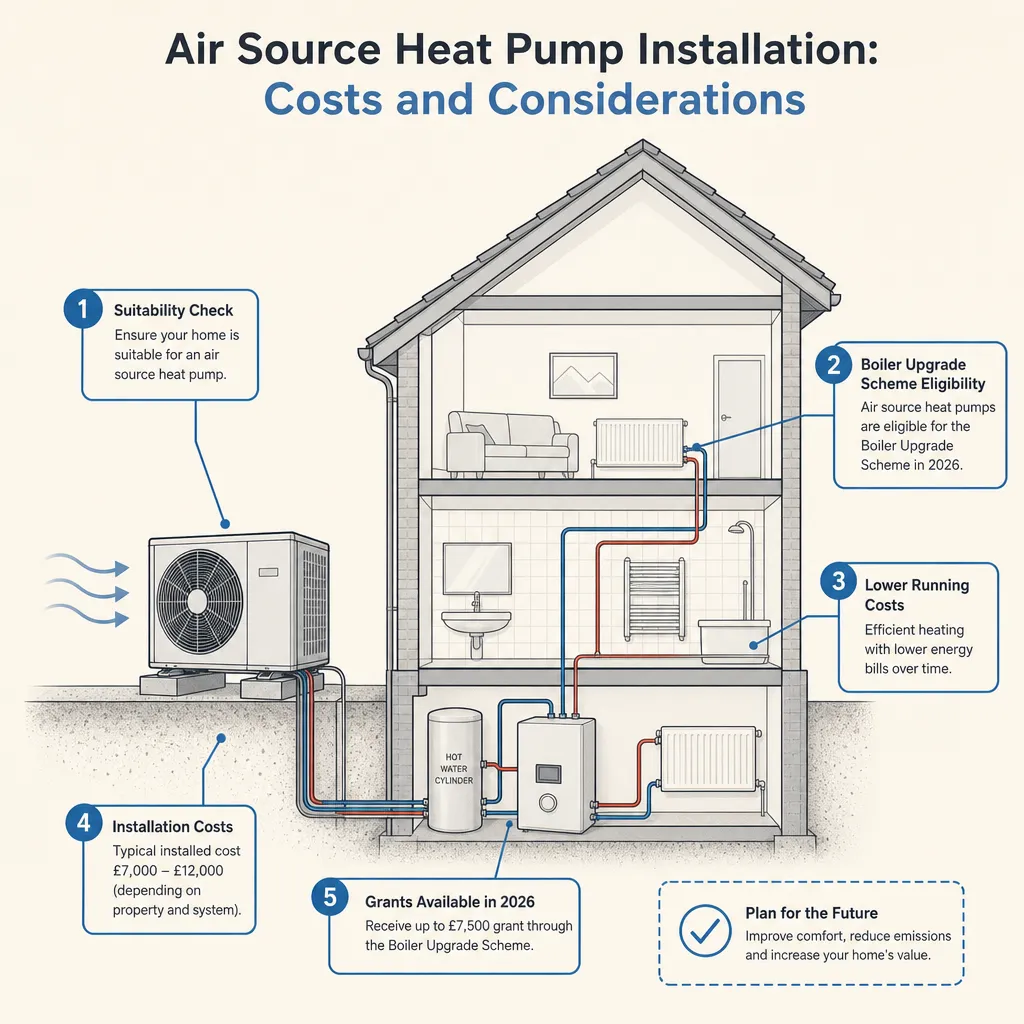
Air Source Heat Pump Installation: Costs and Considerations
Air source heat pump installation in the UK typically costs £8,000–£15,000 before the £7,500 Boiler Upgrade Scheme grant, available through MCS-certified installers in England and Wales.
 Energy & Retrofit
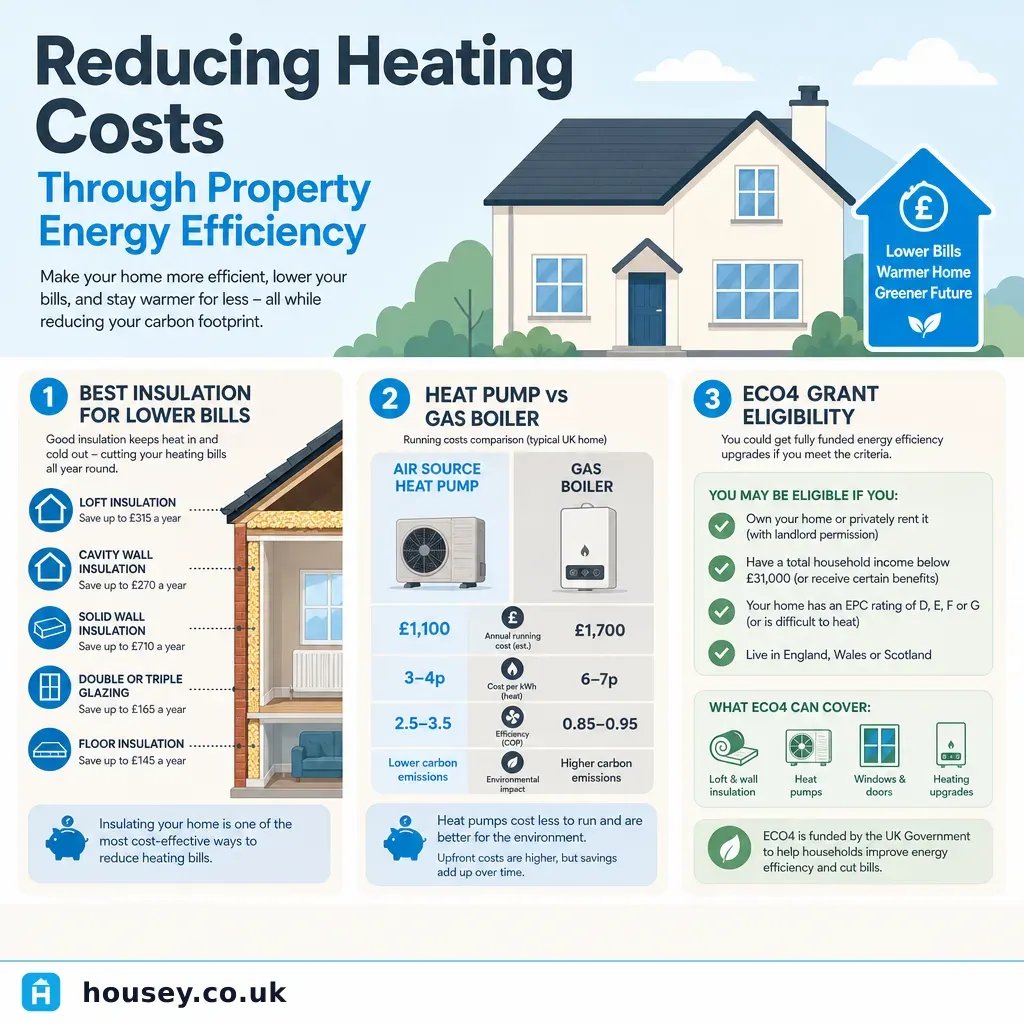
Reducing Heating Costs Through Property Energy Efficiency
Reducing heating costs starts with identifying where heat is lost — typically walls (30–35%), roof (20–25%), and windows.
 Energy & Retrofit
Making your home resilient to climate change: practical strategies
UK homeowners can improve climate resilience by addressing flood risk, overheating, and energy efficiency together.
 Energy & Retrofit
Heat Pump Servicing and Maintenance: Regular Care and Costs
Heat pumps should be serviced by a qualified engineer once a year; most manufacturers require this to keep the warranty valid.
 Energy & Retrofit
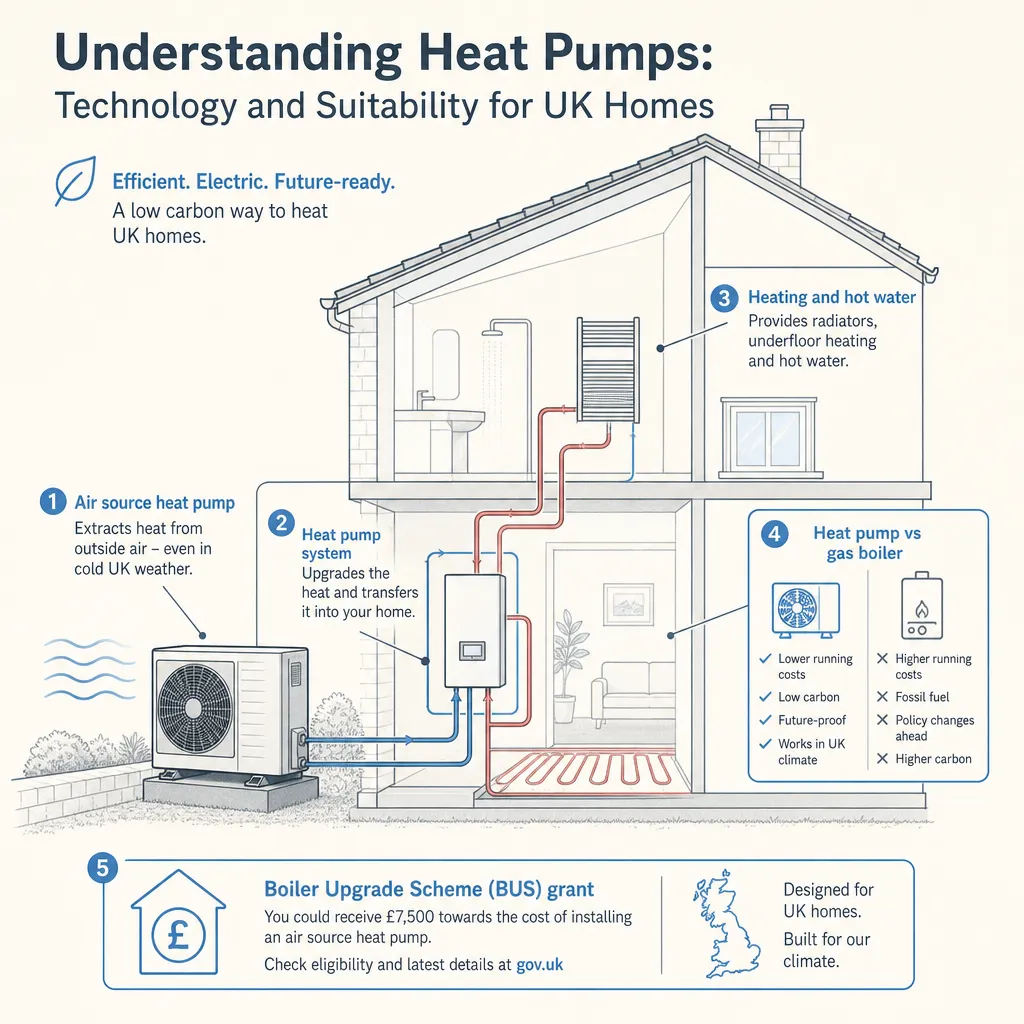
Understanding Heat Pumps: Technology and Suitability for UK Homes
Heat pumps extract heat from the air or ground and transfer it indoors, typically achieving efficiencies of 250–400% compared to a conventional boiler's near 100%.