Finding a Reliable Renovation Contractor: What to Look For
By Housey · Last reviewed 12th of May 2026

Finding a Reliable Renovation Contractor: What to Look For
A renovation project — whether a loft conversion, kitchen extension, or full house refurbishment — is one of the largest discretionary spends most UK homeowners will make. Contractors vary enormously in competence, communication, and financial stability, and the selection process often receives less attention than the design phase. Getting this right from the outset significantly reduces the risk of cost overruns, delays, defective workmanship, and the difficulty of resolving disputes mid-project when leverage is limited.
Key points
- The Federation of Master Builders (FMB) and TrustMark are two government-endorsed quality schemes for UK building contractors; membership involves vetting but should be verified directly on each scheme's website, not taken on faith from a contractor's own marketing.
- Always obtain at least three written, itemised quotes; a quote substantially cheaper than the others may indicate scope exclusions, lower-grade materials, or unregistered subcontractors.
- A renovation contractor should carry public liability insurance of at least £2 million; for larger projects, £5 million is preferable — always ask for a current certificate, not a verbal assurance.
- A written contract — JCT Minor Works 2016 or JCT Homeowner/Occupier — protects both parties; stage payments should be tied to measurable progress milestones, not calendar dates.
- Building Regulations approval (separate from planning permission) is required for most structural, electrical, gas, and thermal performance work — confirm before work starts who is responsible for making the application.
What type of contractor does your project need?
Not every renovation requires the same type of firm. Matching the contractor type to your project reduces coordination risk and misaligned expectations.
Project type | Contractor type to consider | What to check |
|---|---|---|
Full house refurbishment or complex multi-trade project | Principal contractor or design-and-build firm | Project management track record, subcontractor management, planning and building control experience |
Single-storey or two-storey extension | Extension builder or general building contractor | Structural groundworks experience, knowledge of Party Wall Act where applicable, building control sign-off process |
Loft conversion | Specialist loft conversion company or experienced general builder | Permitted development knowledge, steel beam specification, dormer or Velux experience |
Kitchen or bathroom renovation | Specialist fitter plus trades (plumber, electrician) | Gas Safe or NICEIC registration for relevant trades; clarity on who coordinates subcontractors |
Structural repairs | Chartered builder or structural specialist | Evidence of working from engineer's drawings; professional indemnity on any design elements |
For design-led projects, a design-and-build firm manages both architecture and construction under a single contract, which reduces the coordination risk of appointing separate designers and builders.
How to find candidates
The most reliable starting points for identifying candidates are:
- Personal recommendation from someone whose completed work you can inspect — particularly for projects of a similar type and scale to yours.
- FMB Find a Builder — members are assessed by FMB inspectors and must carry appropriate insurance; check membership status directly at fmb.org.uk.
- TrustMark — the government-endorsed scheme covering renovation, repair, and improvement contractors; search by postcode and trade at trustmark.org.uk.
- Local architects or surveyors — professionals who administer building contracts regularly often have vetted shortlists of reliable contractors.
- Which? Trusted Traders — independently assessed, with background checks and verified customer reviews.
Online review platforms such as Checkatrade or Rated People can be useful for smaller trades, but apply scrutiny: check that reviews are independently verified, recent, and relate to projects comparable to yours.
What to check before inviting a contractor to quote
Before any site visit or design discussion, run these checks:
- Companies House: search the company name at find-and-update.company-information.service.gov.uk. Check when it was incorporated, whether it is active, and whether any directors have been associated with previously dissolved companies with unpaid creditors.
- Insurance: ask for a current certificate of public liability insurance — not a policy schedule, but the in-force certificate. For a major renovation, £2 million minimum; £5 million preferable.
- Accreditations: check FMB, TrustMark, or relevant trade body membership directly on the scheme's own website — not from a logo on a contractor's brochure.
- References: request two or three client references from comparable completed projects. Ask specifically how the contractor handled unexpected problems — access issues, concealed defects, design changes — not just whether the project finished.
Homeowner checklist: evaluating contractor quotes
When written quotes arrive, use this checklist before comparing prices:
Red flags during the contractor selection process
Watch for these warning signs before committing:
- Demand for a very large upfront deposit — a 10–20% deposit for materials on a larger project is normal; 40–50% or more before any work begins is unusual and creates significant financial exposure.
- Pressure to decide quickly — "I have a gap starting Monday" without time for reference checks or written quote review.
- Cash-only payment requests — this often indicates VAT avoidance and makes contractual disputes considerably harder to resolve.
- No written quote or a single-line figure without scope breakdown — impossible to manage variations or compare meaningfully.
- Reluctance to name subcontractors for regulated trades such as gas, electrical, or structural steelwork.
- No public liability insurance documentation available on request.
- Reviews clustered tightly in date — several five-star reviews within a short window may indicate fabricated feedback.
- Building Regulations fees included as a fixed lump with no explanation of which Building Control Body (BCB) is used or who submits applications.
What to ask before signing a contract
- What contract form do you propose — JCT Minor Works, JCT Homeowner, or your own terms?
- Who holds professional indemnity insurance for any design elements, and to what value?
- How are variations to scope managed — in writing, with a price agreed before work proceeds?
- Which subcontractors will carry out gas, electrical, and structural work, and what are their accreditations?
- What is your dispute resolution process if we disagree on quality or cost?
- Will you provide an operation and maintenance pack or handover documentation on completion?
- What retention do you propose, and on what terms is it released?
When to get professional help
For larger or more complex renovation projects, consider additional professional oversight:
- An architect or contract administrator can prepare a detailed specification, manage tendering, and administer the contract — adding cost but significantly reducing the risk of scope disputes and quality shortfalls.
- For projects above approximately £50,000, a formally administered JCT contract with retention and a defined defects liability period is strongly advisable.
- If you are appointing extension builders for a structural project, confirm early who engages the structural engineer, submits the Building Regulations application, and holds responsibility for sign-off.
- If a contractor abandons the site or a serious dispute arises, consult a solicitor or the contractor's trade association — the FMB, for instance, offers a dispute resolution service for member contractors.
How Housey can help
Housey connects UK homeowners with vetted extension builders and design-and-build firms suited to your project type and location. Submit a single brief, compare quotes and credentials from qualified contractors, and appoint with confidence.
Frequently asked questions
How many quotes should I get for a renovation?
Three is the practical minimum for most projects. For larger renovations — typically £30,000 and above — three to four itemised written quotes give a meaningful basis for comparison and help you identify scope discrepancies between tenderers. Make sure each tenderer is quoting for precisely the same specified scope before comparing figures.
Do renovation contractors need to be registered with anyone?
There is no single UK licensing requirement for general building contractors. However, subcontractors carrying out gas work must be on the Gas Safe Register, and electrical work covered by Part P of the Building Regulations must be certified by a Competent Person Scheme (NICEIC, NAPIT, or similar) or signed off by a local authority Building Inspector.
What is a JCT Homeowner Contract?
The Joint Contracts Tribunal (JCT) produces standard building contracts for domestic projects. The JCT Homeowner/Occupier contract sets out payment terms, variations, defects liability, and dispute resolution in plain English and is designed for use without an architect. It is available from the RIBA bookshop and widely recognised by UK builders.
Is TrustMark membership a guarantee of good work?
TrustMark membership involves vetting by a scheme operator against standards for technical competence, customer service, and trading practices — it reduces but does not eliminate risk. Always take up references from comparable completed projects and use a written contract regardless of any accreditation a contractor holds.
Sources and further reading
- TrustMark — government-endorsed quality scheme — TrustMark
- Federation of Master Builders — find a builder — Federation of Master Builders
- JCT contracts for homeowners — Joint Contracts Tribunal
- GOV.UK — Building Regulations approval — GOV.UK
- Companies House — company search — Companies House
- Citizens Advice — getting work done on your home — Citizens Advice
Useful next reads
 Improvement & Build
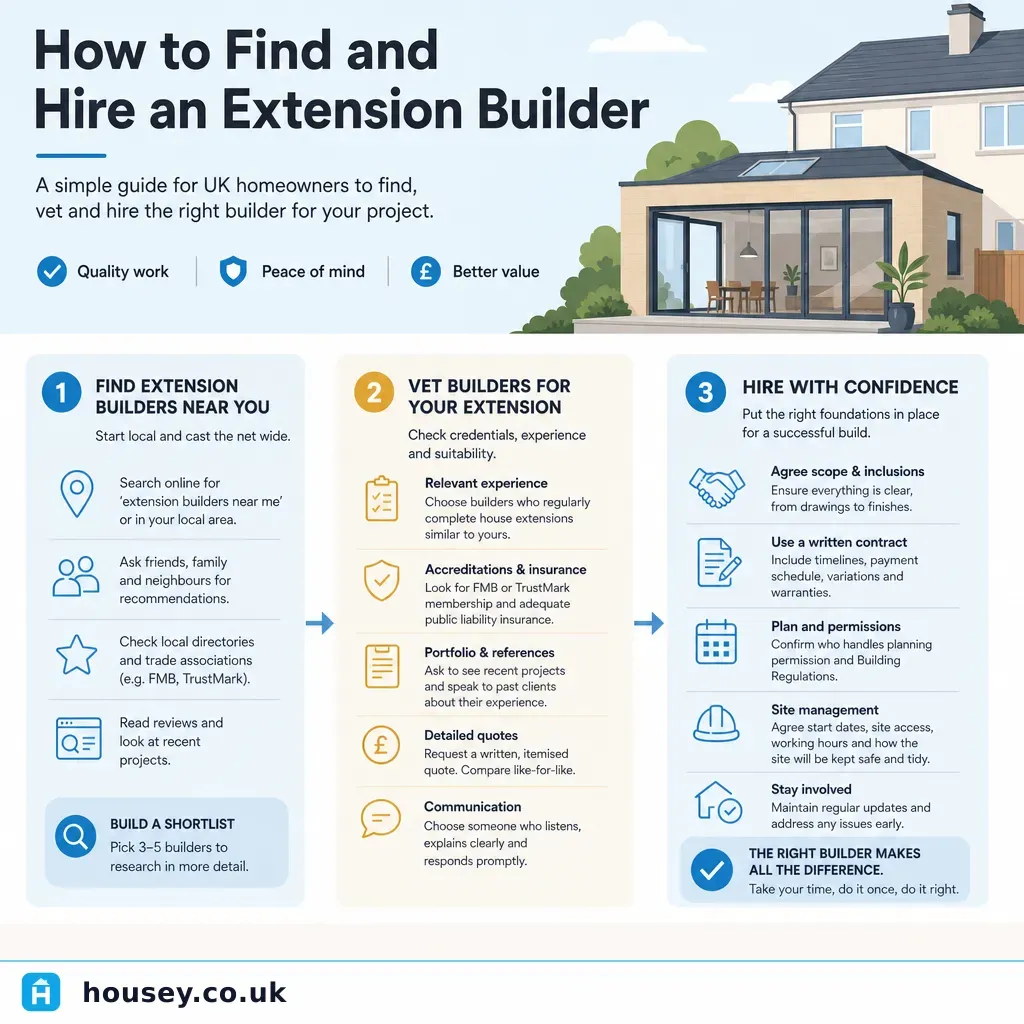
How to Find and Hire an Extension Builder
To hire a reliable extension builder, get at least three detailed written quotes from contractors with documented experience of similar projects.
 Improvement & Build
Who to Contact for Broken Door Handle Repair
For a broken door handle, a general handyperson can handle most internal timber door repairs, while a joiner or locksmith is better suited to external doors, particularly if the lock mechanism is affected.
 Improvement & Build
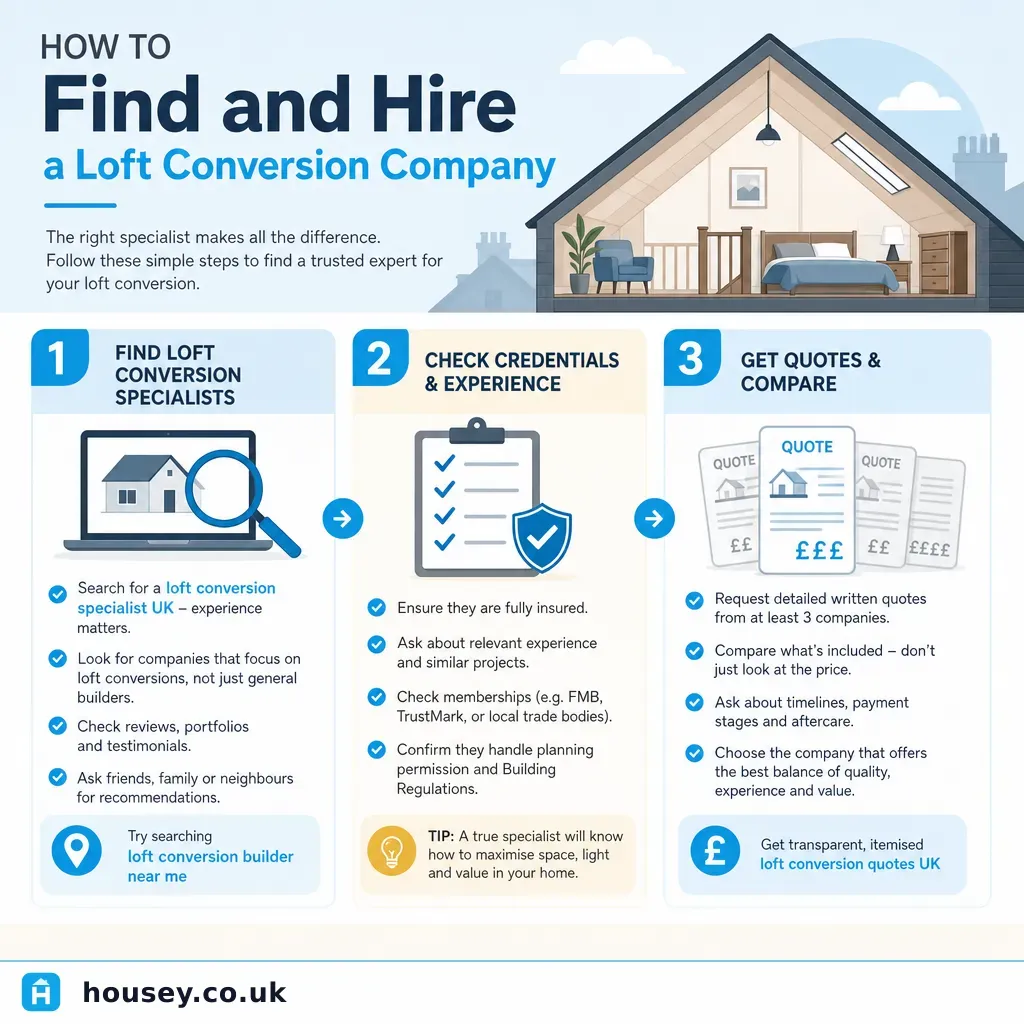
How to Find and Hire a Loft Conversion Company
To hire a loft conversion company, get at least three quotes from TrustMark-registered or FMB-member firms.
 Improvement & Build
Finding the Best Driveway Paver for Your Project
To find a reliable driveway paver in the UK, get at least three written quotes, check the installer is registered with a trade body such as the National Federation of Builders or Marshalls Approved Installer scheme, ask to see recent local work, and confirm the quote covers drainage, edging, and planning.
 Improvement & Build
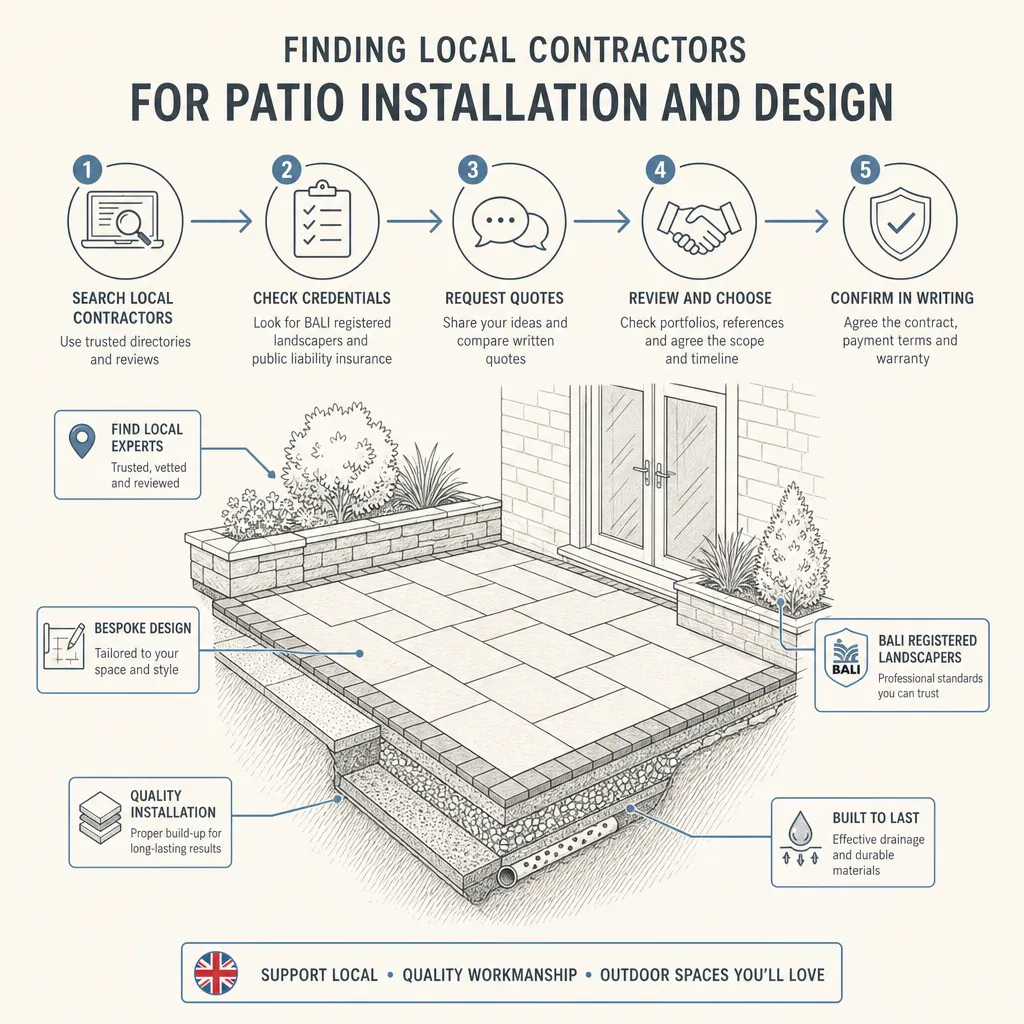
Finding Local Contractors for Patio Installation and Design
For most residential patios, a local landscaper or paving specialist manages the project from design to laying.