Furniture Removal and Disposal Service Costs
By Housey · Last reviewed 7th of May 2026
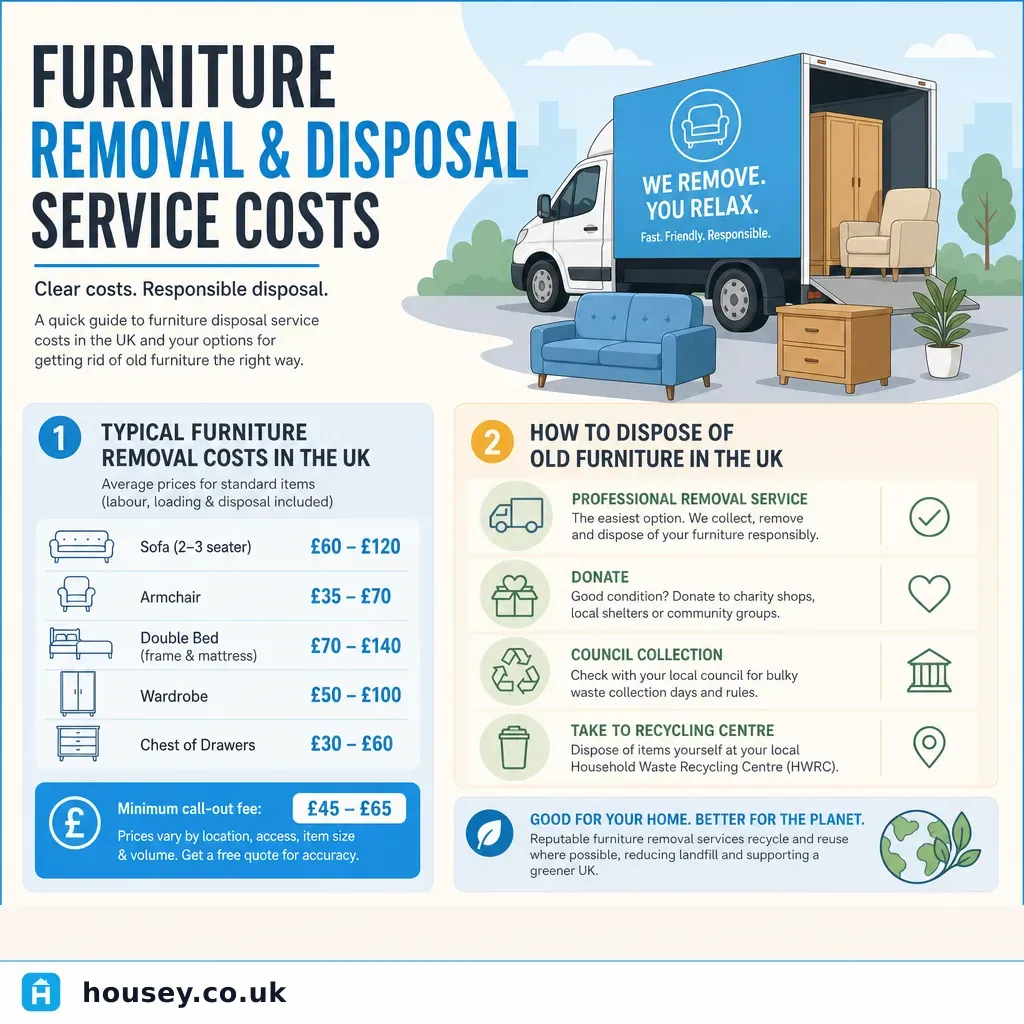
Furniture Removal and Disposal Service Costs
Whether you are clearing a property after a house move, dealing with inherited furniture, or simply upgrading a room, disposing of bulky items in the UK involves more choices — and more rules — than many homeowners expect. Councils have tightened collection restrictions, landfill tax has changed what operators can accept, and using an unlicensed carrier can leave you legally exposed even if you had no idea the waste was being fly-tipped.
Key points
- Fly-tipping is a criminal offence under section 33 of the Environmental Protection Act 1990, carrying fines of up to £50,000 or two years' imprisonment for serious cases; never hand furniture to anyone who cannot produce a valid Environment Agency waste carrier registration number.
- All businesses transporting waste — including furniture removal services — must be registered with the Environment Agency as a licensed waste carrier; registration is verifiable free on the Environment Agency's public register.
- Many councils offer a bulky waste collection service, typically charging £10–£40 per item; some areas provide one free collection per household per year.
- Mattresses require specialist recycling and attract a surcharge of £20–£50 per item from most professional services.
- Furniture in good condition can often be collected free by charities such as the British Heart Foundation or Emmaus, who resell it to fund their activities.
What affects the cost of furniture removal and disposal?
Volume and item type: A single sofa costs far less to remove than a full room of furniture. Mattresses attract surcharges because operators face higher tip fees due to the specialist sorting required at licensed facilities.
Access and location: Ground-floor removal is straightforward. A second-floor flat without a lift, or a narrow Victorian terrace with restricted parking, increases labour time significantly.
Disposal route: Items going to charity or a recycling facility cost the operator less to handle than landfill; reputable services often reflect this in their pricing. Items destined for landfill attract higher fees under the current UK Landfill Tax rate.
Urgency: Same-day or next-day bookings attract a premium. Booking a week or more in advance usually reduces cost.
Dismantling required: Flat-pack wardrobes, built-in units, or large modular sofas that must be dismantled before removal cost more than items that can be carried out intact.
Indicative costs for furniture removal and disposal in the UK
Indicative UK costs, last reviewed 2026-05-07.
Service type | Typical price range | Notes |
|---|---|---|
Council bulky waste collection (1–2 items) | £10–£40 per item | Varies by council; some offer one free collection per year |
Man-and-van single item removal | £50–£120 | Depends on item size, floor, and distance to tip |
Full room clearance | £150–£400 | Includes loading and legal disposal |
Full house clearance (3-bed property) | £400–£1,200+ | Depends on volume and any saleable items |
Mattress disposal surcharge | £20–£50 per mattress | Specialist recycling usually required |
Skip hire (2-tonne mini skip) | £150–£250 | You load it; a permit is needed if placed on a public road |
Charity collection (good condition furniture) | Usually free | British Heart Foundation, Emmaus, Salvation Army |
Prices are illustrative and vary by region, with London and the South East typically higher. Always confirm whether quotes include VAT and tip fees before accepting.
Choosing the right disposal route
Which furniture removal option suits your situation?
- Furniture in good useable condition → Try charity collection first — British Heart Foundation, Emmaus, and local furniture banks collect free and resell the items.
- Items have significant value (antique, designer, solid wood) → Contact a second-hand dealer or auction house before booking a clearance.
- One or two bulky items, no urgency → Book a council bulky waste collection — usually the cheapest licensed option in most areas.
- Multiple items or quick turnaround needed → Book a licensed clearance or man-and-van service with verified waste carrier registration.
- Full property clearance → Use a professional house clearance company; ask what proportion they donate, resell, or recycle before landfilling.
- Prefer to do it yourself → Hire a skip (check whether a council road permit is needed) or make trips to your local household waste recycling centre (HWRC), free for household residents in most council areas.
How to verify a waste carrier is licensed
Under the Environmental Protection Act 1990 and the Controlled Waste (Registration of Carriers and Seizure of Vehicles) Regulations 1991, transporting waste without registration is an offence. If you commission an unlicensed carrier who fly-tips the waste, you may share legal responsibility. Verify any operator's registration free on the Environment Agency's public register via GOV.UK before booking.
Red flags that suggest an unlicensed or unreliable operator:
- The company will not provide a waste carrier registration number.
- The quote is significantly cheaper than all competitors — unlicensed carriers undercut by avoiding licensed tip fees.
- Payment requested in cash only with no written receipt or booking confirmation.
- No written information offered on where the waste will be taken.
What to ask before booking a furniture removal service
- What is your Environment Agency waste carrier registration number?
- Is VAT included in your quoted price?
- Do you charge extra for mattresses or electrically powered furniture (WEEE items)?
- What proportion of items do you donate, resell, or recycle rather than send to landfill?
- What happens if the job takes longer than estimated due to access or dismantling?
- Will I receive a waste transfer note confirming lawful disposal?
- What is your cancellation and rescheduling policy?
A reputable operator will answer all of these questions without hesitation.
Worked UK property scenario
Situation: A homeowner in Birmingham is downsizing from a 3-bedroom semi-detached to a smaller flat. She needs to dispose of a large corner sofa, two double beds with mattresses, a wardrobe, and miscellaneous smaller items the new property cannot accommodate.
Options taken:
- British Heart Foundation — confirms it will collect the corner sofa and one bed free of charge, as both are in resaleable condition.
- Council bulky waste collection — booked for the second bed at no charge, though with a three-week wait.
- Licensed clearance company — quotes £270 including mattress surcharges and VAT to remove the remaining mattresses, wardrobe, and smaller items.
Outcome: Two large items removed at no cost. Licensed clearance handles the rest for £270 — compared with an estimated £450–£600 for a full clearance of all items. This scenario is illustrative; charity availability and council booking times vary by postcode and season.
When to get professional help
A council collection or man-and-van service is usually sufficient for one or two items. Consider a professional house clearance company when clearing a property after a bereavement, when volume exceeds what skip hire can handle practically, when you are a landlord working to a tight deadline, or when you need auditable evidence of lawful disposal as an executor or estate manager.
How Housey can help
Housey connects homeowners with vetted house clearance and house removals services across the UK. Request and compare quotes from verified providers with confirmed waste carrier registration — all in one place.
Frequently asked questions
Can I take furniture to the tip myself?
Yes. Household waste recycling centres (HWRCs) are free for household residents in most council areas. Many now require pre-booking via your council's website. Some councils restrict van or trailer access or charge for loads classified as trade waste. Check the rules for your postcode before loading up, as policies vary considerably between local authority areas.
What happens to furniture collected by a clearance company?
Reputable operators sort items before or after collection. Useable furniture may go to charity partners, second-hand dealers, or resale platforms. Items that cannot be reused go to a licensed waste transfer station for sorting and recycling. Landfill is a last resort for quality operators. Ask for the company's diversion-from-landfill rate or recycling policy if environmental impact matters to you.
Are furniture removal services subject to VAT?
Yes. Most professional furniture removal and disposal services charge 20% VAT. Council bulky waste collections may be charged as a flat rate — check whether VAT is included on your council's booking page. Always ask contractors whether quoted prices are inclusive or exclusive of VAT before confirming a booking to avoid unexpected additions to the final invoice.
How much notice do I need for a council bulky waste collection?
This varies by council, from same-week booking in some areas to three or four weeks in others. January and the start of summer are typically busiest when home clearances peak. Check your local council's website for current availability, as slots fill quickly during busy periods.
What is a waste transfer note and should I ask for one?
A waste transfer note records the legal transfer of controlled waste between parties. Ask any professional removal or clearance service to provide one and keep it for at least two years. It confirms lawful disposal via a registered carrier — important for landlords and estate executors if enforcement questions arise later.
Sources and further reading
- Environmental Protection Act 1990 — legislation.gov.uk
- Check if a waste carrier, broker or dealer is registered — Environment Agency / GOV.UK
- Bulky waste and large item collections — GOV.UK
- Register as a waste carrier, broker or dealer — Environment Agency / GOV.UK
- Waste electrical and electronic equipment (WEEE) regulations — GOV.UK
Useful next reads
 Buying & Moving
House Clearance Pricing and Service Options
House clearance costs in the UK range from around £150 for a one-bedroom flat to £1,500 or more for a four-bedroom house, depending on volume, location, and how much can be donated or recycled.
 Buying & Moving
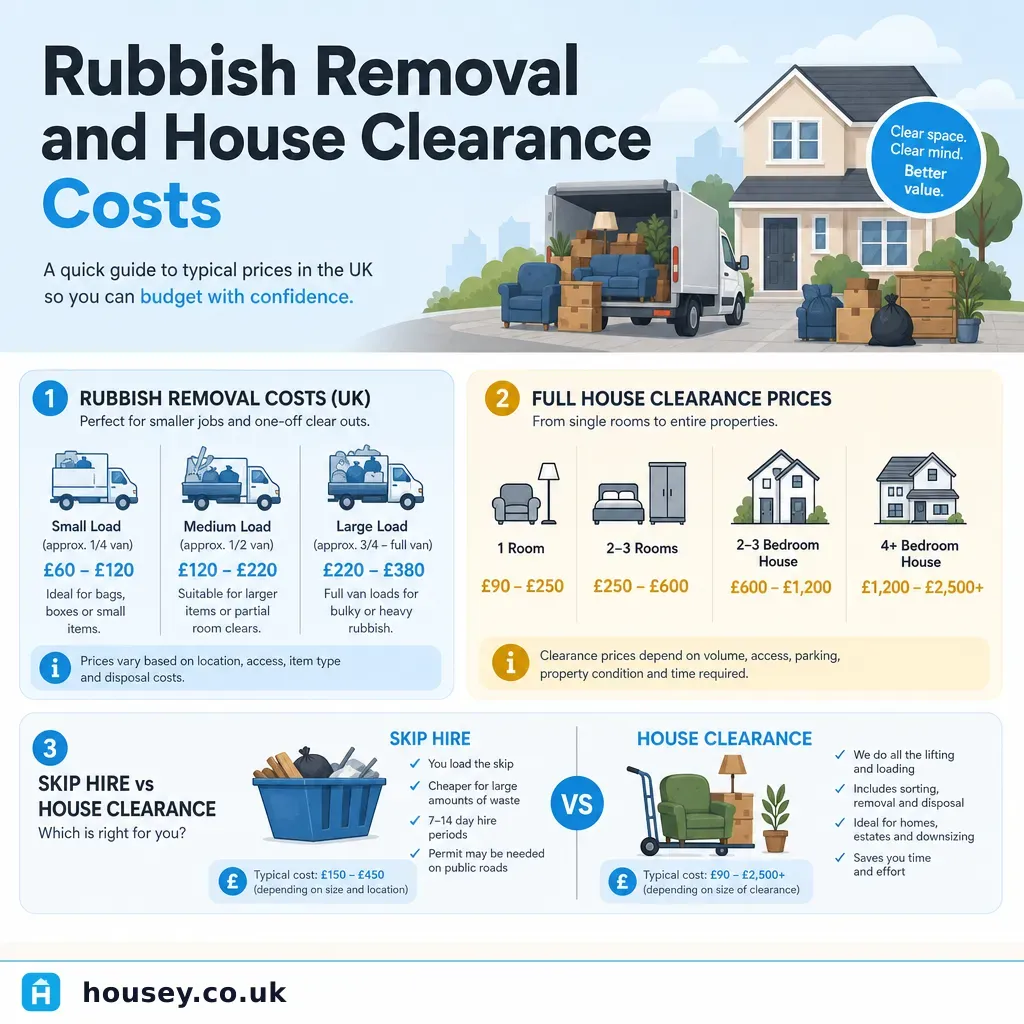
Rubbish Removal and House Clearance Costs
House clearance in the UK typically costs £150–£400 for a single room and £500–£1,500 for a full three-bedroom property, depending on volume, access, and hazardous items.
 Buying & Moving
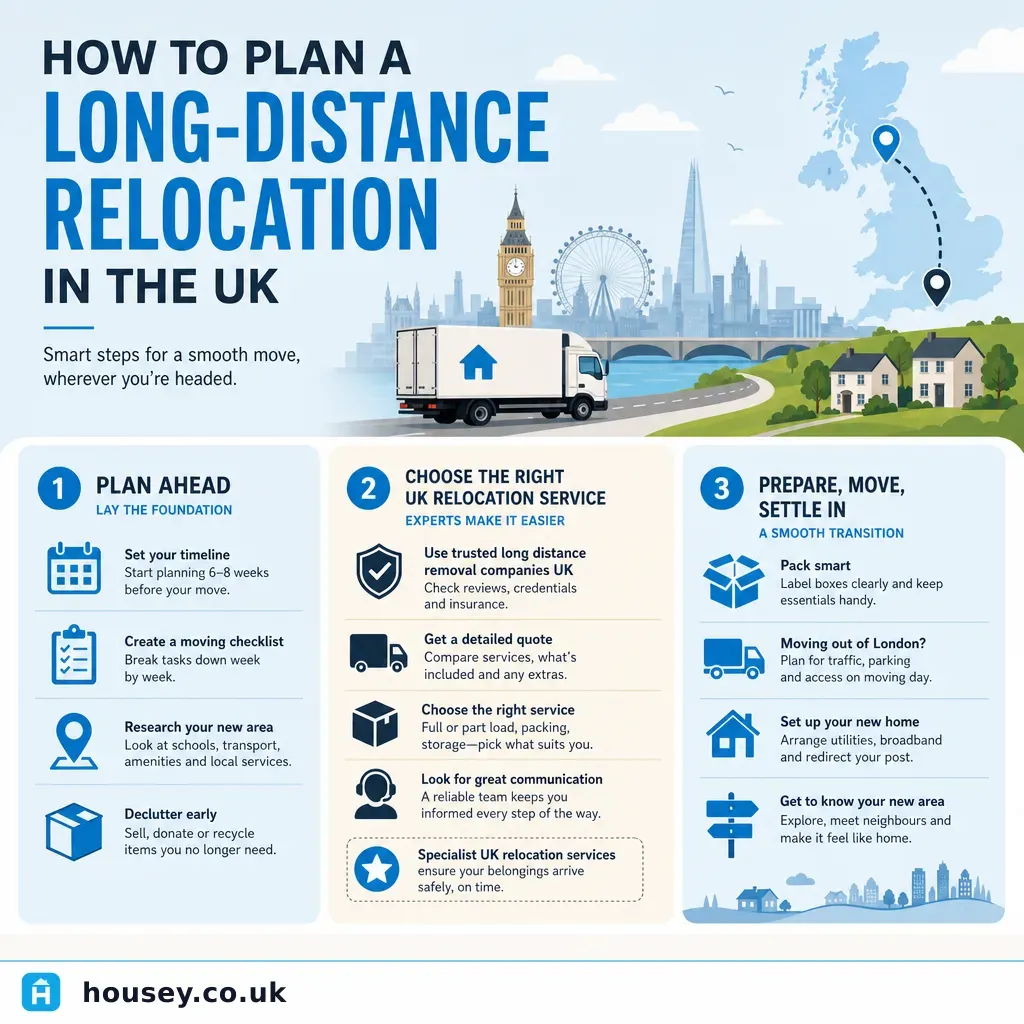
How to Plan a Long-Distance Relocation in the UK
A successful long-distance relocation in the UK involves coordinating removals, conveyancing, storage, and area research well in advance.
 Buying & Moving
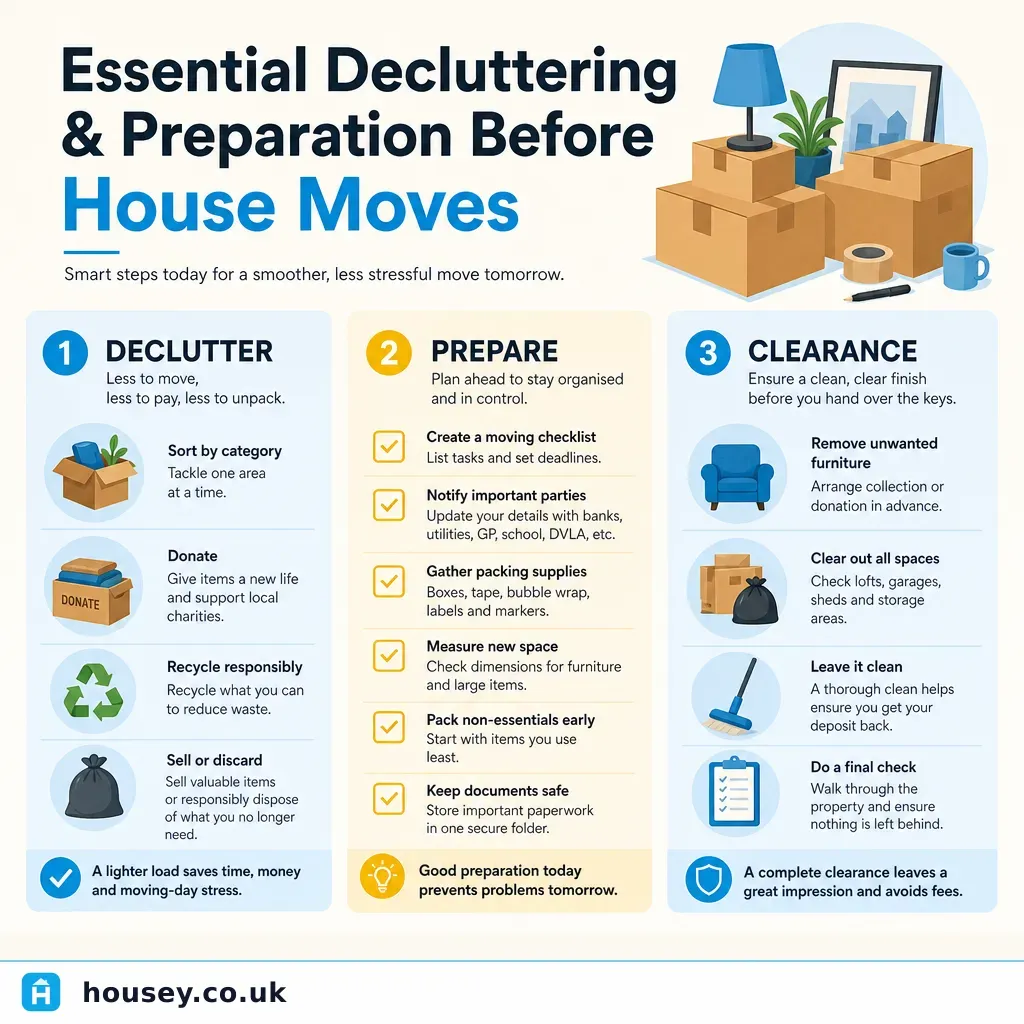
Essential decluttering and preparation before house moves
Decluttering before a house move reduces removal costs, improves property photographs, and simplifies unpacking.
 Buying & Moving
Planning Your Home Removal: What to Expect from Professional Services
A professional removal company loads, transports, and unloads your household belongings between properties.