House Clearance Pricing and Service Options
By Housey · Last reviewed 8th of May 2026

House Clearance Pricing and Service Options
Moving house, handling a probate estate, and downsizing all create the same practical challenge: a property full of belongings that need clearing quickly and responsibly. House clearance companies handle collection, sorting, disposal, and sometimes resale or charitable donation — but costs vary widely depending on property size, volume, access, and how much of the contents can be diverted from landfill. Choosing the wrong company can also expose you to legal liability if waste is fly-tipped in your name, so understanding the licensing requirements is just as important as comparing prices.
Key points
- A studio or one-bedroom flat typically costs £150–£400 to clear; a four-bedroom house ranges from £700 to £1,500 or more. (Indicative UK costs, last reviewed 2026-05-08.)
- Anyone carrying waste in the course of a business must hold a valid Waste Carrier Licence under the Environmental Protection Act 1990 — verifiable on the Environment Agency's public register.
- Fly-tipping traced back to your waste can result in a Fixed Penalty Notice of up to £400 or prosecution, even if a contractor caused it, under the Duty of Care provisions.
- A signed waste transfer note is the legal proof that your waste was handled correctly — always request one before paying the final invoice.
- Probate clearances may contain items of significant financial value; have antiques, jewellery, or collectables assessed before disposal rather than after.
How house clearance pricing works
House clearance companies generally price by volume, time, or a flat rate based on a pre-visit or virtual assessment. The three most common pricing models are:
Pricing model | How it works | Best for |
|---|---|---|
Per van load | Priced by fraction of a van — quarter, half, or full | Small to medium clearances with mixed items |
Whole-property flat rate | Fixed price following a site visit or photo assessment | Full-property clearances, probate, estate |
Hourly rate | Labour charged by the hour, plus skip or disposal cost | Partial clearances and ongoing decluttering |
Most reputable companies carry out a physical or video walkthrough before quoting. Be cautious of companies that quote purely on room count without assessing volume, weight, or access conditions.
Indicative UK cost ranges, last reviewed 2026-05-08:
Property type | Typical range |
|---|---|
Studio or bedsit | £100–£300 |
1-bedroom flat | £150–£400 |
2-bedroom house or flat | £300–£600 |
3-bedroom house | £500–£900 |
4-bedroom house | £700–£1,500+ |
Large estate or commercial clearance | Quoted individually |
Costs vary significantly by region — London and the South East typically run 20–40% higher — and by access, item weight, and how much can be donated or resold rather than sent to landfill.
What affects the price
Several factors push quotes higher or lower than the typical ranges above:
- Volume and weight: heavy items such as sofas, mattresses, and white goods cost more due to landfill gate fees and handling time.
- Location: Environment Agency-regulated disposal costs vary across England, Scotland, Wales, and Northern Ireland, and labour rates differ by region.
- Access: ground-floor properties with off-street parking are quickest and cheapest; narrow staircases, no lift access, or permit-only streets add cost and time.
- Hazardous materials: asbestos cement products, old paint, tyres, and certain chemicals require specialist licensed disposal and cannot be included in a standard clearance — this should be quoted separately.
- Timing: same-day or next-day availability often carries a premium over a planned booking.
- Resale value of contents: if items have genuine resale potential — vintage furniture, tools, working appliances — a company may reduce the fee, or offer a partial clearance credit for larger estates.
Checking a company is properly licensed
Under the Environmental Protection Act 1990 and the Controlled Waste (England and Wales) Regulations 2012, anyone carrying waste in the course of a business must be a registered waste carrier. If a contractor fly-tips your waste, you may share legal liability under the Duty of Care regime.
How to verify a company:
- Ask for the company's Waste Carrier Licence number before agreeing terms.
- Search the Environment Agency's public register (England) at environment.agency.gov.uk; equivalent registers exist via SEPA (Scotland), Natural Resources Wales, and NIEA (Northern Ireland).
- Confirm the licence is current and covers the waste types involved.
- Look for membership of the British Association of Removers (BAR), TrustMark, or the Clearance and Recycling Association as additional quality indicators.
Avoid any company that quotes cash-only without paperwork or refuses to provide a licence number when asked.
Estate and probate clearances
Estate clearances — where a property is cleared following a death — often involve greater sensitivity and complexity than a standard move-out.
- Items may carry significant financial or sentimental value; an antiques valuer or specialist auctioneer should assess contents before anything is removed.
- Executors and solicitors may require a written record of what was removed and how it was disposed of, particularly for estate accounts.
- Probate clearance specialists often catalogue contents, arrange charitable collection, coordinate auction, and provide documentation useful for estate administration.
- Do not instruct a clearance company on a probate property without written authorisation from the executor, administrator, or instructing solicitor.
What to ask before accepting a quote
- Is this quote based on a physical or video site visit, or an estimate based on room count alone?
- What does the price include — all rooms, the loft, shed, and outbuildings?
- What is excluded, and how will unexpected items discovered on the day be priced?
- What is the company's waste carrier licence number, and can you provide documentation?
- What proportion of items will be donated, recycled, or resold versus sent to landfill?
- Will you provide a signed waste transfer note on completion?
- Is VAT included in the quoted price?
Red flags to watch out for
- Verbal-only quotes that change significantly on the day of the clearance.
- Inability or unwillingness to provide a waste carrier licence number when asked directly.
- Cash-only payment with no receipt or invoice provided.
- No site visit or photo assessment before quoting, particularly for larger or more complex properties.
- Items later discovered to have been fly-tipped at a roadside, lay-by, or industrial estate.
- High-pressure tactics to confirm the booking before you have had time to compare other quotes.
- No stated policy on what happens to usable furniture and appliances — charity donation versus landfill.
When to get professional help
A standard house clearance does not require specialist professional advice beyond confirming the contractor is licensed. However, consider additional input in these situations:
- Suspected asbestos: artex ceilings, pipe lagging, corrugated garage roofing, or vinyl floor tiles from pre-1999 construction may contain asbestos. Do not disturb suspected materials — arrange a survey by a licensed asbestos surveyor before clearance begins.
- Antiques and valuables: if the property may contain items of financial value, a probate valuer, antiques specialist, or auction house should assess before anything is removed or disposed of.
- Contested probate: if the estate is under dispute or administration, seek legal advice before instructing any contractor to remove contents.
- Hazardous waste: old paint, chemicals, batteries, and similar materials require specialist collection — most local councils offer a hazardous household waste collection service.
How Housey can help
If you need to arrange a house clearance — whether for a move, a probate property, or a full-property declutter before a sale — Housey can connect you with licensed, vetted house clearance companies in your area. Compare quotes and choose with confidence.
Frequently asked questions
How much does a house clearance typically cost in the UK?
A one-bedroom flat typically costs £150–£400; a three-bedroom house £500–£900; a four-bedroom property £700–£1,500+. Costs depend on volume, location, access, and how much can be donated or resold. London and the South East tend to be 20–40% higher. Always get at least three written quotes. Indicative UK costs, last reviewed 2026-05-08.
Do I need to do anything before the clearance company arrives?
Remove personal documents — passports, bank statements, medical records — and any items you want to keep. If there are antiques or valuables, have them assessed beforehand. Check whether the company needs a parking permit or access code. For probate properties, confirm you have written authority from the executor or solicitor before instructing any clearance work.
Can a house clearance company take everything, including white goods and furniture?
Most will take furniture, appliances, carpets, and general household items. Items such as suspected asbestos products, certain chemicals, tyres, and clinical waste require specialist handling and cannot go in a standard clearance. Ask the company explicitly about any unusual items before confirming the booking to avoid unexpected additional charges arising on the day.
What is a waste transfer note and do I need one?
A waste transfer note is a legal document confirming your waste was handed to a licensed carrier and disposed of correctly. Under the Duty of Care provisions of the Environmental Protection Act 1990, you remain responsible for your waste even after handing it over. Always ask for a signed waste transfer note as proof of compliant disposal.
Will a clearance company pay me for items of value?
Some companies will reduce their fee if items have genuine resale potential. For estate clearances with antiques, jewellery, or collectable furniture, a specialist probate valuer or auctioneer may recover significantly more than a standard clearance credit. It is worth discussing valuation before booking, particularly for larger estates where the contents may include items of meaningful financial value.
Sources and further reading
- Duty of care for waste — GOV.UK — legal responsibilities for householders and businesses handling waste
- Waste carrier registration — Environment Agency public register — official register for checking licensed waste carriers in England
- Environmental Protection Act 1990 — legislation.gov.uk — primary legislation covering waste management and the duty of care
- TrustMark — government-endorsed quality scheme — find registered traders including waste and clearance operators
Useful next reads
 Buying & Moving
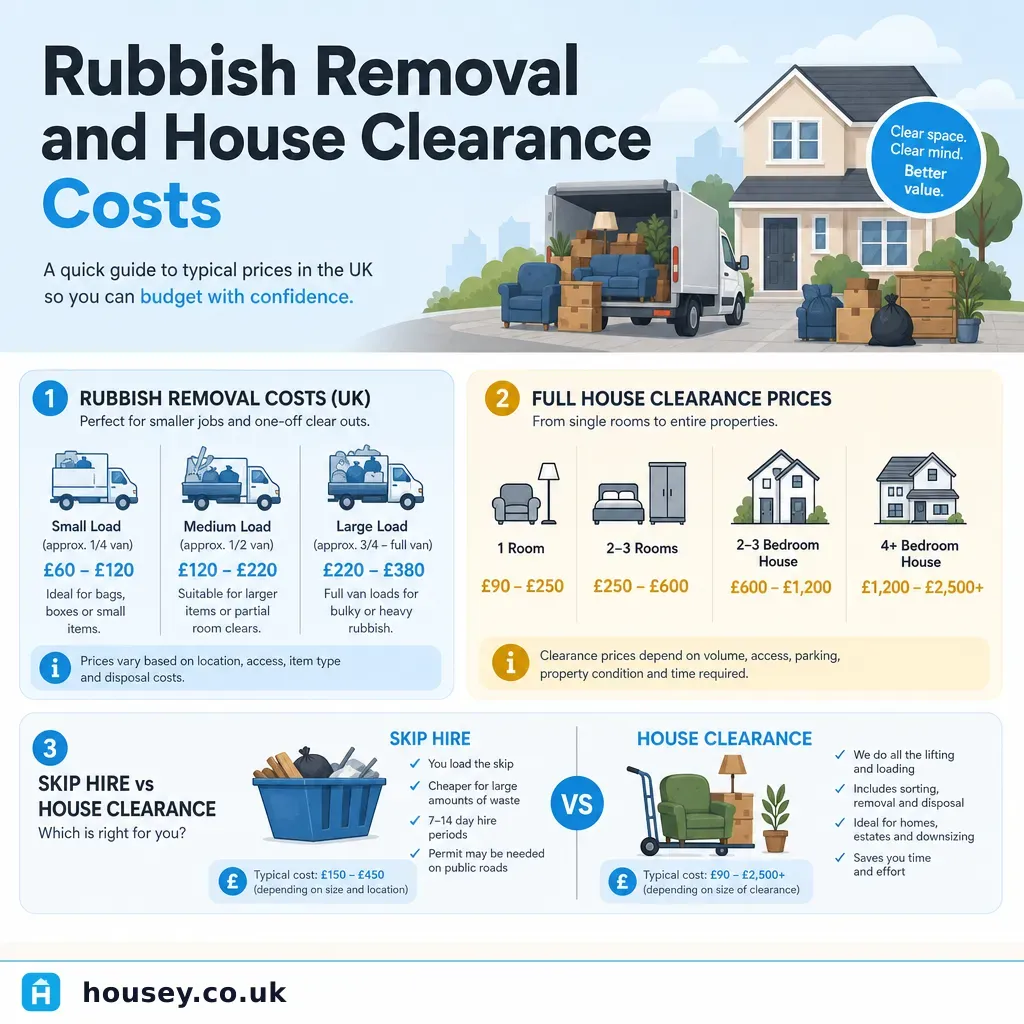
Rubbish Removal and House Clearance Costs
House clearance in the UK typically costs £150–£400 for a single room and £500–£1,500 for a full three-bedroom property, depending on volume, access, and hazardous items.
 Buying & Moving
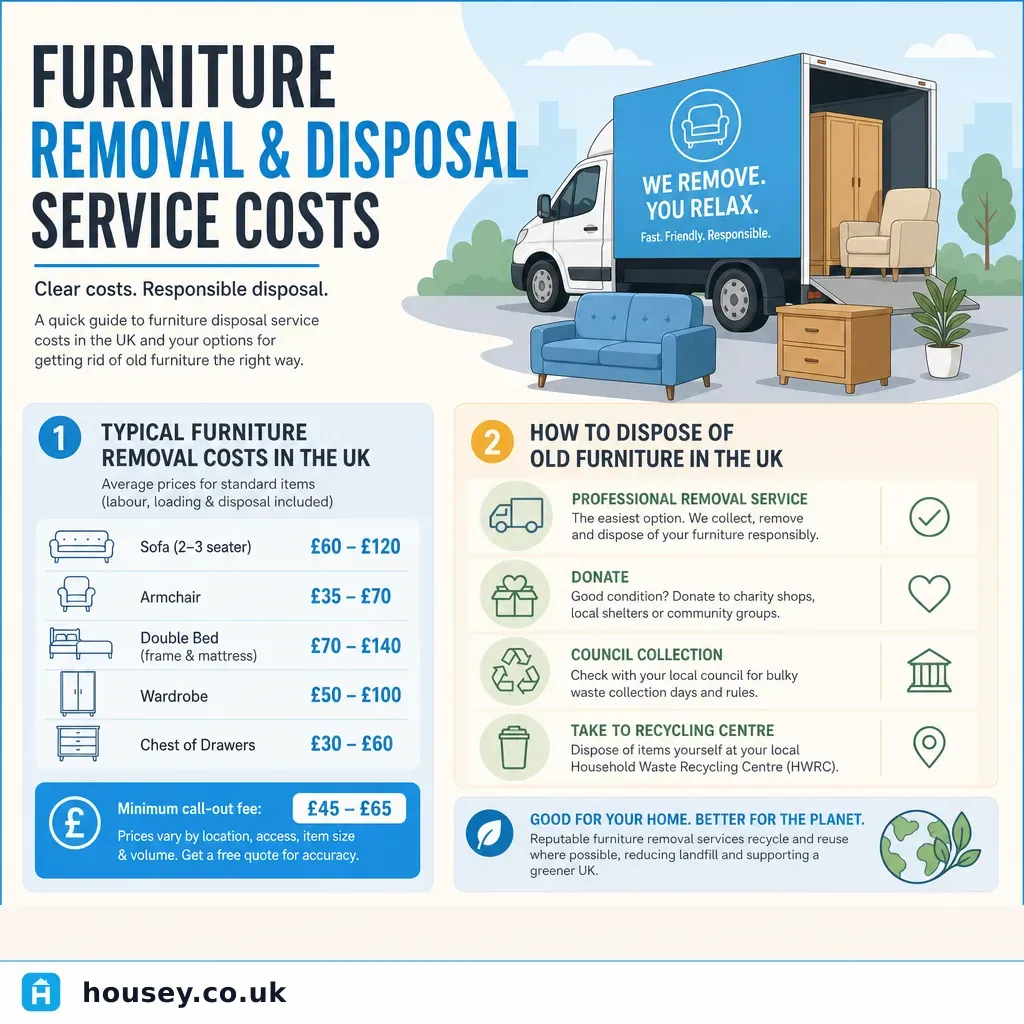
Furniture Removal and Disposal Service Costs
Furniture removal and disposal in the UK typically costs £50–£300 for a van load, depending on volume, item type, and whether the service includes recycling or charity donation.
 Buying & Moving
Professional House Clearance Services for Your Home
A professional house clearance firm removes all or part of a property's contents and disposes of them at licensed facilities.
 Buying & Moving
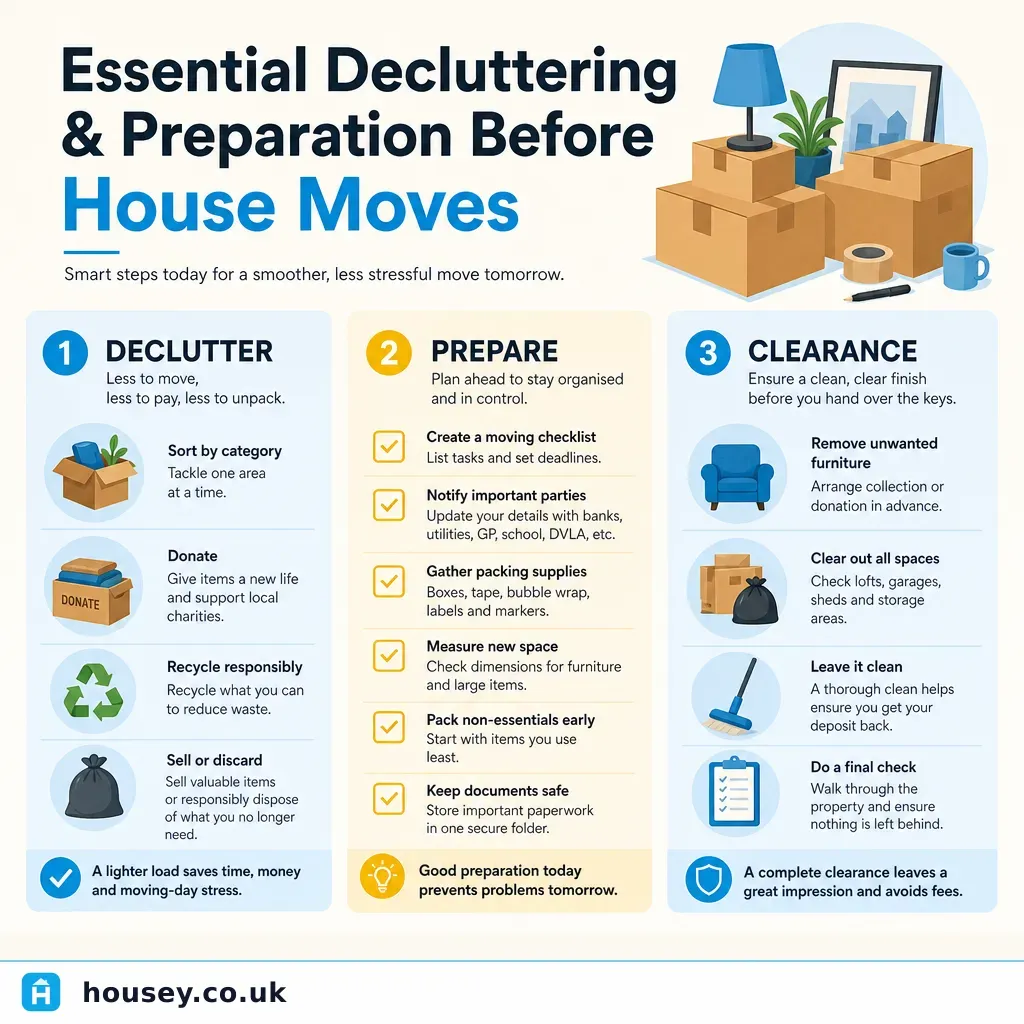
Essential decluttering and preparation before house moves
Decluttering before a house move reduces removal costs, improves property photographs, and simplifies unpacking.
 Buying & Moving
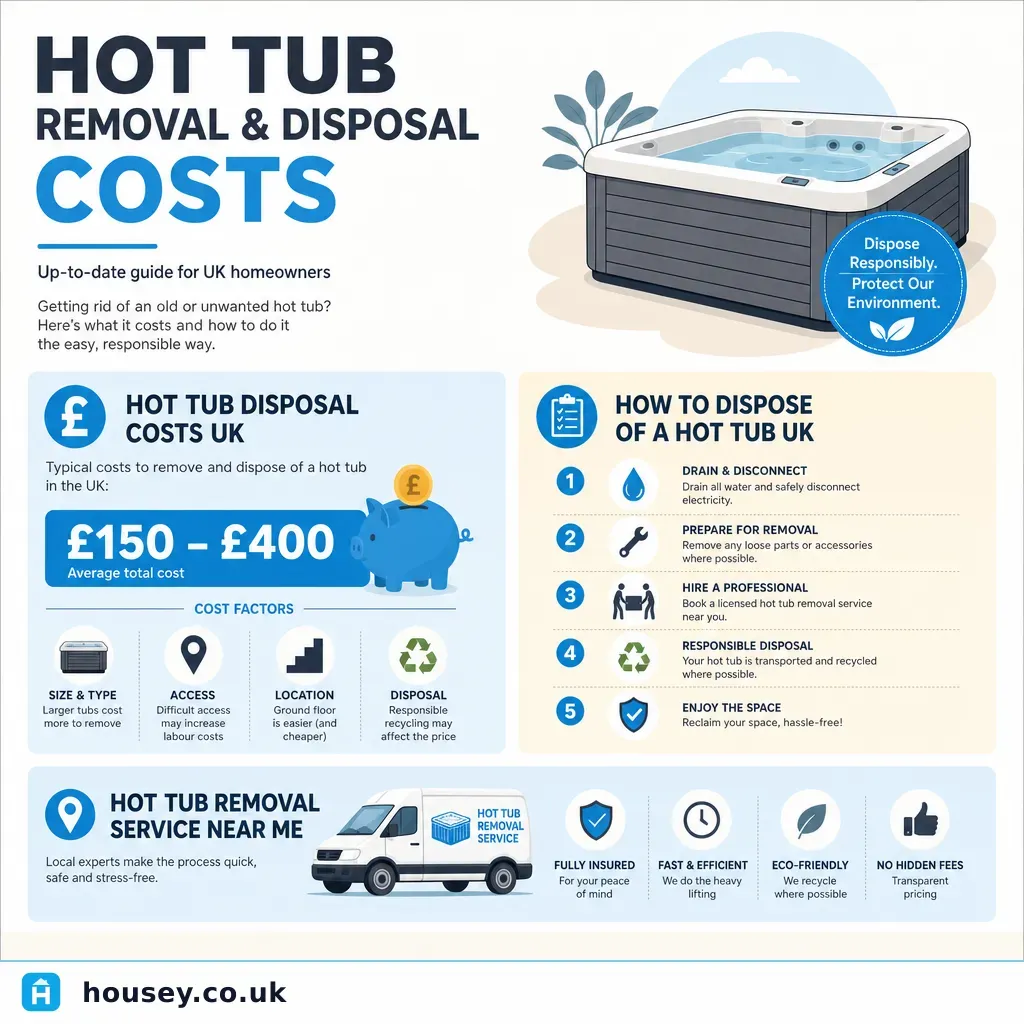
Hot Tub Removal and Disposal Costs
Hot tub removal in the UK typically costs £150–£450 for a straightforward garden removal, though prices rise if electrical disconnection is required, access is difficult, or specialist disposal is needed.