Essential decluttering and preparation before house moves
By Housey · Last reviewed 30th of May 2026
Essential decluttering and preparation before house moves
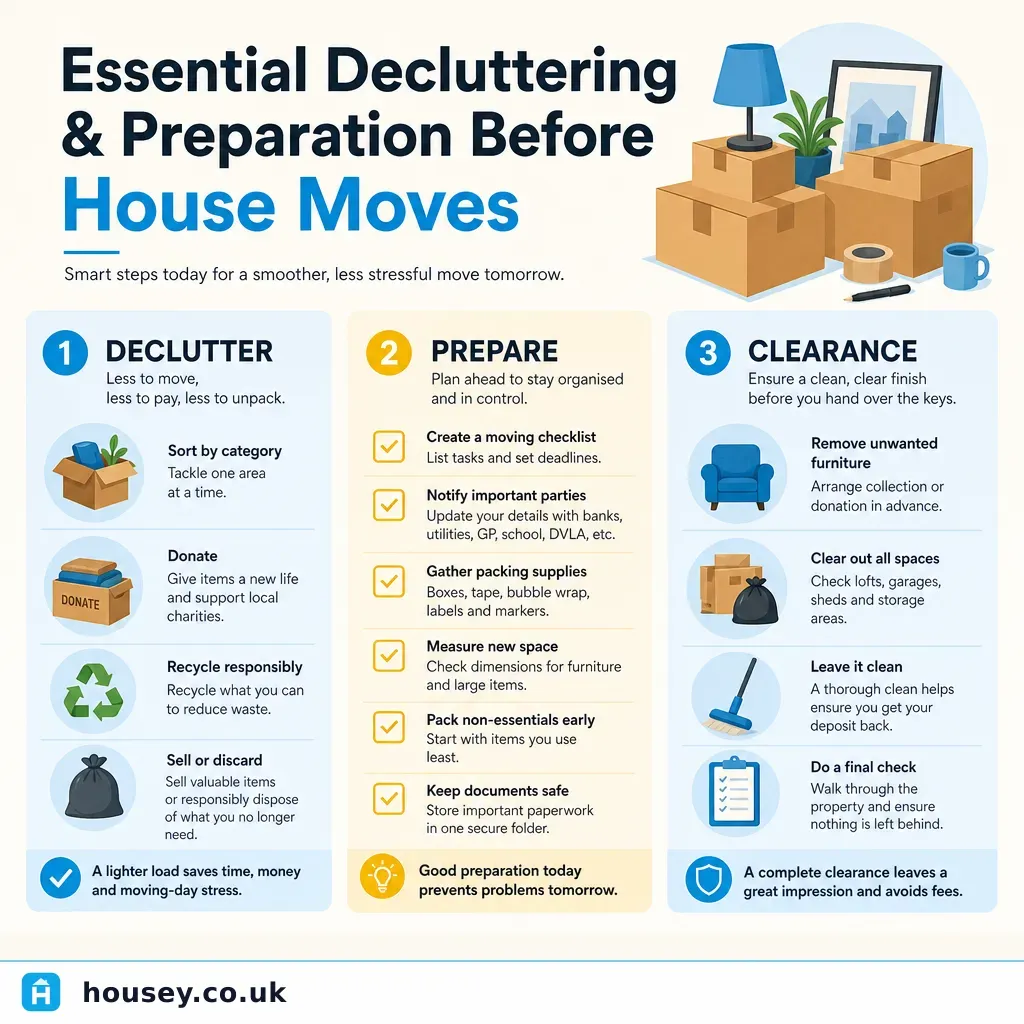
Moving house is one of the most logistically demanding events in adult life, and the weeks before completion day tend to compress into a blur of packing boxes, phone calls, and forgotten to-do lists. Whether you are leaving a family home of twenty years or vacating a flat, what you choose not to take with you can significantly affect your removal costs, the quality of your property photographs, and the ease of settling in at the other end. Getting the sequence right — declutter before you market, reduce volume before you quote, sort before you pack — makes each subsequent step cheaper and less stressful.
Key points
- Decluttering before listing can improve property photographs and first impressions, potentially reducing the time a property sits on the market.
- Removal companies typically quote by volume (cubic footage or van load), so fewer items directly reduces the cost of the move.
- UK charities including British Heart Foundation and Emmaus offer free large-item furniture collection for items in good condition; lead times are typically one to three weeks.
- Local councils operate household waste recycling centres (HWRCs) where most items can be disposed of free of charge; fly-tipping carries fines of up to £50,000 under the Environmental Protection Act 1990.
- Professional house clearance companies must hold a valid Waste Carrier Licence from the Environment Agency under the Waste (England and Wales) Regulations 2011; always verify this before instructing a firm.
What to sort, sell, donate, or bin
When beginning a declutter, the simplest framework is to assign every item to one of four categories before it is boxed:
- Keep — items you use regularly and want in the new home.
- Sell — items in good condition with resale value (furniture, appliances, tools, children's equipment).
- Donate — usable items that are not worth selling individually.
- Dispose — broken, expired, or genuinely worthless items.
Avoid a fifth "maybe" pile. Items left undecided almost always travel with you and clutter the new space.
What to address before property photography
Estate agents typically advise decluttering before marketing photography takes place. Rooms with visible storage overflows, mismatched furniture, or cluttered surfaces photograph poorly and reduce buyer interest at the online browsing stage. Key areas to clear before the photographer arrives:
- Worktops and surfaces in kitchens and bathrooms.
- Bulky furniture that makes rooms appear smaller.
- Built-in storage that spills into the room.
- Excessive ornamental clutter (not required, but helps buyers picture themselves in the space).
If your property is being professionally photographed, check with your estate agent whether they also produce floorplans, which are now expected by most buyers on Rightmove and Zoopla.
A room-by-room decluttering checklist
Kitchen
Living and dining rooms
Bedrooms
Garage, loft, and outbuildings
Paperwork
Deciding what to do with furniture and large items
Option | Best for | Lead time needed | Indicative cost |
|---|---|---|---|
Facebook Marketplace / eBay | Items in good condition with clear demand | 2–6 weeks | Free to list; buyer collects |
Charity collection (BHF, Emmaus, Scope) | Sofas, wardrobes, dining sets in good condition | 1–3 weeks | Free |
Council bulky waste collection | Items charities will not accept | 1–2 weeks | £0–£40 depending on council |
House clearance company | Large volumes, estates, time-pressured moves | 1 week or less | £200–£1,000+ by volume |
Skip hire | Mixed non-hazardous waste | 2–7 days for delivery | £150–£350 for a standard skip |
Indicative UK costs, last reviewed 2026-05-30. Quotes vary significantly by region and volume.
Decision tree: should you hire a house clearance company?
- Hire a clearance company if you have a full property to empty, face a tight completion timeline, are clearing a relative's estate, or are physically unable to manage large-item removal yourself.
- Handle it yourself if you have fewer than one van-load of items to dispose of, have sufficient time before moving day, and can access a HWRC or charity collection.
- Get a professional quote first if you are unsure of the volume — most clearance firms offer a free, no-obligation survey visit.
- Check credentials always — verify a Waste Carrier Licence on the Environment Agency's public register before instructing any clearance firm.
How to reduce removal costs through decluttering
Removal companies charge by volume, so the relationship between decluttering and removal cost is direct. A typical large three-bedroom house move might require a 60–70 cubic foot van. Removing a significant proportion of unwanted contents before the quote visit can reduce the stated volume and therefore the final price.
Practical steps to take before a removal company visits:
- Complete as much of your four-category sort as possible.
- Identify any items requiring specialist handling: a piano, large aquarium, workshop machinery, or artworks.
- Note access constraints at either address — parking restrictions, stairs, narrow doorways.
- Confirm which items, if any, you plan to move yourself.
Professional removal firms registered with the British Association of Removers (BAR) are subject to a code of practice and a consumer protection scheme. Look for BAR membership or equivalent accreditation when comparing quotes.
When to get professional help
Most home movers can handle decluttering without professional support. Consider hiring specialists when:
- The property has not been cleared in many years and contains large-scale accumulations.
- A bereavement has left an estate to clear with no family capacity.
- Completion has been brought forward and there is insufficient time for a phased approach.
- Items may contain hazardous materials — suspected asbestos-containing materials should not be disturbed; seek specialist advice before any handling.
- The property is listed or in a Conservation Area and period fittings need careful removal.
How Housey can help
If you need professional support for your move, Housey can connect you with vetted local providers. Compare quotes from house clearance companies for whole-property emptying or large-item removal, or browse house removal firms who can advise on volume and packing. If you are still preparing to market the property, consider booking a property photography and floorplan service once the declutter is complete.
Frequently asked questions
How far in advance should I start decluttering before a house move?
Most moving specialists suggest beginning at least eight to twelve weeks before your target moving date. Starting early allows you to sell items through online marketplaces, organise charity collections — which can have lead times of two to three weeks — and tackle one room at a time without the pressure of an imminent completion date.
Do I need to tell my removal company about everything I'm taking?
Yes. Your removal company needs an accurate inventory to quote correctly and bring the right vehicle. Undisclosed items — particularly large or heavy pieces — can cause delays on moving day and may increase costs if a second vehicle is required. Walk through every room with the surveyor during their quote visit.
Can I leave items in the property after I have moved out?
Not without written agreement. Under standard UK conveyancing practice, properties should be left clear unless items are listed in the fixtures and fittings form (TA10 in England and Wales). Leaving unwanted items can lead to deductions from a rental deposit or disputes and potential legal costs in a sale.
What is a Waste Carrier Licence and why does it matter?
A Waste Carrier Licence is required by law under the Environmental Protection Act 1990 for anyone transporting waste for hire or reward. Without it, a clearance firm is operating illegally, and you could be held jointly responsible if waste is fly-tipped. Verify any clearance firm's licence free of charge on the Environment Agency's public register before instructing them.
Sources and further reading
- Register as a waste carrier — GOV.UK / Environment Agency
- British Association of Removers — Code of practice and consumer protection for removals
- Find your local household waste recycling centre — GOV.UK
- Furniture and electrical goods donations — British Heart Foundation
- Environmental Protection Act 1990 — legislation.gov.uk
Useful next reads
 Buying & Moving
Rubbish Removal and House Clearance Costs
House clearance in the UK typically costs £150–£400 for a single room and £500–£1,500 for a full three-bedroom property, depending on volume, access, and hazardous items.
 Buying & Moving
Professional House Clearance Services for Your Home
A professional house clearance firm removes all or part of a property's contents and disposes of them at licensed facilities.
 Buying & Moving
House Clearance Pricing and Service Options
House clearance costs in the UK range from around £150 for a one-bedroom flat to £1,500 or more for a four-bedroom house, depending on volume, location, and how much can be donated or recycled.
 Buying & Moving
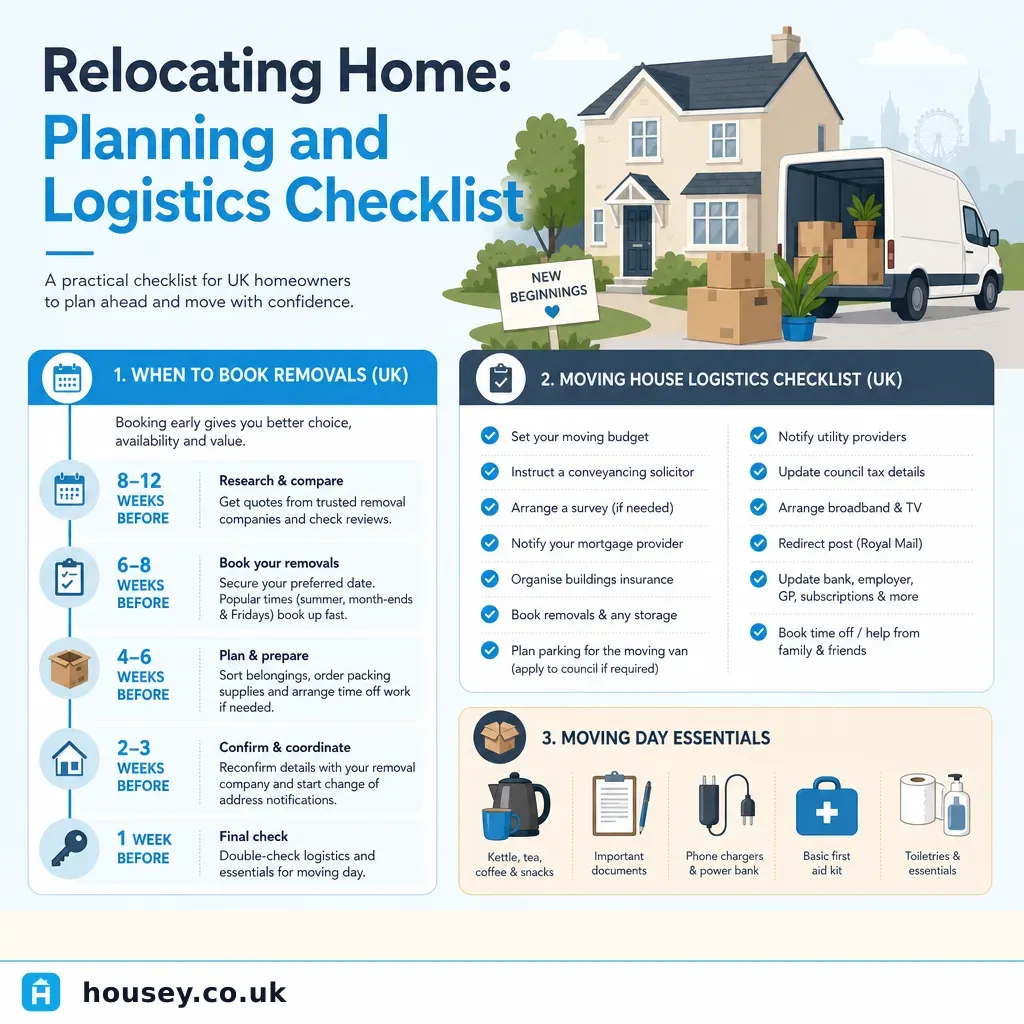
Relocating Home: Planning and Logistics Checklist
Successful home relocation in the UK typically requires 8–12 weeks of advance planning.
 Buying & Moving
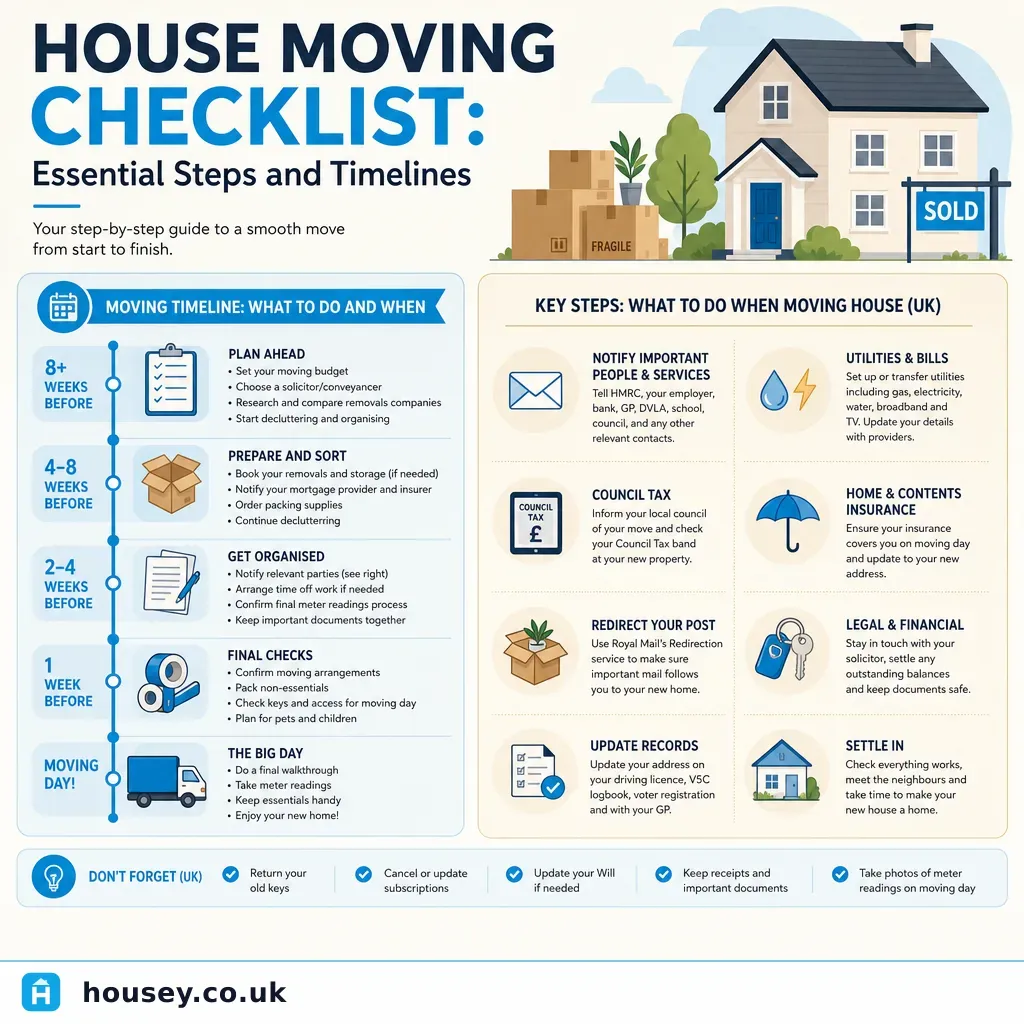
House Moving Checklist: Essential Steps and Timelines
A UK house move typically spans 8–12 weeks of preparation: book removals 4–6 weeks out, notify the DVLA, HMRC, and utilities as exchange approaches, take meter readings on moving day, and update Council Tax and the electoral register on arrival.