Rubbish Removal and House Clearance Costs
By Housey · Last reviewed 10th of May 2026
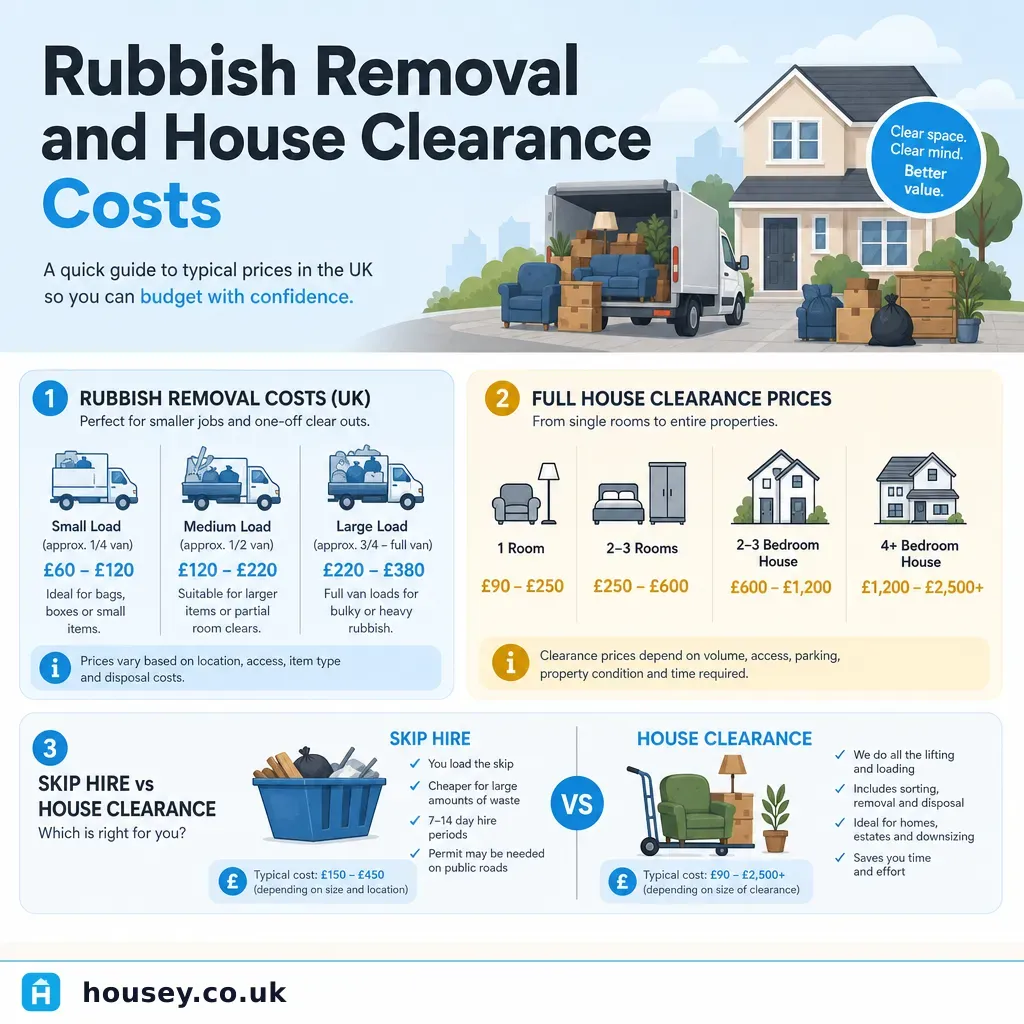
Rubbish Removal and House Clearance Costs
Whether you are clearing a property ahead of a sale, dealing with the estate of a relative, or emptying a house before renovation work, rubbish removal and house clearance are tasks most UK homeowners encounter at some point. Costs vary significantly depending on volume, access, hazardous materials, and how quickly the work needs to be done. Understanding how clearance companies structure their pricing — and what legitimate operators are legally required to do with your waste — helps you compare quotes confidently and avoid being overcharged or, more seriously, left liable for fly-tipped waste.
Key points
- All waste carriers operating in England must be registered with the Environment Agency under the Environmental Protection Act 1990; Scotland, Wales, and Northern Ireland have equivalent schemes. Hiring an unregistered carrier can make you liable for any fly-tipped waste as the original waste producer.
- Clearance companies typically price by van load, by property size (bedroom count), or by weight; there is no standard unit, so comparing quotes requires understanding what measure each price covers.
- Items containing hazardous materials — fridges with refrigerant gas, asbestos-containing materials, fluorescent tubes — cannot go in standard waste streams and usually attract a surcharge or require specialist removal.
- Charity resale or donation of saleable items can reduce the net cost of clearance; many reputable firms deduct the value of items they can resell from the total job price.
- A full three-bedroom house clearance typically costs £500–£1,500; Indicative UK costs, last reviewed 2026-05-10. Prices vary by region, access, and volume of specialist waste.
What affects the cost of house clearance?
Most firms base their initial estimate on the number of van loads required. A Luton van (approximately 17 m³) is a common industry measure. Expect to be asked how many rooms need clearing, how full they are, and whether there are outbuildings, lofts, or cellars.
Property type | Approximate van loads | Indicative clearance cost |
|---|---|---|
Single room or garage | 0.5–1 load | £150–£400 |
1–2 bedroom flat | 1–2 loads | £350–£700 |
3 bedroom house | 2–4 loads | £500–£1,200 |
4–5 bedroom house | 4–7 loads | £900–£2,000+ |
Estate or hoarding clearance | Variable | Priced individually |
Indicative UK costs, last reviewed 2026-05-10. Prices vary by region, access, and type of items included.
Access and logistics
Ground-floor access from a front door is the simplest and cheapest scenario. Expect surcharges where there is no vehicle access close to the property, narrow staircases or tight corridors, items stored in an unbounded loft, or a high-rise flat with lift restrictions.
Hazardous items
Most clearance companies will remove old televisions and monitors (regulated under WEEE rules) and fridges or freezers (which contain refrigerant gas and must be taken to a licensed facility). However, items that may contain asbestos — including artex ceilings in pre-2000 properties, old vinyl floor tiles, pipe lagging, and some insulating boards — must not be disturbed or removed by a standard clearance company. Specialist asbestos removal by an HSE-licensed contractor is required. Declaring any likely asbestos-containing materials before booking is important.
Salvage and resale credit
A growing number of clearance companies offset their fee against the resale or donation value of saleable items. Antiques, quality furniture, working appliances, and collectables may earn a credit against the clearance cost. If you believe items have significant value, consider obtaining a separate valuation before agreeing a clearance price, or arrange private sale of those items first.
Skip hire, professional clearance, or man-and-van: which option suits your job?
Option | Best for | Not ideal for | Indicative cost | Main risk if wrong choice |
|---|---|---|---|---|
Professional house clearance | Full property; estates; limited time; mobility constraints | Small volumes of clean mixed waste | £350–£2,000+ | Overpaying for a job skip hire could handle |
Skip hire | Building waste; garden waste; DIY clearance | Mattresses, fridges, hazardous items; no skip access | £150–£400 per skip | Prohibited items cause skip refusal or surcharge |
Man-and-van rubbish removal | Single-room or small-volume clearance | Large properties; items needing specialist disposal | £60–£200 per load | Unregistered carriers risk fly-tipping liability |
Council bulky waste collection | 1–4 large items (sofas, beds, white goods) | Full property clearance | Free–£50 per booking | Restricted item count; waiting times vary by council |
Indicative UK costs, last reviewed 2026-05-10.
Checklist: preparing for a house clearance
Quote comparison: what to ask before accepting a price
- Is the price fixed, or could it increase on the day if there is more volume than expected?
- What is your Environment Agency waste carrier licence number?
- How do you dispose of the waste — do you use a licensed transfer station?
- How are hazardous or WEEE items handled — are they included or excluded from the price?
- Do you offer a salvage credit for items with resale value, and how is it calculated?
- Is VAT included in the quote?
- What proof of disposal (waste transfer note) will I receive?
- What are your payment terms, and do you require a deposit?
A legitimate carrier must issue a waste transfer note for any load of non-household waste. Keep this document — it is your evidence that you met your legal duty of care under the Environmental Protection Act 1990.
When to get professional help
Most house clearance is straightforward, but seek specialist input if:
- You suspect asbestos-containing materials are present — do not disturb. Contact an HSE-licensed asbestos contractor for an assessment before any clearance begins.
- The property is a hoarding situation with potential sanitation or structural risks — a specialist firm with relevant experience is more appropriate than a standard removal team.
- The property contains items that appear to be antiques, valuable artwork, or collectables — consider an estate agent or auctioneer valuation before clearance.
- The property is a letting and items may belong to a former tenant — check your legal obligations under the Torts (Interference with Goods) Act 1977 before disposing of belongings that are not yours.
How Housey can help
Housey connects you with reputable house clearance providers who carry Environment Agency registration and can quote for full or partial property clearances across the UK. If you need temporary local storage options for items you want to keep but cannot immediately accommodate, Housey can help with that too.
Frequently asked questions
Do I need to be present during a house clearance?
Not necessarily, but it is advisable for at least part of the job so you can confirm nothing you wished to keep has been removed and answer questions about specific items. Many clearance firms are experienced working unsupervised for probate or absentee-owner situations — clear written instructions and a walkthrough photograph record are essential in those cases.
Can house clearance costs be charged to a deceased estate?
Yes. Clearance costs incurred in administering a deceased person's estate are normally deductible as an estate expense before inheritance tax is calculated. Keep all receipts and waste transfer notes for the executors' records. Consult a solicitor or probate specialist for confirmation in your specific situation, as rules can vary.
What happens to items from a house clearance?
Reputable companies sort items for reuse — charity donation, auction, or resale — then recycling, with only residual waste going to landfill. Ask the company what proportion they divert from landfill; many operators claim 80–95% diversion rates, though independent verification varies. A waste transfer note confirms items reached a licensed facility.
Is house clearance VAT-rated?
House clearance by a VAT-registered business is generally subject to VAT at 20%. Some smaller operators may be below the VAT registration threshold and charge no VAT. Always ask whether a quote is inclusive or exclusive of VAT before comparing prices, as the difference can be significant on larger jobs.
Sources and further reading
- Register as a waste carrier — GOV.UK, carrier registration requirements for England
- Environmental Protection Act 1990 — legislation.gov.uk, duty of care for waste producers
- HSE — Asbestos guidance — Health and Safety Executive, asbestos handling and removal requirements
- WEEE producer responsibility guidance — GOV.UK, electrical and electronic waste obligations
- Torts (Interference with Goods) Act 1977 — legislation.gov.uk, disposal obligations for third-party belongings
Useful next reads
 Buying & Moving
Professional House Clearance Services for Your Home
A professional house clearance firm removes all or part of a property's contents and disposes of them at licensed facilities.
 Buying & Moving
House Clearance Pricing and Service Options
House clearance costs in the UK range from around £150 for a one-bedroom flat to £1,500 or more for a four-bedroom house, depending on volume, location, and how much can be donated or recycled.
 Buying & Moving
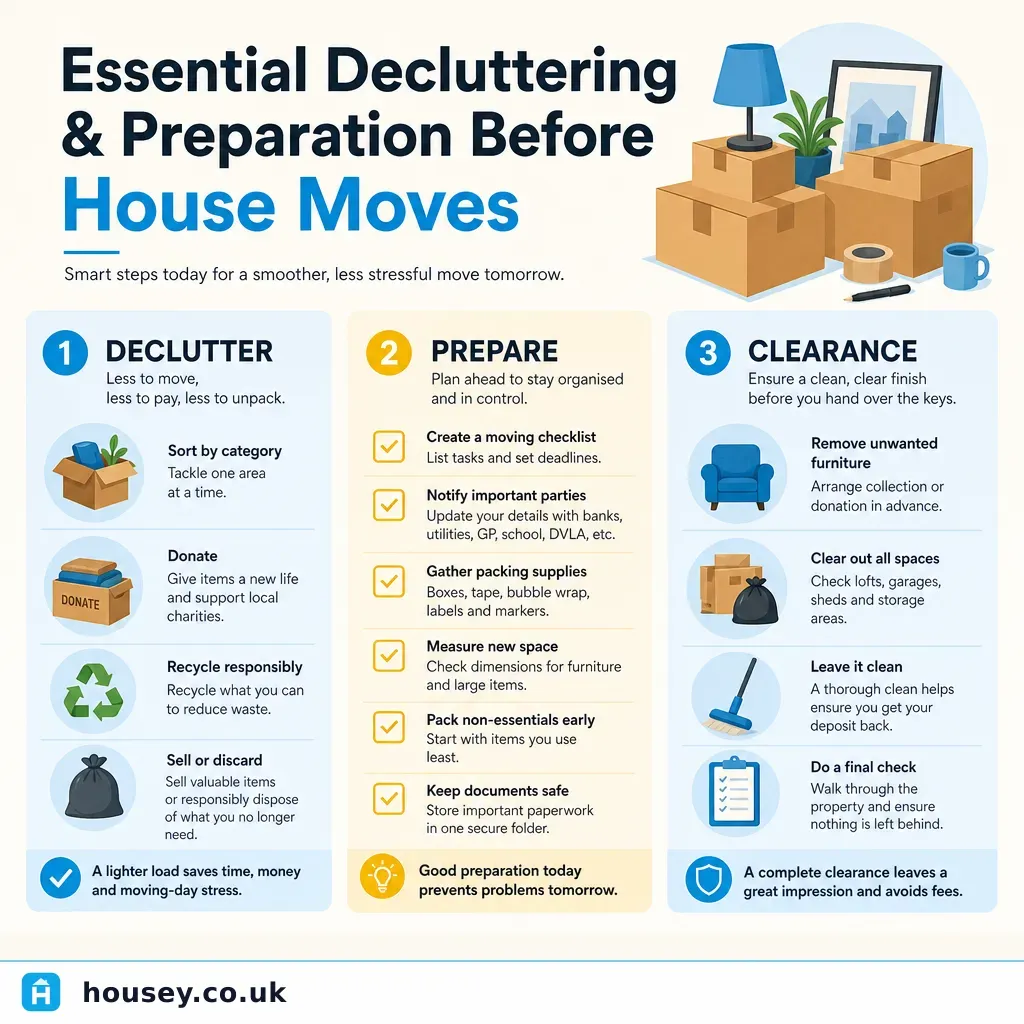
Essential decluttering and preparation before house moves
Decluttering before a house move reduces removal costs, improves property photographs, and simplifies unpacking.
 Buying & Moving
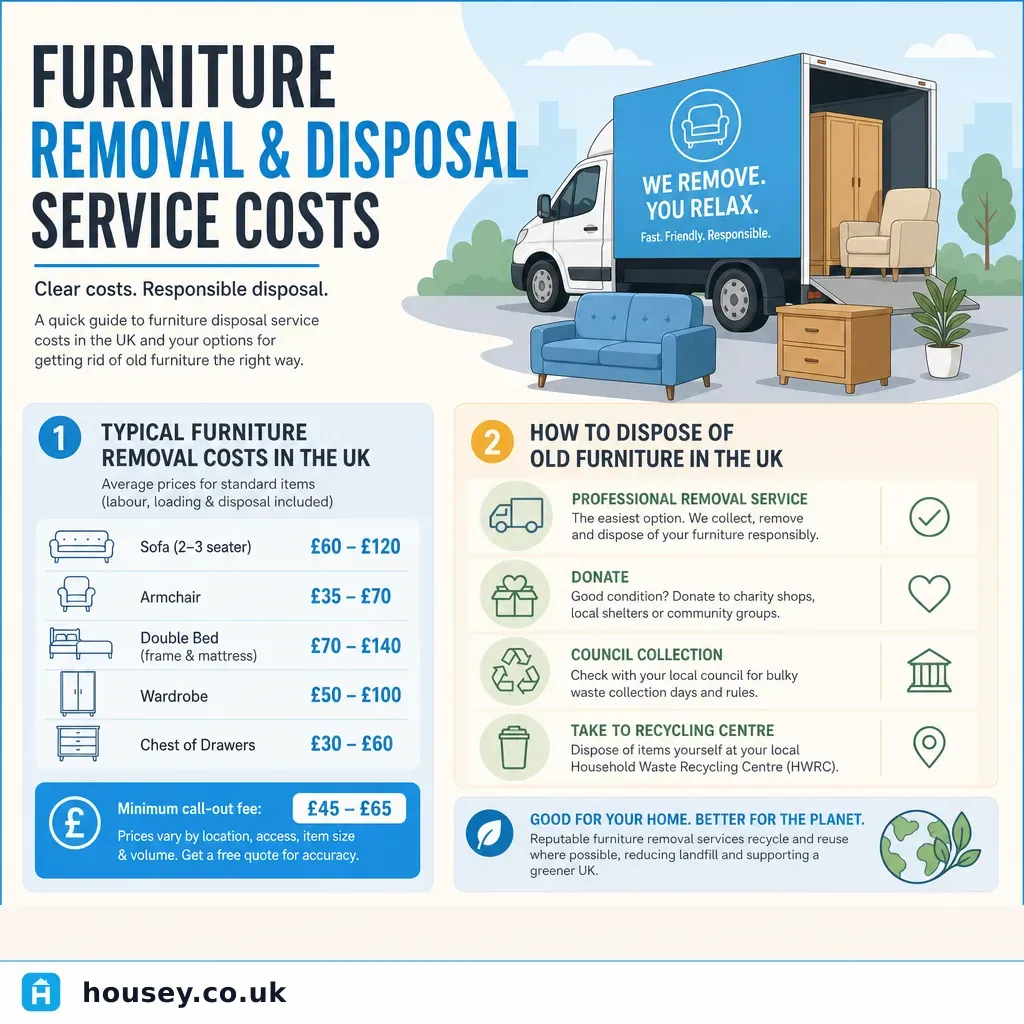
Furniture Removal and Disposal Service Costs
Furniture removal and disposal in the UK typically costs £50–£300 for a van load, depending on volume, item type, and whether the service includes recycling or charity donation.
 Buying & Moving
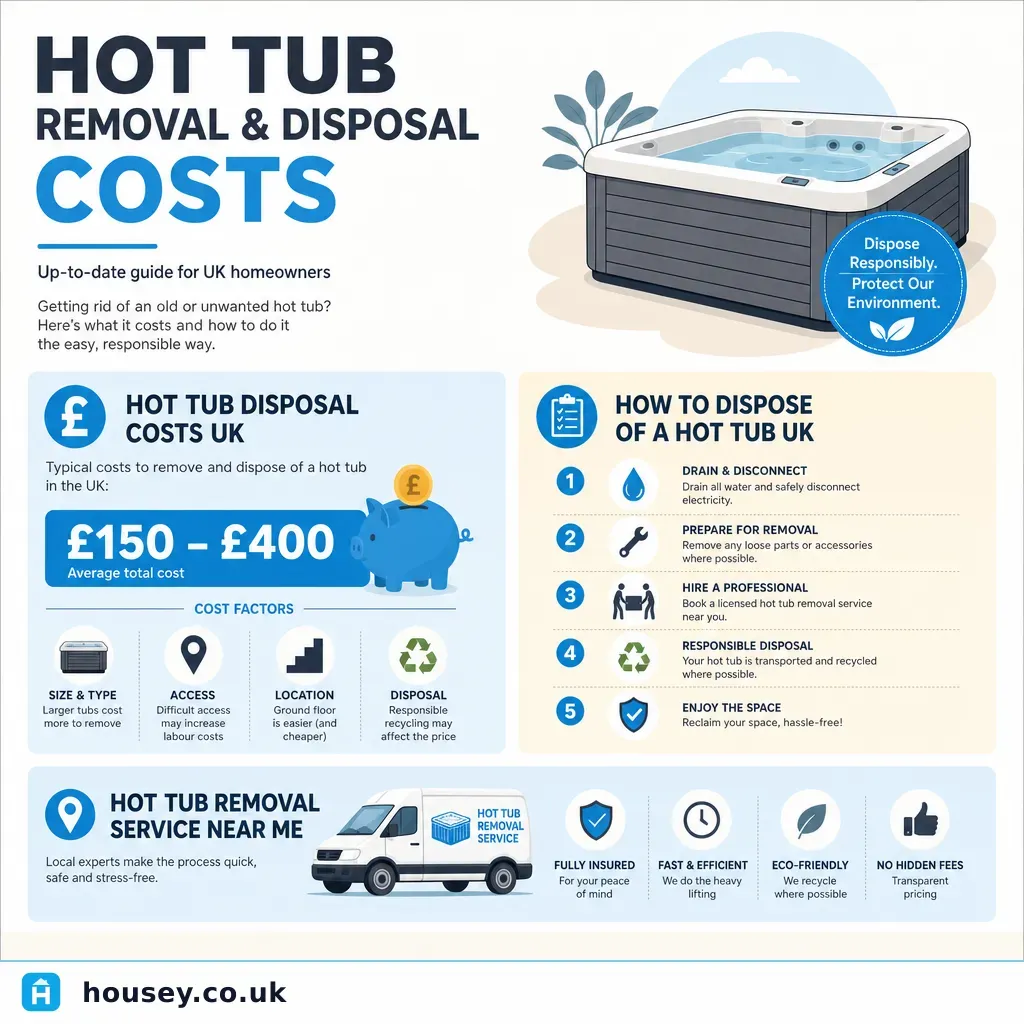
Hot Tub Removal and Disposal Costs
Hot tub removal in the UK typically costs £150–£450 for a straightforward garden removal, though prices rise if electrical disconnection is required, access is difficult, or specialist disposal is needed.