Planning A Garage Construction: Design And Regulations
By Housey · Last reviewed 30th of May 2026
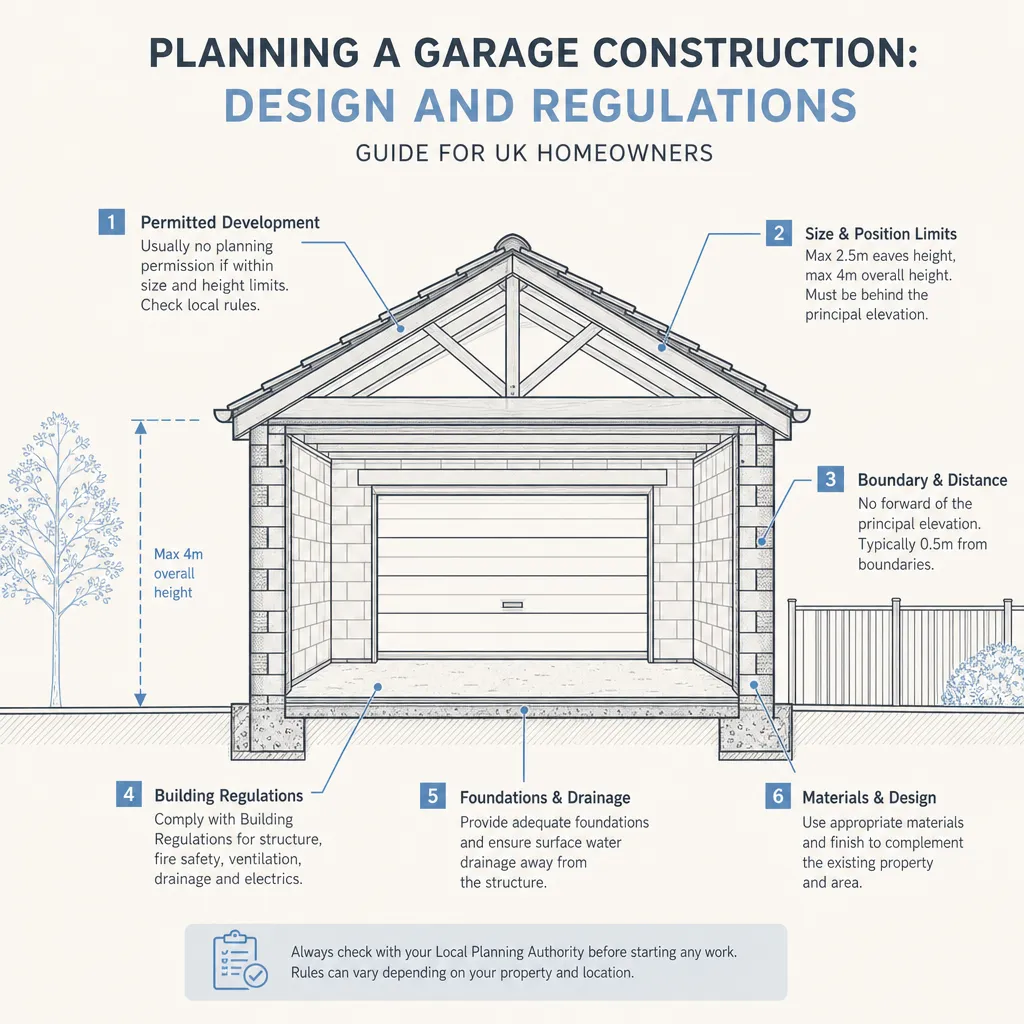
Planning A Garage Construction: Design And Regulations
Building a garage — whether detached at the end of a garden, attached to the side of a house, or integral within the main structure — comes up most often when a homeowner is weighing up parking security, workshop space, or extra storage. The project can appear straightforward until questions arise about permitted development, building regulations, boundary setbacks, and what happens if the design does not comply. Getting the regulatory groundwork right before construction begins avoids costly enforcement action, complications at mortgage survey, and difficulties on future sale.
Key points
- Most detached single-storey garages in England qualify for permitted development under the Town and Country Planning (General Permitted Development) (England) Order 2015, meaning no planning permission is required — provided specific conditions on height, footprint, and siting are all met.
- Building Regulations 2010 approval is required for any garage attached to a dwelling, and for detached garages with a floor area over 30m²; detached garages under 15m² are generally exempt.
- A garage sited within 2 metres of a boundary must not exceed 2.5 metres in overall height to qualify for permitted development in England.
- Permitted development rights are removed or restricted in conservation areas, Areas of Outstanding Natural Beauty (AONBs), National Parks, and listed building curtilages, and where an Article 4 direction is in place — always confirm with your Local Planning Authority (LPA) before starting.
- For any garage sharing a wall with or built close to a neighbouring structure, the Party Wall etc. Act 1996 may require formal notification to adjoining owners before work begins.
Do you need planning permission?
In England, permitted development rights under the Town and Country Planning (General Permitted Development) (England) Order 2015 allow most detached garage projects to proceed without a planning application, provided all of the following conditions are met:
- The garage must be single-storey.
- Total coverage by all outbuildings on the plot must not exceed 50% of the curtilage (excluding the original house footprint).
- Maximum eaves height: 2.5 metres.
- Maximum overall height: 4 metres (dual-pitched roof) or 3 metres (any other roof form).
- If within 2 metres of a boundary, overall height must not exceed 2.5 metres.
- The structure must not be positioned forward of the principal elevation facing a highway.
- It must not be used as separate living accommodation.
Rules differ in Scotland, Wales, and Northern Ireland — consult the relevant devolved planning authority, Scottish Government planning guidance, Welsh Government planning pages, or nidirect.gov.uk as appropriate.
Which option should you choose?
- Choose permitted development if all conditions above are met and no local restrictions apply — no application is required.
- Apply for full planning permission if your design exceeds any permitted development threshold, or if your property is in a conservation area or AONB.
- Seek a Certificate of Lawful Development if you want formal written confirmation from your LPA that the work is lawful — this is valuable evidence on future sale.
- Consult your LPA directly before starting if your property is subject to an Article 4 direction, is listed, or is in a National Park.
- Obtain Listed Building Consent for any works — however minor — if your home is listed at any grade.
Building regulations: when do they apply?
Planning permission and building regulations are separate requirements. Even where no planning application is needed, building regulations under the Building Regulations 2010 may still apply to the construction itself.
Garage type | Building regulations required? | Key Approved Documents |
|---|---|---|
Detached garage under 15m² | No — generally exempt | — |
Detached garage 15–30m² | No — if single-storey, at least 1m from boundary or non-combustible materials | — |
Detached garage over 30m² | Yes | Part A (Structure), Part L (Energy), Part B (Fire) |
Garage attached to the house | Yes | Part A, Part B, Part C (Moisture), Part L, Part F (Ventilation) |
Integral garage within house footprint | Yes | Full compliance required |
For attached and integral garages, Approved Document B requires at minimum a 30-minute fire-resistant door and appropriate ceiling and floor separation between the garage and habitable rooms. Any new drainage connection to a public sewer requires consent from your sewerage undertaker under the Water Industry Act 1991.
Building regulations approval is obtained by submitting a Full Plans application (recommended for attached or complex garages) or a Building Notice to your Local Authority Building Control (LABC), or through a private Registered Building Inspector. A completion certificate should be obtained at the end of the project — it is important evidence for future buyers and mortgage lenders.
Design considerations: getting the details right
Internal dimensions A minimum internal clear width of approximately 3 metres suits a single car; a double garage typically needs 5.5–6 metres of internal width. Allow at least 5.5 metres of depth for a standard vehicle with adequate room to move around it.
Foundations Ground conditions vary considerably across the UK: clay soils, filled ground, proximity to trees, or sloping sites may require structural engineering input on foundation depth and type. Standard strip foundations suit most uncomplicated domestic garages on stable ground.
Roof form and drainage Pitched roofs — duo-pitched or mono-pitched — generally perform better long-term in the UK climate than flat roofs, though modern flat-roof membranes with adequate insulation are widely used. Roof drainage must connect to an appropriate system; a new connection to the public sewer requires sewerage undertaker consent.
Electrical installation Any electrical circuits in an attached garage must comply with Part P of the Building Regulations and be carried out by a Part P competent person registered with NICEIC, NAPIT, or an equivalent scheme. For detached garages, work should still be carried out by a qualified electrician.
Fire separation for attached garages A fire-resisting door of at least FD30S specification — a 30-minute fire door with smoke seals — is required at any opening between an attached garage and habitable rooms, as specified in Approved Document B.
Homeowner checklist before you start
Important limitations
This article provides general information only and applies primarily to England unless otherwise stated. Planning and building regulations rules are complex, subject to change, and vary significantly by property type, tenure, location, prior extensions, and local authority policy. Nothing in this article constitutes professional planning, structural, or legal advice. A qualified professional — such as an architectural technologist, planning consultant, or building control consultant — should assess your specific project before any work is instructed.
When this becomes urgent
Seek immediate professional advice if:
- You have already started work and suspect it may not comply with permitted development conditions or building regulations.
- Your LPA has issued a planning enforcement notice or made enquiries about unauthorised works.
- Building control has raised concerns about structural adequacy during an inspection.
- A neighbour has served a Party Wall Act notice or issued a formal legal objection and you are unsure how to respond.
- You discover that your property has a restriction, Article 4 direction, or listing that was not apparent at the planning stage.
What to ask a qualified professional
Before appointing a designer or submitting any application, ask:
- Does my property have full permitted development rights, or are they restricted in any way?
- Do I need planning permission, and if so, what conditions are likely to be imposed?
- Which Approved Documents under the Building Regulations 2010 apply to my design?
- Do the ground conditions require structural engineering input on foundations?
- Is Party Wall Act notification required, and to which neighbours?
- What drawings and documentation are needed for a building regulations application?
- What inspections will building control carry out, and at what stages?
- What completion documentation will I receive, and how does it affect the property's marketability?
When to get professional help
Most garage construction projects benefit from input by an architectural technologist or building designer, even for relatively simple detached structures. Seek professional advice if:
- The property is in a conservation area, AONB, or National Park.
- The home is listed at any grade.
- You are proposing an attached or integral garage.
- The proposed site has unusual ground conditions, sloping terrain, or is near trees.
- You plan to install electrical circuits, drainage, or a heating system.
- A neighbour shares the boundary or has previously raised concerns.
- Total outbuilding coverage across the plot is near or above 50% of the curtilage.
For larger or more complex projects, a project manager can coordinate trades and manage the build programme effectively.
How Housey can help
Housey connects you with vetted architectural technologists and building control consultants who can assess your project, prepare regulatory drawings, and handle planning or building regulations applications on your behalf. Use the Housey quote comparison tool to see fees from local professionals before committing.
Frequently asked questions
Do I need planning permission to build a garage in the UK?
In England, most detached single-storey garages qualify for permitted development and do not require planning permission, provided they meet conditions on size, height, and position. Garages in conservation areas, on listed properties, or exceeding permitted development thresholds will need a full planning application. Scotland, Wales, and Northern Ireland have different rules — check with your devolved planning authority.
Does a detached garage need building regulations approval?
A detached garage under 15m² is generally exempt from building regulations. Between 15m² and 30m², approval may not be needed if the garage is single-storey and at least 1m from the boundary or built from non-combustible materials. Over 30m², or if attached to the house, building regulations approval is required under the Building Regulations 2010.
How close to the boundary can I build a garage?
Under permitted development rules in England, a garage within 2 metres of a boundary must not exceed 2.5 metres in overall height. Structures set more than 2m from the boundary may be up to 4 metres high (dual-pitched roof) or 3 metres (other roof forms). If building close to a shared boundary, Party Wall Act obligations may also apply.
What is a Certificate of Lawful Development?
A Certificate of Lawful Development (CLD) is formal written confirmation from your Local Planning Authority that a proposed or completed development is lawful under planning legislation. It is not required for permitted development work but provides important evidence — particularly when selling the property — that no planning permission was needed for the garage.
Can I convert my garage into living space later?
Yes, but converting a garage from ancillary storage to habitable accommodation typically requires both planning permission and building regulations approval, even if the original garage was built under permitted development. The conversion must meet insulation, ventilation, fire safety, and structural standards set out in the Building Regulations 2010.
Sources and further reading
- Permitted development rights for householders: technical guidance — GOV.UK
- Planning Portal: Outbuildings — Planning Portal
- Building Regulations 2010 — legislation.gov.uk
- Approved Document B: Fire safety — GOV.UK
- Party Wall etc. Act 1996 — legislation.gov.uk
- Find your local planning authority — GOV.UK
Useful next reads
 Planning & Pre-Build
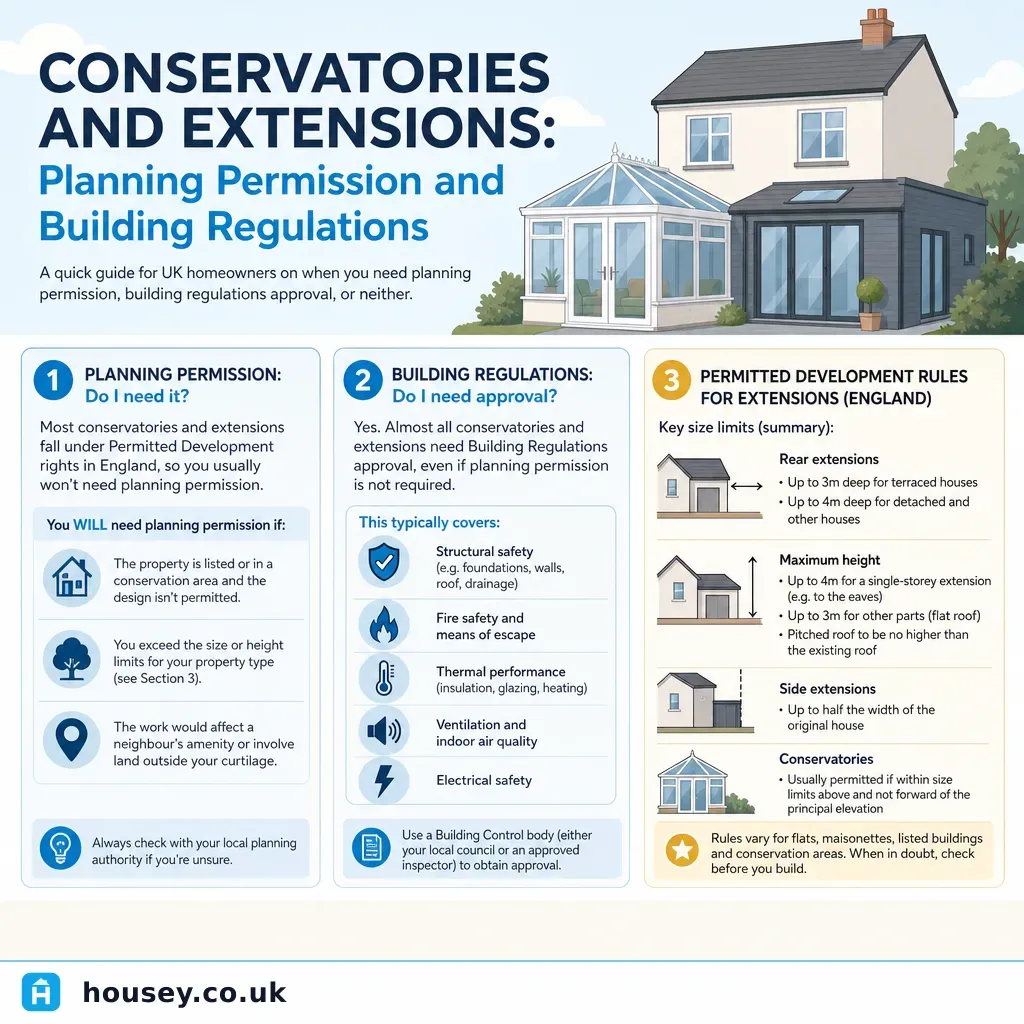
Conservatories and Extensions: Planning Permission and Building Regulations
Whether your conservatory or extension needs planning permission depends on its size, height, position, and property type.
 Planning & Pre-Build
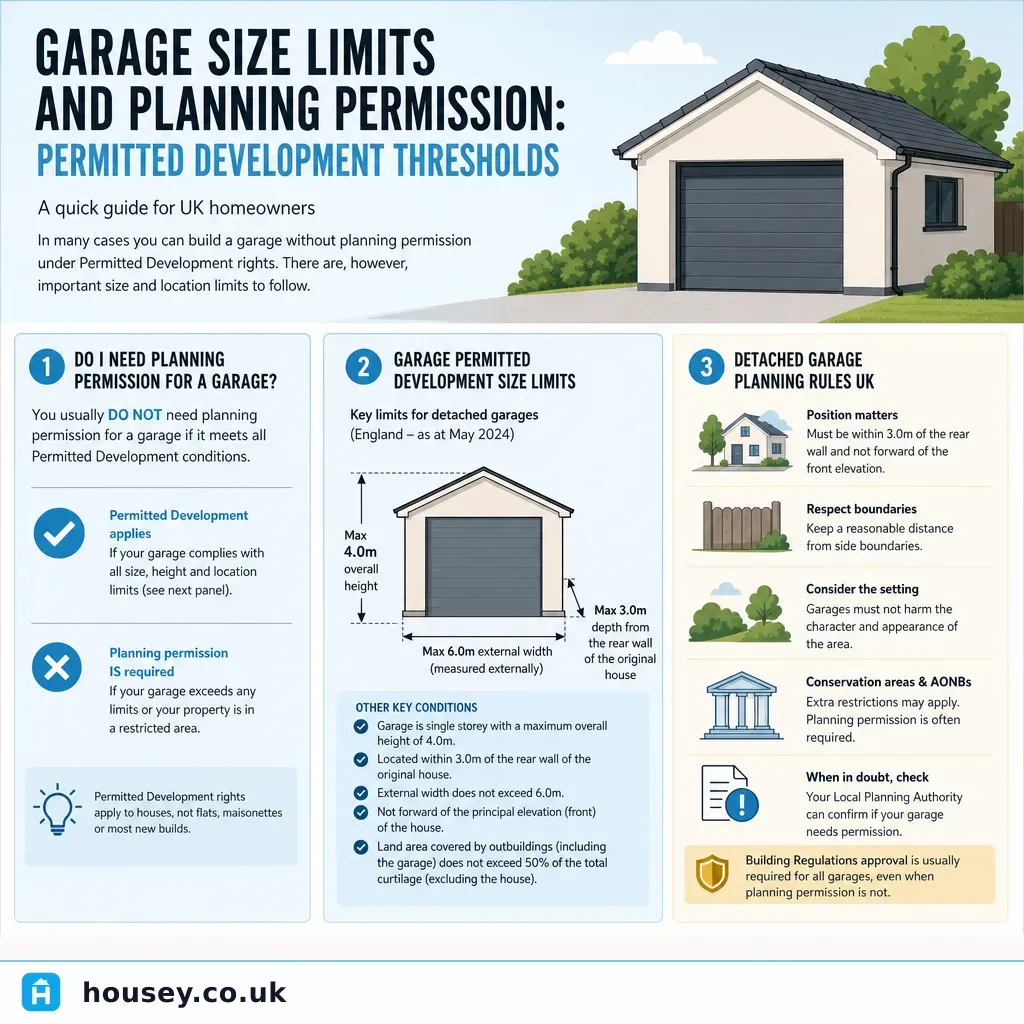
Garage Size Limits and Planning Permission: Permitted Development Thresholds
A detached garage is usually permitted development under Class E of the GPDO 2015 if it covers less than 50% of the curtilage and meets height limits.
 Planning & Pre-Build
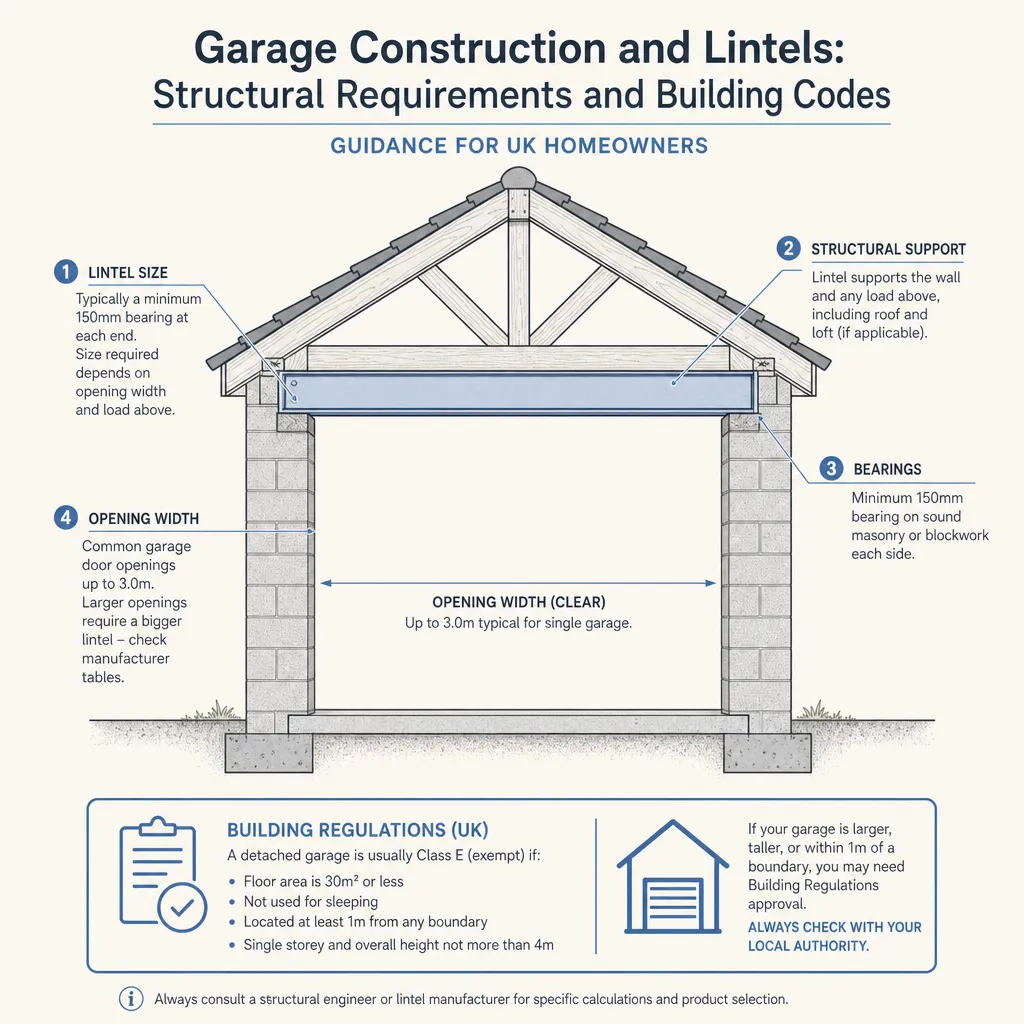
Garage Construction and Lintels: Structural Requirements and Building Codes
Garage lintels must be sized to carry the loads above each opening — masonry, roof structure, and any floor above.
 Planning & Pre-Build
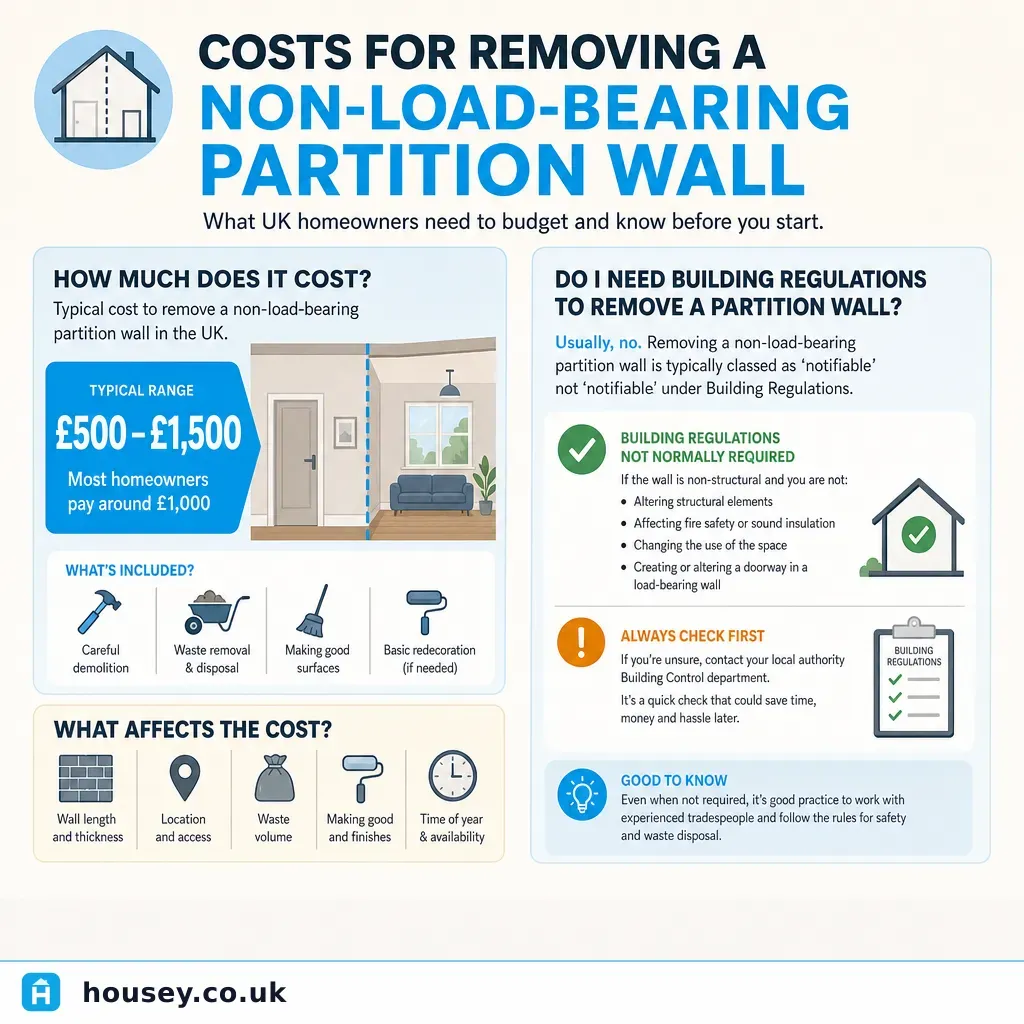
Costs for removing a non-load-bearing partition wall
Removing a non-load-bearing partition wall in a UK home typically costs £300–£1,500 in labour, plus £200–£600 or more for replastering and making good.
 Planning & Pre-Build
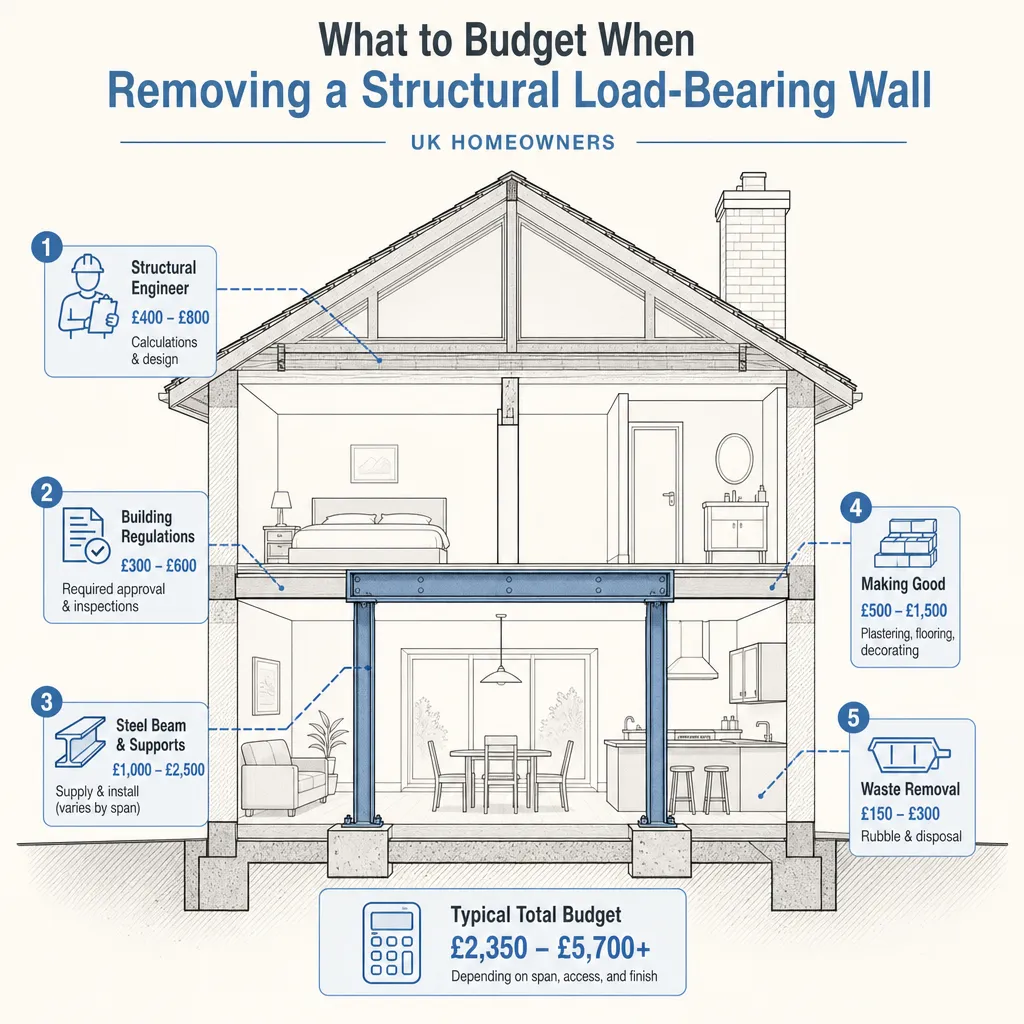
What to Budget When Removing a Structural Load-Bearing Wall
Removing a load-bearing wall in a typical UK home costs £2,500–£8,000 or more in total, covering a structural engineer's calculations, Building Regulations approval, the steel beam, builder's labour, and replastering.