Guide to Planning Permission Requirements for Property Development
By Housey · Last reviewed 30th of May 2026
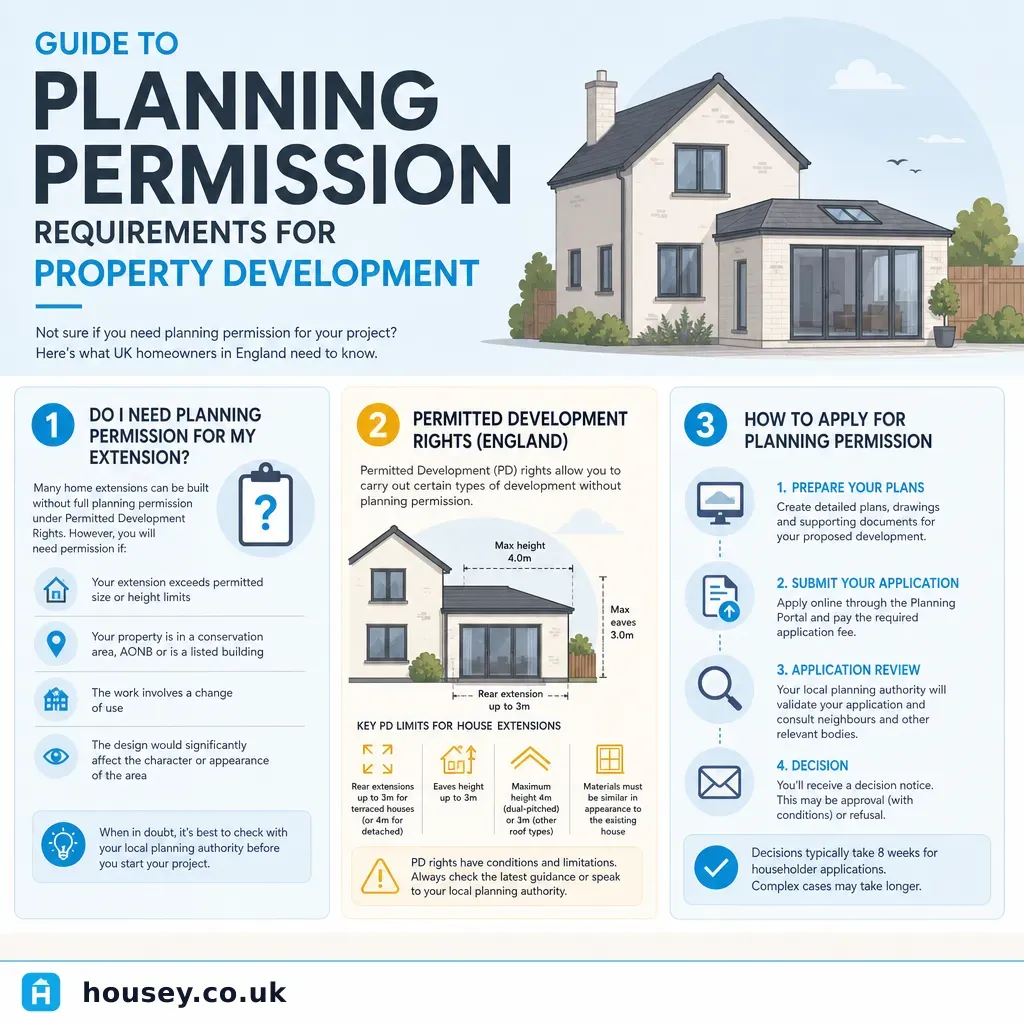
Guide to Planning Permission Requirements for Property Development
Planning permission affects almost every significant change to a UK home or land. Whether you are extending a Victorian terrace, converting a garage, or building a new dwelling on a plot, understanding when approval is required — and how to obtain it — can be the difference between a smooth project and an enforcement notice. Rules are set by local planning authorities (LPAs) and shaped by national policy, so requirements in Surrey may differ from those in Sheffield.
Key points
- Planning permission is regulated by local planning authorities (LPAs) under the Town and Country Planning Act 1990 and the Town and Country Planning (General Permitted Development) (England) Order 2015.
- Many home improvements in England fall within permitted development (PD) rights and do not require a formal planning application — but these rights are typically restricted in conservation areas, for listed buildings, and where Article 4 directions are in force.
- A householder planning application in England costs £258 (as of April 2024); fees differ in Wales, Scotland, and Northern Ireland.
- Standard householder applications must be decided within 8 weeks; major applications within 13 weeks — if the LPA misses the deadline without agreement, you may appeal on grounds of non-determination.
- Carrying out work that requires planning permission without obtaining it can result in an enforcement notice requiring alteration or demolition at your own cost.
Do you need planning permission?
The starting point is whether your project falls within permitted development rights under the General Permitted Development Order (GPDO), which sets out classes of development that do not require an application, subject to conditions and limitations.
Decision guide:
- Choose permitted development (no application needed) if your project is within the size limits for your property type, uses matching materials, and the property is not listed, not in a conservation area, and is not a flat.
- Apply for a Lawful Development Certificate (LDC) if you believe your project is lawful but want written confirmation for future sales or mortgage applications. An LDC costs approximately £103 in England (2024 fee schedule).
- Apply for full planning permission if the project exceeds PD limits, involves a change of use, a new dwelling, or is in a restricted location such as a National Park, Area of Outstanding Natural Beauty (AONB), or conservation area.
- Check with your LPA before starting if the property is listed, subject to an Article 4 direction, is a flat, or the project is near protected trees or on Green Belt land.
- Consult a planning consultant if you are uncertain of the rules, have received a problematic pre-application response, or are planning a more complex or commercial scheme.
Permitted development vs full planning permission
Aspect | Permitted Development | Full Planning Application |
|---|---|---|
Approval required | No (within conditions and limits) | Yes |
Application fee (England) | Free (LDC ~£103 if desired) | £258 householder (April 2024) |
Decision timeframe | No formal decision needed | 8 weeks (householder); 13 weeks (major) |
Common restrictions | Size, height, materials, location | Site-specific; policy-based |
Conservation area or listed building | Rights typically restricted or removed | Standard route; heritage officer consulted |
Validity | Permanent within PD limits | Usually 3 years to begin work |
Understanding permitted development rights
Permitted development rights allow certain works to proceed without a planning application. Commonly used PD rights for homeowners in England include:
- Single-storey rear extensions: up to 4 m for detached houses and 3 m for other houses under standard PD; up to 8 m or 6 m respectively under the Neighbour Consultation Scheme (also called larger home extensions).
- Loft conversions: up to 40 m³ additional volume for terraced houses, and 50 m³ for detached and semi-detached properties, subject to roof height and ridge restrictions.
- Outbuildings: permitted within 50% of the original curtilage (excluding the house footprint), with a maximum 2.5 m eaves height and 4 m ridge height for dual-pitch roofs, provided they are not forward of the principal elevation.
- Porches: up to 3 m² floor area and 3 m in height, not within 2 m of a highway boundary.
If your property is in a conservation area, World Heritage Site, National Park, or AONB, or if it is a listed building, many of these rights are restricted or removed entirely. Always verify with your LPA before starting any work.
The planning application process in England
When a full application is required, the process typically follows these stages:
- Pre-application enquiry (optional but recommended): submit a description of the proposal to your LPA for informal feedback before committing to full drawings and fees.
- Prepare documents: usually the completed application form, site location plan (1:1,250 or 1:2,500 scale), block plan (1:500), existing and proposed floor plans and elevations, and a design and access statement (required for some applications).
- Submit via the Planning Portal: most applications in England are submitted at planningportal.co.uk. The LPA validates the submission and starts the statutory clock.
- Consultation period: the LPA notifies neighbours and statutory consultees; the public has at least 21 days to comment on most applications.
- Assessment and decision: a planning officer assesses the proposal against the National Planning Policy Framework (NPPF), the LPA's Local Plan, and any supplementary planning guidance.
- Decision notice: issued within 8 or 13 weeks. Permission normally carries conditions; refusal includes stated reasons.
- Appeal: if refused, you may appeal to the Planning Inspectorate within 12 weeks of a householder refusal in England.
Common reasons planning applications are refused
- Design out of character with the surrounding streetscape or conservation area character appraisal.
- Overdevelopment: the scale of the proposal is disproportionate to the plot or street pattern.
- Impact on neighbouring amenity: overlooking, overshadowing, or loss of daylight to adjoining properties.
- Highway safety: insufficient parking, poor visibility splays, or conflict with the public highway.
- Flood risk: the site is in Flood Zone 2 or 3 without an adequate flood-risk assessment and sequential test.
- Ecology: protected species or protected trees are present without an appropriate mitigation strategy.
A pre-application enquiry or a review by a planning consultant before submission can identify and address these issues early.
Important limitations
This article provides general guidance on the planning permission framework in England. Planning rules are set and applied by individual local planning authorities and vary considerably by property type, location, history of prior consents, and local policy. The GPDO is amended periodically — always check the current version and your LPA's specific requirements before relying on any general guidance. This article does not constitute planning advice for any specific project or site. Your LPA or a qualified planning consultant should advise on your individual circumstances.
When this becomes urgent
Seek professional advice promptly if:
- You have already started or completed works that may require permission — enforcement action can be taken without prior warning.
- You have received a planning enforcement notice or a letter from the LPA querying the lawfulness of a development.
- You are buying or selling a property where an extension or outbuilding was built without clear evidence of planning permission or PD compliance.
- The project involves a listed building — listed building consent is required for any works affecting the character of the building, internally or externally, and unauthorised works are a criminal offence under the Planning (Listed Buildings and Conservation Areas) Act 1990.
What to ask a qualified professional
Before instructing a planning consultant or preparing a submission, ask:
- Does my specific project require planning permission, or does it fall within current permitted development rights?
- Is my property subject to any Article 4 directions, conservation area designations, or tree preservation orders (TPOs) that affect PD rights?
- Would a pre-application enquiry with the LPA be worthwhile, and what would it cost?
- What documents are required for a valid application, and what are the current fees?
- Which policies in the LPA's Local Plan are most relevant to my proposal?
- If an application is refused, what are the realistic prospects on appeal and what are the timescales?
- Should I apply for a Lawful Development Certificate rather than — or before — a full application?
When to get professional help
Most straightforward householder applications can be self-submitted, but professional planning advice is worth considering when:
- The project involves a listed building or is within a conservation area.
- You have received informal or formal enforcement correspondence from the LPA.
- The proposal involves a change of use, Green Belt land, a flood zone, or protected species.
- A pre-application response has raised substantive policy objections.
- You are planning a more complex scheme: a new dwelling, multiple units, or a mixed-use development.
- You have received a refusal and are weighing a planning appeal.
How Housey can help
Housey connects you with experienced planning consultants who can advise on permitted development limits, prepare pre-application enquiries, and manage full planning submissions on your behalf. Once planning is secured or confirmed under permitted development, our network also includes professionals who produce building regulations drawings to take your approved project through to construction and building control sign-off.
Frequently asked questions
How long does planning permission last in England?
In England, most planning permissions are valid for three years from the date of the decision notice. You must begin the development — not necessarily complete it — within that period. If work does not start within three years you will need to reapply, and the policy context or LPA guidance may have changed in the interim.
Can my neighbour block my planning application?
Neighbours can submit objections during the statutory consultation period, but objections are material considerations rather than a veto. The planning officer weighs all relevant considerations against planning policy. A large number of objections may prompt committee referral, but planning decisions are made on planning grounds, not by public vote.
What is a Lawful Development Certificate?
A Lawful Development Certificate (LDC) is a formal determination by the LPA that your proposed works are lawful — either because they fall within permitted development rights or because an existing breach has become immune from enforcement. An LDC costs approximately £103 in England (2024) and provides written security for future sales and mortgage applications.
What happens if I build without planning permission?
If you carry out work requiring permission without obtaining it, the LPA may issue an enforcement notice requiring alteration, demolition, or reinstatement. Ignoring an enforcement notice is a criminal offence. There is a four-year limitation period for operational development on dwellinghouses and a ten-year period for change of use — but these periods offer no guarantee of immunity. Always resolve unauthorised development before marketing a property.
Sources and further reading
- Planning Portal — Do I need planning permission? — Planning Portal
- Town and Country Planning Act 1990 — legislation.gov.uk
- Town and Country Planning (General Permitted Development) (England) Order 2015 — legislation.gov.uk
- National Planning Policy Framework — GOV.UK
- Apply for planning permission — GOV.UK
- Planning application fees in England — GOV.UK
Useful next reads
 Planning & Pre-Build
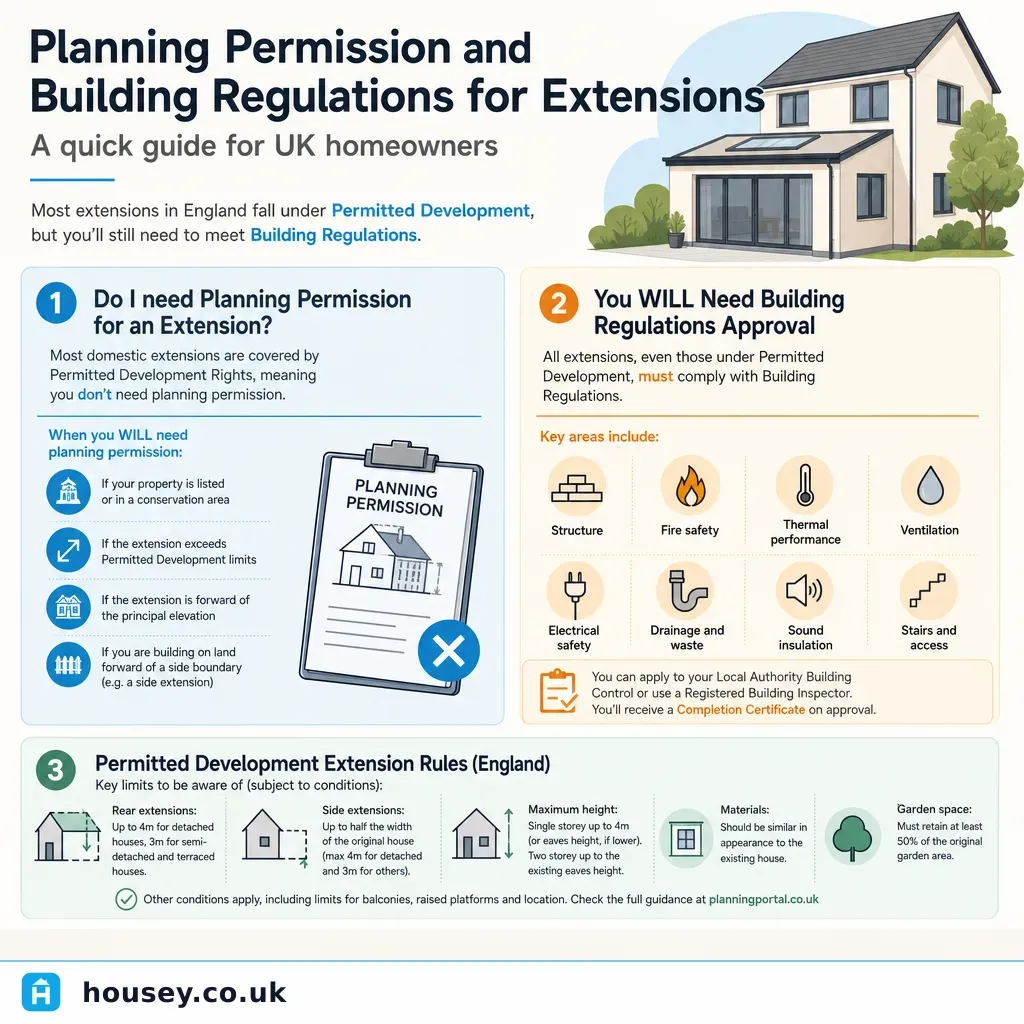
Planning Permission and Building Regulations for Extensions
UK home extensions usually require both planning permission and Building Regulations approval, though most smaller rear extensions qualify as Permitted Development under the GPDO 2015 and need no planning application.
 Planning & Pre-Build
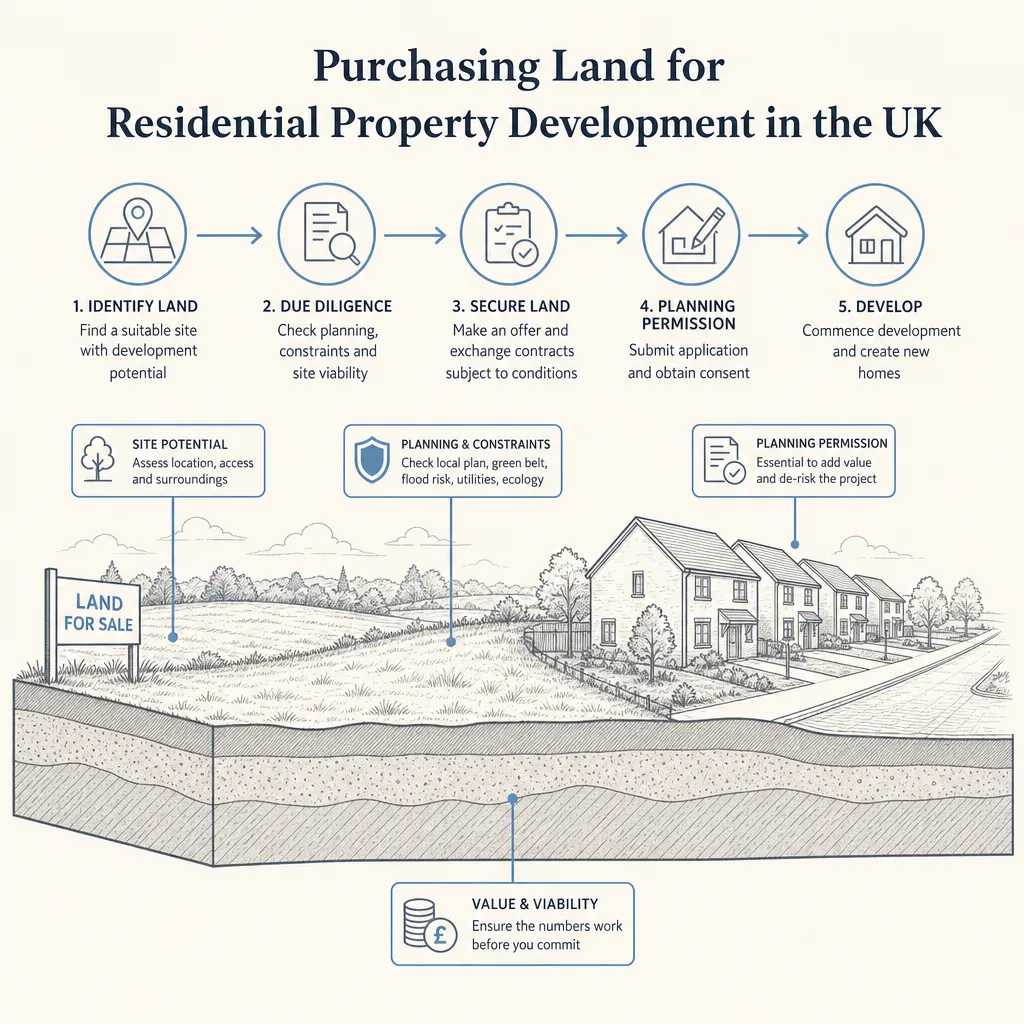
Purchasing Land for Residential Property Development in the UK
Buying development land in the UK involves due diligence on planning status, ground conditions, legal title, and utilities access before exchange.
 Planning & Pre-Build
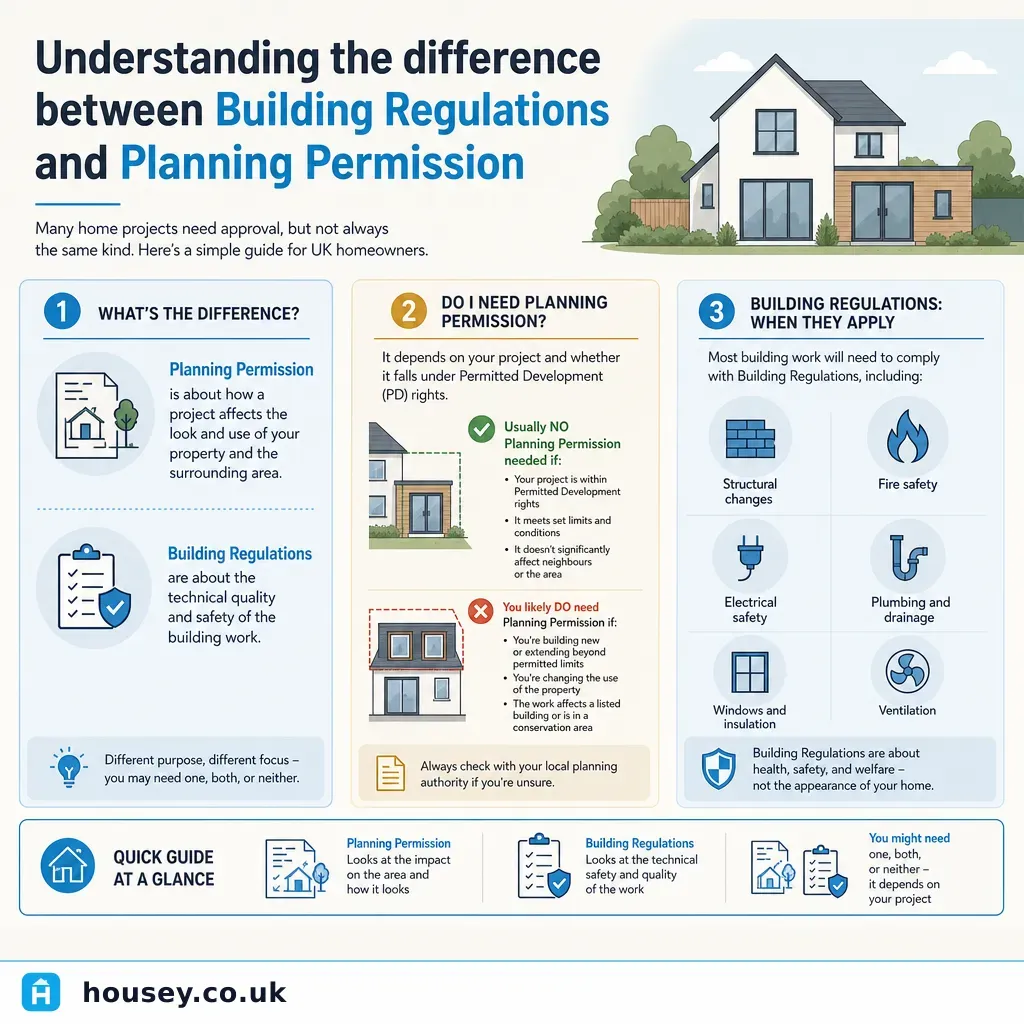
Understanding the difference between building regulations and planning permission
Planning permission is granted by your Local Planning Authority and controls whether a development is acceptable in principle — its appearance, use, and impact on the area.
 Planning & Pre-Build
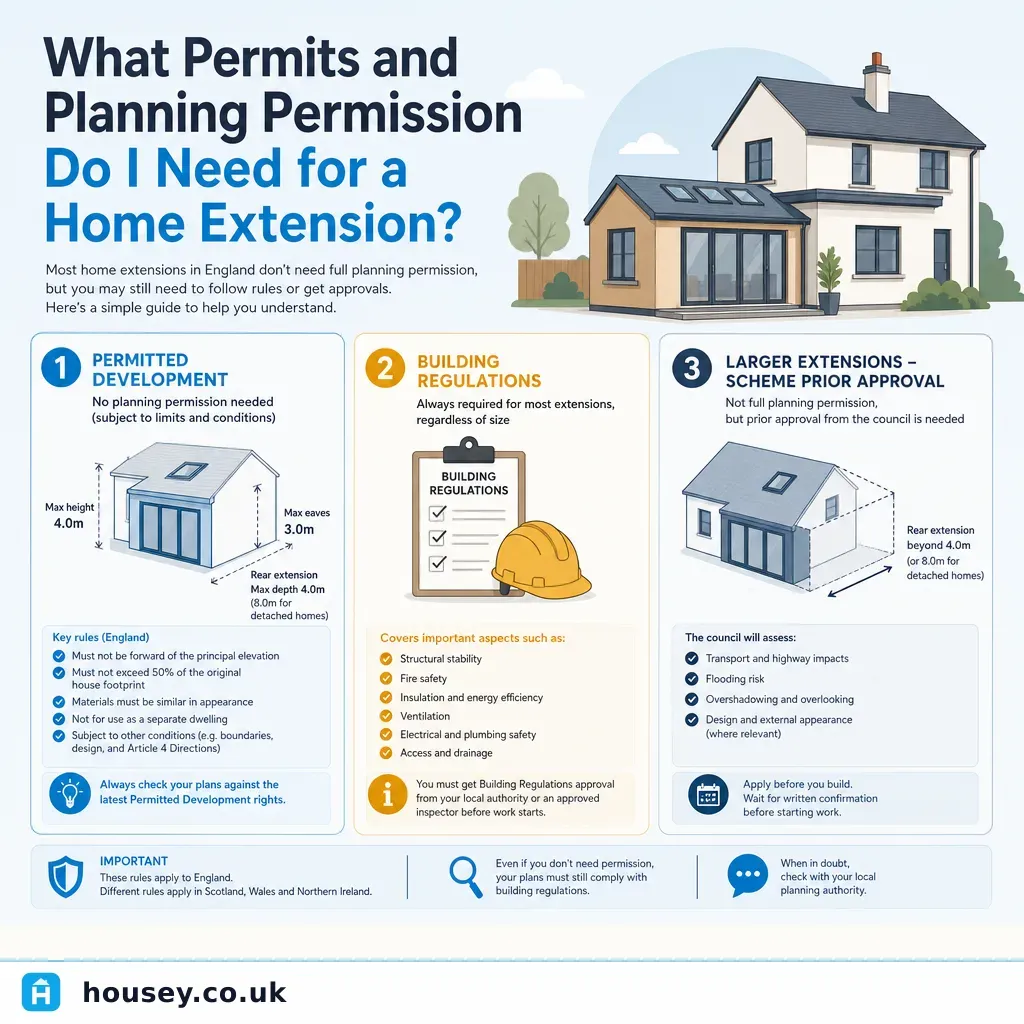
What Permits and Planning Permission Do I Need for a Home Extension?
Most single-storey rear extensions fall under permitted development and do not need a formal planning application, provided they stay within size limits set out in the Town and Country Planning (General Permitted Development) (England) Order 2015.
 Planning & Pre-Build
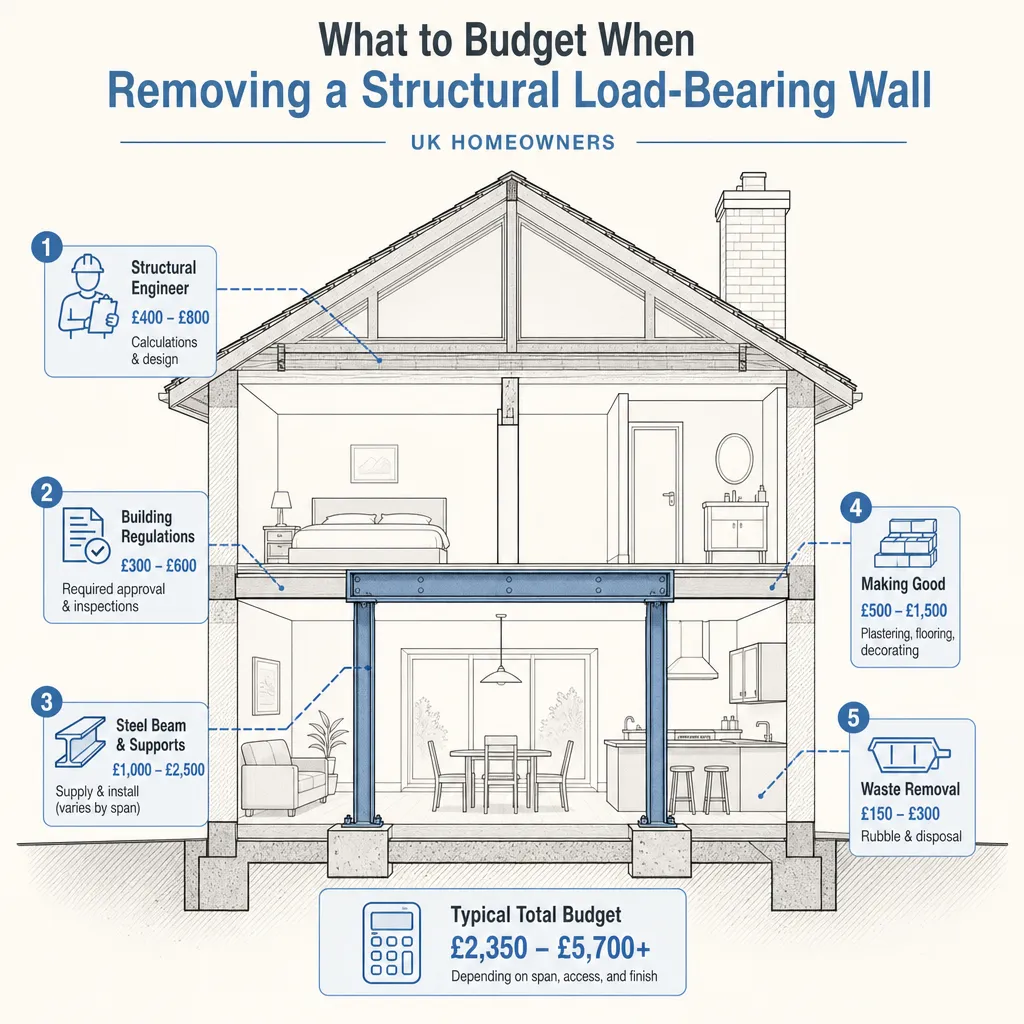
What to Budget When Removing a Structural Load-Bearing Wall
Removing a load-bearing wall in a typical UK home costs £2,500–£8,000 or more in total, covering a structural engineer's calculations, Building Regulations approval, the steel beam, builder's labour, and replastering.