Essential Guidance for Home Moving During Disruption Periods
By Housey · Last reviewed 10th of May 2026
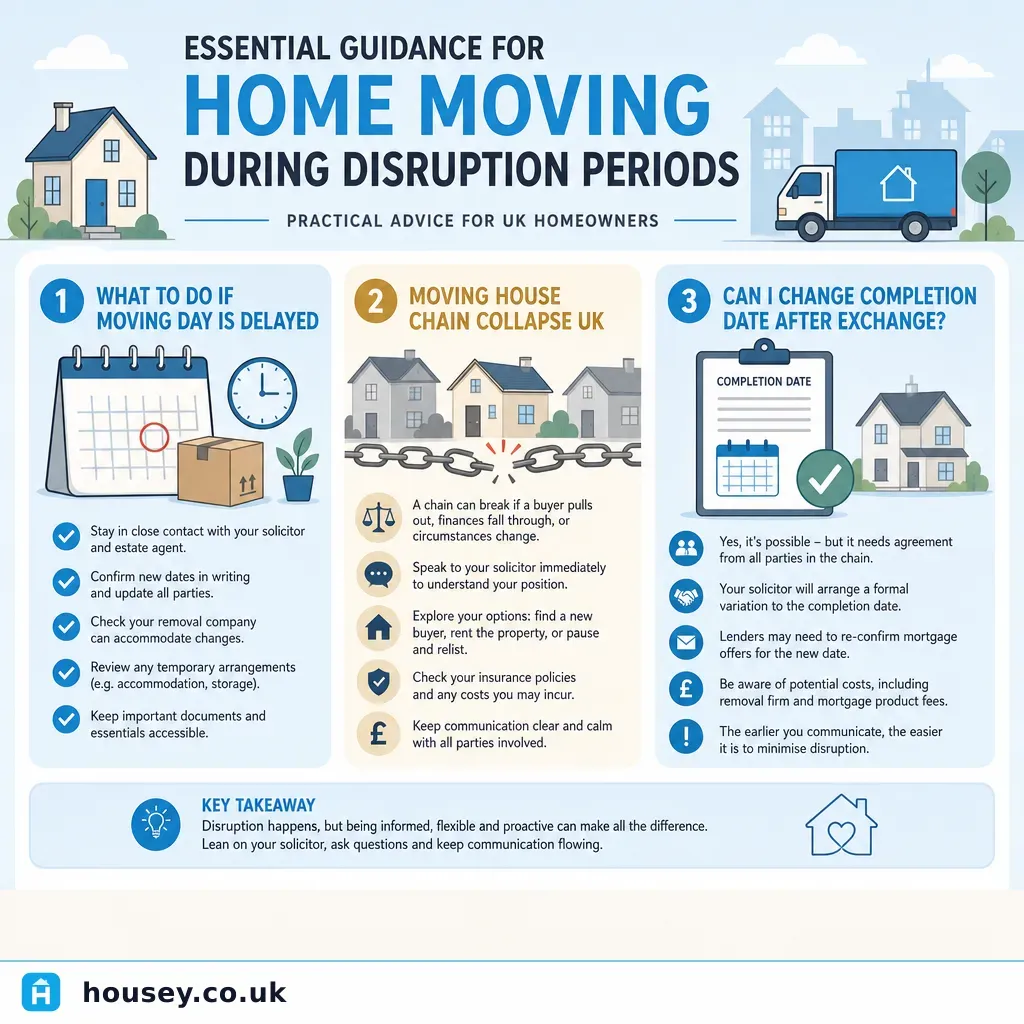
Essential Guidance for Home Moving During Disruption Periods
Moving house involves a carefully timed sequence of legal, financial, and logistical steps — solicitors, removal companies, mortgage lenders, and chains of other buyers and sellers all need to align on the same date. When disruption strikes, whether through adverse weather, transport problems, a family emergency, or an unexpected delay elsewhere in a property chain, even well-prepared moves can face serious complications.
Key points
- Exchange of contracts legally commits both buyer and seller to a completion date; changing that date after exchange requires both parties' written agreement and may incur financial penalties.
- A removal company is not automatically obliged to honour a booking if the completion date changes — check rescheduling and cancellation terms carefully before signing their contract.
- Buildings insurance on your new property typically begins at exchange, not completion — a coverage gap during a disrupted period can leave you financially exposed.
- The Property Ombudsman code of practice applies to most estate agents in England, Wales, and Scotland; if your agent fails to communicate delays promptly, a formal complaints route is available.
- HMRC allows 14 days from completion to pay Stamp Duty Land Tax in England and Northern Ireland — disruption to a completion date does not automatically extend this statutory deadline.
Planning ahead: when disruption is anticipated
Some disruptions can be anticipated — seasonal flooding risk, planned industrial action, a chain involving a property with known complications, or a completion date falling during a busy school holiday period. Early preparation significantly reduces the damage when something goes wrong.
Decision tree: should you proceed, delay, or renegotiate?
- Proceed as planned if disruption is minor, your removal company confirms flexibility, and all parties in the chain agree to proceed on the agreed date.
- Request a completion date change if practical moving is impossible and all parties can accommodate the shift — your solicitor handles this formally in writing.
- Negotiate a longer exchange-to-completion gap if you are still pre-exchange and disruption is predictable — far easier to arrange before exchange than after.
- Escalate to your solicitor immediately if you have already exchanged and completion looks impossible — breach of contract carries financial consequences and time matters.
- Contact your mortgage lender if your mortgage offer has an expiry date close to the disrupted completion date — extensions are possible but not guaranteed and may require a new valuation.
The legal and contractual framework
Understanding what you have legally committed to at each stage prevents costly misunderstandings during disruption.
Before exchange: Either party can withdraw without financial penalty. This is the safest point to reassess if disruption appears likely to affect your move significantly.
At exchange: You and the seller have a legally binding contract. The completion date is fixed. Changing it requires both parties' consent, arranged through your solicitors. Without the seller's agreement, you risk breach of contract — the seller can rescind and retain your deposit (typically 10% of the purchase price) and may be entitled to claim further damages.
At completion: Funds transfer and keys are released. If funds cannot transfer on the agreed day, you may face daily penalty interest at the rate specified in your contract.
Ask your solicitor explicitly before exchange what the financial consequences are if you cannot complete on the agreed date. If they have not explained this in writing, request a clear summary before you sign.
Practical moving logistics during disruption
Even when the legal side is under control, physical logistics can unravel quickly. Planning for contingencies in advance is far less stressful than reacting on the day.
Homeowner checklist: preparing for a disruption-resilient move
What to ask your removal company before moving
Before confirming your removal booking, get clear written answers to these questions:
- What is your rescheduling policy and what notice period do you require?
- Is there a charge if the completion date changes after my deposit is paid?
- Do you offer short-term storage if we cannot access the new property on the planned day?
- Are operatives employed directly or subcontracted, and how does this affect my contract?
- What are the per-item limits in your liability cover for damaged or lost goods?
- Will you provide a detailed inventory of items moved, or should I arrange separate inventory documentation?
Managing a chain during disruption
Property chains are the most common source of moving disruption in England and Wales. A delay at any point — a buyer withdrawing, a probate issue, a mortgage valuation problem — can cascade across multiple households simultaneously.
Key questions to ask your solicitor about the chain:
- How many properties are in the chain above and below us?
- Are there any known complications with other parties in the chain?
- If the chain collapses elsewhere, what is our financial exposure?
- Is simultaneous exchange and completion possible, or can we negotiate a shorter exchange-to-completion period to reduce chain risk?
Scottish property transactions differ: once missives are concluded, offers are binding on both parties. This significantly reduces the risk of late chain collapse compared with transactions under English and Welsh law, where either party can withdraw up to exchange without financial penalty.
When to get professional help
Most moving disruption can be managed with good communication and contingency planning. Seek professional input promptly if:
- You have already exchanged contracts and completion looks unlikely on the agreed date.
- You are in a dispute over deposit retention or default interest charges.
- Your solicitor is uncontactable as the completion deadline approaches.
- Your mortgage offer is close to expiry and your lender is not responding.
- Your removal company has failed to appear, damaged goods, or is disputing liability.
Contact your solicitor immediately — or instruct a new one if your current firm is unresponsive. The Legal Ombudsman handles complaints about solicitors in England and Wales after an initial complaint to the firm. The Solicitors Regulation Authority can act in cases of serious professional misconduct.
How Housey can help
Housey connects you with trusted house removal companies that understand the particular pressures of UK property chains, as well as experienced conveyancing solicitors who can help you manage exchange and completion with confidence. If you need an accurate record of a property's condition before handover, an inventory clerk provides documentation that protects both parties if a dispute arises later.
Frequently asked questions
What happens if my removal company does not turn up on moving day?
If your removal company fails to appear without valid reason and you have a written contract, you may have a claim for breach of contract. Document everything in writing immediately. If the company is a member of the British Association of Removers (BAR), BAR operates a conciliation service. You may also be able to pursue a claim through your credit card provider if you paid by card.
Can I change my completion date after exchange?
Yes, but only with the written agreement of all parties in the chain. Your solicitor must formally agree the new date with the other side — it is not a unilateral decision. Without that agreement, you are in breach of contract and could face financial penalties including loss of your deposit, typically 10% of the purchase price.
Does disruption affect my Stamp Duty Land Tax deadline?
HMRC requires SDLT within 14 days of completion in England and Northern Ireland. Land Transaction Tax in Wales has a 30-day deadline; Land and Buildings Transaction Tax in Scotland is also 30 days. Disruption to the physical move does not automatically extend these statutory deadlines. Speak to your solicitor if completion looks likely to be delayed.
Should I take out separate moving insurance beyond my removal company's liability cover?
Removal company liability is often limited by weight or declared value per item. For high-value or sentimental items, dedicated home removal insurance may offer more comprehensive protection. Check whether your existing home contents policy covers goods in transit or in temporary storage before deciding whether additional cover is needed.
What can I do if my solicitor is unresponsive during a critical period?
Contact the firm's client relationship partner or complaints officer in writing. If you remain unable to get a response and completion is imminent, instruct a new solicitor immediately on an emergency basis. The Legal Ombudsman handles complaints about solicitors in England and Wales after an initial complaint to the firm; the Solicitors Regulation Authority can act on serious professional misconduct.
Sources and further reading
- Buying or selling your home — GOV.UK
- Stamp Duty Land Tax — GOV.UK / HMRC
- Moving home — Citizens Advice
- The Property Ombudsman — The Property Ombudsman
- British Association of Removers: consumer advice — British Association of Removers
Useful next reads
 Buying & Moving
How to Plan a House Move: A Practical Guide to Residential Relocations
A UK house move goes more smoothly with planning that starts 6–8 weeks before moving day.
 Buying & Moving
Managing Residential Moves During Major Urban Events
Moving house during a major urban event — a marathon, carnival, street festival, or large sporting occasion — requires advance planning around road closures, parking suspensions, and access restrictions.
 Buying & Moving
Essential Considerations For Planning A Property Relocation
Planning a UK property relocation means coordinating legal, financial, and practical steps across several months.
 Buying & Moving
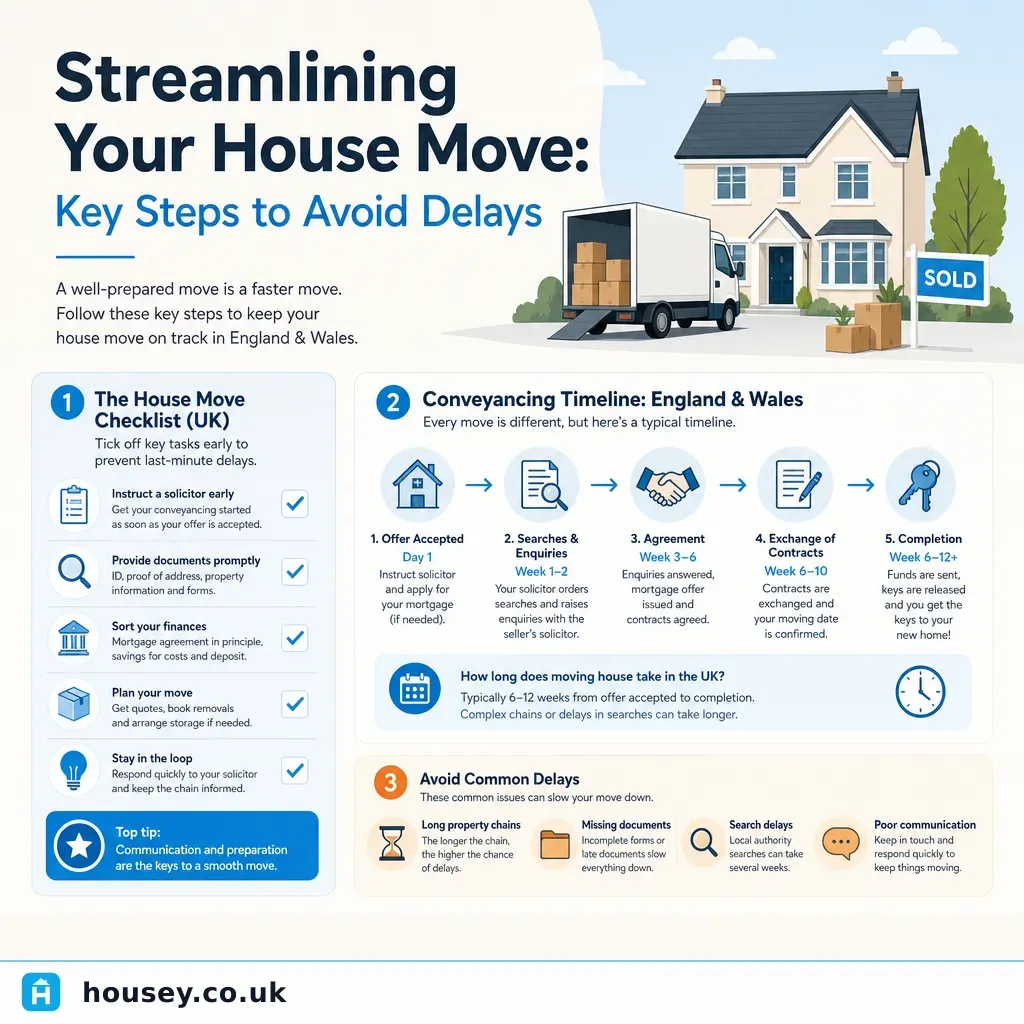
Streamlining Your House Move: Key Steps to Avoid Delays
The key to a smooth house move is acting early: instruct your conveyancer and surveyor on the day an offer is accepted, gather required documents before your solicitor requests them, and shortlist removal firms before exchange.
 Buying & Moving
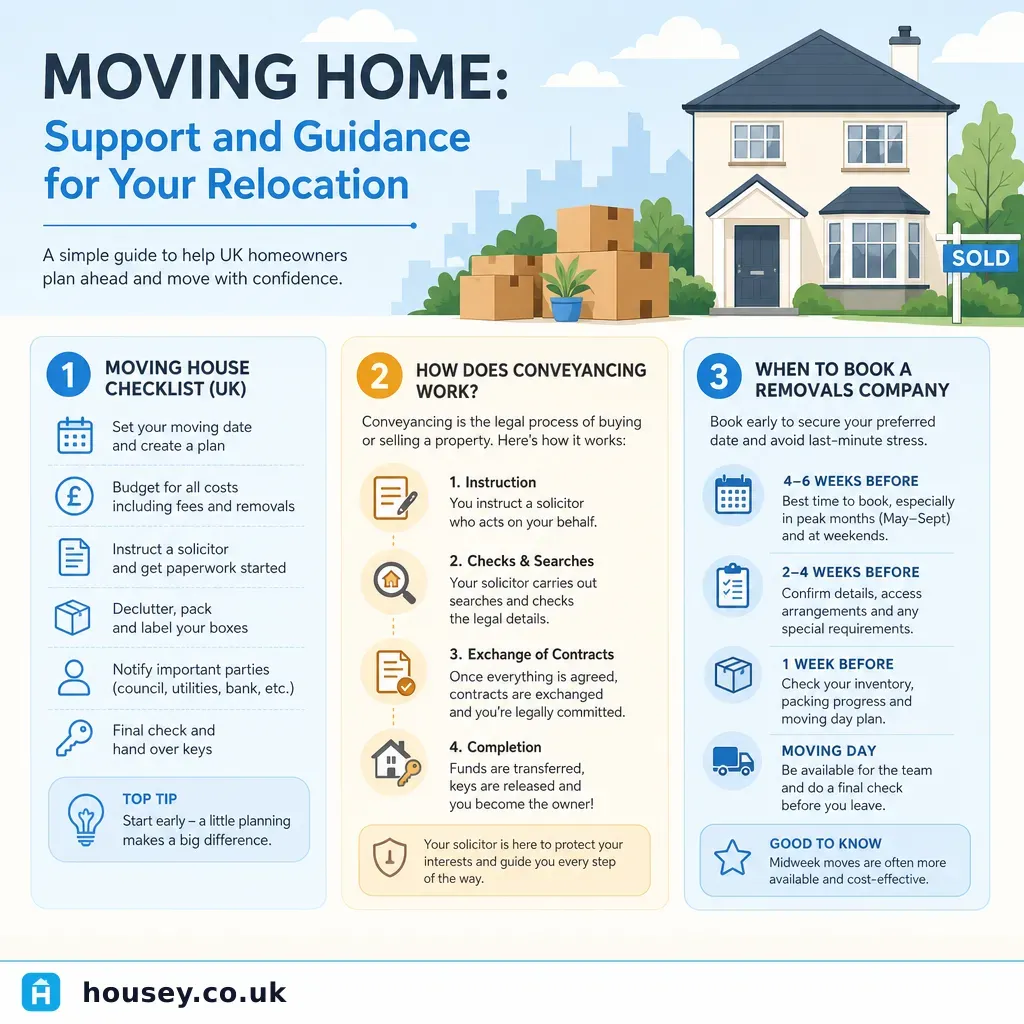
Moving Home: Support and Guidance for Your Relocation
Moving home involves coordinating conveyancing, removals, and logistics across 8–16 weeks.