Moving Home: Support and Guidance for Your Relocation
By Housey · Last reviewed 10th of May 2026
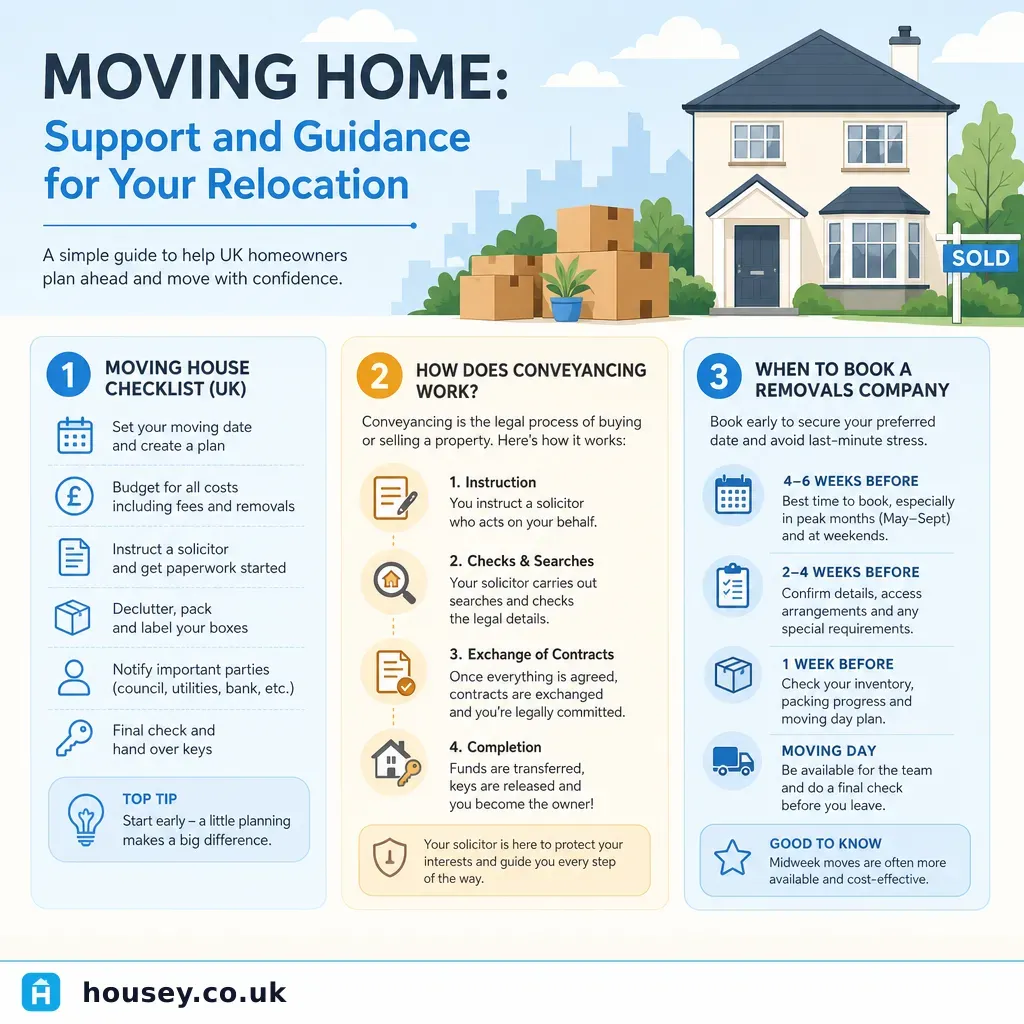
Moving Home: Support and Guidance for Your Relocation
Moving house in the UK involves coordinating several professional services at the same time, often while managing a property chain, a mortgage application, and the practical demands of daily life. From the moment an offer is accepted to the day the keys are handed over, there are legal steps, financial deadlines, and logistical decisions that need to happen in the right order. Understanding the sequence — and knowing which professionals to instruct when — makes the process significantly less stressful and reduces the risk of costly delays.
Key points
- The average UK house move from offer acceptance to completion takes 8–16 weeks, though leasehold purchases or longer chains typically take longer, according to the HomeOwners Alliance.
- You must exchange contracts before a completion date becomes legally binding; up to that point, either party can withdraw, and you risk losing your deposit if you pull out after exchange.
- Your solicitor or licensed conveyancer must carry out legally required searches — local authority, drainage, environmental — before exchange; these typically take between two and six weeks to return.
- Stamp duty land tax (SDLT) in England and Northern Ireland must be filed and paid within 14 days of completion; equivalent taxes apply in Wales (Land Transaction Tax) and Scotland (Land and Buildings Transaction Tax).
- Goods-in-transit insurance from a removals company covers your belongings during the move, but cover limits and exclusions vary — always confirm the terms before booking.
Understanding the moving timeline
Knowing what happens when helps you avoid being rushed into decisions, missing deadlines, or discovering that a key step has not been instructed in time.
Stage | Typical timing from offer acceptance |
|---|---|
Instruct solicitor or licensed conveyancer | Immediately |
Mortgage application submitted (if applicable) | Week 1–2 |
Searches ordered | Week 1–3 |
Survey commissioned by buyer | Week 1–3 |
Searches and enquiries returned | Week 3–8 |
Mortgage offer received | Week 4–8 |
Exchange of contracts | Week 6–14 |
Completion | Week 8–16 (commonly 1–2 weeks after exchange) |
SDLT return filed and paid | Within 14 days of completion |
Timescales are indicative. Leasehold transactions, properties in chains, or those with title complications typically take longer. Source: HomeOwners Alliance moving house guidance.
Choosing and booking a removals company
Book your removals company as early as possible — ideally as soon as you have a realistic exchange window in sight. Popular completion days, particularly Fridays and month-end dates, fill quickly. Last-minute bookings are more expensive and limit your choice of provider.
What to ask before accepting a quote from a removals company
- Is the company a member of the British Association of Removers (BAR) or the Removals Industry Ombudsman Scheme?
- What insurance cover applies to your goods during transit, and what is the claims process if something is damaged?
- Is packing included in the quote, or is it an additional cost?
- Do they disassemble and reassemble furniture?
- What is their procedure if completion is delayed on the day?
- Are there items they will not transport — pianos, certain antiques, hazardous materials?
- Is VAT included in the quoted price?
For moves that involve a gap between leaving your current property and accessing the new one, ask whether the company offers short-term storage and whether your goods remain insured during that period.
What conveyancing involves
Conveyancing is the legal transfer of property ownership. Your solicitor or licensed conveyancer investigates the title, raises enquiries with the seller's solicitor, reviews the contract, manages the financial transfer, and registers the new ownership at HM Land Registry.
Key documents in a typical residential conveyancing transaction:
- TA6 Property Information Form — completed by the seller, covering boundaries, disputes, planning history, and services
- TA10 Fittings and Contents Form — specifies what is and is not included in the sale price
- Official copy of title — obtained from HM Land Registry, confirming ownership and any registered charges
- Mortgage offer — must be received and reviewed by your solicitor before exchange
- Transfer deed (TR1 or TP1) — the legal document transferring ownership on completion day
You have the right to verify your conveyancer's qualifications and regulatory status before instructing them. Solicitors are regulated by the Solicitors Regulation Authority (SRA); licensed conveyancers are regulated by the Council for Licensed Conveyancers (CLC). Both publish searchable registers online.
Do you need an inventory clerk?
If you are moving into or out of a rented property as part of your relocation, a professional inventory report protects both tenant and landlord at the start and end of a tenancy. A professional inventory clerk produces a detailed, time-stamped record of the property's condition and contents that can be referred to if there is a dispute over the deposit.
For buyers and sellers, formal inventory reports are less commonly commissioned — but they can be useful when a sale contract includes specific contents or fixtures, or when there is ambiguity about what was agreed in the TA10 Fittings and Contents Form.
Moving day checklist
Use this checklist on or immediately before completion day to avoid the most common problems:
Before leaving your current property:
On arrival at your new property:
Which professionals do you need?
The services required for a typical move vary depending on whether you are buying, selling, renting, or managing a combination of transactions:
- Buying a property — conveyancer (required), surveyor (strongly recommended), removals company
- Selling a property — conveyancer (required), energy performance certificate (EPC) assessor (legally required for marketing), removals company
- Moving into or out of a rental — inventory clerk (strongly recommended), removals company
- Moving into temporary accommodation — removals company with storage capability
When to get professional help
Most of the moving process flows through the professionals you instruct. However, specific situations warrant prompt action:
- If there is a discrepancy between the seller's TA6 responses and what you observe at the property during a pre-completion inspection, raise this with your solicitor before exchange — remedies are far more limited after contracts have been exchanged.
- If your completion is delayed and you have already vacated your current property, speak to your solicitor immediately about storage costs and responsibility.
- If you are buying a leasehold flat, check whether a Notice of Transfer is required by the lease (most require it) and confirm that your solicitor will serve it on the freeholder within the required timeframe after completion.
- If high-value items are damaged during the move, notify the removals company in writing the same day and contact your insurer promptly.
How Housey can help
Housey connects you with trusted professionals at every stage of your move. Compare quotes from vetted house removals companies, instruct a conveyancing solicitor or licensed conveyancer as soon as your offer is accepted, or find a professional inventory clerk if you need a formal condition report for a rental property.
Frequently asked questions
When should I book a removals company?
Book as soon as you have a realistic exchange window — typically 4–6 weeks before your anticipated completion date. Popular completion days, particularly Fridays and end-of-month dates, book up quickly, so earlier is better. Confirm the booking once exchange has occurred and a fixed completion date has been agreed by both solicitors.
What is the difference between exchange and completion?
Exchange of contracts is when both parties sign and swap identical contracts, making the transaction legally binding and setting a fixed completion date. Completion is when the purchase funds are transferred and you receive the keys. The gap between exchange and completion is typically 1–2 weeks but can be agreed to suit both parties. You cannot legally set a completion date before exchange has taken place.
Do I have to use a solicitor, or can I do my own conveyancing?
You are legally entitled to conduct your own conveyancing, but mortgage lenders almost always require a qualified solicitor or licensed conveyancer to act for them, which in practice means most buyers and sellers use a professional. Solicitors are regulated by the Solicitors Regulation Authority; licensed conveyancers by the Council for Licensed Conveyancers. Both hold searchable registers of qualified practitioners.
What happens if the removal van cannot access my new street?
Discuss access before moving day. For narrow streets, parking restrictions, or high-rise flats, the company may need to use a smaller vehicle and make multiple trips, which takes longer and may cost more. Check whether there are resident permit zones near the property, and if needed, apply to your local council for a temporary parking suspension well in advance of completion day.
Is my furniture covered if something is damaged during the move?
Reputable removals companies carry goods-in-transit insurance, but cover limits and exclusions vary between providers. Check the policy before you sign, and ask specifically about high-value items, antiques, and electronics. Your home insurance policy may also provide cover for items in transit — check the terms directly with your insurer before moving day.
Sources and further reading
- Stamp duty land tax — GOV.UK
- HM Land Registry: property ownership and registration — HM Land Registry
- British Association of Removers: find a member — British Association of Removers
- Council for Licensed Conveyancers: find a conveyancer — Council for Licensed Conveyancers
- Moving house guide and checklist — HomeOwners Alliance
Useful next reads
 Buying & Moving
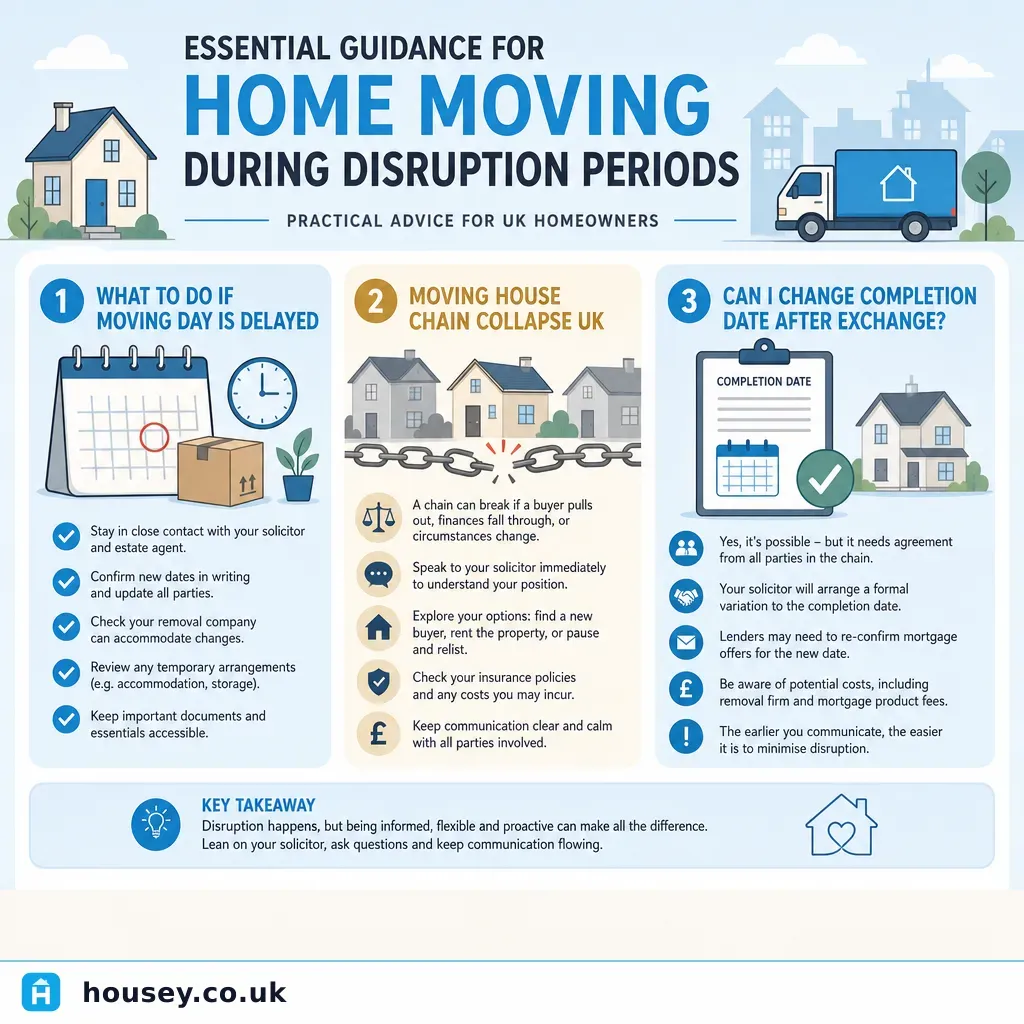
Essential Guidance for Home Moving During Disruption Periods
If disruption affects your move, your options depend on whether you have exchanged contracts.
 Buying & Moving
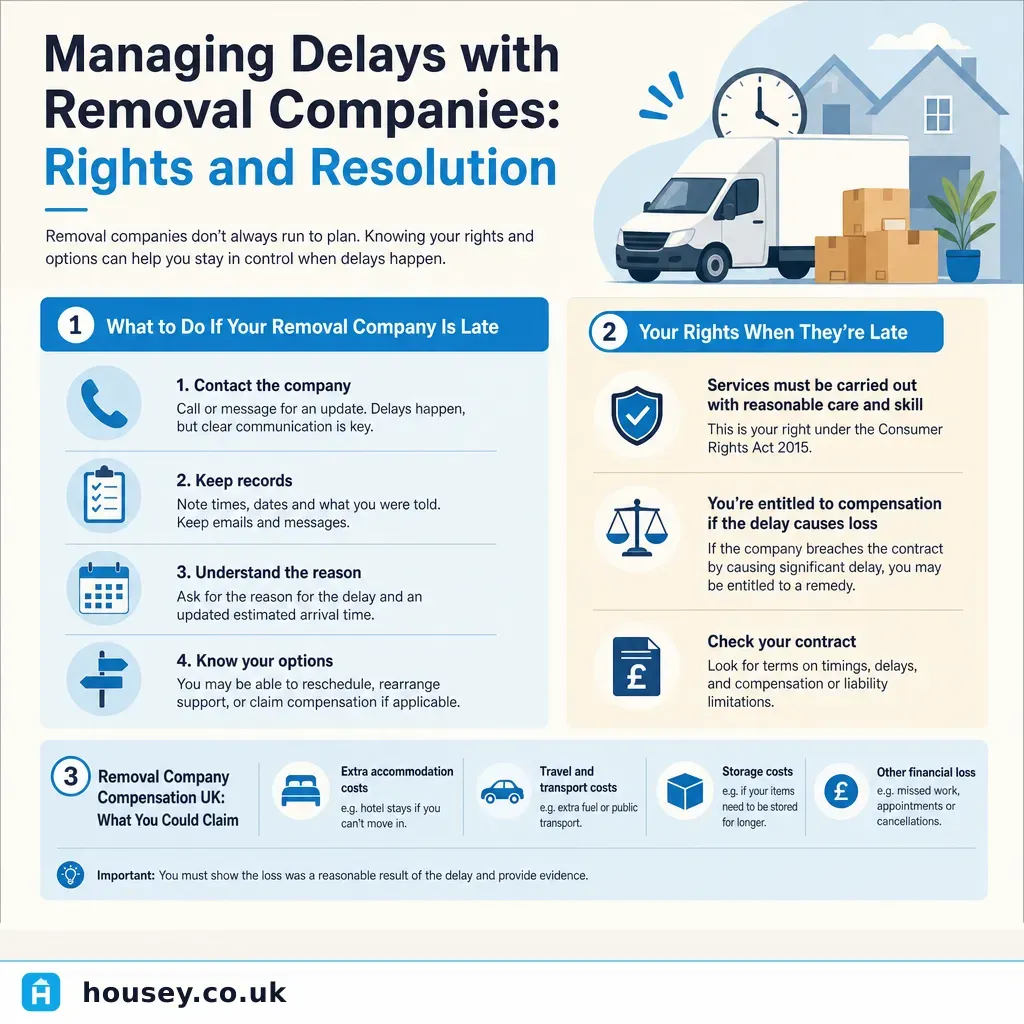
Managing Delays with Removal Companies: Rights and Resolution
If a removal company is late, your rights depend on your contract and whether the company is BAR-registered.
 Buying & Moving
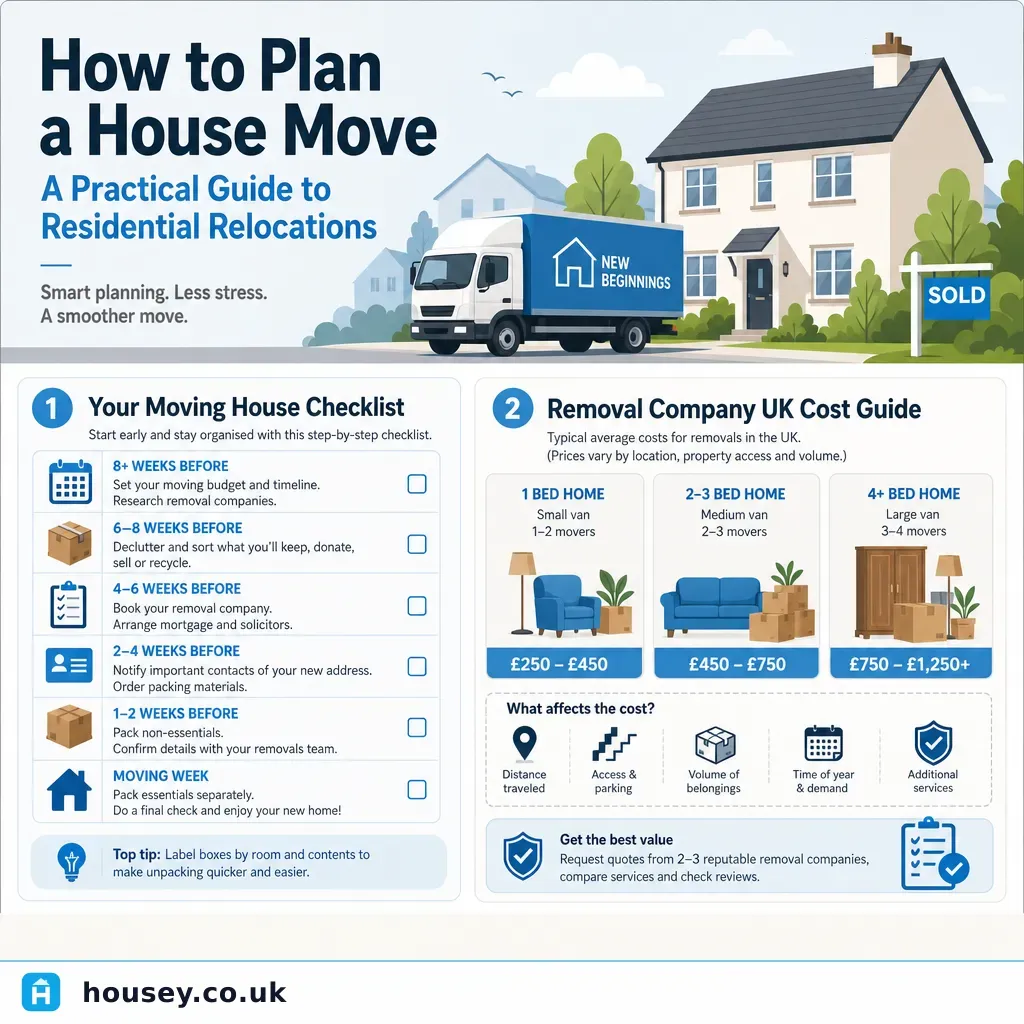
How to Plan a House Move: A Practical Guide to Residential Relocations
A UK house move goes more smoothly with planning that starts 6–8 weeks before moving day.
 Buying & Moving
Managing Property Relocation in Major Urban Centres
Urban house moves require planning beyond a standard removal, particularly around vehicle emission zone compliance, parking bay suspensions, and lift access in purpose-built flats.
 Buying & Moving
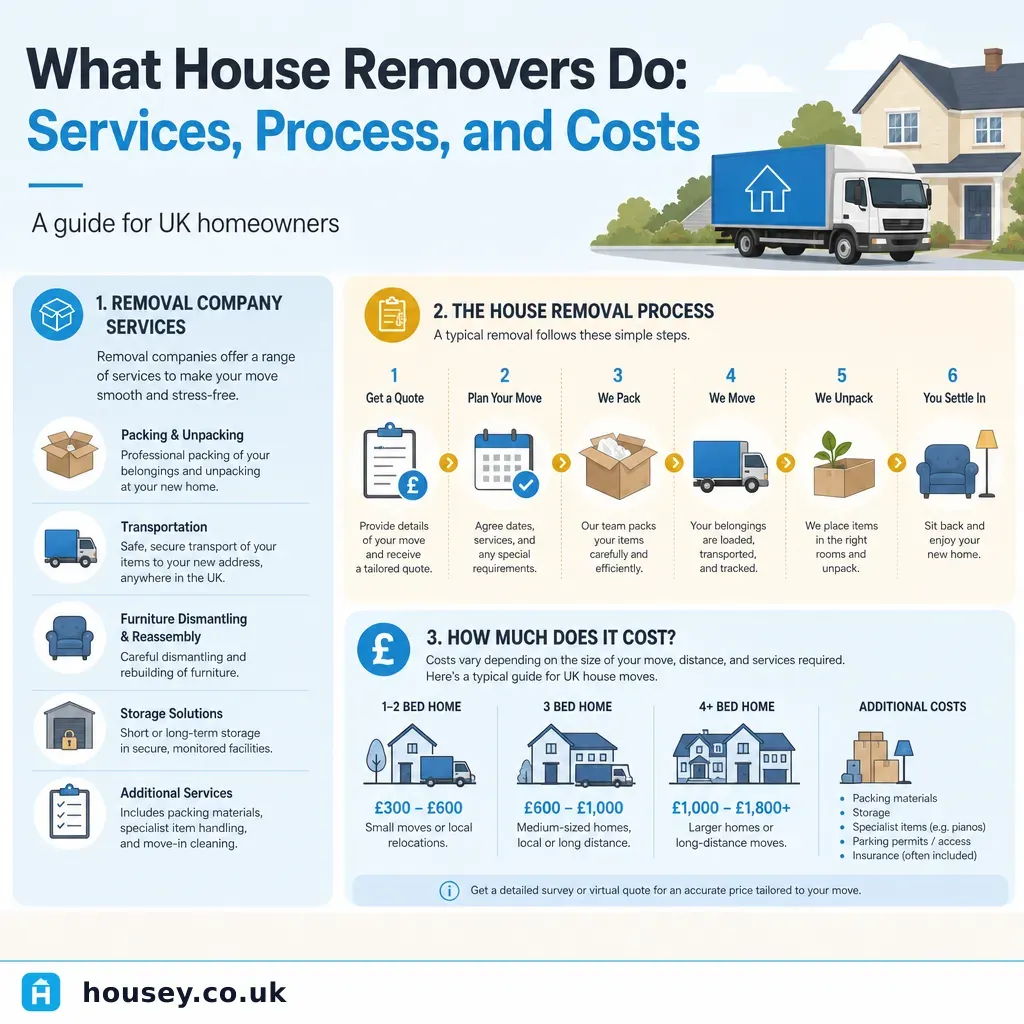
What House Removers Do: Services, Process, and Costs
House removers load, transport, and unload your belongings between properties.