Streamlining Your House Move: Key Steps to Avoid Delays
By Housey · Last reviewed 19th of May 2026
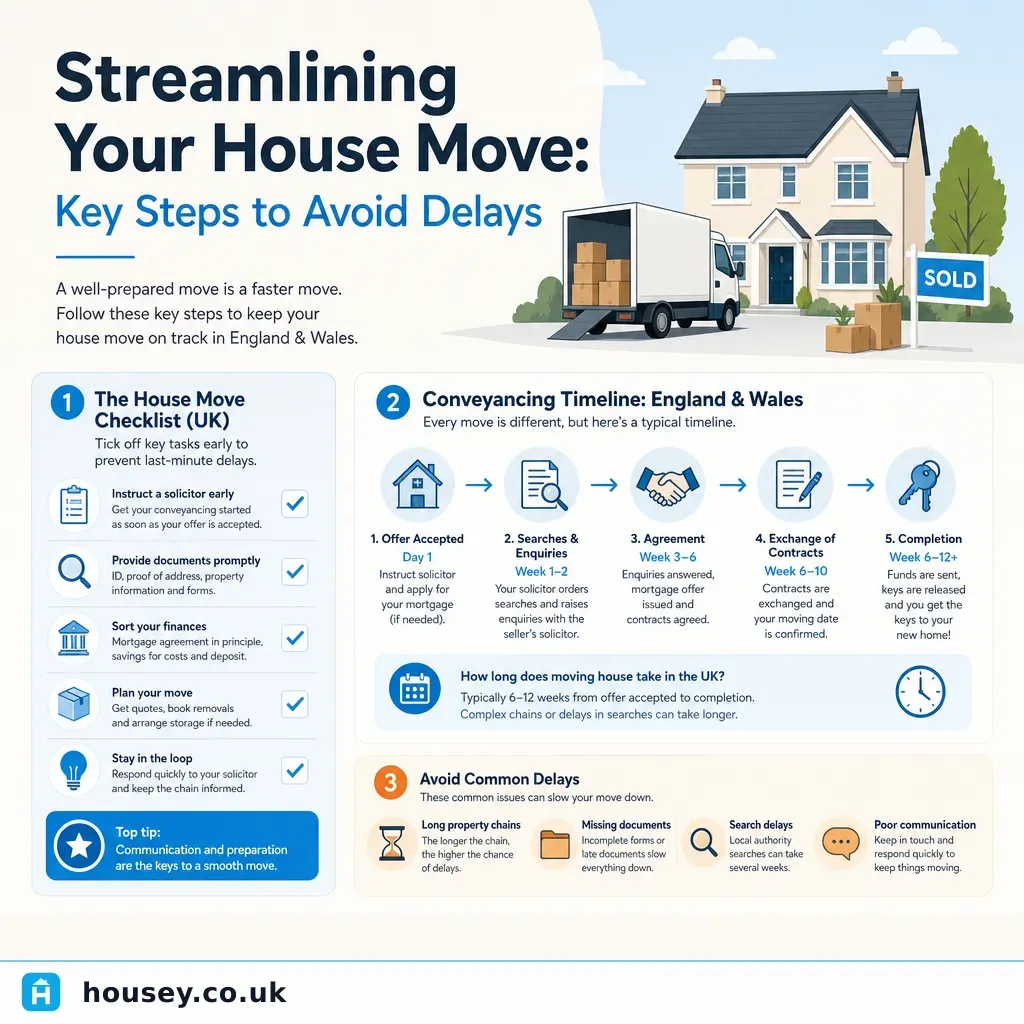
Streamlining Your House Move: Key Steps to Avoid Delays
A house move involves interlocking processes — conveyancing, property surveys, mortgage arrangements, and removal logistics — that must align for completion to happen on time. Delays at any one stage ripple through a chain, and the consequences can range from additional storage costs and extended temporary accommodation to losing a buyer or seller altogether.
Key points
- The average time from offer accepted to completion in England and Wales is 12–16 weeks; chains of three or more properties frequently take longer, with 20 weeks not uncommon.
- Exchange of contracts is the legally binding commitment in English and Welsh property law — until exchange, either party may withdraw without financial penalty beyond survey and legal costs already incurred.
- Conveyancers require official copies of the title register (from HM Land Registry), completed Property Information Forms (TA6 and TA10), and evidence of identity before substantive work can begin.
- Local authority search turnaround times vary widely — from under one week in some councils to 4–6 weeks in others — and are one of the most common sources of unexpected delay.
- In Scotland, property transactions proceed under Scots law; conclusion of missives creates a binding contract earlier in the process than exchange of contracts does in England and Wales.
Where delays typically cluster
Understanding which stages cause the most disruption helps you act before problems compound.
Stage | Typical duration | Common delay triggers |
|---|---|---|
Offer accepted to survey instructed | 1–2 weeks | Awaiting mortgage decision; choosing surveyor |
Survey booked to report received | 1–3 weeks | Surveyor availability; access difficulties |
Conveyancer searches | 2–6 weeks | Local authority search backlogs (vary by council) |
Mortgage offer issued | 2–4 weeks | Lender valuation delays; underwriting queries |
Exchange of contracts | Once all enquiries resolved | Outstanding queries; chain holdups at any point |
Exchange to completion | Typically 1–4 weeks | Agreed move dates; removal logistics |
Local authority searches are among the most unpredictable elements. Your conveyancer may be able to obtain insurance-backed indemnity searches, returned in 24–48 hours, if your mortgage lender will accept them — ask about this option early rather than waiting to discover how long a standard search will take.
Documents to prepare before you start
The fastest way to introduce delay is to wait until your conveyancer requests a document before locating it. Begin gathering these when an offer is agreed:
If you are selling:
- Title deeds or HM Land Registry title number
- Completed TA6 (Property Information Form) and TA10 (Fittings and Contents Form)
- Planning permissions and building regulations completion certificates for extensions or structural alterations
- Gas Safe certificates and boiler service history
- Electrical Installation Condition Report (EICR) if available
- FENSA or CERTASS certificates for replacement windows and doors
- Any existing property surveys or specialist reports
If you are buying:
- Proof of identity (passport or driving licence) and proof of address (recent utility bill or bank statement)
- Bank statements covering at least three months to evidence deposit funds
- Gifted deposit letter and the donor's bank statements if part of the deposit is a gift
- Mortgage Agreement in Principle
Having these ready at the outset can reduce the conveyancing period by one to three weeks.
Decision tree: spotting and unblocking delays
- Survey reveals a significant defect → Ask your solicitor to raise formal enquiries and instruct a specialist report without delay. Unresolved enquiries will block exchange.
- Your buyer's mortgage is taking more than three weeks → Ask them to chase their mortgage broker. If a lender's valuation has not yet been booked, that is the most likely bottleneck.
- Local authority search outstanding at week five → Ask your solicitor whether an insurance-backed indemnity search is acceptable to your lender as an alternative.
- Someone in the chain is not progressing → Identify the specific block and who owns it. A chain moves only as fast as its slowest participant.
- You have not yet confirmed a removal firm → Shortlist and provisionally book before exchange. Late bookings in peak periods (March–April, July–August, December) result in limited choice and higher cost.
- Your completion date is disputed between parties → Agree a target date in writing as early as possible. Changing it after exchange requires all parties in the chain to agree.
Worked example: a three-property chain in Bristol
Scenario: Aisha is a first-time buyer purchasing a Victorian terrace from Marcus, who is in turn buying a new-build from a developer.
- Week 1–2: Offer accepted. Aisha instructs both her conveyancer and a RICS Level 2 surveyor on the same day.
- Week 3: Survey completed. Damp is noted near the bay window. Aisha commissions a specialist damp report (£150 call-out). Marcus's Property Information Forms arrive incomplete — no FENSA certificate for recently replaced windows. Marcus obtains a replacement certificate via the FENSA website within 48 hours.
- Week 5: Aisha's mortgage offer arrives. Bristol City Council returns local authority searches in three weeks.
- Week 6–7: All outstanding enquiries resolved. The developer confirms the new-build is ready for occupation.
- Week 8: Exchange of contracts across all three parties simultaneously. Completion set for week 10.
- Week 10: Completion day. Aisha's removal firm — provisionally booked at week four — collects from her rental flat at 8 a.m.
What made this work: Simultaneous instruction of conveyancer and surveyor on day one; prompt resolution of the FENSA query; and the removal firm booked before exchange rather than after.
Moving day checklist
Important limitations
This article provides general guidance on the house-moving process in England and Wales. Conveyancing is a regulated legal activity; the timescales, forms, and processes described here are illustrative. Your transaction may differ depending on property title, tenure (freehold or leasehold), mortgage lender requirements, and local authority procedures. Nothing in this article constitutes legal advice. Always instruct a qualified solicitor regulated by the Solicitors Regulation Authority (SRA) or a licensed conveyancer regulated by the Council for Licensed Conveyancers (CLC) for your transaction.
When to get professional help
Seek qualified legal advice immediately if:
- Completion monies have not been received by the agreed time on completion day
- Your buyer or seller has served a notice to complete
- Title issues, missing planning consents, undisclosed easements, or boundary disputes emerge during the process
- You are being pressured to exchange before all searches, enquiries, and mortgage conditions are resolved
- Your chain collapses and you need to assess your legal position regarding costs already incurred
Your conveyancer is your first point of contact for most issues. If you feel your conveyancer is unresponsive or has made an error, the Legal Ombudsman handles complaints about solicitors and licensed conveyancers in England and Wales, and the SRA handles serious professional conduct concerns.
What to ask a qualified professional
Before instructing a conveyancer:
- Are you regulated by the SRA or CLC, and is this firm accredited under the Law Society's Conveyancing Quality Scheme (CQS)?
- What is your current average time from instruction to exchange on a transaction like mine?
- How will you communicate progress, and what is your typical response time to queries?
- Are all costs quoted inclusive of disbursements, search fees, and VAT?
- Are you on my mortgage lender's approved panel?
During the transaction:
- What are the outstanding items currently preventing exchange?
- Is an indemnity insurance policy appropriate for any missing certificates or consents?
- What do I need to do now to keep the process moving?
How Housey can help
Housey makes it straightforward to compare vetted professionals across every stage of a move. Find and compare quotes for conveyancing from regulated solicitors and licensed conveyancers, book trusted house removals from local firms with verified reviews, and arrange storage if your completion dates do not align perfectly. Getting the right team instructed early is the most reliable way to keep a move on track.
Frequently asked questions
How long does conveyancing take in England and Wales?
Conveyancing typically takes 8–14 weeks for a straightforward purchase or sale. Chains and complex titles can extend this to 16–20 weeks or more. The main variables are local authority search turnaround, mortgage processing times, and how promptly all parties respond to enquiries. Instructing your conveyancer on the same day an offer is accepted — not after mortgage approval — removes one of the most common sources of early delay.
Can I exchange and complete on the same day?
Yes. Simultaneous exchange and completion is possible and common for first-time buyers with no chain, where all parties are ready and funds are in place. It is less common in a chain because coordinating multiple parties on the same day increases the risk of last-minute collapse. Both exchange and completion must be confirmed by your solicitor and all related parties before the day.
What happens if my buyer pulls out before exchange?
In England and Wales, either party may withdraw before exchange without financial penalty, though you may not recover survey and legal costs already spent. This is why exchange — not acceptance of an offer — is the legally significant milestone. After exchange, the withdrawing party typically forfeits the deposit or faces a damages claim. In Scotland, the binding commitment arises at conclusion of missives, which occurs earlier in the process.
Should I book removals before or after exchange?
Shortlist and provisionally book a removal firm once you have an expected completion date, even before formal exchange. Most firms will hold a provisional date without full payment. In peak periods — late spring, summer, and December — demand often exceeds supply. Waiting until after exchange in these periods frequently results in limited availability, higher costs, or the need to settle for a less experienced firm.
Sources and further reading
- GOV.UK — Buying and selling a home — HM Government
- Citizens Advice — Moving house — Citizens Advice
- The Law Society — Buying and selling your home — The Law Society
- Royal Mail — Redirection service — Royal Mail
- Legal Ombudsman — Making a complaint — Legal Ombudsman
Useful next reads
 Buying & Moving
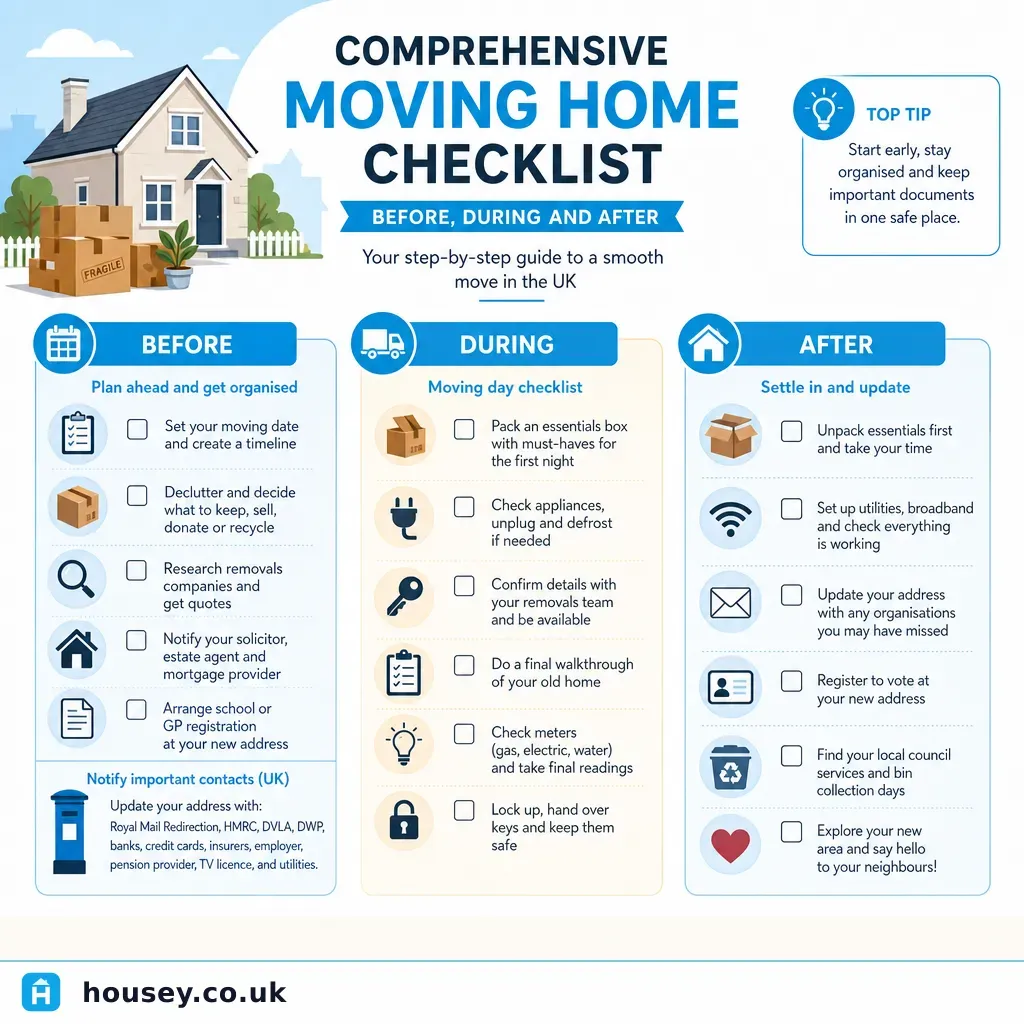
Comprehensive Moving Home Checklist: Before, During and After
Moving house in the UK involves tasks across roughly eight weeks: instructing a conveyancer and removal firm early, systematically notifying organisations of your new address, confirming buildings insurance from exchange, taking meter readings on completion day, and registering with the new council and utilities promptly.
 Buying & Moving
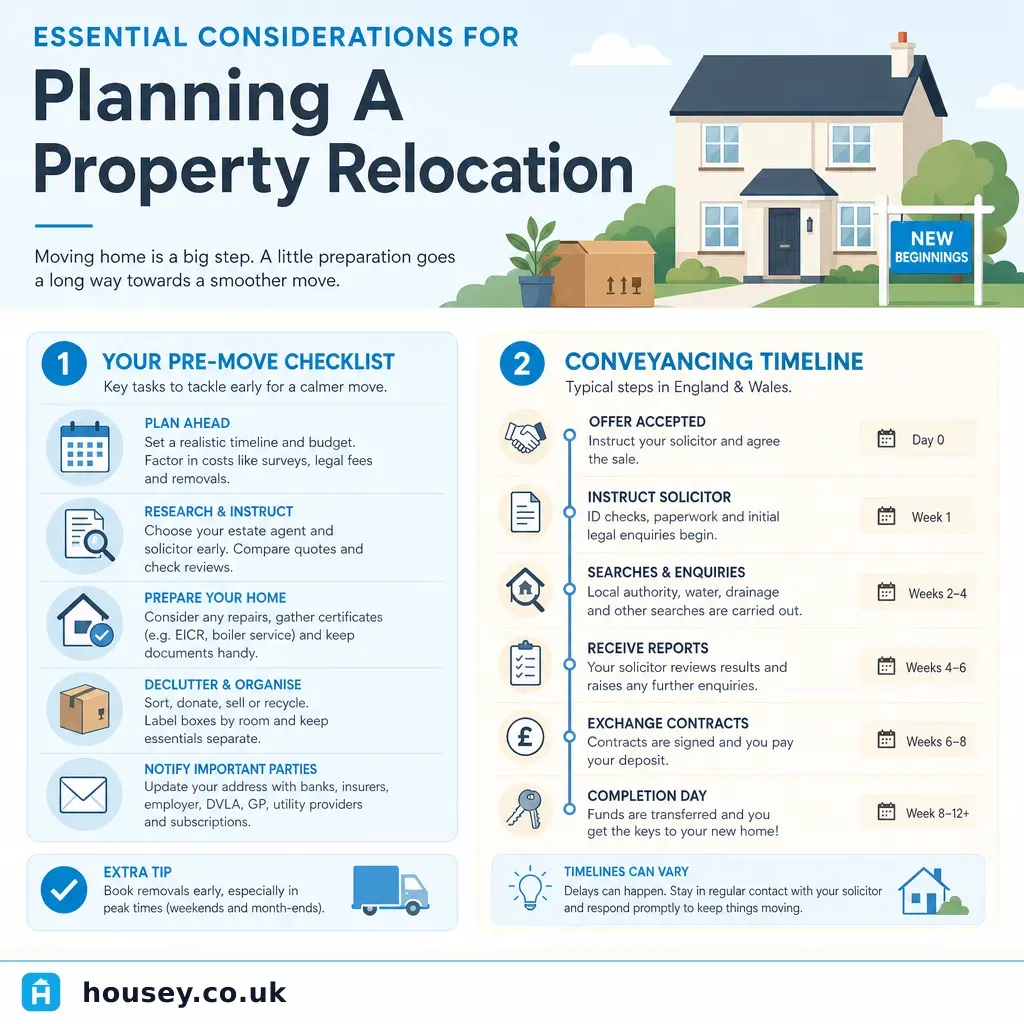
Essential Considerations For Planning A Property Relocation
Planning a UK property relocation means coordinating legal, financial, and practical steps across several months.
 Buying & Moving
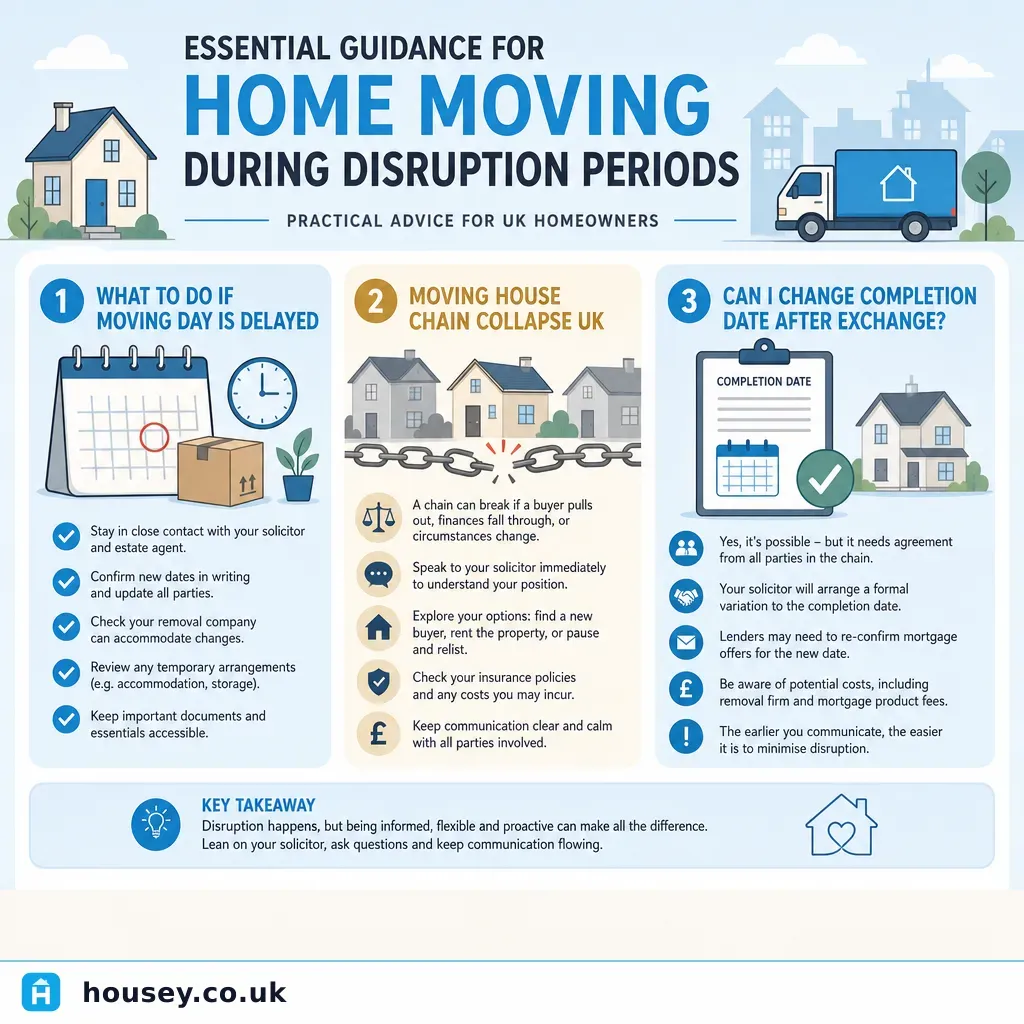
Essential Guidance for Home Moving During Disruption Periods
If disruption affects your move, your options depend on whether you have exchanged contracts.
 Buying & Moving
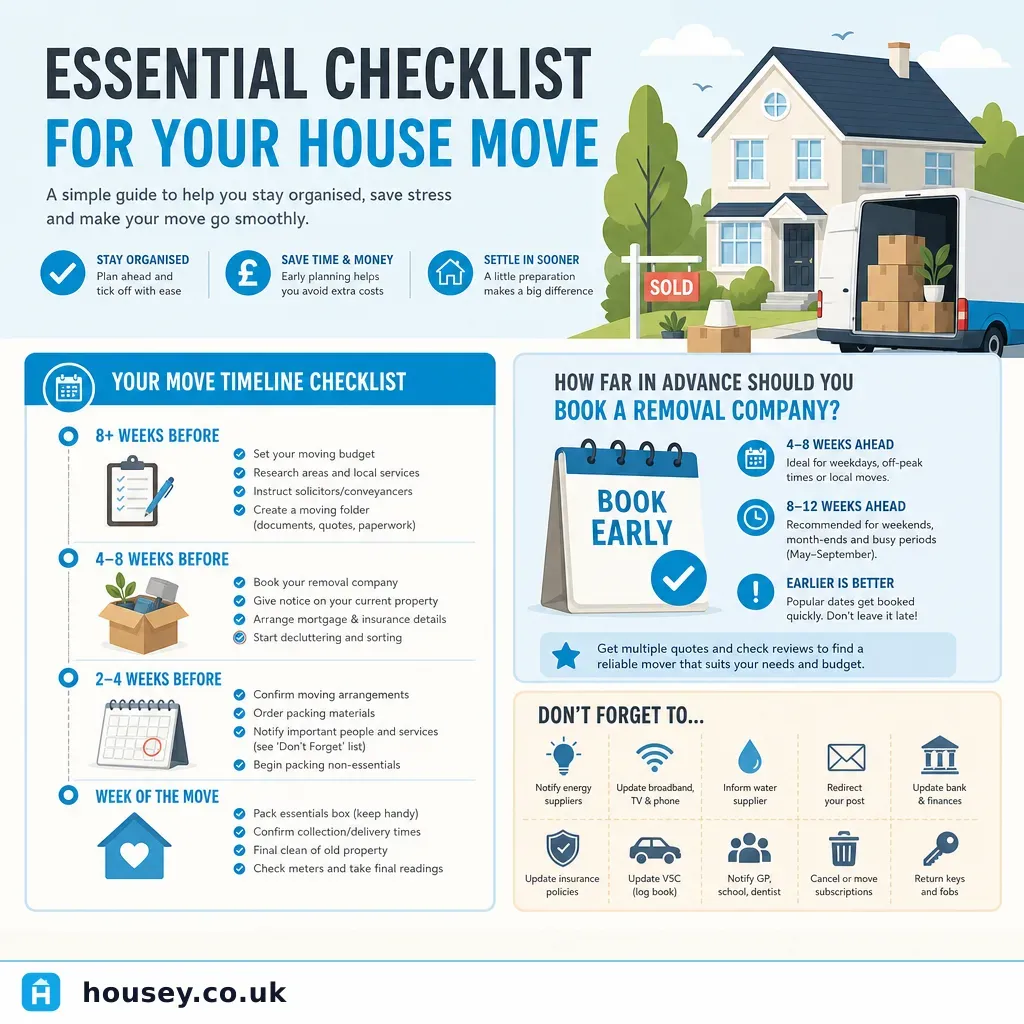
Essential Checklist for Your House Move
A successful UK house move relies on a staged checklist covering eight to twelve weeks before moving day through to two weeks after arrival.
 Buying & Moving
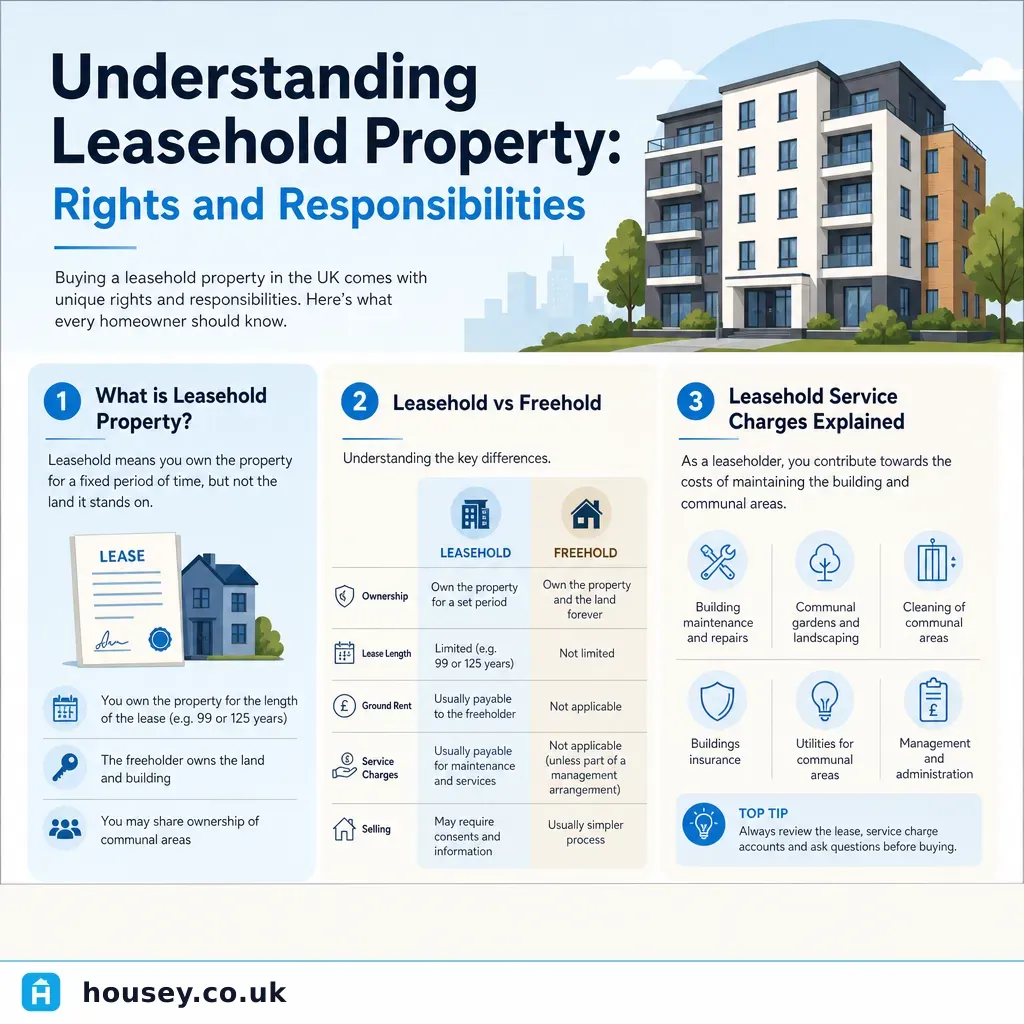
Understanding Leasehold Property: Rights and Responsibilities
Leasehold means you own a time-limited interest in a property while the freeholder owns the land and building.