How Removal Services Integrate Storage Solutions
By Housey · Last reviewed 30th of May 2026

How Removal Services Integrate Storage Solutions
For many UK movers, completion dates do not align neatly: you finish on your sale before your purchase is ready, a new build runs late, or you are downsizing but are not yet certain what will fit the new property. Removal companies have adapted to this reality by building storage directly into their service offering, removing the need to arrange a separate facility or manage two sets of logistics. Understanding how that integration works — and what to ask before you book — helps you avoid unexpected costs and plan a smoother move.
Key points
- Most removal companies with integrated storage use either containerised storage (a sealed unit filled at your home and transported to a warehouse) or warehouse racking (items catalogued and stored on individual shelving in a shared facility).
- BAR (British Association of Removers) membership means a firm's storage facilities should meet minimum industry standards; BAR also operates a pre-payment protection scheme for consumers.
- Goods-in-storage insurance is usually included in a removal firm's service, but standard cover limits are often capped — commonly £30,000–£50,000 — so high-value items may need separate declaration or additional cover.
- Short-term storage of one to eight weeks between exchange and completion is the most common use case in UK residential moves.
- Re-delivery notice periods typically range from 24 to 72 hours depending on the firm and storage model; confirm this before signing any agreement.
What integrated removal and storage actually means
Choosing the right model starts with understanding what integrated storage involves. The removal firm handles collection, transportation, and holding of your belongings without you arranging a third-party facility. The company loads your goods on moving day, transports them to their warehouse, and releases them when you need re-delivery.
This differs from hiring an independent self-storage unit, where you retain full access and manage the space yourself. With integrated removal storage, the firm typically holds goods in sealed containers on your behalf.
Comparing the main storage models:
Model | How it works | Best for | Access during storage |
|---|---|---|---|
Containerised storage | Your goods fill a dedicated container at your property; it is sealed and stored in a warehouse | Short gaps between moves; security-focused customers | Pre-arranged only — not walk-in |
Warehouse racking | Items are individually catalogued and stored on shelving in a shared facility | Longer-term storage; partial retrieval needed | Often available with scheduled notice |
Independent self-storage | You hire a unit and manage it yourself; removal firm drops goods off, you handle access | Full control; frequent access needed | Unrestricted during opening hours |
Common reasons UK homeowners use combined removal and storage
A gap between completion dates is the most frequent driver of integrated storage use in the UK. In England and Wales, chain-related timing uncertainty means sellers and buyers rarely complete simultaneously, leaving a period where belongings must go somewhere. Other common scenarios include:
- New build delays: developer completion dates can shift by weeks or months, particularly for apartment blocks.
- Probate clearances: you may need to empty a property quickly while decisions about the contents are still being made.
- Downsizing: moving to a smaller home means some items need temporary storage while you decide what to keep.
- Renovation before move-in: you have completed on a property but want to carry out works before furniture arrives.
- Landlord refurbishment: storage is needed between tenancies when significant works are under way.
How the booking and collection process works
When requesting an integrated removal and storage quote, most firms conduct a home survey — in person or via video call — to assess the volume of goods, identify specialist-handling requirements, and calculate the number of vehicles and storage containers needed. The survey forms the basis of a combined quote covering:
- Removal day labour and vehicles.
- Packing materials and services (if selected).
- Storage container or warehouse space.
- Re-delivery to your new address.
Confirm whether VAT is included and whether the quote is fixed-price or subject to variation if the volume assessed differs from the actual load on moving day.
What to ask before accepting a removal and storage quote
Before committing, ask the following:
- What is included and excluded? Does the quote cover packing materials, furniture dismantling, and re-delivery?
- What insurance is provided? What is the per-claim limit, and what is excluded — for example, fragile items or goods not packed by the firm?
- How is storage priced? Per week, per container, or per cubic metre? Are there minimum storage periods?
- Is the storage facility alarmed, monitored, and fire-protected? What pest control arrangements are in place?
- How much notice is required for re-delivery? Some firms need 48–72 hours to prepare your container.
- Is temperature control available? Important for antiques, musical instruments, and certain electronics.
- What happens if your storage period extends? Are there automatic price increases or penalty charges after an initial term?
- Is the firm a BAR member or affiliated with another trade body? BAR membership requires facilities to meet minimum standards and provides a pre-payment protection scheme.
Homeowner checklist: preparing for removal with storage
Before collection day, work through the following:
When to get professional help
Removal and storage is generally straightforward, but a few situations warrant additional care:
- If you have high-value items — art, antiques, wine, musical instruments — worth more than the firm's standard insurance cap, arrange specialist valuations and additional cover before moving day.
- If your storage period is likely to exceed three months, compare integrated removal storage costs against independent self-storage for the same volume; self-storage can offer better value at longer durations.
- If you are using storage as part of a probate clearance, consult a solicitor if there is any uncertainty about ownership of contents before moving or disposing of items.
How Housey can help
Housey connects you with vetted house removals companies across the UK, including firms that offer integrated storage solutions. Compare quotes from pre-screened local providers to find the right combination for your move dates and budget.
Frequently asked questions
How long can I store my belongings with a removal company?
Most removal firms offer storage terms from one week up to 12 months or longer. Short-term storage of one to eight weeks is most common for house moves. For longer commitments, ask about tiered pricing — the weekly rate often reduces the longer you store, so get a breakdown before committing.
Is my furniture insured while in a removal company's storage facility?
Removal companies typically include goods-in-storage insurance, but cover limits and exclusions vary. Check the policy for per-claim limits and note that high-value items, jewellery, and goods not packed by the firm are often excluded. Declare high-value items separately if the policy requires it.
Can I access my belongings during removal storage?
Access depends on the storage model. Containerised storage usually requires 24–72 hours' advance notice to retrieve items. Warehouse racking facilities may offer scheduled access visits. Confirm access arrangements before booking, particularly if you expect to need items during the storage period.
Is integrated removal storage cheaper than separate self-storage?
Not always. For short-term gaps where double-handling would be impractical, integrated storage is often competitive. For longer durations or frequent access needs, independent self-storage may offer better value. Compare itemised quotes from both options, including re-delivery costs, before deciding.
Sources and further reading
- British Association of Removers — member search and standards — British Association of Removers (BAR)
- GOV.UK — buying or selling property — GOV.UK
- Citizens Advice — moving home — Citizens Advice
Useful next reads
 Buying & Moving
Planning Your Home Removal: What to Expect from Professional Services
A professional removal company loads, transports, and unloads your household belongings between properties.
 Buying & Moving
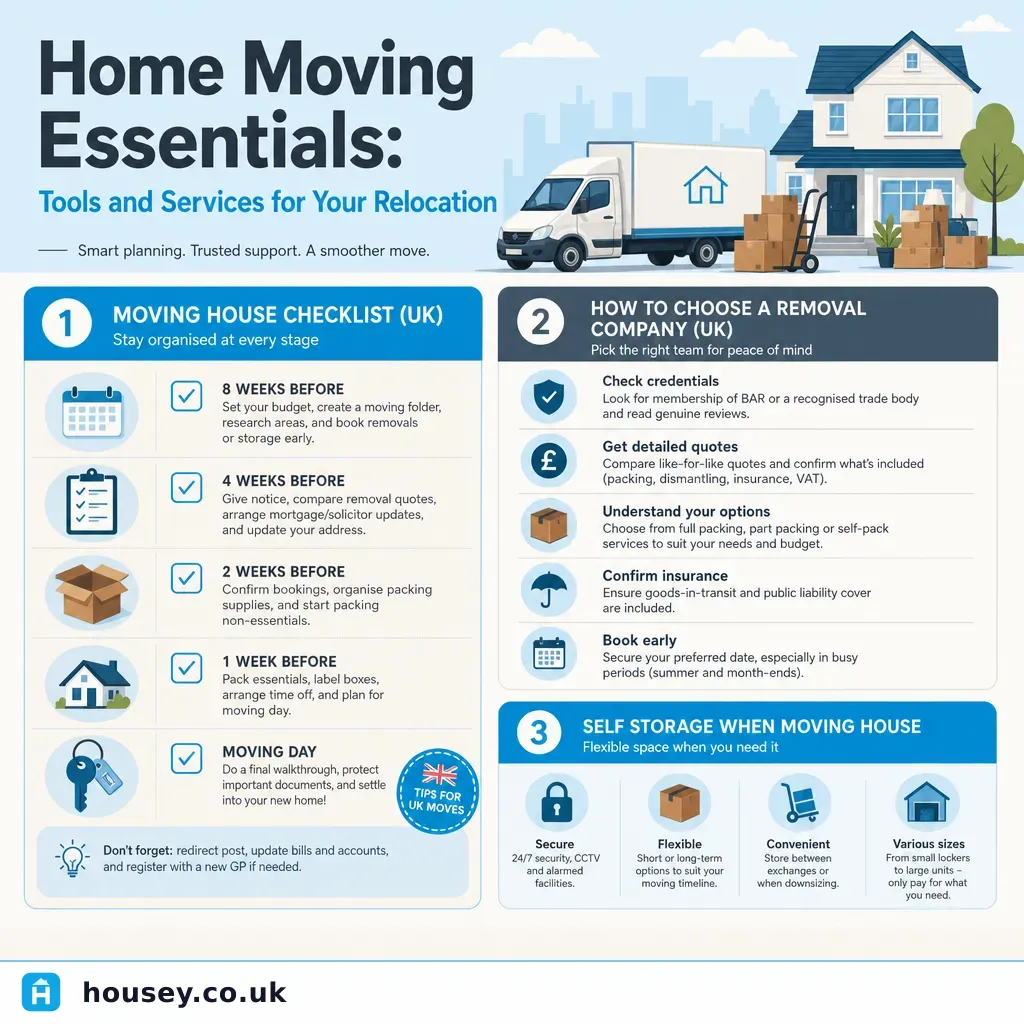
Home Moving Essentials: Tools and Services for Your Relocation
Moving house in the UK involves far more than hiring a removal van.
 Buying & Moving
House Removal Costs and Moving Logistics: A UK Guide
House removals in the UK typically cost £300–£1,500 for a local move and £800–£4,000+ for a long-distance or large property removal, depending on volume, distance, and services chosen.
 Buying & Moving
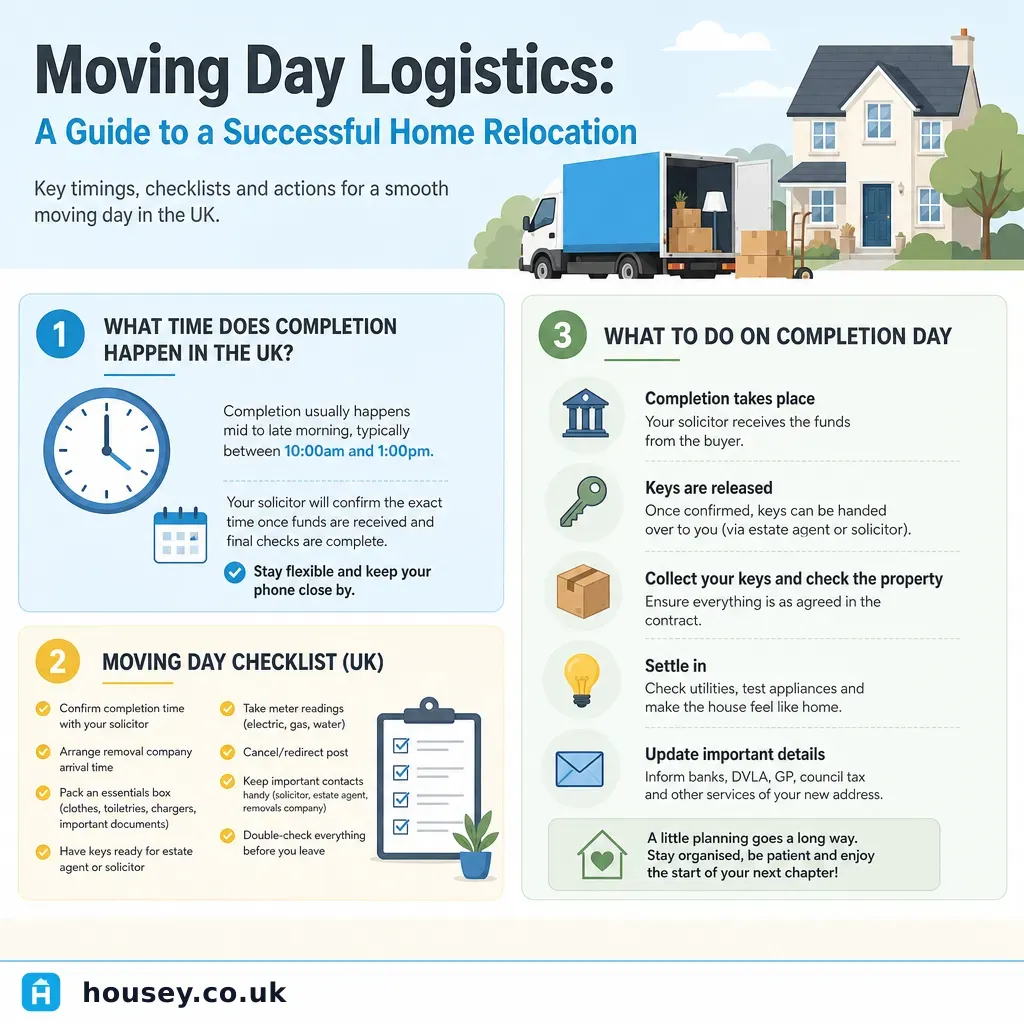
Moving Day Logistics: A Guide to a Successful Home Relocation
On moving day, wait for your solicitor to confirm completion before collecting keys — there is no fixed handover time and most UK completions happen between 11am and 2pm.
 Buying & Moving
How to Plan a House Move: A Practical Guide to Residential Relocations
A UK house move goes more smoothly with planning that starts 6–8 weeks before moving day.