Home Moving Essentials: Tools and Services for Your Relocation
By Housey · Last reviewed 18th of May 2026
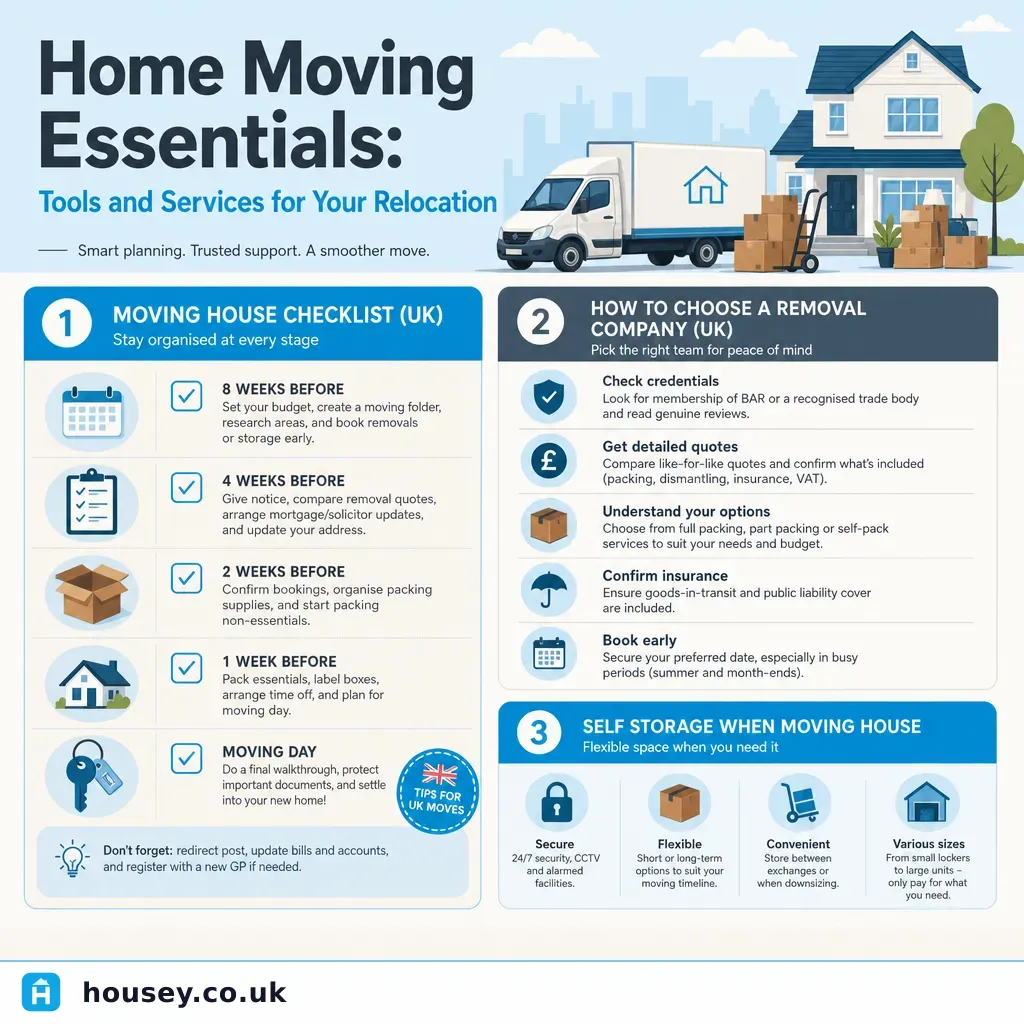
Home Moving Essentials: Tools and Services for Your Relocation
Moving house touches nearly every aspect of daily life at once — managing a chain, coordinating tradespeople, notifying a dozen institutions, and physically transporting everything you own to a tight and often immovable timeline. For most people in the UK, the true logistical complexity only becomes clear once contracts are exchanged and a completion date is confirmed. Planning which services you need, and booking them in the right order, can make the difference between a smooth handover and a stressful, costly one.
Key points
- Most full-service UK removal companies carry out a pre-move survey — often at no charge — before providing a fixed or itemised quote; always request this before accepting any price.
- Removal firms that are members of the British Association of Removers (BAR) are bound by a Code of Practice and offer an independent Alternative Dispute Resolution (ADR) scheme for consumers.
- For tenanted properties, an independent inventory clerk's check-out report is the primary evidence used in tenancy deposit disputes — a landlord-produced report carries significantly less evidential weight with deposit protection schemes.
- Self-storage facilities typically require a minimum of one month's rental; 24-hour access units generally cost more than standard daytime-access options.
- Specialist removers for pianos, antiques, wine, and fine art usually require separate insurance and specialist packing — confirm this explicitly when requesting a quote.
What moving services do you actually need?
The right combination of services depends entirely on your situation. A first-time buyer moving from a rented flat needs very different support from a family selling a four-bedroom semi with a garage, loft, and twenty years of accumulated belongings.
Situation | Services likely needed |
|---|---|
Moving from rented flat, limited belongings | Removal van or man-and-van; house clearance for unwanted items |
Family move with full household contents | Full-service removal company; packing materials; possible storage |
Property sale with no onward purchase confirmed | House clearance; self-storage; removal with integrated storage facility |
Landlord with tenant moving out | Independent inventory clerk (check-out); house clearance if required |
Selling a property before going to market | Property photography and floorplans |
Moving fragile or high-value items | Specialist removers with appropriate accreditation and bespoke insurance |
Choosing and comparing removal companies
Removal quotes vary significantly based on volume of goods, distance, access conditions (stairs, parking restrictions, narrow streets), packing requirements, and time of year. Moving on a Friday or at the end of the month — when the majority of residential completions in England and Wales cluster — often attracts a premium from popular firms.
What to ask before accepting a removal quote
- Will you carry out a pre-move survey (in-person or by video call) before providing your quote?
- Is the quote fixed-price or estimated — and what factors could cause the final price to increase?
- What insurance is included for loss or damage to goods, and what is the claims process and timeframe?
- Are packing materials and packing services included in the price, or charged separately?
- Are you a member of the British Association of Removers (BAR) or another recognised trade body?
- How do you handle parking restrictions, narrow access, or items that cannot pass through doorways?
- What is your cancellation or postponement policy if completion is delayed by the chain?
Obtaining at least three quotes is advisable for larger moves. Verify that each quote covers the same scope — some firms include packing labour and materials, others do not.
When to book — and your moving timeline checklist
For a standard residential move, most removal companies recommend booking 4–6 weeks in advance. During peak periods (late spring and summer, school holiday weekends, end-of-month Fridays), 8 weeks or more is sensible. Once exchange of contracts has occurred and a completion date is confirmed, book immediately.
Moving timeline checklist:
Storage: bridging the gap between properties
Self-storage is a practical option when there is a gap between leaving one property and gaining access to the next — a situation that arises in chain breaks, renovation projects where the new property is not immediately habitable, or when downsizing requires time to decide what to keep.
Key questions when comparing self-storage facilities:
- Is access available 24 hours a day, or restricted to staffed business hours?
- Is the unit climate-controlled (important for antiques, electronics, wine, or musical instruments)?
- What security measures are in place — CCTV, individual door alarms, on-site staff?
- What is the minimum rental period, and how much notice is required to vacate?
- Is contents insurance included in the rental price, or do you need a separate policy?
Many removal companies offer storage as part of a single contract, which can simplify logistics when you do not yet have a confirmed delivery date for the new property.
House clearance: removing what you are not taking
If a property contains furniture, appliances, or accumulated belongings that will not be moving to the new address, a professional house clearance service can remove them quickly and legally. Reputable clearance firms should hold a valid waste carrier registration (verifiable on the GOV.UK check-a-waste-carrier service) and be able to provide a waste transfer note on request. Items in good condition are often donated to charities or resold rather than sent to landfill.
Red flags with house clearance quotes:
- A price given without visiting or inspecting the property in person.
- No mention of waste carrier registration or an inability to provide a waste transfer note.
- Payment demanded entirely in cash with no written receipt or paperwork.
- No explanation of whether items will be disposed of, donated, or sold on.
Inventory clerks for tenanted properties
If you are moving out of a rented property, or if you are a landlord with a tenant vacating, an independent inventory clerk produces an objective check-out report comparing the property's current condition against the original check-in inventory. This report is the primary evidence used in tenancy deposit disputes administered through the relevant deposit protection scheme — the Tenancy Deposit Scheme (TDS), Deposit Protection Service (DPS), or MyDeposits.
A report produced by the landlord or letting agent carries significantly less weight. An independent clerk's report — particularly one countersigned by the outgoing tenant — is more likely to be accepted as authoritative in a formal dispute.
Property photography and floorplans before you sell
If you are selling your current property before moving, professional property photography and floorplans can affect both the speed of sale and the price achieved. Estate agents often include photography in their standard fee, but quality varies considerably between agents. Independent photographers specialising in residential property typically produce stronger results, particularly for low-light rooms, challenging exterior angles, and properties where layout is a key selling point.
When to get professional help
For most standard UK moves, a reputable removal company combined with clearance and storage where needed is sufficient. Seek specialist help if:
- You are moving high-value or fragile items — art, antiques, wine collections, or pianos — where standard removal insurance may not provide adequate cover.
- Your property has restricted access, listed building constraints, or an unusual layout requiring specialist equipment or planning.
- You are involved in a contested tenancy deposit dispute and need professional independent documentation of the property's condition.
- You are managing a property clearance involving hoarding situations or specialist waste streams that require licensed contractors.
How Housey can help
Housey connects you with vetted house removal companies, house clearance specialists, independent inventory clerks, and self-storage providers across the UK — so you can compare quotes and book the right combination of services for your specific move, without starting your search from scratch.
Frequently asked questions
How far in advance should I book a removal company?
For most moves, 4–6 weeks ahead is sufficient. During peak periods — May to September, end-of-month completion dates, and school holiday weeks — 8 weeks or more is advisable. Never leave booking until after exchange: the typical gap between exchange and completion (one to four weeks) is too short for popular firms in busy seasons, and last-minute availability often costs significantly more.
What insurance do removal companies typically provide?
Most removal companies include basic goods-in-transit and public liability insurance in their standard terms, but the level of cover varies considerably. Check the excess, the basis of valuation (replacement or depreciated value), and whether high-value or fragile items require a separate declaration or additional premium. Ask for written confirmation of what is and is not covered before you sign the contract.
Do I need a separate inventory clerk if my estate agent offers the service?
For tenant moves, a truly independent clerk — not employed by the letting agent or landlord — is the safest option. Tenancy deposit protection schemes give more evidential weight to independent reports, particularly when countersigned by the outgoing tenant. An agent-produced report is more likely to be challenged successfully by a tenant in a formal dispute process.
Can I use the same company for removals and storage?
Yes — many removal companies offer integrated storage as part of a single contract, which simplifies coordination when there is a gap between move dates. Compare the daily or monthly storage rate against standalone self-storage facilities, and check the access hours, contents insurance terms, and minimum rental period carefully before committing to a combined arrangement.
Sources and further reading
- Using a removal firm — Citizens Advice
- British Association of Removers (BAR) — Code of Practice and consumer protection — BAR
- Royal Mail redirection service — Royal Mail
- Tenancy deposit protection schemes — GOV.UK
- Check if a business or broker carries waste legally — Environment Agency / GOV.UK
Useful next reads
 Buying & Moving
How Removal Services Integrate Storage Solutions
Many UK removal companies offer integrated storage as part of their moving service, letting you store belongings in a secure facility — often a sealed container or warehouse unit — when completion dates do not align.
 Buying & Moving
The Evolution and Development of the Removals Industry
The UK removals industry has transformed from Victorian horse-drawn furniture wagons into a specialist logistics sector with professional accreditation, containerised storage, international moves, and digital booking.
 Buying & Moving
House Removal Costs and Moving Logistics: A UK Guide
House removals in the UK typically cost £300–£1,500 for a local move and £800–£4,000+ for a long-distance or large property removal, depending on volume, distance, and services chosen.
 Buying & Moving
Moving Day Logistics: A Guide to a Successful Home Relocation
On moving day, wait for your solicitor to confirm completion before collecting keys — there is no fixed handover time and most UK completions happen between 11am and 2pm.
 Buying & Moving
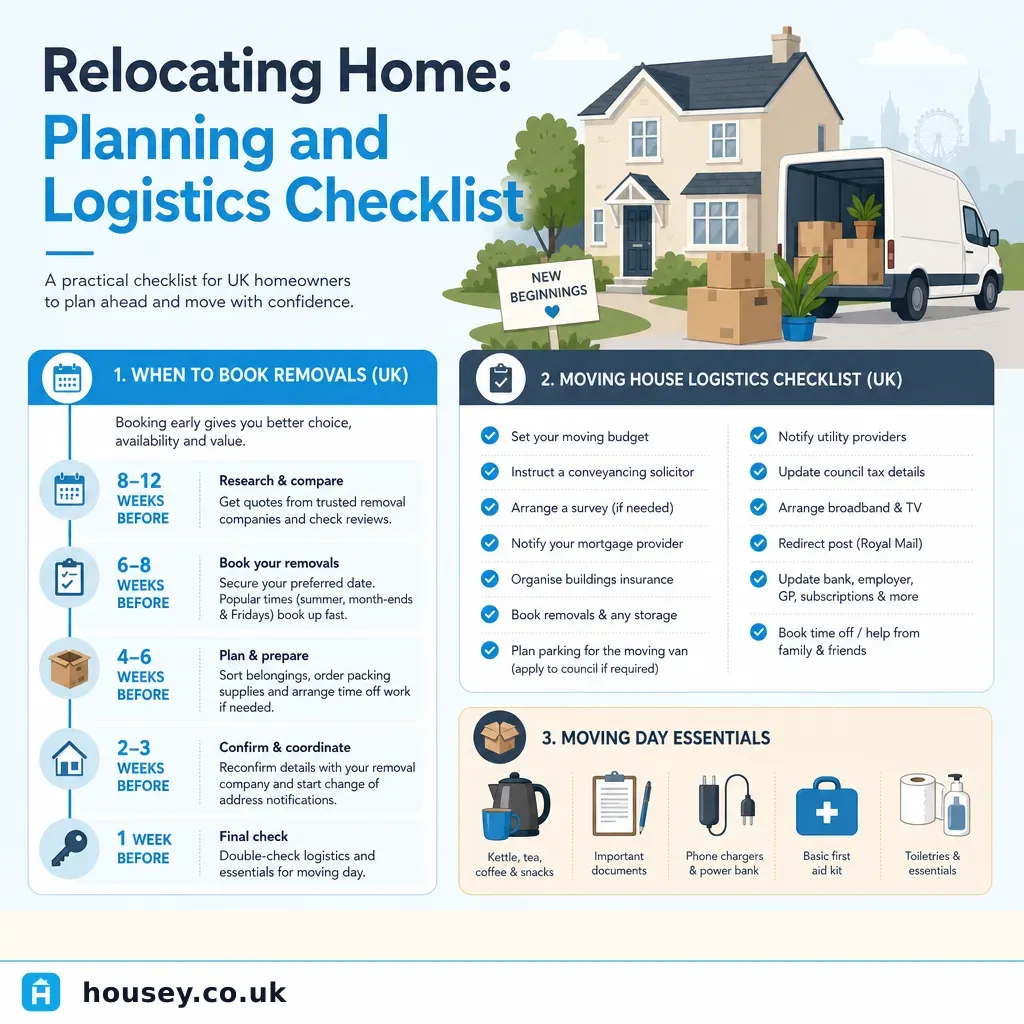
Relocating Home: Planning and Logistics Checklist
Successful home relocation in the UK typically requires 8–12 weeks of advance planning.