How to Sell Your House Fast in the UK
By Housey · Last reviewed 24th of May 2026
How to Sell Your House Fast in the UK
Slow property sales cost money — in ongoing mortgage payments, extended holding costs, and the risk of a deal collapsing before completion. Whether you are relocating for work, in a time-sensitive chain, or simply want to avoid months of uncertainty, the strategies that move a property quickly are well understood, even if they are not always followed.
Key points
- A valid Energy Performance Certificate (EPC) is a legal requirement before your property can be marketed for sale in England; failing to provide one can result in a penalty of up to £5,000.
- Overpricing at launch is the most common cause of prolonged time on market; properties that require a price reduction typically sell for less than those priced correctly from day one.
- Instructing a conveyancer before accepting an offer — rather than after — can reduce the legal stage by four to eight weeks.
- Unconditional auction achieves the fastest legal completion — exchange on the fall of the hammer, completion within 28 days — but typically at below open-market value.
- Missing building regulations certificates for extensions, loft conversions, or other notifiable works are among the most common causes of delays at the solicitor enquiry stage.
Price it right from day one
The most reliable way to accelerate a sale is accurate pricing. An overpriced property accumulates days-on-market history that buyers and their agents can see, and typically sells for less after a reduction than it would have at the correct price from the outset.
Getting an accurate property valuation from a RICS-registered valuer, or at minimum two reputable local estate agents, gives you a reliable anchor. Online automated valuations are useful for context but should not replace professional judgement — they do not account for condition, recent improvements, or local market nuances.
When comparing agent valuations, treat any figure significantly higher than the others with caution. Overvaluing to win an instruction is a known practice. Ask each agent to justify their figure with comparable sold prices from HM Land Registry.
Choose your estate agent carefully
Not all estate agents deliver the same results. When speed matters:
- Review their average days to sell on Rightmove or Zoopla.
- Ask what proportion of their listings sell at or above asking price.
- Confirm what marketing is included: professional photography, floor plans, premium listing upgrades, and social media promotion.
- Ask about their buyer database — some agents have registered buyers actively looking in your price range who have not yet seen your property.
Sole agency agreements typically run for 6–12 weeks with notice periods. Multi-agency arrangements cost more in commission but can widen exposure quickly if speed is the overriding priority.
Get legal preparation underway early
One of the most effective and most overlooked ways to speed up a property sale is to instruct a conveyancer before you have an offer. Your solicitor or licensed conveyancer can prepare the contract pack in advance: completing the Property Information Form (TA6), the Fittings and Contents Form (TA10), gathering the title register from HM Land Registry, and requesting management information if the property is leasehold.
When an offer is accepted, sellers who have completed their legal groundwork are typically able to exchange four to six weeks sooner than those who wait. Professional conveyancing instructed early is one of the highest-leverage steps available to a motivated seller.
Presentation and kerb appeal
Buyers form impressions within seconds, both online and in person. Before listing:
- Declutter all rooms, including storage spaces — buyers open cupboards.
- Attend to visible maintenance: repaint scuffed walls, fix dripping taps, oil stiff door hinges.
- Improve kerb appeal: cut the grass, clear gutters, repaint the front door if faded.
- Ensure the property is well lit and clean for viewings.
Professional photography makes a measurable difference to click-through rates on property portals. If your agent uses a phone camera, ask why.
Which method of sale suits your situation?
Method | Best for | Not ideal for | Typical timescale | Main risk |
|---|---|---|---|---|
Traditional estate agent | Most sellers; maximises open-market price | Those needing completion in under 8 weeks | 12–26 weeks to completion | Chain collapse or slow legal process |
Online estate agent | Cost-conscious sellers comfortable managing viewings | Those needing strong local market expertise | 12–26 weeks | Less support through the process |
Unconditional auction | Unusual properties, probate, motivated sellers | Those needing maximum sale price | Exchange on fall of hammer; completion within 28 days | Sale price typically below open market |
Cash buying company | Sellers needing completion in 2–4 weeks | Those wanting open-market value | 2–6 weeks | Significant discount — typically 75–85% of market value |
Part-exchange (via developer) | Buyers purchasing a new-build who need to sell | Those not buying a new-build | Varies | Tied to developer's valuation |
Timescales are indicative. Actual completion dates depend on chain, mortgage, legal complexity, and local market.
Pre-sale checklist: what to do before you list
Red flags that may slow your sale
Watch out for these issues that commonly stall or kill property sales:
- Missing building regulations certificates for extensions, loft conversions, or other notifiable works — buyers' solicitors will raise these as enquiries and may require indemnity insurance.
- Short lease length (below 80 years on a leasehold flat) — this can make the property unmortgageable for buyers without a lease extension first.
- Japanese knotweed in or near the garden — legally required to be disclosed on the TA6; many mortgage lenders refuse to lend on affected properties.
- Unusual title issues such as flying freehold or shared driveways — these require specialist legal handling and slow the process significantly.
- Damp or structural issues discovered during a buyer's survey — address known defects before listing or price them in transparently; undisclosed issues can cause a sale to collapse at survey stage.
When to get professional help
If your property has been on the market for more than eight weeks without offers, seek a frank reassessment — of the price, the photography, the agent's marketing, and whether there are legal or condition issues deterring buyers. A RICS-registered surveyor can give an objective opinion of value and identify condition issues that may be affecting buyer confidence.
If you are considering a cash buying company or quick-sale firm, seek independent legal advice before signing any agreement. Some contracts include clauses that are difficult to exit.
How Housey can help
Housey connects you with qualified professionals at every stage of a sale. Get an accurate property valuation to anchor your pricing strategy, or instruct professional conveyancing early to reduce the time between offer and exchange. Compare quotes from vetted local providers before you commit.
Frequently asked questions
How long does it typically take to sell a house in the UK?
From listing to completion, the UK average is roughly 3–6 months, varying by location, property type, and chain complexity. The legal stage from offer to exchange typically takes 8–12 weeks for a straightforward freehold transaction. Leasehold sales, complex chains, or missing documents can extend this considerably. Instructing a conveyancer before listing is the most reliable way to shorten the legal phase.
Does pricing low actually help sell a property faster?
Pricing below market value typically attracts more interest and can generate competing offers, sometimes pushing the final price above what a higher asking price would have achieved. This depends on local market conditions. In a slow market, underpricing may simply result in a lower sale price. A valuation from a RICS-registered professional gives you the evidence to make this decision with confidence.
Should I use a traditional or online estate agent to sell quickly?
Both can achieve fast sales. Traditional agents often have stronger local buyer databases and provide more active support through the sale process. Online agents typically charge lower fees but require more self-management. The agent's track record in your specific area and price bracket matters more than the agency model — check recent sold prices on Rightmove for any agent you are considering.
What is the quickest legal route to sell a property in the UK?
Unconditional auction offers the fastest legal completion — exchange occurs on the fall of the hammer, with completion following within 28 days. Cash quick-sale companies can complete in 2–4 weeks but typically offer 75–85% of open-market value. For most sellers, instructing a conveyancer before listing and responding to enquiries promptly is the most effective way to minimise time without sacrificing value.
Sources and further reading
- UK House Price Index — HM Land Registry / GOV.UK
- Selling your home — Citizens Advice
- Conveyancing forms (TA6, TA10) — The Law Society
- Energy Performance Certificates when selling — GOV.UK
- Selling your home guidance — Propertymark
Useful next reads
 Buying & Moving
Proven Strategies for Selling Your Property Quickly and Effectively
To sell your UK home quickly, price it accurately from the outset, invest in professional photography and a measured floorplan, prepare your conveyancing documents before accepting an offer, and ensure the property presents well for viewings.
 Buying & Moving
Property Enhancement Strategies for a Successful Sale
Enhancing a UK property before listing typically involves improving kerb appeal, decluttering and neutralising décor, addressing minor maintenance issues, and investing in professional photography.
 Buying & Moving
Pricing Strategy: Why Overvaluing Your Home Can Harm Your Sale
Overvaluing your home typically leads to fewer viewings, longer time on market, and eventual price reductions that can stigmatise the listing.
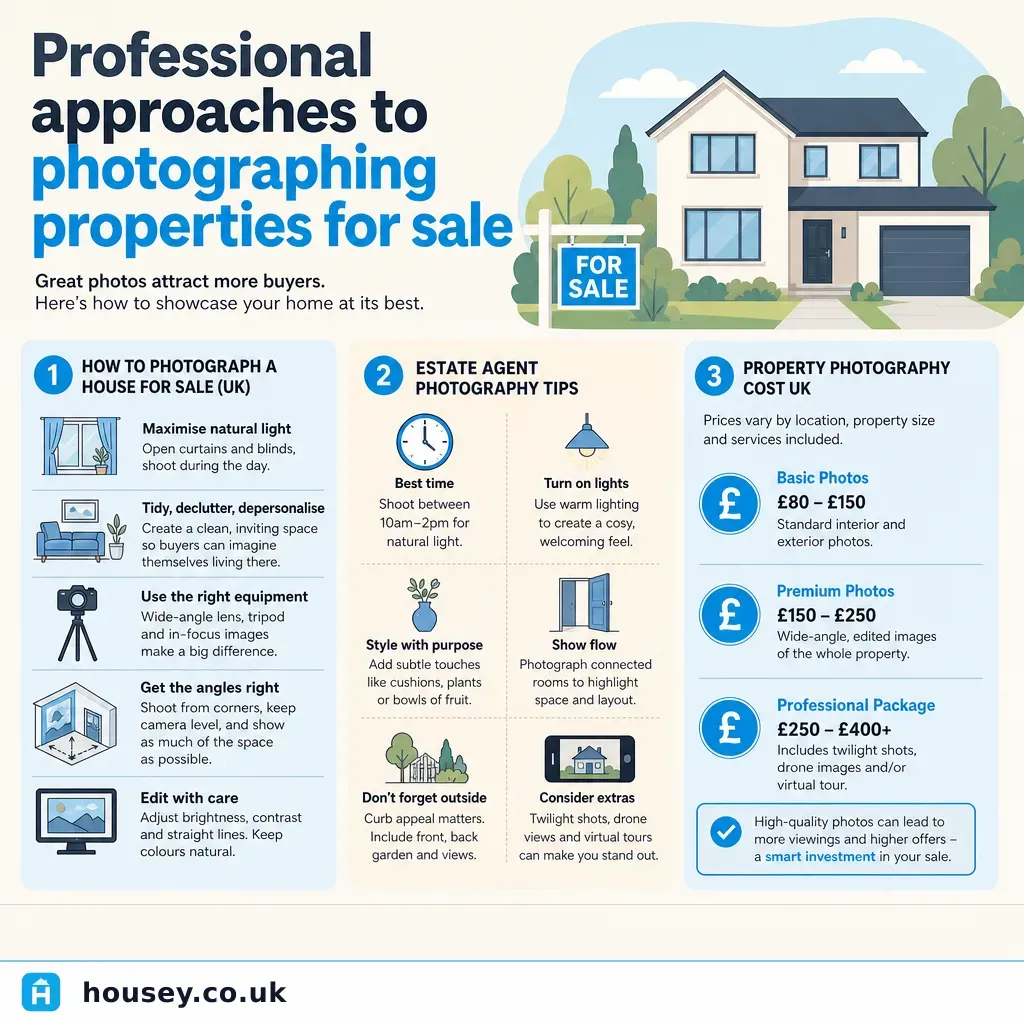 Buying & Moving
Professional approaches to photographing properties for sale
Professional property photography uses wide-angle lenses, HDR exposure blending, and careful staging to present rooms accurately and attractively.
 Buying & Moving
Using Art and Decor to Enhance Property Appeal When Selling
Thoughtfully chosen art and décor can make rooms feel larger, lighter, and more aspirational to buyers.