Instructing a Solicitor Before Finding Your New Home: Timing and Process
By Housey · Last reviewed 25th of May 2026
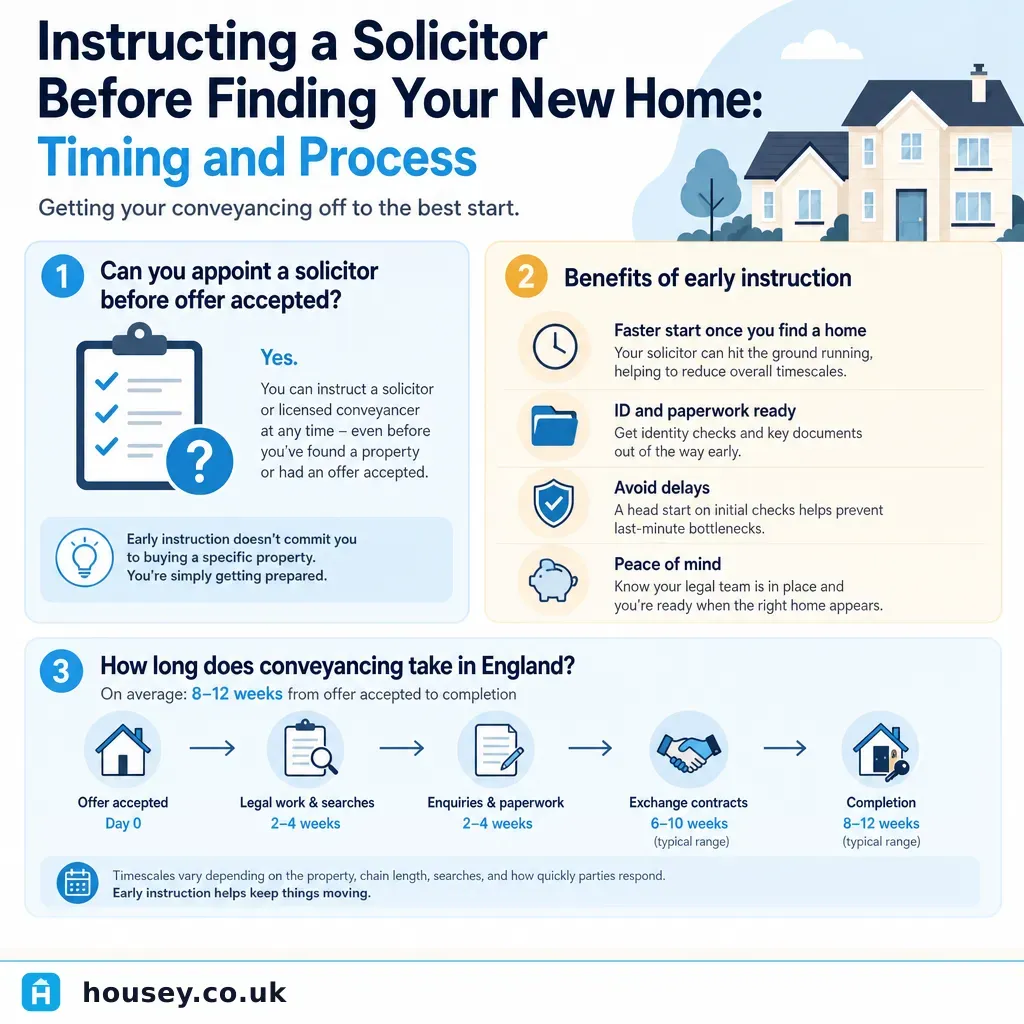
Instructing a Solicitor Before Finding Your New Home: Timing and Process
Most property buyers in England and Wales don't think about instructing a conveyancer until an offer has been accepted — but in a competitive market, the days spent searching for a firm and completing initial paperwork after going under offer can cost you momentum, delay exchange, or leave you exposed to a seller accepting a higher bid. Understanding what can be done before you identify a property helps you move faster and with fewer last-minute surprises when the transaction clock starts.
Key points
- Most sellers in England and Wales expect buyers to be in a position to exchange within 8–12 weeks of offer acceptance, though there is no legal obligation to meet any particular deadline.
- Anti-money laundering (AML) identity verification is required under the Money Laundering, Terrorist Financing and Transfer of Funds (Information on the Payer) Regulations 2017 before a conveyancer can begin work; completing this in advance eliminates a typical 1–5 day delay at the outset.
- Many solicitors and licensed conveyancers offer a pre-instruction service allowing AML checks, client onboarding, and source of funds verification to be completed before any offer is made.
- A Mortgage in Principle (Decision in Principle) from a lender should be secured before property searching; most estate agents will ask to see one before presenting an offer.
- Average transaction times in England and Wales are approximately 12–16 weeks from offer acceptance to completion, though chains, local authority search delays, and survey results frequently extend this.
- The Law Society's Find a Solicitor directory and the CLC register allow buyers to compare regulated firms calmly before going under offer and time pressure.
Why the timing of instruction matters
In England and Wales, property purchases are not legally binding until exchange of contracts. Between offer acceptance and exchange — the period commonly known as "subject to contract" — either party can withdraw without legal penalty. This is when conveyancing work, surveys, and mortgage approval take place.
Delays in instructing a solicitor compress this period unnecessarily. The longer a transaction takes to reach exchange, the greater the exposure to:
- Sellers withdrawing or accepting a higher offer (gazumping).
- Another buyer in the chain pulling out.
- Mortgage offer expiry (most lender offers are valid for 3–6 months from issue).
- Survey results triggering renegotiation or a delayed response.
Instructing a conveyancer early — even before any offer is made — means AML checks and onboarding are complete, and the solicitor can request searches and review the draft contract as soon as it arrives from the seller's conveyancer.
What a conveyancer can do before you find a property
A conveyancer cannot carry out substantive legal work before a specific property is identified — there is no title to review, no searches to commission, and no draft contract to examine. However, several preparatory steps can usefully be completed in advance.
Pre-instruction tasks a conveyancer can complete
- Identity verification (AML checks): required by the Money Laundering, Terrorist Financing and Transfer of Funds (Information on the Payer) Regulations 2017. Many firms now offer secure online ID verification through digital portals.
- Client onboarding and engagement letter: completing initial terms of engagement, billing arrangements, and source of funds declarations.
- Source of funds documentation: particularly relevant for cash buyers or those receiving a gifted deposit — providing bank statements or a signed gift letter in advance prevents delays once a transaction begins.
- Process briefing: understanding what searches will be needed, what the buyer should prepare, and what happens between offer and completion.
Document-preparation checklist for buyers
Gathering these documents before going under offer will save time at the start of your transaction:
When should you formally instruct?
The conventional approach — and the one most buyers still use — is to instruct on offer acceptance. This works, but it means starting from scratch while the clock is already ticking.
Decision tree: when to instruct a conveyancer
- Instruct before property search if: you are a cash buyer or have a mortgage in principle and plan to move quickly; you are a first-time buyer who wants an early briefing on the process.
- Instruct at offer acceptance if: you prefer to compare quotes on a transaction-specific basis (leasehold vs freehold affects fee structures) and the market is not particularly time-pressured.
- Instruct within 24–48 hours of offer acceptance if: you are in a chain, the seller has already found their onward purchase, or the seller's agent has indicated a tight exchange deadline.
- Request a pre-instruction consultation if: you are uncertain about conveyancing costs, the leasehold vs freehold distinction, or whether a solicitor or licensed conveyancer is the better fit for your purchase.
Worked example: first-time buyer in a competitive market
Aisha is buying a 1980s leasehold flat in Manchester for £210,000. Competition is high and similar properties have attracted multiple offers. She:
- Secures a Mortgage in Principle from her lender in week 1 of searching.
- Contacts three regulated conveyancers, compares quotes on leasehold experience and fixed-fee terms, and nominates her preferred firm before making any offers.
- Completes online AML identity verification and returns the signed engagement letter in week 2.
- Has an offer accepted in week 4. Her solicitor immediately requests the draft contract from the seller's conveyancer, commissions a local authority search, and requests the leasehold management pack.
- Exchange takes place in week 13. Aisha estimates the early instruction saved at least one to two weeks compared with instructing only after the offer was accepted.
What to check before instructing a conveyancer
- Verify their regulatory status: SRA register, CLC register, or CILEx Regulation register.
- Confirm whether the quoted fee is fixed or subject to variation if complications arise.
- Ask whether AML checks can be completed online and before a property is identified.
- Check whether they are on your mortgage lender's approved conveyancing panel — not all conveyancers are accepted by every lender.
- Ask about typical caseload per fee-earner and average time from instruction to exchange.
Important limitations
This article describes the conveyancing process in England and Wales only. The process in Scotland — where missives replace exchange and the timeline differs significantly — and Northern Ireland is different. Timescales vary considerably depending on property type (leasehold vs freehold), whether the property is a new-build, chain complexity, and local authority search turnaround times. Nothing in this article constitutes legal advice.
What to ask a qualified professional
Before instructing, ask your conveyancer:
- Can I complete my AML identity verification and initial onboarding before I identify a property?
- Are you on my mortgage lender's approved conveyancing panel?
- What is your typical time from instruction to exchange, and what are the most common causes of delay?
- If the transaction becomes more complex — for example, a short lease or title issues emerge — how will additional costs be communicated and agreed?
- How will you keep me updated during the transaction, and how quickly do you typically respond to queries?
When to get professional help
Always instruct a regulated solicitor or licensed conveyancer for any property purchase — not an unregulated service. If you receive a quote from a firm that cannot provide a CLC, SRA, or CILEx Regulation registration number, do not proceed. If a seller's agent pressures you to use their recommended or in-house conveyancer, you are not legally obliged to do so — you have the right to instruct whoever you choose.
How Housey can help
Housey makes it straightforward to find and compare regulated conveyancing professionals for your property purchase — whether you are still searching for a home or ready to proceed. Request quotes early, compare fees and leasehold experience, and get your paperwork sorted before going under offer.
Frequently asked questions
Can I instruct a solicitor before I have found a property?
Yes. Most solicitors and licensed conveyancers will accept early instruction, complete your identity checks, and have your engagement paperwork in place before any offer is made. This can save one to two weeks at the start of a transaction and means you are ready to act quickly once an offer is accepted.
Does early instruction cost more?
Not usually. Most conveyancers charge on a per-transaction basis, and the fee is broadly the same whether you instruct early or after offer acceptance. Some firms may charge a small administration fee for pre-instruction onboarding if no transaction proceeds — ask about this before signing an engagement letter.
What if I instruct a conveyancer and then do not find a suitable property?
You can withdraw at any time before exchange without penalty to the seller. If the conveyancer has done no substantive work, you may owe nothing or only a small disbursement fee. Clarify the firm's policy on abortive transactions in the engagement letter before you sign.
Do I need the same solicitor for buying and selling if I am in a chain?
No. You can use different firms for each transaction. Using the same firm can simplify communication, but it is not always cheaper or faster. Compare quotes separately for the purchase and the sale to ensure you have the right fit and best value for each transaction.
Sources and further reading
- Buying a home — Law Society
- HM Land Registry: what we do — HM Land Registry
- The Money Laundering, Terrorist Financing and Transfer of Funds (Information on the Payer) Regulations 2017 — legislation.gov.uk
- Buying a home — Citizens Advice
- Find a conveyancer — Council for Licensed Conveyancers
Useful next reads
 Buying & Moving
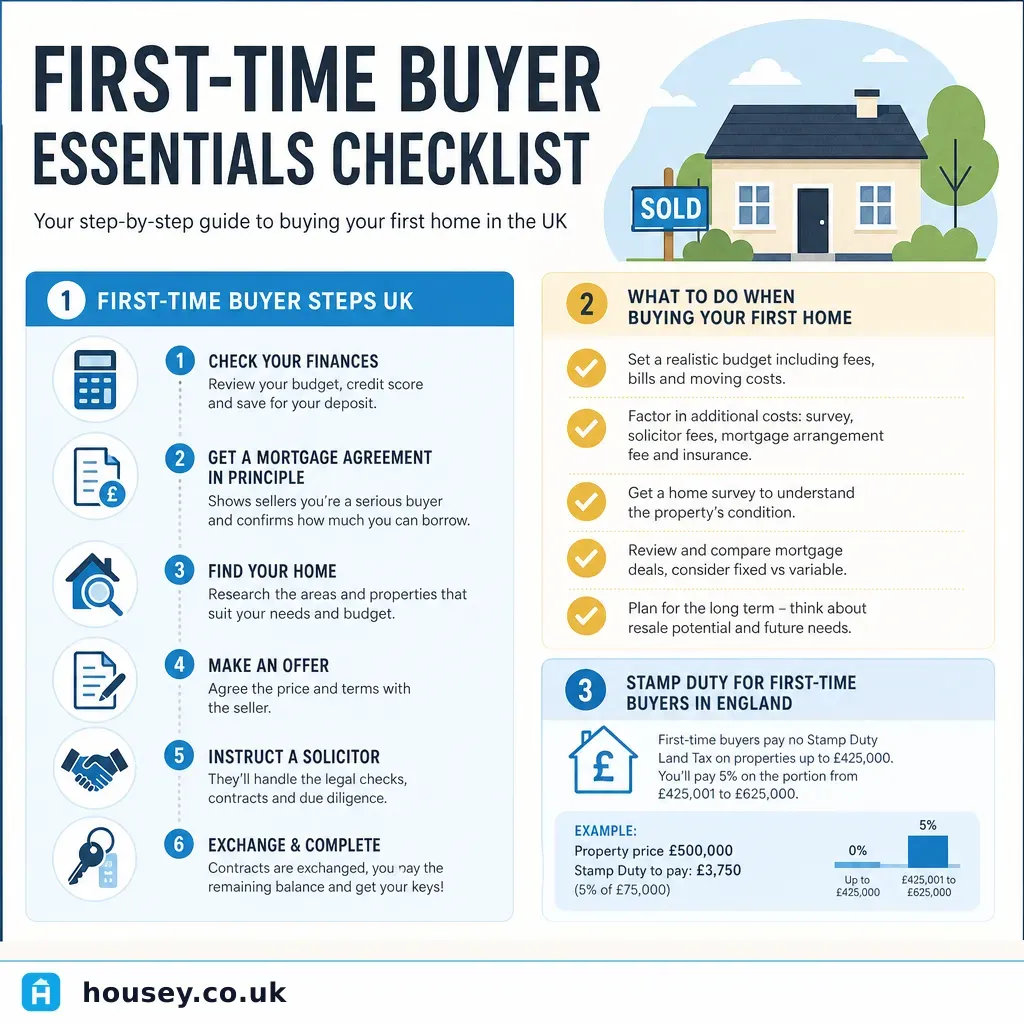
First-Time Buyer Essentials Checklist
Buying your first home involves obtaining a mortgage in principle, making an offer, instructing a solicitor, arranging a survey, and exchanging contracts before completion.
 Buying & Moving
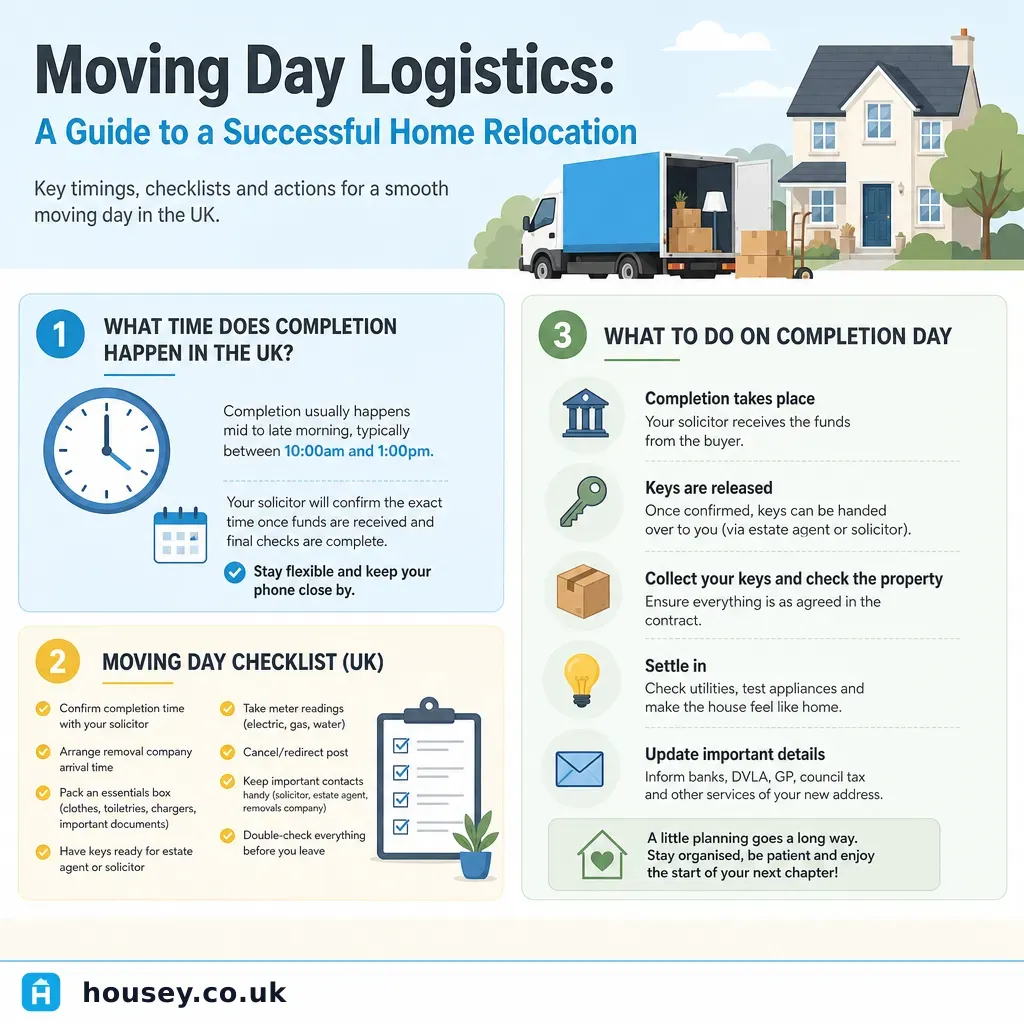
Moving Day Logistics: A Guide to a Successful Home Relocation
On moving day, wait for your solicitor to confirm completion before collecting keys — there is no fixed handover time and most UK completions happen between 11am and 2pm.
 Buying & Moving
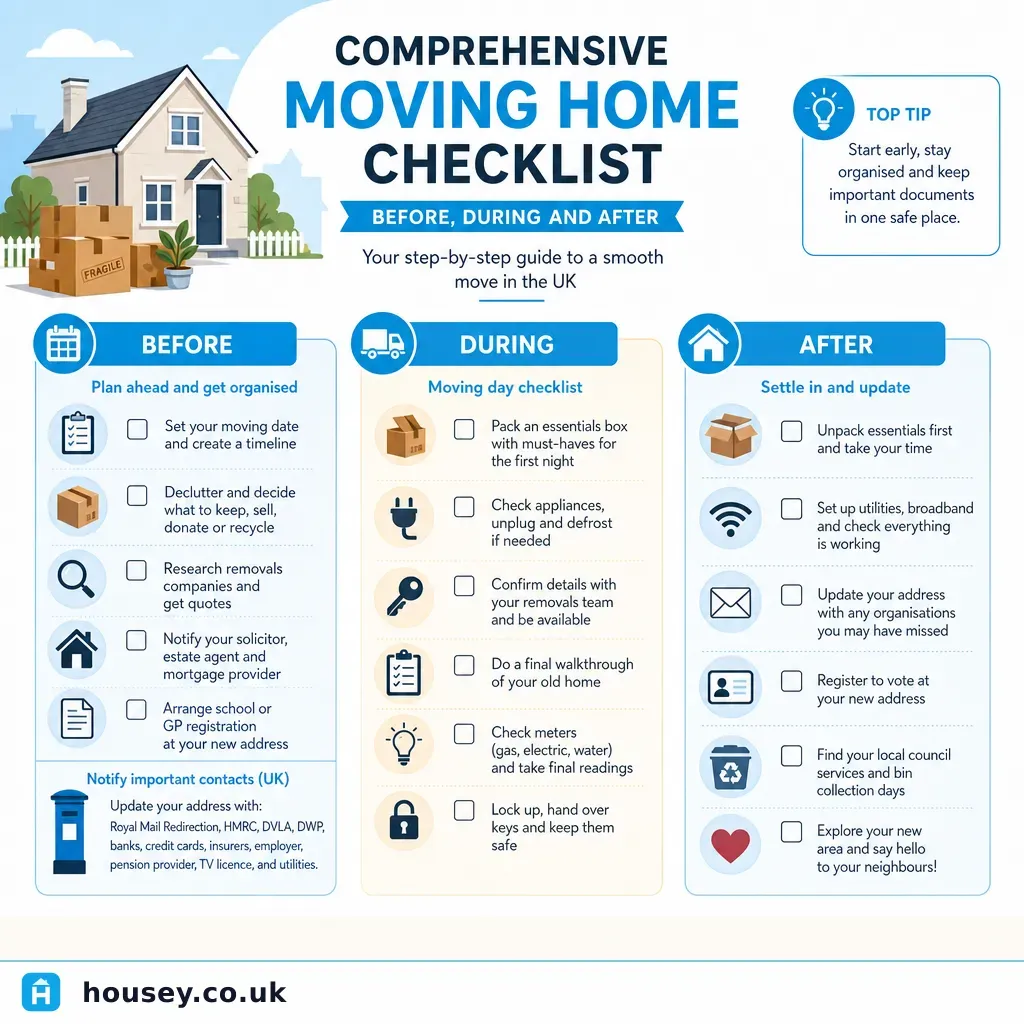
Comprehensive Moving Home Checklist: Before, During and After
Moving house in the UK involves tasks across roughly eight weeks: instructing a conveyancer and removal firm early, systematically notifying organisations of your new address, confirming buildings insurance from exchange, taking meter readings on completion day, and registering with the new council and utilities promptly.
 Buying & Moving
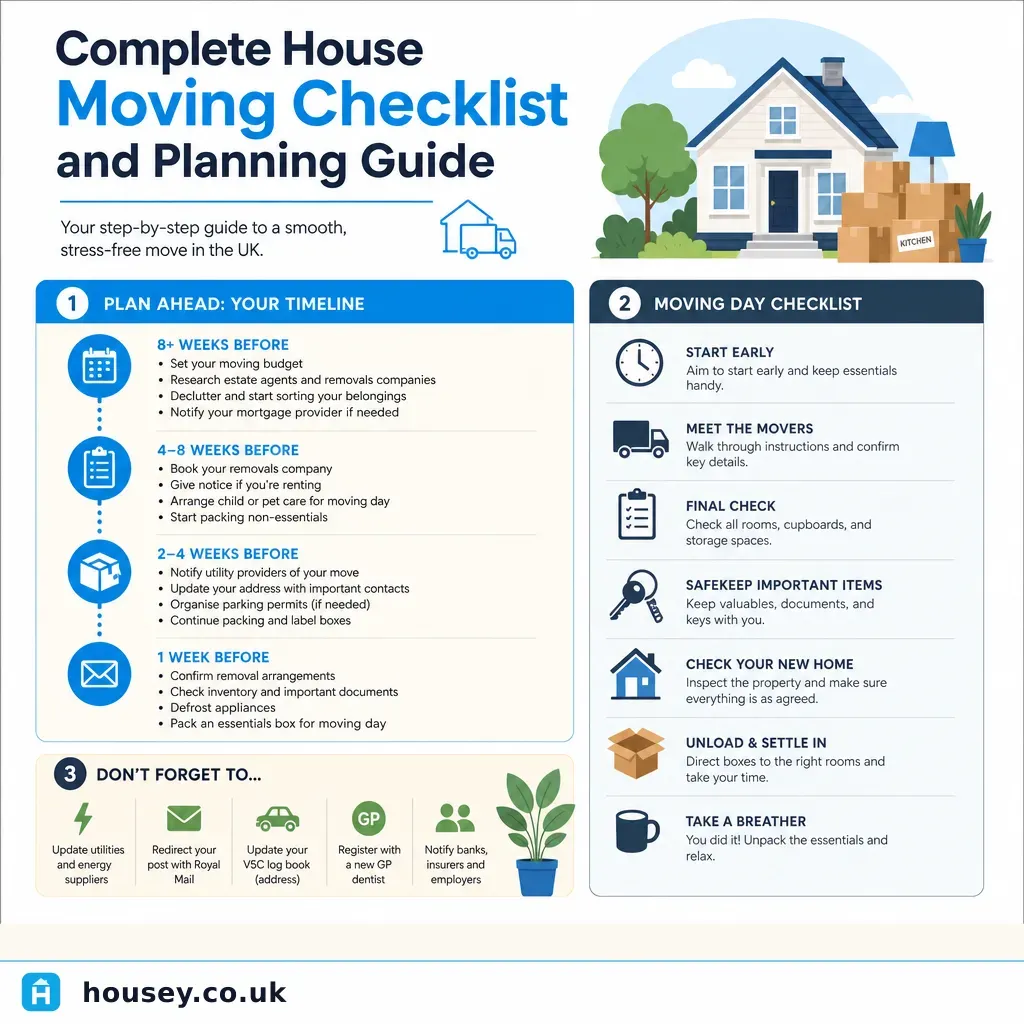
Complete House Moving Checklist and Planning Guide
A successful UK house move requires planning across 8 or more weeks: booking a removal firm early, decluttering before packing, notifying DVLA, HMRC, and utility providers, and confirming completion day logistics in advance.
 Buying & Moving
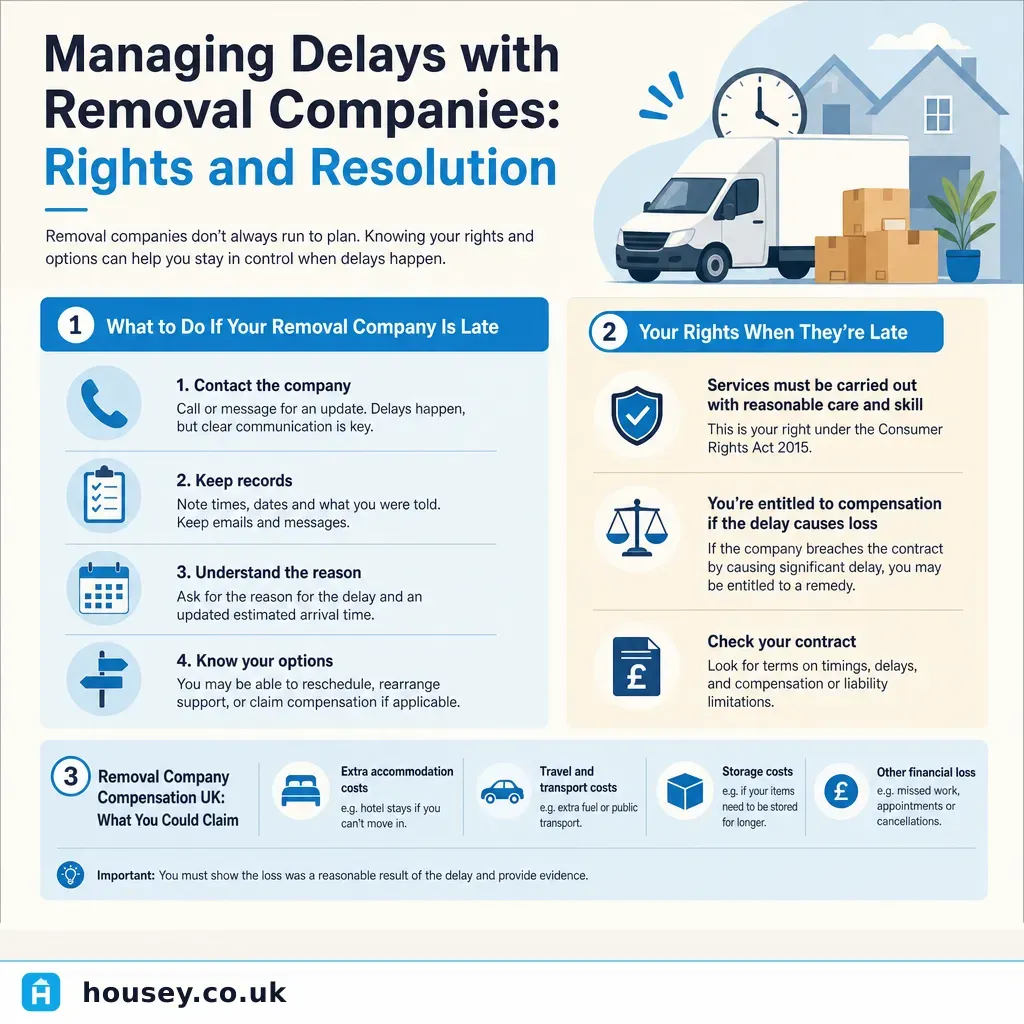
Managing Delays with Removal Companies: Rights and Resolution
If a removal company is late, your rights depend on your contract and whether the company is BAR-registered.