Joint Mortgage to Single Ownership: Removing Names and Modifying Deeds
By Housey · Last reviewed 25th of May 2026
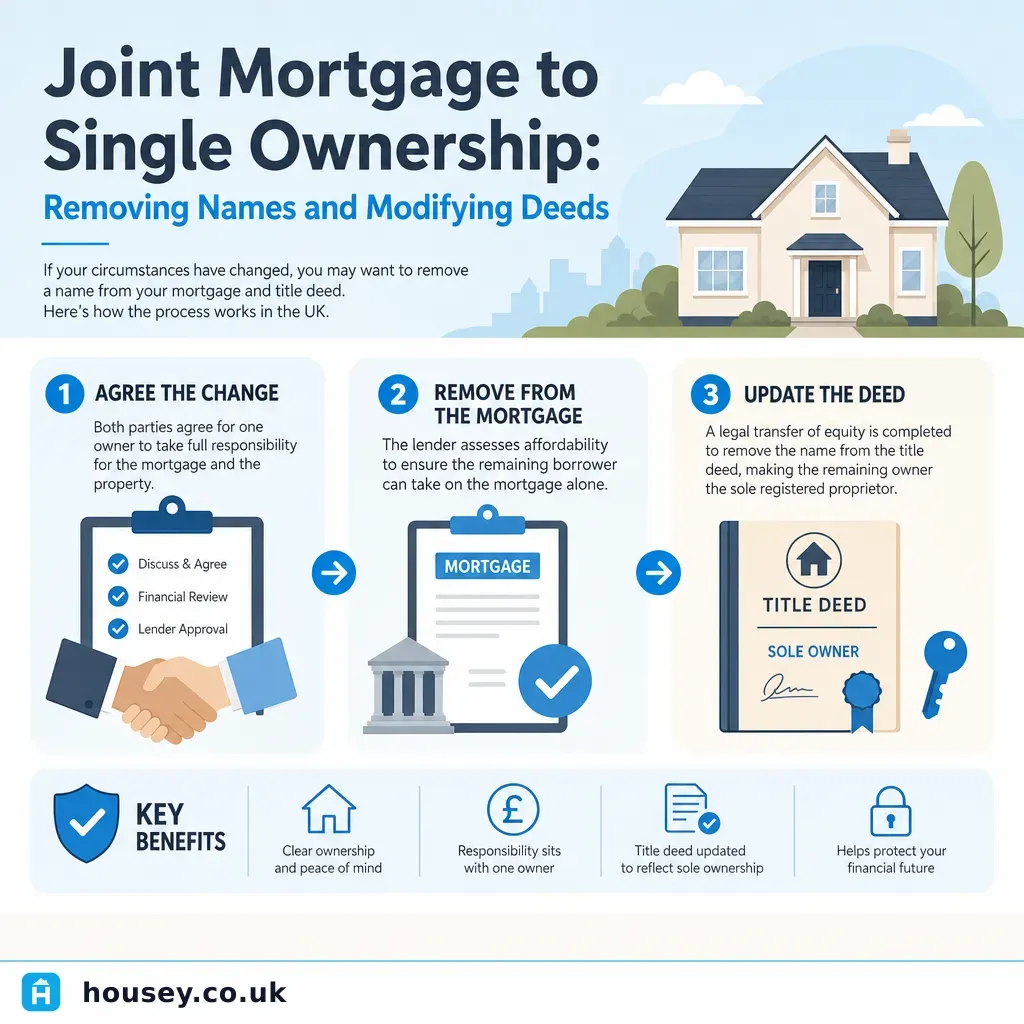
Joint Mortgage to Single Ownership: Removing Names and Modifying Deeds
Removing a name from a joint mortgage most often arises during relationship breakdown, separation, or when one co-owner wishes to buy the other out. The process touches two distinct legal regimes simultaneously — property ownership law and mortgage lending — and both must proceed in step. Missing either strand leaves the title or the loan in a state that will cause serious problems at any future sale or remortgage.
Key points
- A transfer of equity changes legal ownership and must be registered at HM Land Registry; the registration fee scales with the declared value of the transaction, starting at £20 for lower-value transfers.
- Stamp Duty Land Tax (SDLT) may be payable on the chargeable consideration, which includes any cash payment made to the departing party plus their proportionate share of the outstanding mortgage debt assumed by the remaining owner.
- Your mortgage lender must give formal written consent before any borrower can be removed; they will independently reassess the remaining applicant's income, credit position, and affordability.
- Capital Gains Tax (CGT) may apply if the departing party's share of the property is not, and has not always been, their only or main residence — governed by HMRC's Private Residence Relief rules.
- A licensed conveyancer or solicitor is required to manage both the Land Registry title transfer and lender liaison; this is not a process that can be completed without professional help.
What "removing a name" actually involves
"Removing a name from the mortgage" is shorthand for two legally separate actions that must happen together:
- Transfer of equity — changing the registered owners at HM Land Registry so the property is held in the sole name of the remaining owner, or a new combination of names.
- Mortgage modification or remortgage — obtaining your lender's formal written consent to remove a borrower from the loan account. Most lenders treat this as a new sole application and reassess affordability from scratch; some require a full remortgage to a different product rather than a simple borrower change.
A conveyancer manages both processes in parallel, liaising with your lender's solicitors and coordinating the Land Registry application with the mortgage modification documentation. You cannot complete the title change while a mortgage is in place without the lender's prior written consent.
Lender consent: what to expect
Every lender has its own internal policy on borrower removal. In most cases:
- The remaining borrower is assessed as a new sole applicant — income, credit score, and debt-to-income ratio are all reviewed afresh.
- If the sole income cannot service the existing loan, the lender may decline, requiring a product transfer to a lower-rate mortgage, the addition of a new joint borrower, or a sale.
- A consent-to-transfer or administration fee may apply, typically £50–£300. (Indicative UK costs, last reviewed 2026-05-25.)
- Lender consent must be given in writing before any Land Registry application is submitted.
Do not proceed on the basis of a verbal indication from a customer service representative. Formal written consent from the lender's solicitors is required before the conveyancer can submit the AP1 form to HM Land Registry.
Stamp Duty Land Tax and other costs
SDLT is calculated on the chargeable consideration, which is the total value received by the departing party. This includes:
- Any cash payment made to buy out the outgoing party's share of the equity.
- Their proportionate share of the outstanding mortgage, which the remaining owner effectively assumes.
For example: if the departing party receives £40,000 in cash and the outstanding mortgage is £160,000 (so they are relieved of an £80,000 liability), the chargeable consideration is £120,000.
Reliefs may reduce or eliminate the SDLT charge — transfers between spouses or civil partners as part of a divorce or separation may qualify for relief. These rules are highly fact-specific. GOV.UK publishes guidance on SDLT on transfers of equity; confirm the current position with your conveyancer before any figures are agreed with the other party.
Worked UK property scenario
Scenario: A couple jointly own a 2008-build semi-detached house in the East Midlands, valued at approximately £240,000 with a £150,000 repayment mortgage outstanding. One partner wishes to buy the other out. The departing partner's share is agreed at £45,000 (representing half of the £90,000 equity). The SDLT chargeable consideration is £45,000 (cash) plus £75,000 (half the mortgage assumed by the remaining owner) = £120,000 total. >At the time of writing £120,000 falls below the standard residential SDLT nil-rate threshold, but thresholds change and higher-rate supplements may apply in some circumstances — confirm current figures with your conveyancer. The remaining owner's conveyancer applies to the lender for a consent to transfer, confirms sole affordability, prepares the TR1 transfer deed, and submits an AP1 form to HM Land Registry. With both parties cooperating and lender consent received promptly, the whole process typically takes 4–8 weeks.
Costs involved in removing a name
Cost item | Typical range (indicative, 2026-05-25) | Notes |
|---|---|---|
Conveyancer legal fee | £500–£1,500 | Varies by firm and complexity |
HM Land Registry fee | £20–£500+ | Scales with declared value; see fee schedule |
SDLT (if applicable) | Variable | Depends on chargeable consideration and reliefs |
Lender consent or transfer fee | £50–£300 | Not charged by all lenders |
Mortgage arrangement fee | £0–£2,000+ | Only if a full remortgage to a new product is required |
ID verification and search fees | £50–£300 | Usually required on a remortgage |
Indicative UK costs, last reviewed 2026-05-25. Always obtain written quotes before instructing.
Important limitations
This article provides general information about transfer of equity and joint mortgage modification in England and Wales. Scotland uses a separate conveyancing system under Scots law; Northern Ireland follows its own framework. Nothing in this article constitutes legal, tax, or financial advice. Your specific situation — including mortgage product terms, SDLT and CGT position, any court orders, tenure type, and the presence of any second charge — must be assessed by qualified professionals.
What to ask a qualified professional
Before instructing a conveyancer or approaching your lender, gather answers to these questions:
- What is the current outstanding mortgage balance, and will the lender consent to a borrower change or require a full remortgage?
- What is the chargeable consideration for SDLT purposes, and does any relief apply to my specific circumstances?
- Is CGT likely to apply given both parties' occupancy history, and should I take separate tax advice?
- What documents will be needed — proof of income, ID, any separation agreement, court order, or deed of trust?
- Are there any restrictions on the title, such as a second charge, Help to Buy equity loan, or shared ownership arrangement, that could complicate the transfer?
- How long is the process likely to take, and what could cause delays?
- Will both parties need separate representation given potential conflict of interest?
When to get professional help
Instruct a conveyancer before contacting your lender. Seek professional help without delay if:
- A court order, Mesher order, or financial remedy order governs the property as part of family proceedings.
- There is a second charge or another loan secured against the property.
- Either party is in mortgage arrears.
- The property is shared ownership or subject to a Help to Buy equity loan.
- Either party is not a UK resident for tax purposes — CGT and SDLT implications may differ.
- The lender has indicated it will not consent to a borrower change and requires a full remortgage.
How Housey can help
Housey connects you with regulated conveyancers experienced in transfers of equity and joint-to-sole mortgage transactions. Use our conveyancing service to compare quotes from solicitors who handle both the Land Registry title transfer and lender liaison, so both strands of the process move in step and nothing is left unresolved at completion.
Frequently asked questions
How long does it take to remove a name from a joint mortgage?
The process typically takes 4–8 weeks once both parties are cooperating and the lender has agreed in principle. Delays most often arise from the lender's affordability assessment, missing documents, or a court order that has yet to be finalised. If the lender requires a full remortgage rather than a simple consent to transfer, the timeline may extend to 8–12 weeks.
Can a name be removed from a mortgage without the other person's agreement?
No. Both parties to a joint mortgage must consent to any change in borrowers. If agreement cannot be reached voluntarily, a family court may order a transfer of equity or a sale as part of financial remedy proceedings. A solicitor with family law experience should be involved in any disputed situation before steps are taken with the lender.
What are the tax implications of a transfer of equity?
SDLT may apply on the chargeable consideration — cash paid plus the mortgage liability assumed by the remaining owner. CGT may apply for the departing party if the property is not, and has not always been, their main residence. Income tax considerations can arise in landlord scenarios. All three taxes require individual assessment; consult your conveyancer and a tax adviser where CGT is a possibility.
Do both parties need separate solicitors for a transfer of equity?
Not necessarily — both may use the same conveyancer unless a conflict of interest exists. In separation and divorce situations, a conflict of interest is common, and many solicitors will require or recommend separate representation. This protects both parties under SRA professional conduct rules and is practical where competing financial interests are at stake.
Sources and further reading
- Stamp Duty Land Tax on transfers of equity — GOV.UK
- HM Land Registry registration services fees — HM Land Registry
- Tax when you sell your home (Private Residence Relief) — GOV.UK / HMRC
- Conveyancing and residential property practice — The Law Society
Useful next reads
 Buying & Moving
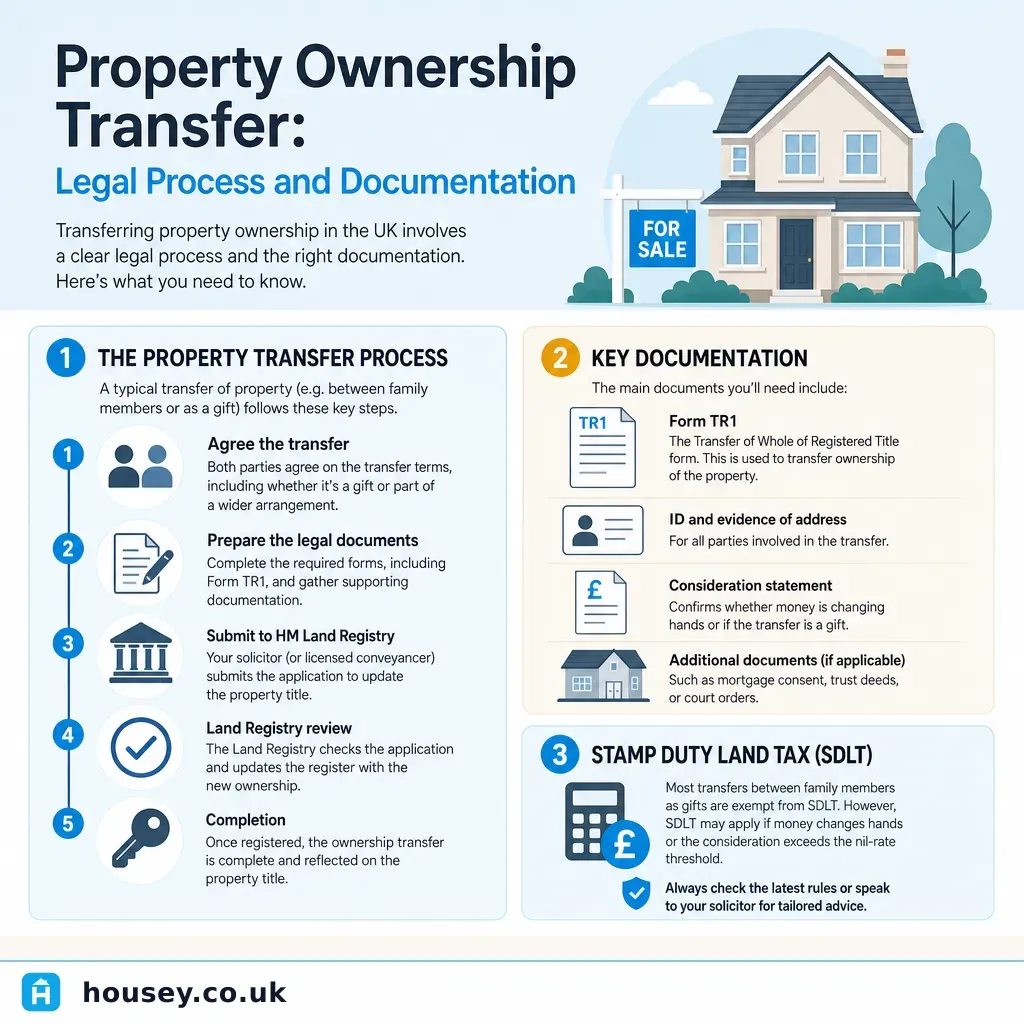
Property Ownership Transfer: Legal Process and Documentation
Transferring property ownership in England and Wales involves a formal legal deed — usually the TR1 form — submitted to HM Land Registry alongside an SDLT return filed within 14 days of completion.
 Buying & Moving
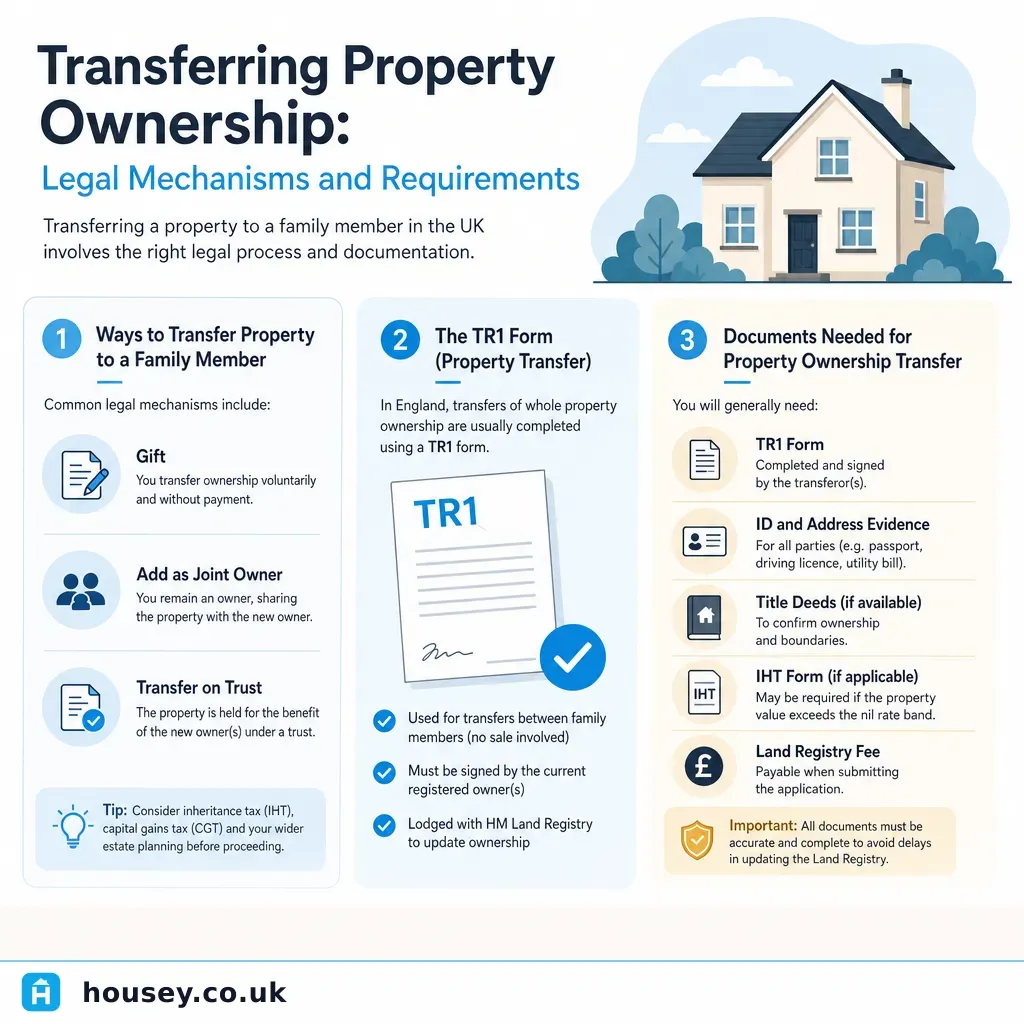
Transferring Property Ownership: Legal Mechanisms and Requirements
In England and Wales, property ownership transfers when HM Land Registry records a change of proprietor, triggered by a completed TR1 deed for full transfers or a TP1 for partial ones.
 Buying & Moving
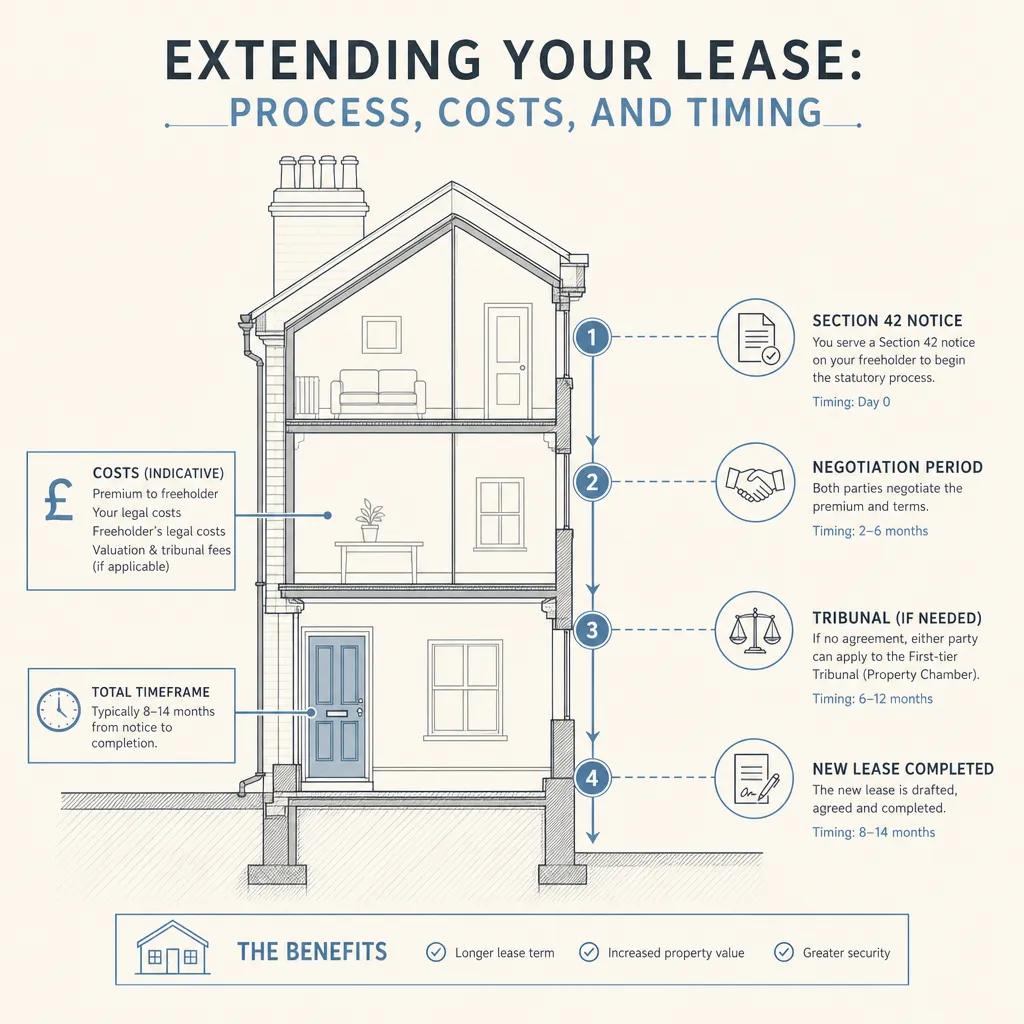
Extending Your Lease: Process, Costs, and Timing
Qualifying leaseholders in England and Wales have a statutory right to extend their lease by 90 years at a peppercorn (nil) ground rent under the Leasehold Reform, Housing and Urban Development Act 1993, provided they have owned for at least two years.
 Buying & Moving
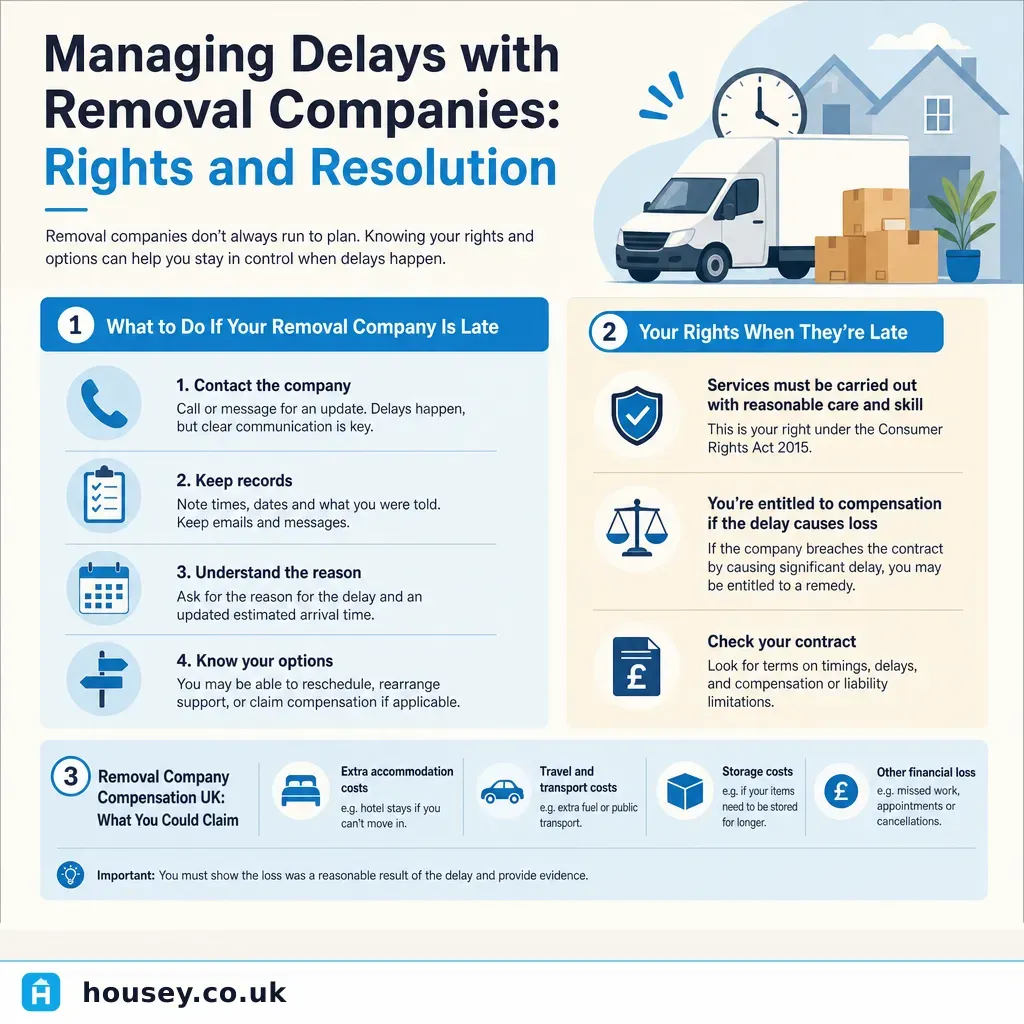
Managing Delays with Removal Companies: Rights and Resolution
If a removal company is late, your rights depend on your contract and whether the company is BAR-registered.
 Buying & Moving
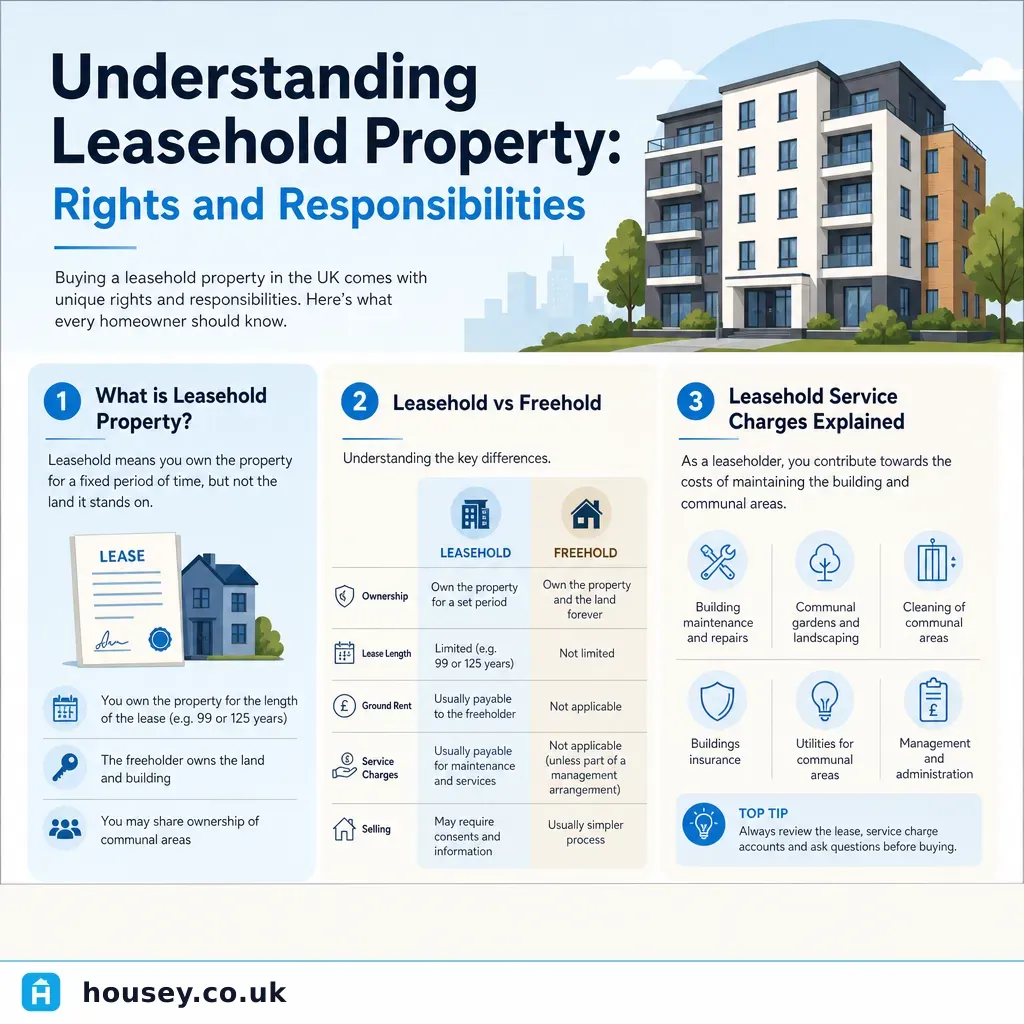
Understanding Leasehold Property: Rights and Responsibilities
Leasehold means you own a time-limited interest in a property while the freeholder owns the land and building.