Property Ownership Transfer: Legal Process and Documentation
By Housey · Last reviewed 25th of May 2026
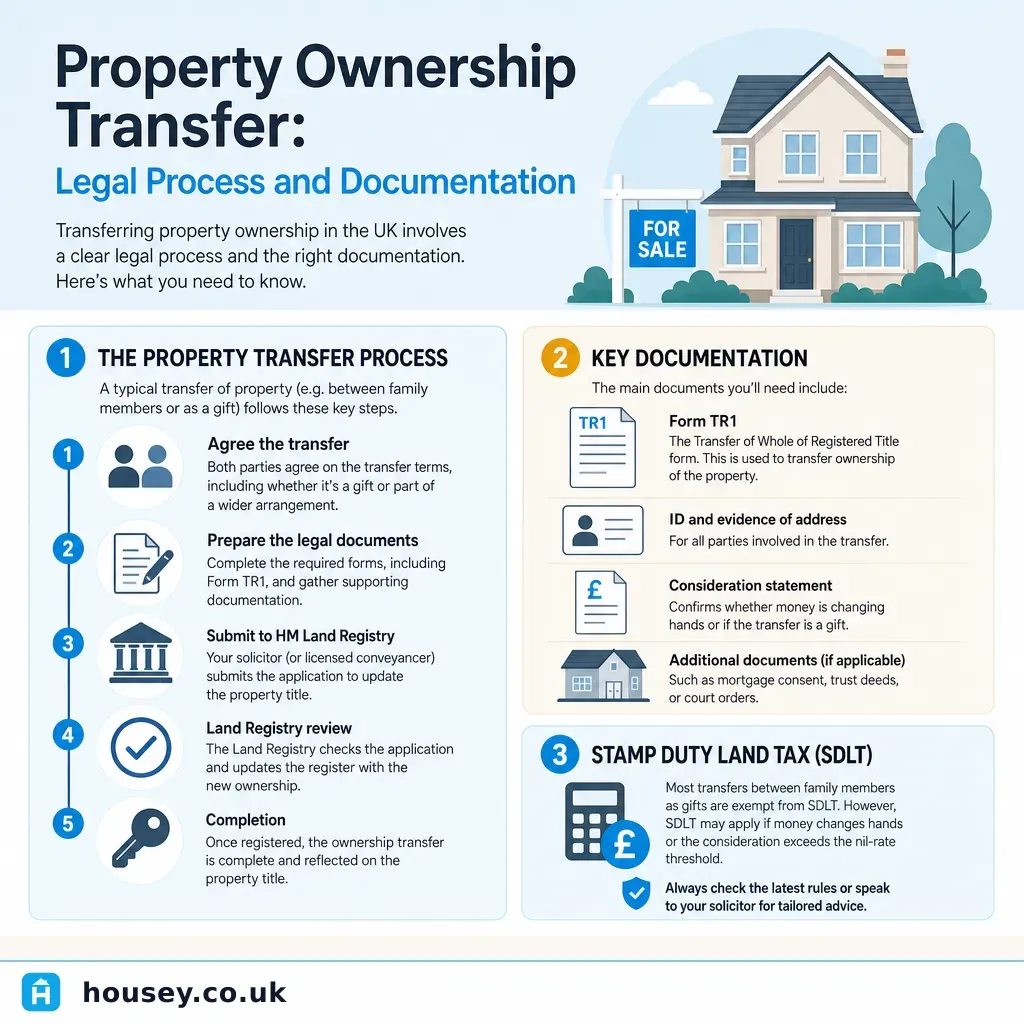
Property Ownership Transfer: Legal Process and Documentation
Transferring legal ownership of a property is one of the most consequential steps in any property transaction in England and Wales. Whether you are buying a home, adding a partner to a title, gifting property to a family member, or adjusting ownership following a relationship change, the process involves formal legal procedures and registration with HM Land Registry. Getting the documentation right — and completing it in the correct order — protects your legal interest in the property and determines when you are, in law, the owner.
Key points
- The TR1 form is the standard HM Land Registry transfer deed for registered freehold and leasehold properties; a TP1 is used where only part of a title is being transferred.
- Stamp Duty Land Tax (SDLT) must be submitted and paid within 14 days of completion in England; in Wales, Land Transaction Tax (LTT) replaces SDLT and must be filed with the Welsh Revenue Authority within 30 days.
- HM Land Registry registration fees are tiered by property value — from £20 for properties up to £80,000 to £910 for properties over £1 million; online lodgement attracts a 25% discount on most applications.
- A transfer without monetary consideration — such as a gift or an equity transfer between family members — still requires a formal deed and a Land Registry application via the AP1 form.
- The transfer is not legally complete until the Land Registry updates the title register; until registration, the buyer holds an equitable interest only and the seller remains the legal owner of record.
How property ownership is transferred in England and Wales
In England and Wales, legal ownership of land is recorded at HM Land Registry. A valid transfer requires a deed — the TR1 for most residential transactions — signed by all parties and witnessed correctly, then registered at the Land Registry to update the title register.
The process broadly follows these stages:
- Instruction of a solicitor or licensed conveyancer — both buyers and sellers typically instruct separate representatives to act in their interests.
- Pre-exchange — searches, enquiries, review of the title register and title plan, mortgage offer secured, survey completed.
- Exchange of contracts — legally binding; a deposit (usually 10%) is paid and a completion date is agreed.
- Completion — remaining funds are transferred electronically, keys are released, and the TR1 deed is dated and handed over.
- Post-completion — SDLT (or LTT) return filed within the statutory deadline; the Land Registry AP1 application is submitted with the TR1, mortgage deed, and supporting documents.
Registration processing times at HM Land Registry vary — check GOV.UK for current lead times before exchange if speed of registration matters to your transaction.
Key documents in a property transfer
Document | Purpose | Who prepares it |
|---|---|---|
TR1 (or TP1 for part of a title) | Transfers legal ownership of the registered estate | Buyer's solicitor |
AP1 | Application to register the transfer at HM Land Registry | Buyer's solicitor |
SDLT1 (or LTT return in Wales) | Tax return for Stamp Duty Land Tax or Land Transaction Tax | Buyer's solicitor |
Title register and title plan | Evidence of current ownership, class of title, and boundaries | HM Land Registry |
Mortgage deed | Records the lender's legal charge over the property | Lender's solicitor |
ID1 / ID2 | Identity verification for parties not represented by a solicitor | Unrepresented party or solicitor |
Transfers without a sale: gifts, equity transfers, and survivorship
Not all transfers involve a purchase price. Common non-sale transfers include:
- Adding or removing a partner or spouse from a title following marriage, separation, or a change in living arrangements.
- Gifting property to a family member, sometimes as part of estate or inheritance planning.
- Transferring equity following divorce, usually required by a court order or financial remedy order.
- Death of a co-owner where joint tenancy applies — survivorship operates automatically; the surviving owner registers using a DJP (death of a joint proprietor) application.
- Death of a co-owner where tenants in common applies — a grant of probate or letters of administration is required first, followed by an assent or TR1 transfer.
Even where no money changes hands, SDLT or LTT may be payable if a mortgage is assumed by the recipient. A solicitor should assess whether the transaction is chargeable before proceeding.
Decision tree: which transfer route applies to your situation?
- Buying or selling a property → standard conveyancing; both parties instruct solicitors; TR1 prepared by the buyer's solicitor.
- Adding someone to your title with a mortgage → lender's consent is required first; both names added via TR1; a new or varied mortgage deed is usually needed.
- Gifting a property with no mortgage → TR1 required; SDLT or LTT review needed even where no price is paid.
- Removing a name after separation → a transfer of equity via TR1; lender's consent required if a mortgage exists; SDLT chargeability should be confirmed.
- Transfer on death (joint tenants) → survivorship applies automatically; surviving owner registers using a DJP application alongside an official copy death certificate.
- Transfer on death (tenants in common) → grant of probate or letters of administration required first; then an assent (AS1) or TR1 transfer.
- Unregistered land → first registration is compulsory on sale; original title deeds and statutory declarations may be required where deeds are incomplete.
Common mistakes that delay registration
- Incorrectly witnessed signatures on the TR1 — a witness cannot be a party to the deed or, in many cases, a close family member of that party.
- SDLT return filed late — financial penalties apply from day 15 after completion and interest accrues daily.
- Outstanding requisitions from HM Land Registry not responded to within the required period, causing the application to be cancelled.
- Missing AP1 enclosures such as certified identity documents, the original discharge of a prior mortgage, or the correct registration fee.
- Failing to obtain the mortgage lender's formal consent before completing a transfer of equity.
Important limitations
This article provides general information about the property transfer process in England and Wales. Requirements vary depending on tenure (freehold or leasehold), whether the property is registered or unregistered, mortgage lender requirements, tax position, and individual circumstances. Rules in Scotland and Northern Ireland differ substantially. Nothing in this article constitutes legal advice. You should instruct a solicitor or licensed conveyancer for any property transfer.
What to ask a qualified professional
Before instructing a solicitor or licensed conveyancer for a property transfer, ask:
- What is included in your quoted fee, and what disbursements — SDLT or LTT, Land Registry fees, search costs — will I pay separately?
- How long is the Land Registry currently taking to process this type of application?
- Does this transfer trigger SDLT or LTT, and if so, how much is payable and when?
- If I am transferring equity with a mortgage outstanding, will you obtain my lender's consent, and is that included in your fee?
- What ID verification do you require, and in what format must it be provided?
- Will this transfer affect my existing mortgage terms, buildings insurance, or any right to buy discount claw-back?
When to get professional help
You should instruct a qualified solicitor or licensed conveyancer for any property transfer. Professional advice is especially important in these situations:
- The property is unregistered land — the first registration process involves additional documents and is time-sensitive.
- The transfer follows a death, divorce, or separation — court orders, grants of probate, or deeds of separation may be involved.
- The property has a mortgage — lender consent is required and the mortgage deed may need updating or replacing.
- There is a dispute about ownership, or the title is subject to restrictions, notices, or charges.
- The transfer involves trust arrangements, a declaration of trust, or tax planning intended to reduce inheritance tax or SDLT.
How Housey can help
If you are buying, selling, or transferring ownership of a property, Housey can connect you with experienced conveyancing solicitors and licensed conveyancers who handle the full range of property transfers across England and Wales — from straightforward residential purchases to equity transfers, gifts, and first registrations of unregistered title.
Frequently asked questions
How long does it take to transfer property ownership in the UK?
A straightforward chain-free sale typically takes 8–12 weeks from offer to completion, though chains and mortgage complexity can extend this significantly. After completion, HM Land Registry registration may take several weeks to several months depending on current workload — check GOV.UK for live processing times before you exchange contracts.
Do I need a solicitor to transfer property ownership?
You are not legally required to use a solicitor, but most mortgage lenders insist on it, and the Land Registry requires correctly executed legal deeds. Using a regulated solicitor or licensed conveyancer protects you against errors, missing documents, and failed registration. Self-conveyancing is technically possible for unencumbered cash purchases but carries real risks.
Can I transfer property to a family member without paying Stamp Duty?
SDLT depends on the chargeable consideration, which includes any mortgage debt assumed by the recipient. A gift with no mortgage and no payment is usually SDLT-free, but rules on connected-party transactions can be complex. Seek professional advice before proceeding, particularly if the property carries an outstanding mortgage.
What is the difference between joint tenants and tenants in common?
Joint tenants own the property together; on death, the surviving owner inherits automatically without probate. Tenants in common hold defined shares — for example 50/50 or 70/30 — which can be left by will. The choice affects inheritance planning significantly and should be documented in a declaration of trust prepared by a solicitor.
Sources and further reading
- Transfer ownership of land or property — GOV.UK
- Stamp Duty Land Tax overview — GOV.UK / HMRC
- HM Land Registry registration services fees — GOV.UK
- Land Transaction Tax guide — Welsh Revenue Authority
- Property topics and guidance — Law Society
Useful next reads
 Buying & Moving
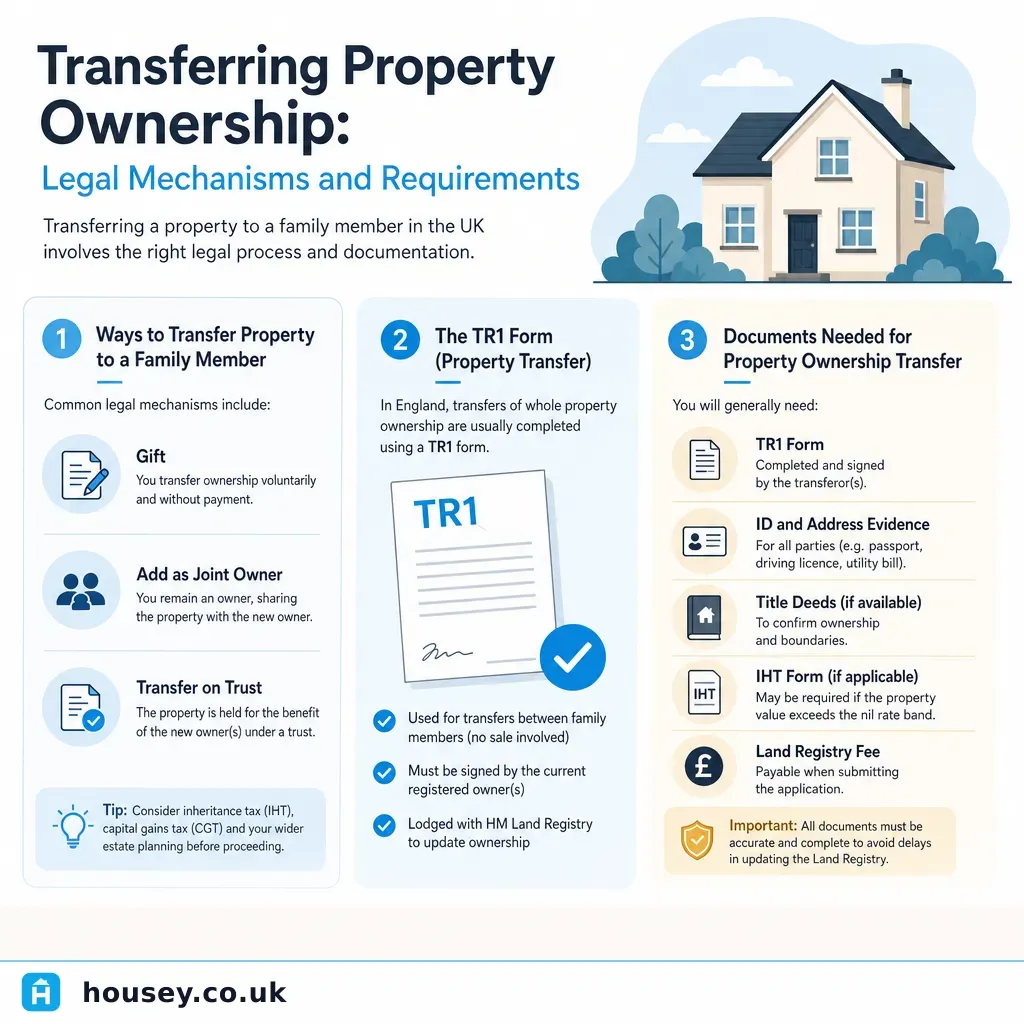
Transferring Property Ownership: Legal Mechanisms and Requirements
In England and Wales, property ownership transfers when HM Land Registry records a change of proprietor, triggered by a completed TR1 deed for full transfers or a TP1 for partial ones.
 Buying & Moving
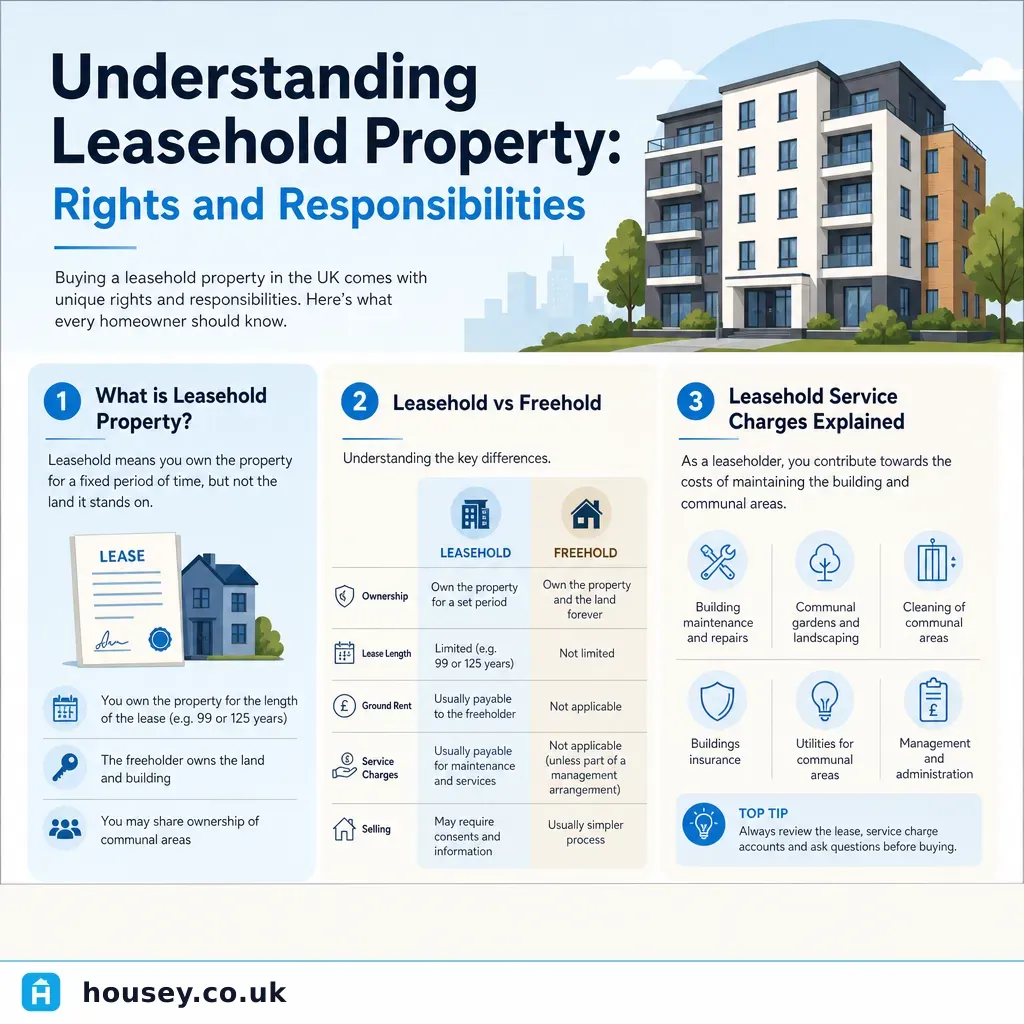
Understanding Leasehold Property: Rights and Responsibilities
Leasehold means you own a time-limited interest in a property while the freeholder owns the land and building.
 Buying & Moving
Navigating Simultaneous Purchase and Sale of Property
When buying and selling simultaneously in England and Wales, both sets of contracts are exchanged on the same day — this is called simultaneous exchange.
 Buying & Moving
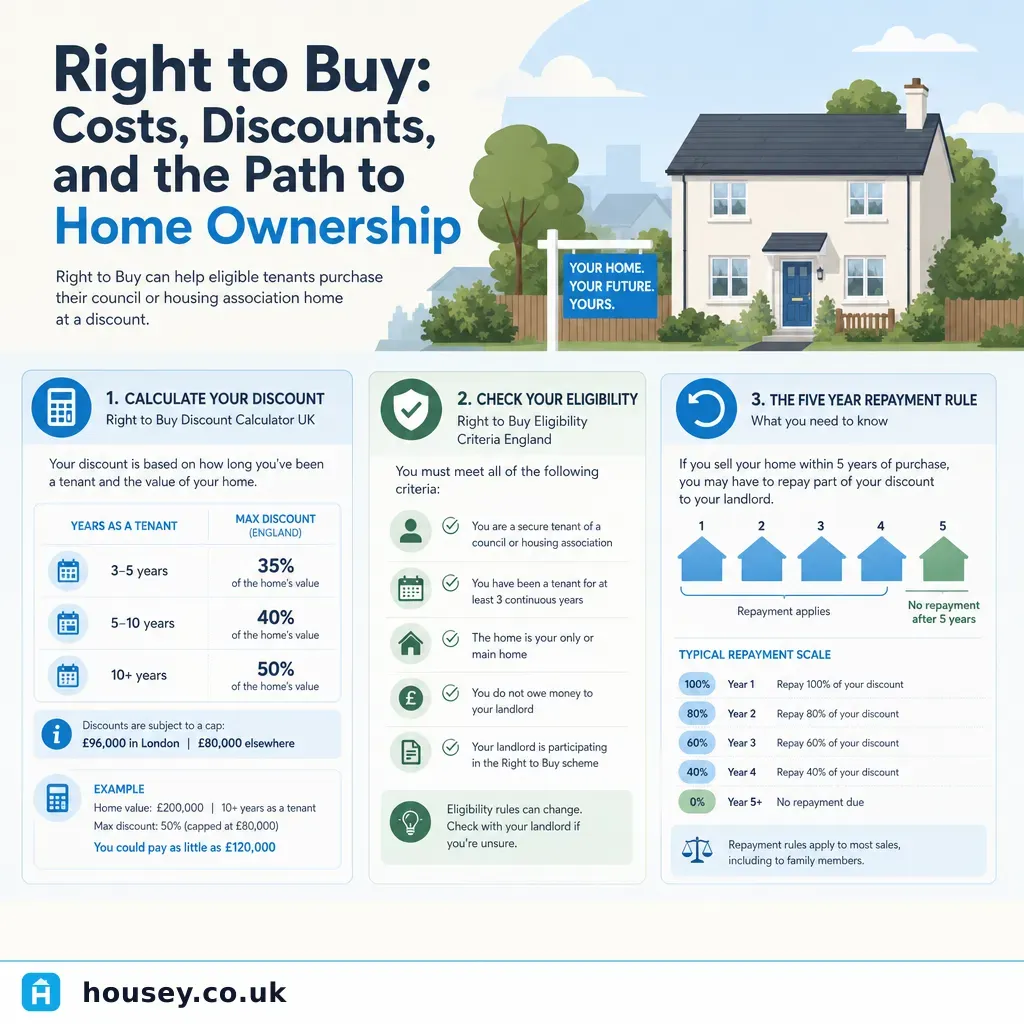
Right to Buy: Costs, Discounts, and the Path to Home Ownership
Right to Buy lets eligible council tenants in England buy their home at a government-funded discount — between 35% and 70% of its value, depending on tenancy length and property type.
 Buying & Moving
Essential Steps to Selling Your Home Successfully
Selling your home successfully in the UK involves obtaining a valid EPC, choosing an estate agent or alternative method, instructing a solicitor or conveyancer early, and completing the Seller's Property Information Form accurately.