Extending Your Lease: Process, Costs, and Timing
By Housey · Last reviewed 25th of May 2026
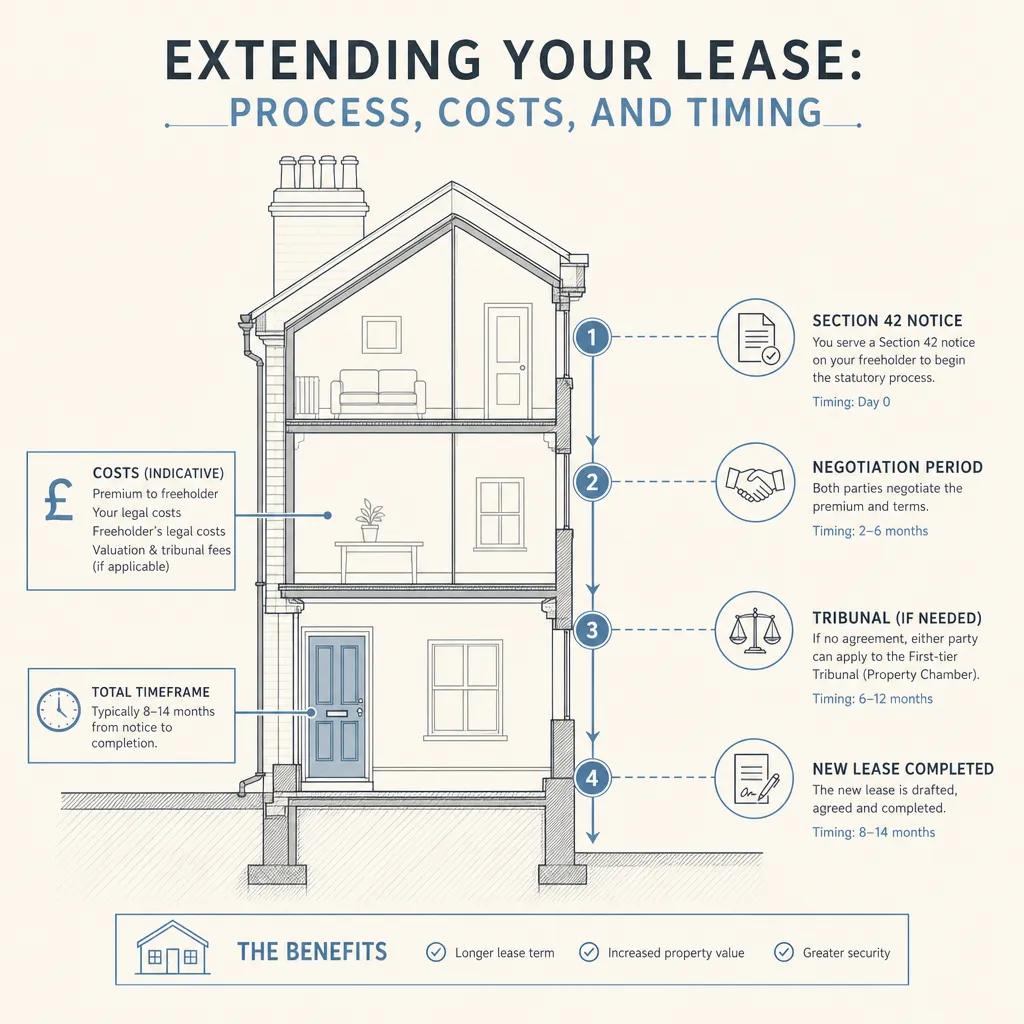
Extending Your Lease: Process, Costs, and Timing
For owners of leasehold flats in England and Wales, the remaining lease term affects the property's value, mortgageability, and saleability in ways that compound over time. Many leaseholders first encounter the issue when a buyer, mortgage lender, or estate agent raises it as a concern — often at a point where acting earlier would have been substantially cheaper. Understanding how the extension process works, and when the financial stakes shift, matters well before any transaction is on the table.
Key points
- Qualifying leaseholders have a statutory right under the Leasehold Reform, Housing and Urban Development Act 1993 to extend a flat's lease by 90 years at a peppercorn (nil) ground rent, provided they have owned for at least two years.
- Once the unexpired term falls below 80 years, "marriage value" becomes payable under the current statutory formula — broadly, half the uplift in property value from the extension — significantly increasing the premium.
- The Leasehold and Freehold Reform Act 2024 received Royal Assent but many provisions, including abolition of marriage value for statutory extensions, had not yet commenced as of 2026-05-25; the 1993 Act framework currently governs most extensions.
- As a leaseholder, you pay your own solicitor and surveyor fees plus the freeholder's "reasonable costs" under section 60 of the 1993 Act.
- The formal statutory process begins with a Section 42 Notice (Tenant's Notice) served on the freeholder, who has two months to respond with a counter-notice.
Statutory vs voluntary lease extension
The first decision is which route to take — understanding the differences is essential before approaching your freeholder.
| Statutory extension | Voluntary extension |
|---|---|---|
Qualifying period | Must have owned 2+ years | No minimum |
Extension term | 90 years added to unexpired term | Negotiated — any agreed term |
Ground rent | Reduced to peppercorn (nil) by law | Freeholder may seek to retain or increase |
Freeholder obligation | Must grant extension on service of notice | No legal obligation to agree |
Freeholder costs you pay | Reasonable costs under s.60 of 1993 Act | No statutory cap on freeholder costs |
Protection | Strong — Tribunal sets premium if no agreement | Weaker — freeholder can hold out or refuse |
Best for | Qualifying leaseholders wanting certainty | Those not yet qualifying, or where informal route is demonstrably faster |
For most qualifying leaseholders, the statutory route provides stronger protections. Voluntary extensions are sometimes used where a good relationship with the freeholder exists, or where the remaining term is long enough that a quick informal top-up is straightforward.
The statutory process step by step
- Instruct a RICS-registered surveyor specialising in leasehold valuation to calculate the likely premium before serving any notice. The premium is based on a statutory formula involving the unexpired term, ground rent, property value, and a deferment rate.
- Instruct a specialist leasehold solicitor to review your title, confirm your qualifying right, and serve the Section 42 Notice. The notice must state your proposed premium; an unrealistically low figure creates tactical difficulties.
- Freeholder's counter-notice must be served within two months, either accepting your proposal or counter-proposing different terms.
- Negotiation: most cases settle through surveyors and solicitors exchanging offers within the statutory two-month negotiation window (extendable by agreement).
- First-tier Tribunal (Property Chamber): if no agreement is reached, either party may apply to determine the premium. This adds cost and time.
- Completion: solicitors draft and exchange the new lease deed, which is registered at HM Land Registry.
Straightforward cases complete in 3–6 months from the Section 42 Notice. Contested cases may take 12–24 months or more.
The 80-year rule in practice
Worked example: South London conversion flat
Consider a first-floor flat in a converted 1970s house in South London, valued at £350,000 with a long lease, where the unexpired term is 78 years and the ground rent is £150 per year.
At 78 years, marriage value is payable — broadly half the difference between the flat's value with the short lease and with the extended long lease. The total premium could be in the region of £15,000–£25,000 or more depending on the surveyor's inputs.
Had the same leaseholder acted when the lease was at 85 years, there would have been no marriage value to pay. The saving on the premium alone would typically be several thousand pounds — often more than enough to cover the cost of acting earlier. This is why most specialist advisers recommend beginning the process when around 85–90 years remain, leaving a buffer before the 80-year threshold could be reached during the process itself.
What does a lease extension cost?
Cost component | Who pays | Indicative range |
|---|---|---|
Lease extension premium | Leaseholder | Varies widely — surveyor's valuation is essential |
Leaseholder's RICS surveyor | Leaseholder | £1,000–£3,000+ |
Leaseholder's solicitor | Leaseholder | £1,500–£3,500+ |
Freeholder's surveyor (reasonable costs) | Leaseholder | £750–£2,000+ |
Freeholder's solicitor (reasonable costs) | Leaseholder | £750–£2,000+ |
Stamp Duty Land Tax and Land Registry fee | Leaseholder | Depends on premium and property value |
Indicative UK costs, last reviewed 2026-05-25. Premiums vary widely by property value, lease length, ground rent, and location. Always obtain a RICS surveyor's valuation before committing to any figure.
Decision tree: when should you act?
- Act now if your lease has fewer than 85 years remaining — you want to complete the extension before the 80-year threshold is reached during the process.
- Get a valuation and consider starting if your lease is between 85 and 95 years — the premium rises as time passes.
- Plan ahead if more than 95 years remain — extension is not urgent, but understanding the process now avoids rushed decisions later.
- Check whether you qualify if you have owned for less than two years — the statutory route is not yet available; consider whether a voluntary extension is feasible or whether waiting makes more sense.
- Take urgent advice if your lease has fallen below 70 years — mainstream lenders may already be declining to lend, and the cost of extension increases with every passing year.
- Do not approach the freeholder informally without professional advice — doing so can weaken your negotiating position under the statutory route.
Important limitations
This article describes the statutory lease extension regime under the Leasehold Reform, Housing and Urban Development Act 1993 as it applies in England and Wales. The Leasehold and Freehold Reform Act 2024 made significant changes but many provisions require secondary legislation before commencing. Rules differ in Scotland and Northern Ireland. The premium payable depends on a statutory formula applied to specific property data; no general guide can give a reliable cost estimate. Instruct a RICS-registered leasehold surveyor and a specialist solicitor before serving any formal notice.
When this becomes urgent
Seek professional advice without delay if: your lease is approaching or has dropped below 80 years; a buyer, solicitor, or mortgage lender has raised the lease length during a sale; your lender has indicated reluctance to lend; your freeholder has approached you with a voluntary extension offer; or you have received any formal notice from your freeholder relating to the lease.
What to ask a qualified professional
- What is my likely premium based on the current statutory formula and this property's specific data?
- Am I within the two-year qualifying period, and is there anything in my title that could affect my statutory right?
- Given the Leasehold and Freehold Reform Act 2024, is there any advantage to waiting before serving a Section 42 Notice?
- What are the freeholder's reasonable professional costs likely to be under section 60 of the 1993 Act?
- Would a voluntary extension be faster or cheaper in my case, and what are the risks of that route?
When to get professional help
A lease extension is legally and financially complex. Both a RICS-registered surveyor and a solicitor experienced in the Leasehold Reform Act are essential before any formal steps are taken. Act immediately if: your freeholder approaches you unsolicited with an extension offer; you receive any formal notice; the lease is already below 80 years; or you are considering serving a Section 42 Notice without professional guidance.
How Housey can help
Housey connects leaseholders with specialists at every stage of the extension process. Find a qualified solicitor through our conveyancing service and get a premium calculated by a RICS-registered valuer through our lease extension valuations service before any formal notice is served.
Frequently asked questions
Do I need to have owned my flat for two years before I can extend?
Yes — the statutory right under the Leasehold Reform, Housing and Urban Development Act 1993 requires at least two years of ownership. If still within the two-year period, a voluntary extension may be possible if the freeholder agrees. The two-year period runs from the date of legal completion of your purchase, not the date you moved in.
Does a statutory lease extension change the ground rent?
Yes. Under a statutory extension, the ground rent is reduced to a peppercorn — effectively nil — for the entire new lease term. This is one of the most valuable benefits of the statutory route. Under a voluntary extension, the freeholder may try to maintain or increase the ground rent, affecting mortgageability and the property's future value.
Can I sell my flat while a lease extension is in progress?
Yes — a Section 42 Notice can be assigned to a buyer, allowing them to continue the statutory process. This is a recognised mechanism but requires careful handling by both sets of solicitors. Not all buyers or their mortgage lenders will accept an assignment, so raise this early in any sale.
What lease length do mortgage lenders require?
Most mainstream lenders require the unexpired term at the end of the mortgage period to be at least 25–30 years, meaning a minimum of around 70–85 years at outset of a standard mortgage. Below approximately 70–75 years, many mainstream lenders will decline. Individual lender requirements vary; check criteria directly or through a mortgage broker.
Sources and further reading
- Leasehold Reform, Housing and Urban Development Act 1993 — legislation.gov.uk
- Leasehold and Freehold Reform Act 2024 — legislation.gov.uk
- Leasehold property: extending, changing or ending a lease — GOV.UK
- Leasehold enfranchisement guidance — RICS
- Lease extension for flats — Leasehold Advisory Service (LEASE)
Useful next reads
 Buying & Moving
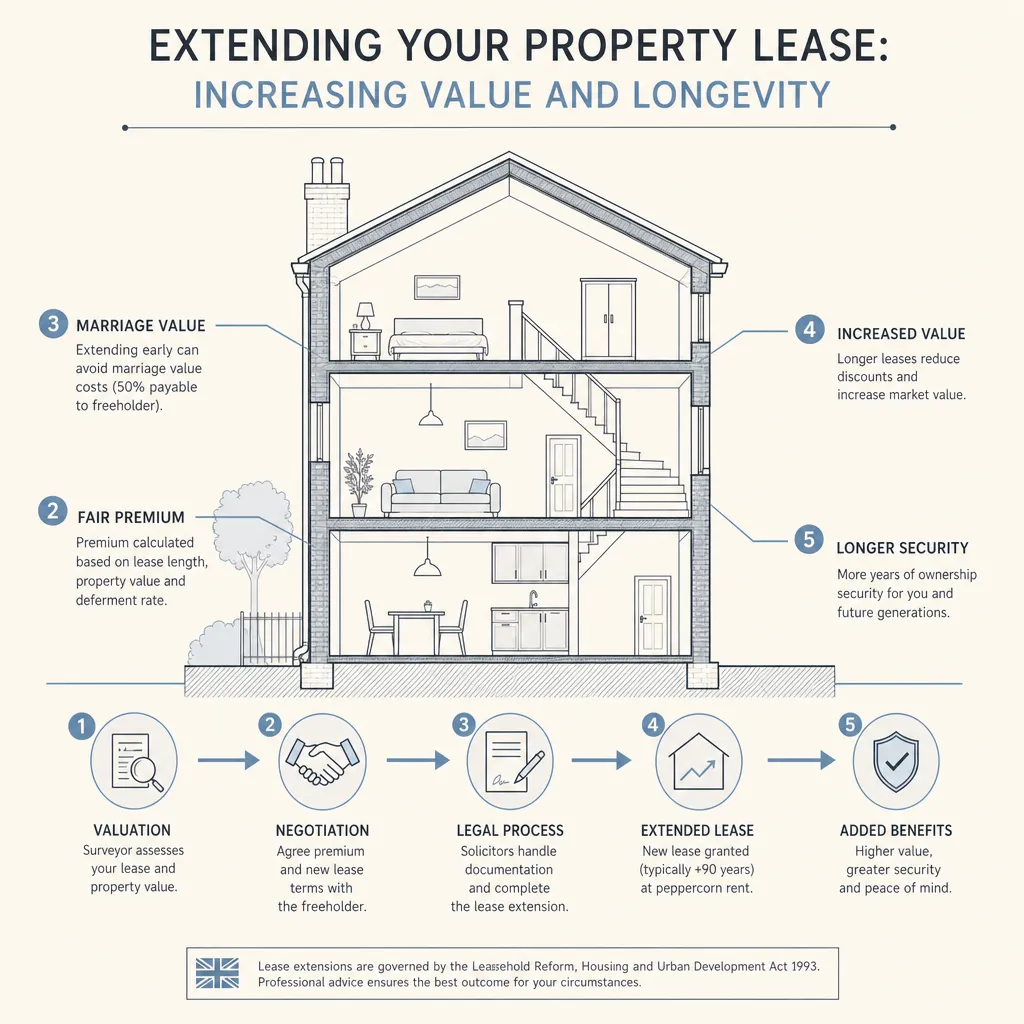
Extending Your Property Lease: Increasing Value and Longevity
Qualifying leaseholders in England and Wales can extend their lease by 90 years at a peppercorn ground rent under the Leasehold Reform, Housing and Urban Development Act 1993.
 Buying & Moving
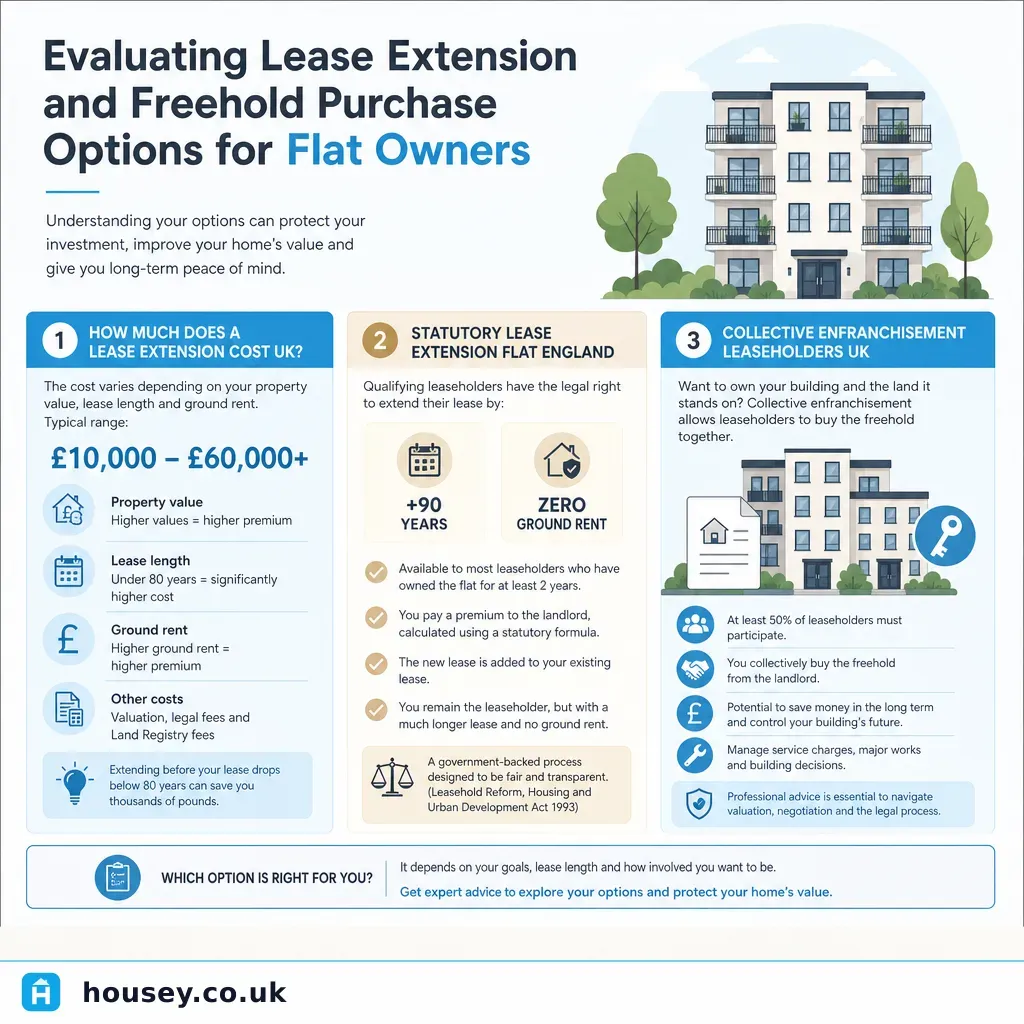
Evaluating Lease Extension and Freehold Purchase Options for Flat Owners
Flat owners in England and Wales can extend their lease by 90 years — increasing to 990 years under pending 2024 reforms — or collectively purchase the freehold.
 Buying & Moving
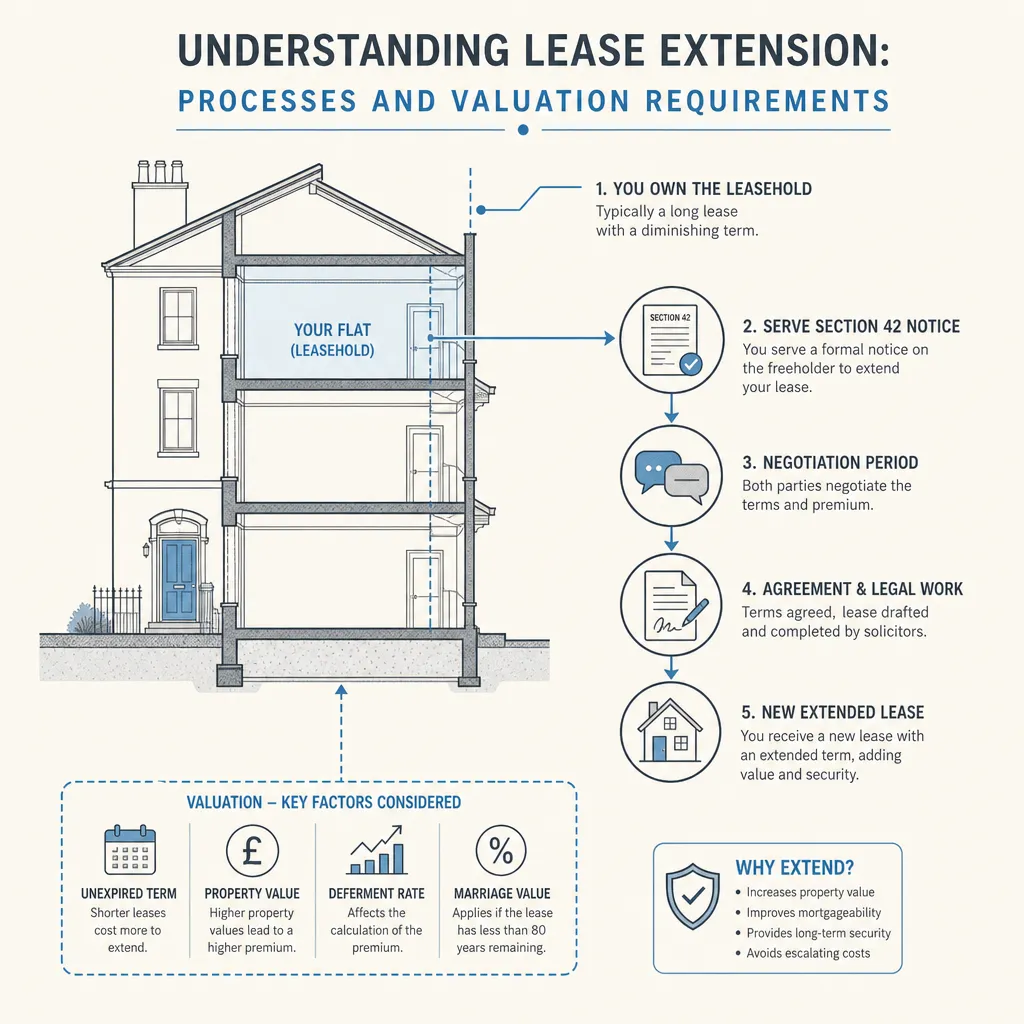
Understanding Lease Extension: Processes and Valuation Requirements
Qualifying flat owners in England and Wales can extend their lease by 90 years under the Leasehold Reform, Housing and Urban Development Act 1993, provided they have owned the property for at least two years.
 Buying & Moving
Joint Mortgage to Single Ownership: Removing Names and Modifying Deeds
Removing a name from a joint mortgage requires both a transfer of equity — updating legal title at HM Land Registry — and the lender's formal written consent to modify the loan.
 Buying & Moving
Understanding Leasehold Property Terminology and Rights
Leasehold means owning occupation rights for a fixed term, not the land or structure.