Keeping Your House Move on Track: Expert Tips for Uninterrupted Relocation
By Housey · Last reviewed 18th of May 2026
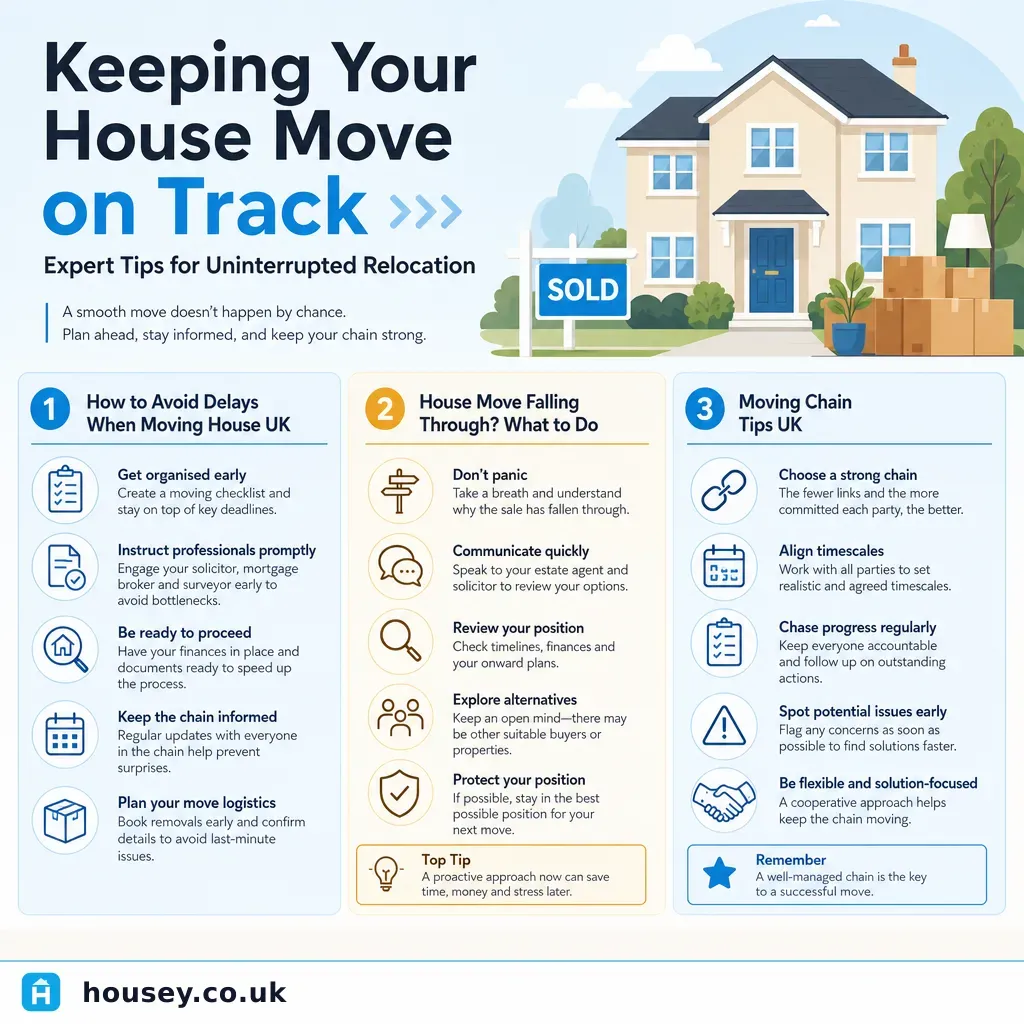
Keeping Your House Move on Track: Expert Tips for Uninterrupted Relocation
Moving house in the UK rarely proceeds without at least one significant complication. The process involves at least two legal teams, a mortgage lender, a surveyor, and frequently a chain of other buyers and sellers — all of whom can introduce delays or, in the worst case, cause a transaction to collapse. Whether you are a first-time buyer or an experienced mover, understanding where disruption typically occurs and how to prepare for it is the most effective thing you can do before problems arise.
Key points
- The average time from offer accepted to completion in England and Wales is 12–16 weeks, though chains, surveys, and searches can extend this significantly.
- Conveyancing searches — local authority, drainage, and environmental — typically take 2–6 weeks; ordering them promptly is one of the biggest ways to speed up a transaction.
- Exchange of contracts is the point at which both buyer and seller are legally committed; prior to exchange, either party can withdraw without financial penalty.
- Removal companies in popular areas are often booked 4–6 weeks ahead of peak periods (spring and summer); securing a provisional date early reduces last-minute risk.
- A move-ready document pack — ID, proof of funds, mortgage in principle, and property information forms completed — can shave days or weeks off the legal process.
Where house moves most commonly stall
Most delays fall into one of four categories.
Legal delays: Conveyancing involves multiple rounds of enquiries, title checks, and search results. If the seller has not completed their Property Information Form (TA6) or Fittings and Contents List (TA10) promptly, progress stalls while solicitors chase.
Survey and valuation delays: A down-valued property or a structural concern flagged in a RICS survey can pause proceedings while parties renegotiate or obtain specialist reports. Getting specialist quotes before rushing to renegotiate prevents larger delays later.
Mortgage delays: Lenders may request additional documentation or a more detailed valuation before issuing a formal mortgage offer. Changes in personal circumstances after the Agreement in Principle — such as a new job or new credit commitments — can reset the clock.
Chain collapses: If another buyer or seller in the chain withdraws for any reason, the whole chain can pause or fall apart. This is the single largest cause of failed transactions in England and Wales.
Which of these you can control
Delay source | In your control? | Action to take |
|---|---|---|
Slow return of property information forms | Partially (if you are the seller) | Complete TA6 and TA10 before or immediately after accepting an offer |
Conveyancing search delays | Limited | Instruct solicitor immediately after offer; ask them to order searches at the same time as the mortgage application |
Survey concerns | Limited | Instruct survey early; get specialist quotes before renegotiating |
Mortgage documentation requests | Yes | Prepare 3 months' payslips, bank statements, ID, and proof of deposit before applying |
Chain collapses | Very limited | Favour chain-free or shorter chains where possible; stay in close contact with your estate agent |
Removal booking | Yes | Book a provisional date early and confirm within 48 hours of exchange |
Building your move-ready document pack
Preparing a document pack before the process starts is one of the most practical steps you can take. It reduces back-and-forth with solicitors and lenders and removes one of the most common sources of day-to-day friction.
Sellers should prepare:
- Completed TA6 (Property Information Form)
- Completed TA10 (Fittings and Contents Form)
- Title deeds or Land Registry title register (your solicitor can obtain this)
- Building regulations completion certificates for any works carried out
- FENSA or CERTASS certificates for replacement windows or doors
- Boiler service records and Gas Safe certificates
- Any planning permissions or approved development applications
Buyers should prepare:
- Proof of identity (passport or driving licence)
- Proof of address (utility bill or bank statement)
- Three months' payslips and bank statements
- Agreement in Principle from your mortgage lender
- Evidence of deposit source, particularly for gifted deposits
Solicitors commonly ask for these documents at the point of instruction. Having them ready avoids days of chasing before substantive legal work can begin.
Decision tree: what to do when your move hits a problem
- If your solicitor has not received search results after four weeks: ask which authority is causing the delay and whether indemnity insurance is available as an interim measure.
- If a survey flags a major defect: do not withdraw immediately. Obtain two or three specialist quotes for remedial work; use these to negotiate on price or request the seller remedies the issue before exchange.
- If your mortgage offer is delayed: check whether your lender needs additional documents; avoid changing jobs, taking on new credit, or making unusual financial transactions in the interim.
- If a chain member withdraws: ask your estate agent immediately how many properties are affected and whether the chain can be rebuilt with a new buyer or seller.
- If completion is delayed at short notice: contact your removals company as early as possible — many can hold belongings overnight at their depot as a contingency.
Red flags that need immediate action
- A solicitor who does not respond to enquiries within five working days without explanation.
- A seller who has not returned property information forms within four weeks of instructing their solicitor.
- A mortgage offer expiring before exchange — most offers are valid for six months; check your letter of offer.
- A lender-instructed valuation that differs significantly from the agreed purchase price.
- Signs that any party in the chain is in financial difficulty or facing significant personal change — your estate agent may have intelligence worth asking about.
When to get professional help
If communication has broken down and your move has stalled significantly, request that your solicitor escalates formally with the other side. If you have already exchanged and a party is threatening to pull out, seek legal advice immediately — financial penalties and damages may apply under the terms of exchange.
If removals are booked and completion is delayed, contact your removals company as early as possible. Most firms have contingency arrangements for delayed completions but need maximum notice to rebook vehicles and crews.
How Housey can help
Housey connects homeowners with trusted house removals companies and experienced conveyancing solicitors across the UK. Compare quotes from vetted providers in one place, so you can plan your move with confidence from the moment your offer is accepted.
Frequently asked questions
How long does a house move take in the UK from offer to completion?
The average time from accepted offer to completion in England and Wales is 12–16 weeks, though chains can extend this to six months or more in complex cases. Leasehold transactions tend to take longer than freehold. Searches, survey results, mortgage offers, and solicitor enquiries are usually on the critical path.
Can a seller pull out after offer acceptance in the UK?
Yes. In England and Wales, neither party is legally bound until contracts are exchanged. Either party can withdraw without financial penalty prior to exchange, though they may lose fees already paid for surveys or legal work. Scotland operates differently — missives once concluded are legally binding.
How early should I book a removal company?
Aim to book a provisional date as soon as you have an estimated completion timeframe — typically around the point of receiving your mortgage offer or when searches return. Many reputable removals companies in urban areas are booked 4–6 weeks ahead during spring and summer.
What is the difference between exchange and completion?
Exchange of contracts is when both buyer and seller sign and are legally committed; a completion date is agreed at exchange. Completion is when the purchase money transfers and keys are handed over. The period between exchange and completion is typically one to four weeks.
Sources and further reading
- Buying or selling a home — Citizens Advice
- HM Land Registry: property registration — GOV.UK
- RICS home surveys guidance — Royal Institution of Chartered Surveyors
- Conveyancing searches — GOV.UK
Useful next reads
 Buying & Moving
The Advantages of Moving House During the Winter Months
Moving house between November and February usually costs less than in peak summer months, when removal firms are at their busiest.
 Buying & Moving
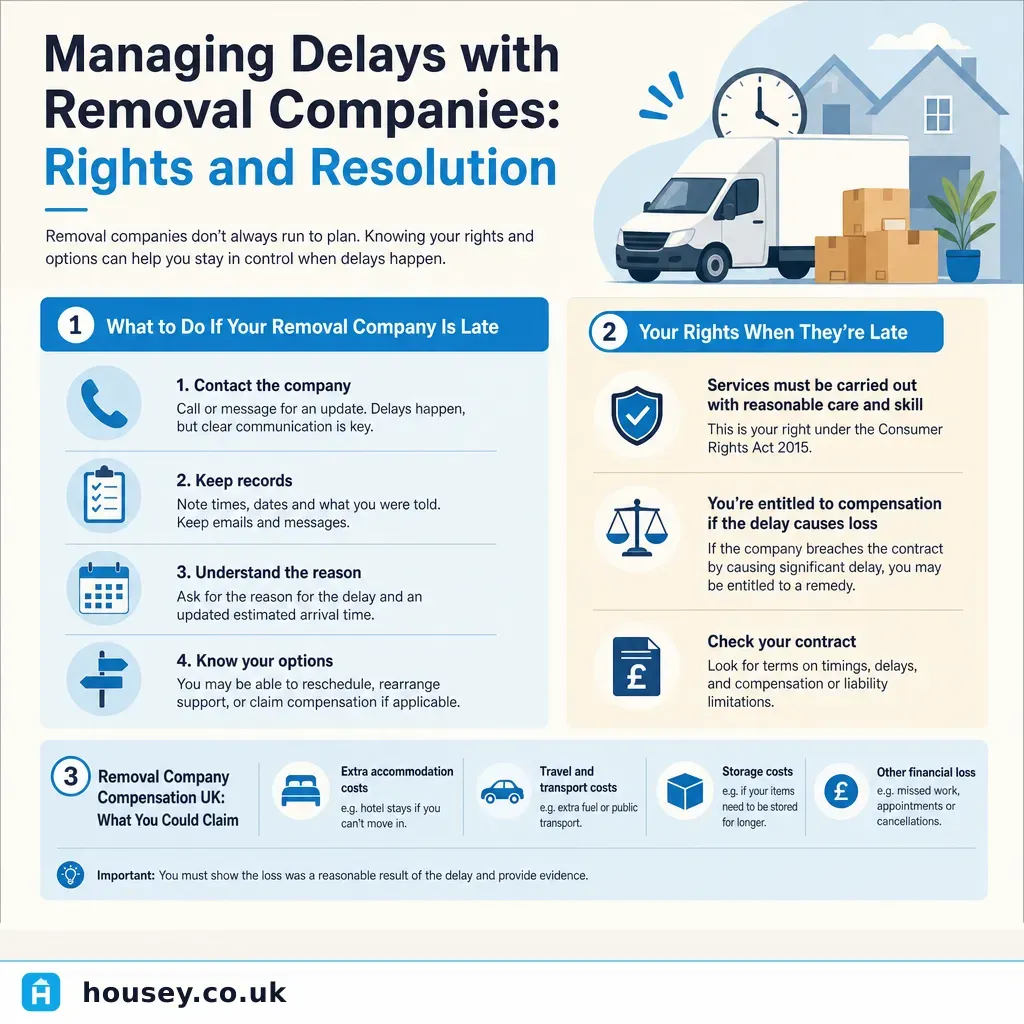
Managing Delays with Removal Companies: Rights and Resolution
If a removal company is late, your rights depend on your contract and whether the company is BAR-registered.
 Buying & Moving
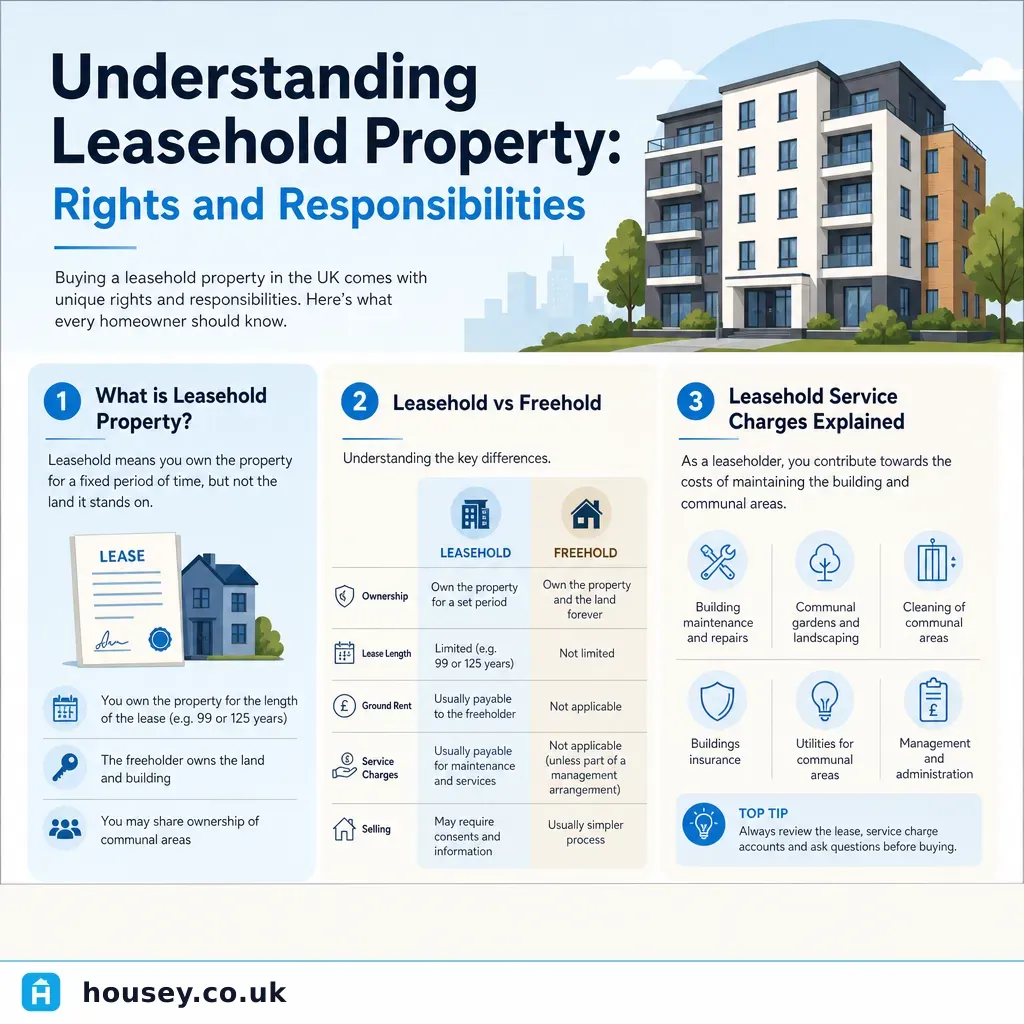
Understanding Leasehold Property: Rights and Responsibilities
Leasehold means you own a time-limited interest in a property while the freeholder owns the land and building.
 Buying & Moving
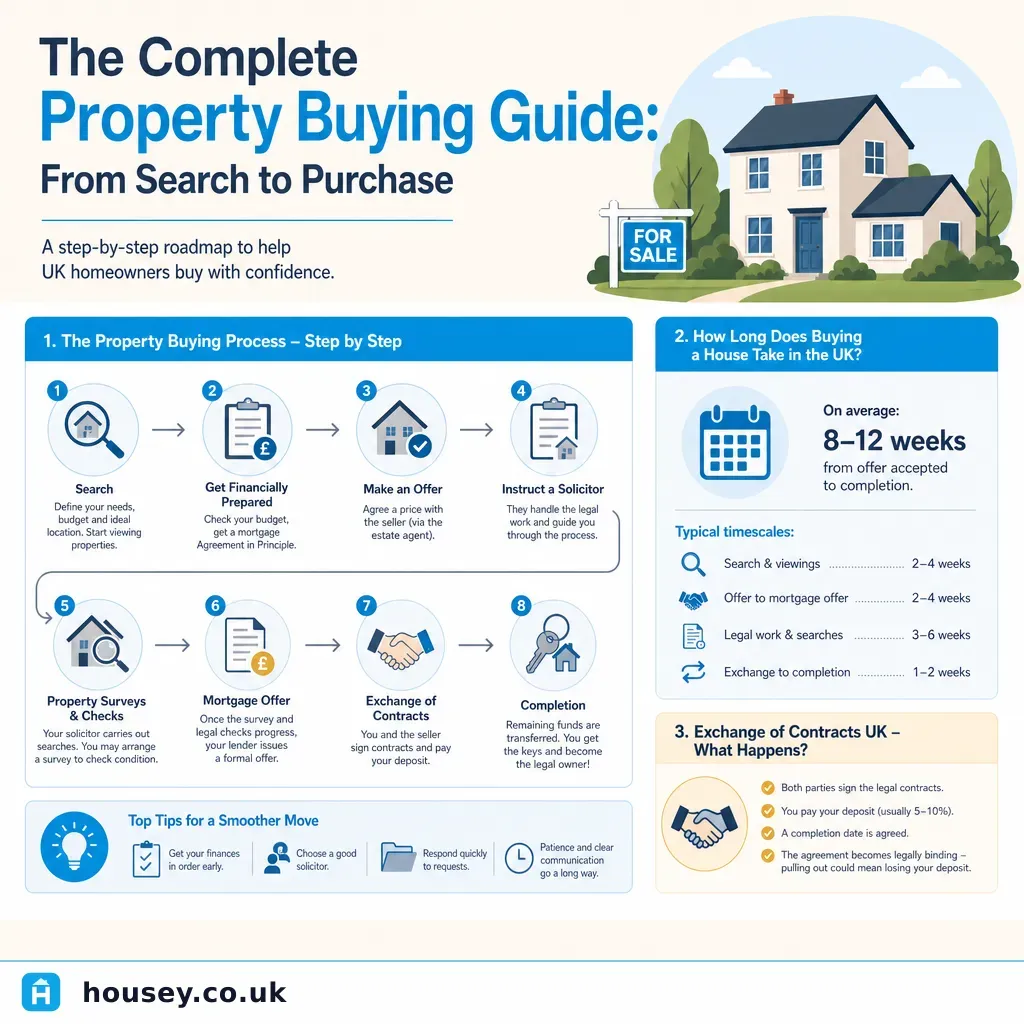
The Complete Property Buying Guide: From Search to Purchase
Buying a property in England and Wales typically takes 3–6 months from accepted offer to completion.
 Buying & Moving
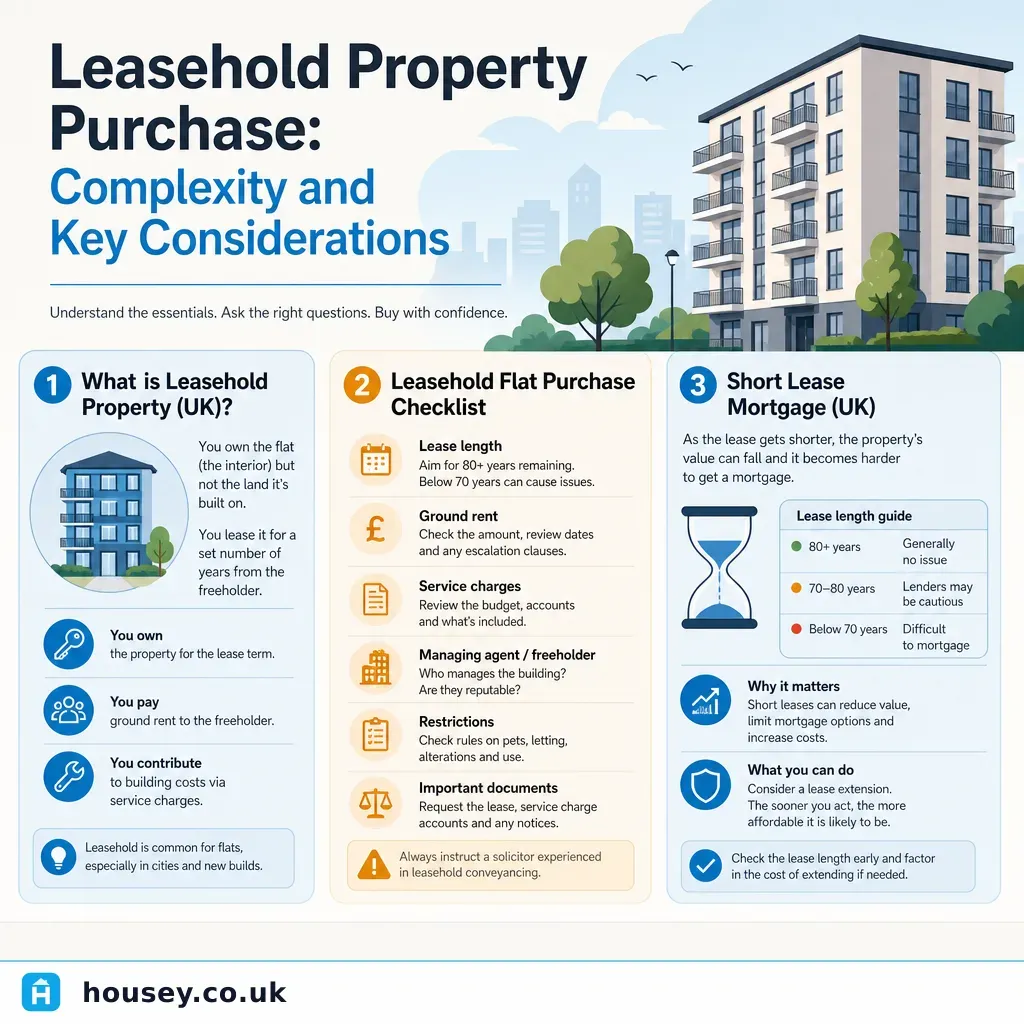
Leasehold Property Purchase: Complexity and Key Considerations
Buying a leasehold property means purchasing the right to occupy for a fixed term rather than owning the land outright.