Landlord Property Maintenance and Upkeep Essentials
By Housey · Last reviewed 30th of May 2026
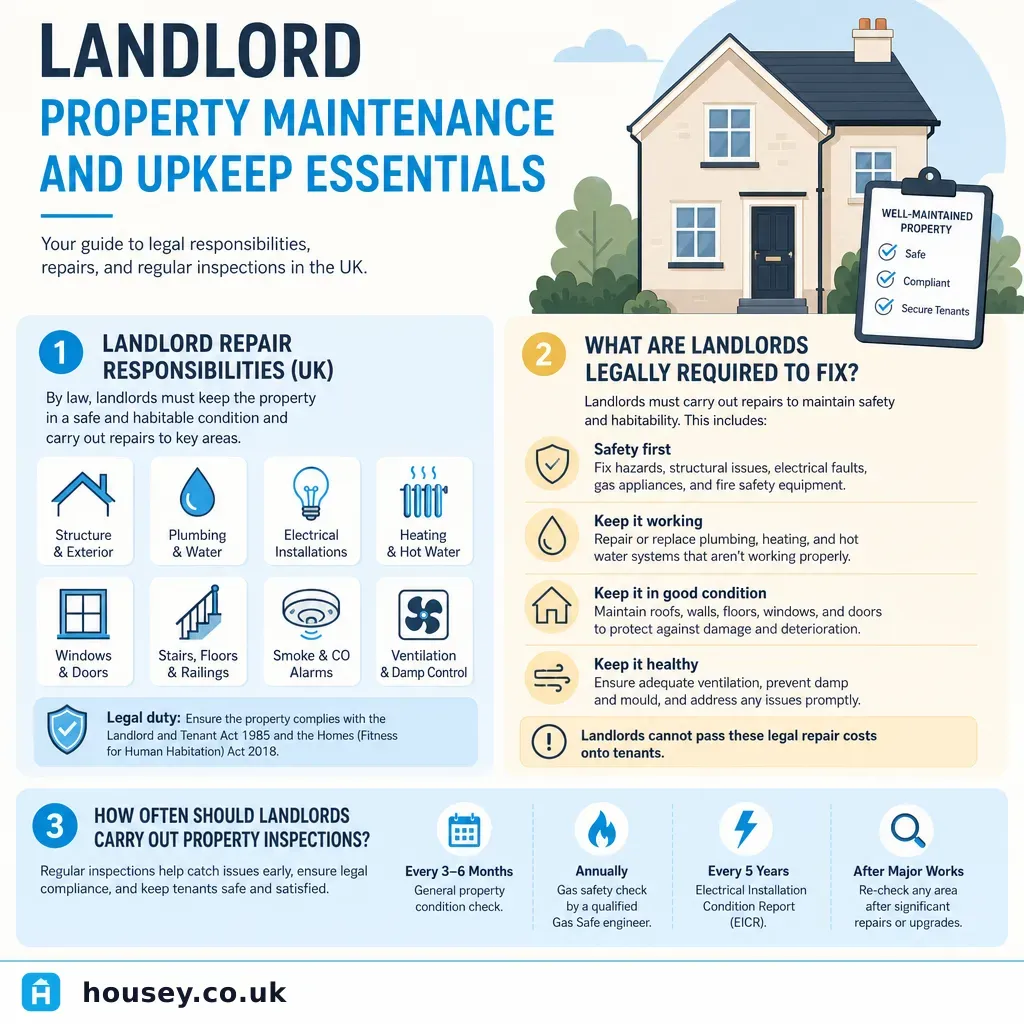
Landlord Property Maintenance and Upkeep Essentials
Keeping a rental property in good repair is both a legal obligation and a practical investment. Disrepair leads to tenant complaints, reduced rental yield, and — in serious cases — enforcement action from local authorities under the Housing Health and Safety Rating System (HHSRS). Whether you own a single Victorian terrace or a small portfolio of 1990s estate houses, a structured approach to maintenance reduces unplanned costs, protects your asset, and keeps you on the right side of evolving regulation.
Key points
- Under the Landlord and Tenant Act 1985, Section 11, landlords are legally responsible for maintaining the structure and exterior, and for heating, hot water, gas, and electrical installations.
- The Housing Health and Safety Rating System (HHSRS), introduced under the Housing Act 2004, gives local councils powers to inspect rented homes and require remediation of category 1 hazards.
- Industry guidance suggests budgeting 1–2% of property value annually for maintenance in average-condition properties; older or solid-wall homes may warrant 2–3%.
- All gas appliance maintenance and the annual Gas Safety Record must be carried out by a Gas Safe registered engineer under the Gas Safety (Installation and Use) Regulations 1998.
- Electrical Installation Condition Reports (EICRs) are required at least every five years in privately rented homes in England under the Electrical Safety Standards in the Private Rented Sector (England) Regulations 2020.
What landlords are legally required to maintain
The Landlord and Tenant Act 1985, Section 11, sets out core repair obligations for most residential tenancies in England and Wales:
- The structure and exterior: walls, roof, foundations, windows, external doors, gutters, drains, and external pipes
- Heating and hot water installations
- Gas pipework, flues, and appliances supplied by the landlord
- Fixed electrical wiring and installations
- Sanitation: basins, sinks, baths, and drains
These obligations cannot be contracted out to tenants, regardless of the tenancy agreement wording. Scotland has equivalent provisions under the Housing (Scotland) Act 2006 repairing standard; Northern Ireland has separate legislation.
Reactive versus preventive maintenance: the real cost difference
Approach | Annual cost profile | Typical scenario | Key risk |
|---|---|---|---|
Reactive only | Low routine spend, high emergency spikes | Boiler fails in January; emergency callout and replacement required | Cash flow shocks, tenant dissatisfaction, legal exposure |
Preventive + reactive | Consistent, predictable spend | Annual boiler service identifies failing component before breakdown | Lower emergency frequency; easier forward planning |
Scheduled + capital reserve | Highest upfront planning effort, lowest long-term cost | Roof replacement planned and budgeted over 10 years | Minimises both emergency costs and capital surprise |
Budgeting 1–2% of property value annually covers routine maintenance in most average-condition properties. Older properties, flat roofs, and solid-wall homes may need 2–3%.
Which professionals handle which maintenance jobs?
Work type | Who to instruct | Qualification or registration to check |
|---|---|---|
Boiler servicing and gas repairs | Gas Safe registered engineer | Gas Safe Register number (verify at gassaferegister.co.uk) |
Electrical fault-finding, EICR | NICEIC or NAPIT registered electrician | Current registration certificate |
Roof repair and inspection | Qualified roofer | NFRC (National Federation of Roofing Contractors) membership preferred |
Damp investigation and treatment | Specialist damp contractor | PCA (Property Care Association) membership preferred |
Blocked or collapsed drainage | Drainage contractor | Insurance and CCTV survey capability |
Replacement windows and doors | FENSA-registered installer | FENSA certificate issued on completion |
Structural concerns or subsidence | Chartered structural engineer or RICS surveyor | MIStructE, MICE, or MRICS |
Building a preventive maintenance programme
A preventive schedule need not be complex. For a single property, an annual checklist is sufficient:
Every 12 months:
- Boiler service by a Gas Safe registered engineer; Gas Safety Record issued and provided to tenant
- Smoke alarm and carbon monoxide detector tested at every tenancy start and periodically thereafter
- Gutters and downpipes cleared of debris, particularly following autumn
- External inspection: roof tiles, pointing, fascias, soffits, external joinery
Every 3–5 years:
- Electrical Installation Condition Report (EICR) — legally required every 5 years for privately rented properties in England
- External redecoration of timber and metal surfaces
- Review of window and door seals; replacement if significant energy loss or draught ingress is evident
When prompted by condition:
- Flat roof inspection (usually every 1–2 years)
- Chimney sweep if a solid fuel burning appliance or open fireplace is in use
What to ask before accepting a maintenance quote
- What is included and excluded from the scope of work?
- Who will carry out the work, and what qualifications or registrations do they hold?
- What certificate, report, or documentation will I receive on completion?
- What assumptions is the quote based on — access, scaffolding, clearance of existing materials?
- What could change the price or timeline once work begins?
- Is VAT included in the quoted figure?
- How will access be arranged with the tenant, and what notice will be given?
Getting two or three quotes for any job over £500 is generally advisable. For recurring work such as boiler servicing or gutter clearance, an annual maintenance contract with a trusted local contractor may reduce costs over time.
Managing damp and mould
Damp and mould are among the most common tenant complaints in UK rental properties. Following Awaab's Law provisions — initially applying to social housing under the Social Housing (Regulation) Act 2023, with private sector obligations developing under the Renters' Rights Act 2024 — landlords are expected to investigate and respond to damp reports within defined timeframes.
Common causes to investigate before instructing treatment:
- Rising damp: typically requires a specialist damp contractor; independent diagnosis before any chemical injection treatment is strongly advisable
- Penetrating damp: usually a roofing, pointing, or external wall fault — investigate externally before treating internally
- Condensation: often an insulation, ventilation, or heating issue — check extractor fans, wall insulation, and heating patterns before assuming a structural cause
Red flags requiring immediate action
- Tenant reports a gas smell — call the Gas Emergency Service (0800 111 999) immediately; do not investigate yourself
- Cracks widening or stepped through brickwork, or sticking doors and windows — commission a structural assessment
- Ceiling staining spreading rapidly or falling plaster — arrange urgent roof or plumbing investigation
- No heating or hot water in winter — repair obligation is effectively immediate under the Landlord and Tenant Act 1985
- Tenant reports sparking or burning smell from electrics — arrange an NICEIC or NAPIT registered electrician visit urgently; do not delay
Important limitations
This article provides general information on landlord maintenance obligations in England. Rules and responsibilities vary between England, Scotland, Wales, and Northern Ireland. Houses in Multiple Occupation (HMOs) carry additional obligations not covered here. Obligations for leasehold properties and listed buildings may differ. Nothing in this article constitutes legal or professional safety advice. Regulations change; always verify that you are following the current version of any relevant legislation, and consult a solicitor if you are uncertain about your specific obligations.
When this becomes urgent
Seek qualified professional help immediately if:
- A tenant reports a gas smell or suspected gas leak — this is a gas emergency
- Your property lacks a current Gas Safety Record while tenants are in situ
- An electrician identifies a category C1 (danger present) or C2 (potentially dangerous) code in an EICR
- Your local authority issues an improvement notice under the HHSRS
- You receive a tenant complaint about conditions that could constitute a category 1 hazard — severe cold, dangerous electrics, or serious structural damp
What to ask a qualified professional
Before instructing a Gas Safe engineer:
- Can you confirm your Gas Safe registration number, and may I verify it on the Gas Safe Register website?
- Will you inspect all landlord-supplied gas appliances, not just the boiler?
- What documentation will I receive, and within what timeframe?
- If a fault is identified, can you carry out remediation under the same instruction?
Before instructing an electrician for an EICR:
- Are you registered with NICEIC, NAPIT, or an equivalent approved scheme under the Electrical Safety Standards Regulations 2020?
- Does the inspection cover all fixed wiring, the consumer unit, and all socket and lighting circuits?
- What happens if the report identifies C1 or C2 items — will you provide a remediation quote at the same time?
- Will tenants need to be present, and how much disruption should they expect?
When to get professional help
For gas work: always a Gas Safe registered engineer — no exceptions. For electrical work involving fixed wiring or the consumer unit: NICEIC or NAPIT registered electrician. For structural concerns or suspected subsidence: chartered structural engineer or RICS-qualified surveyor. For damp of unknown cause: commission an independent survey before any remediation to identify the source correctly.
How Housey can help
Housey connects landlords with specialist contractors for the maintenance jobs that matter most. Whether you need damp proofing specialists for a persistent moisture problem, drainage contractors to investigate a blocked or collapsed drain, roofers for inspection and repair, or window and door installers for worn or failing glazing, Housey helps you compare quotes from vetted local professionals.
Frequently asked questions
Who is responsible for repairs in a rental property?
Under the Landlord and Tenant Act 1985 (Section 11), the landlord is responsible for the structure and exterior and for gas, water, and electrical installations. Tenants are generally responsible for minor internal maintenance and using the property in a reasonable way. Section 11 duties cannot be overridden by the tenancy agreement, regardless of what it states.
How often must I have the electrics inspected in my rental property?
In England, privately rented properties must have an Electrical Installation Condition Report (EICR) at least every five years under the Electrical Safety Standards in the Private Rented Sector (England) Regulations 2020. A copy must be provided to tenants and, on request, to the local authority within 28 days. Scotland and Wales have equivalent but distinct obligations.
Can I do maintenance work myself on my rental property?
You can carry out minor, non-technical maintenance such as decorating, garden work, and minor joinery. Gas work must only be done by a Gas Safe registered engineer. Electrical work involving the consumer unit or fixed wiring should be carried out by a registered electrician. Building work subject to building regulations requires the appropriate notification or building notice.
What is the HHSRS and when can a council use it?
The Housing Health and Safety Rating System (HHSRS) is the framework used by local authorities in England and Wales to assess hazards in rented homes, under the Housing Act 2004. If a category 1 hazard is found — such as severe damp, unsafe electrics, or extreme cold — the council can issue an improvement notice requiring the landlord to carry out repairs within a set timescale.
Sources and further reading
- Landlord and Tenant Act 1985, Section 11 — legislation.gov.uk
- Housing Health and Safety Rating System (HHSRS) guidance — GOV.UK
- Gas Safety (Installation and Use) Regulations 1998 — legislation.gov.uk
- Electrical Safety Standards in the Private Rented Sector (England) Regulations 2020 — legislation.gov.uk
- Gas Safe Register: landlord responsibilities — Gas Safe Register
- Property Care Association: damp surveying guidance — Property Care Association
Useful next reads
 Improvement & Build
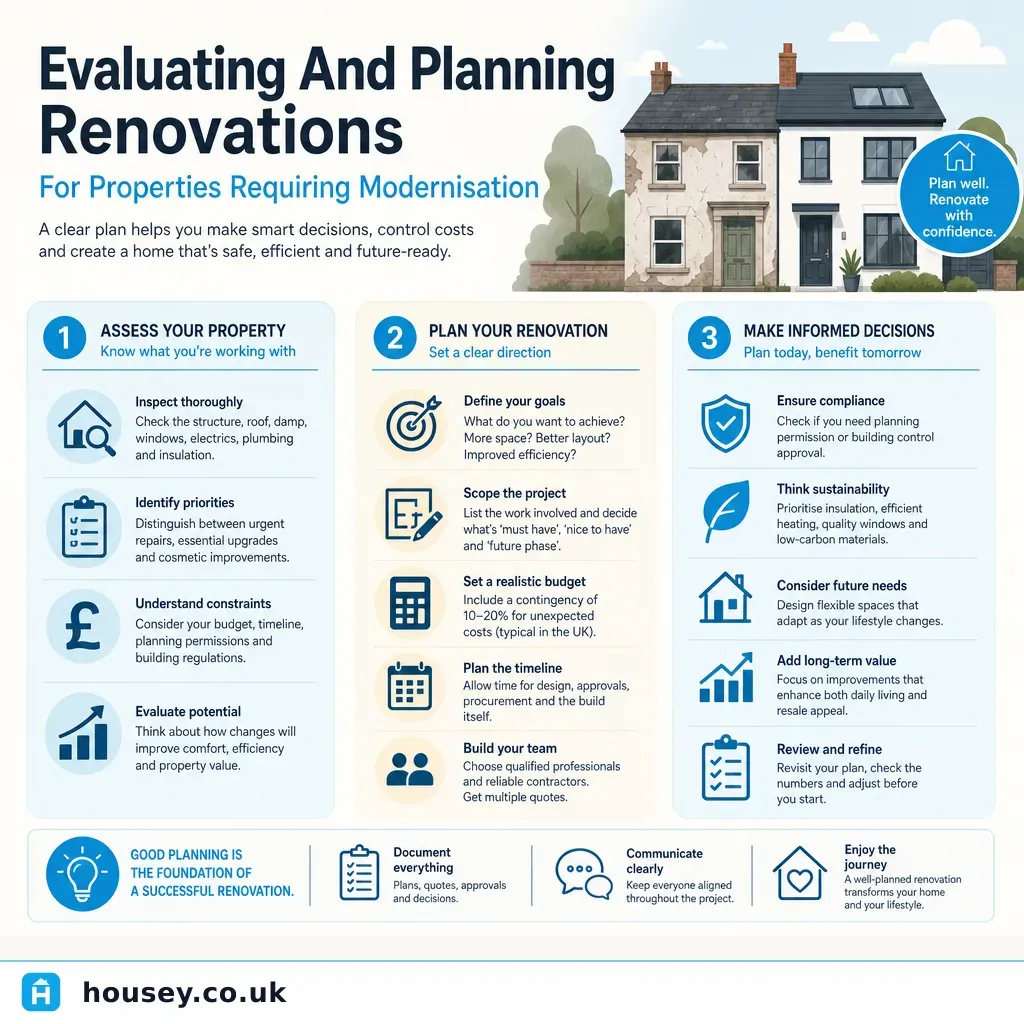
Evaluating And Planning Renovations For Properties Requiring Modernisation
Start by commissioning a condition survey — RICS Level 3 for pre-1919 properties — to identify structural defects, damp, and services issues before finalising a budget.
 Improvement & Build
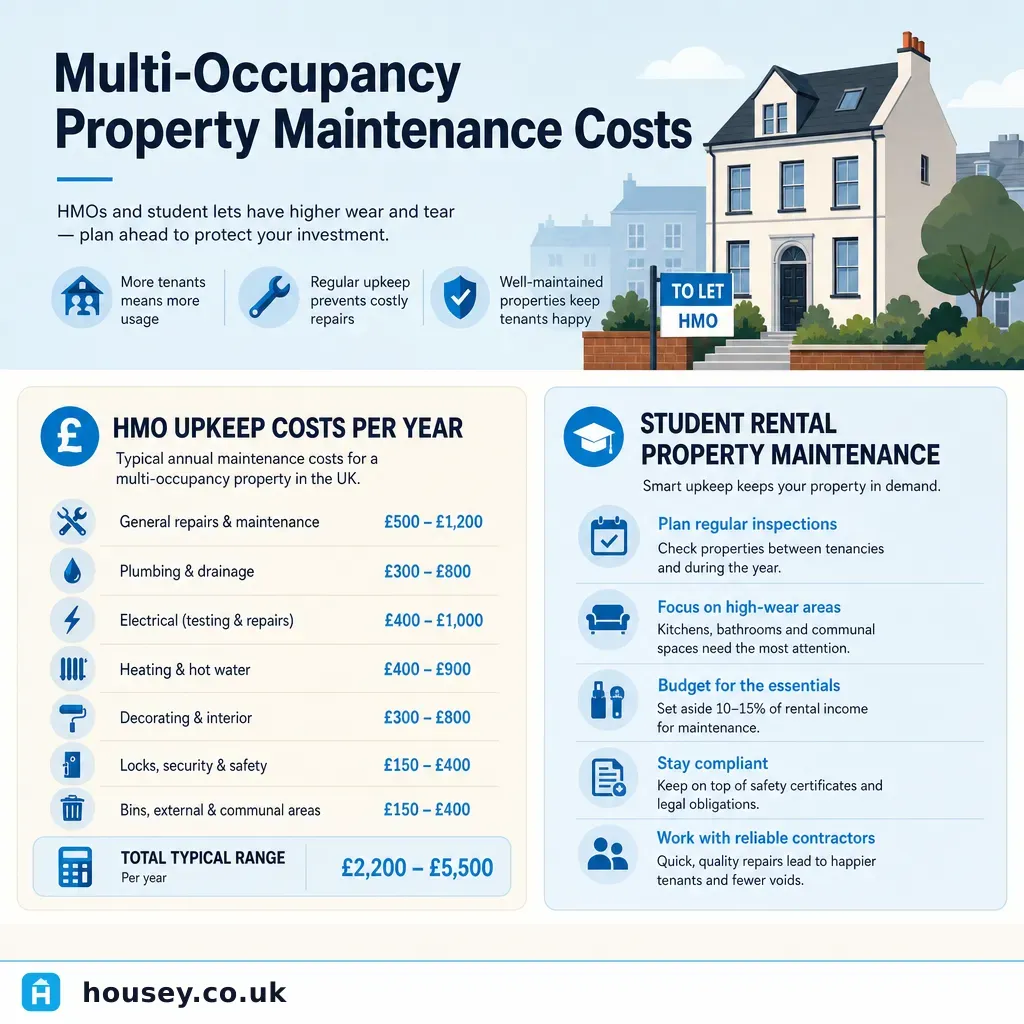
Multi-Occupancy Property Maintenance Costs
HMO maintenance typically costs 15–25% of gross annual rent, rising to 30% or more for older stock or large student lets.
 Improvement & Build
How to Find and Hire an Extension Builder
To hire a reliable extension builder, get at least three detailed written quotes from contractors with documented experience of similar projects.
 Improvement & Build
Expanding Doorways: Planning, Costs, and Building Requirements
Expanding a doorway in a load-bearing wall requires Building Regulations Part A approval and a structural engineer's lintel design.
 Improvement & Build
Who to Contact for Broken Door Handle Repair
For a broken door handle, a general handyperson can handle most internal timber door repairs, while a joiner or locksmith is better suited to external doors, particularly if the lock mechanism is affected.