Multi-Occupancy Property Maintenance Costs
By Housey · Last reviewed 11th of May 2026
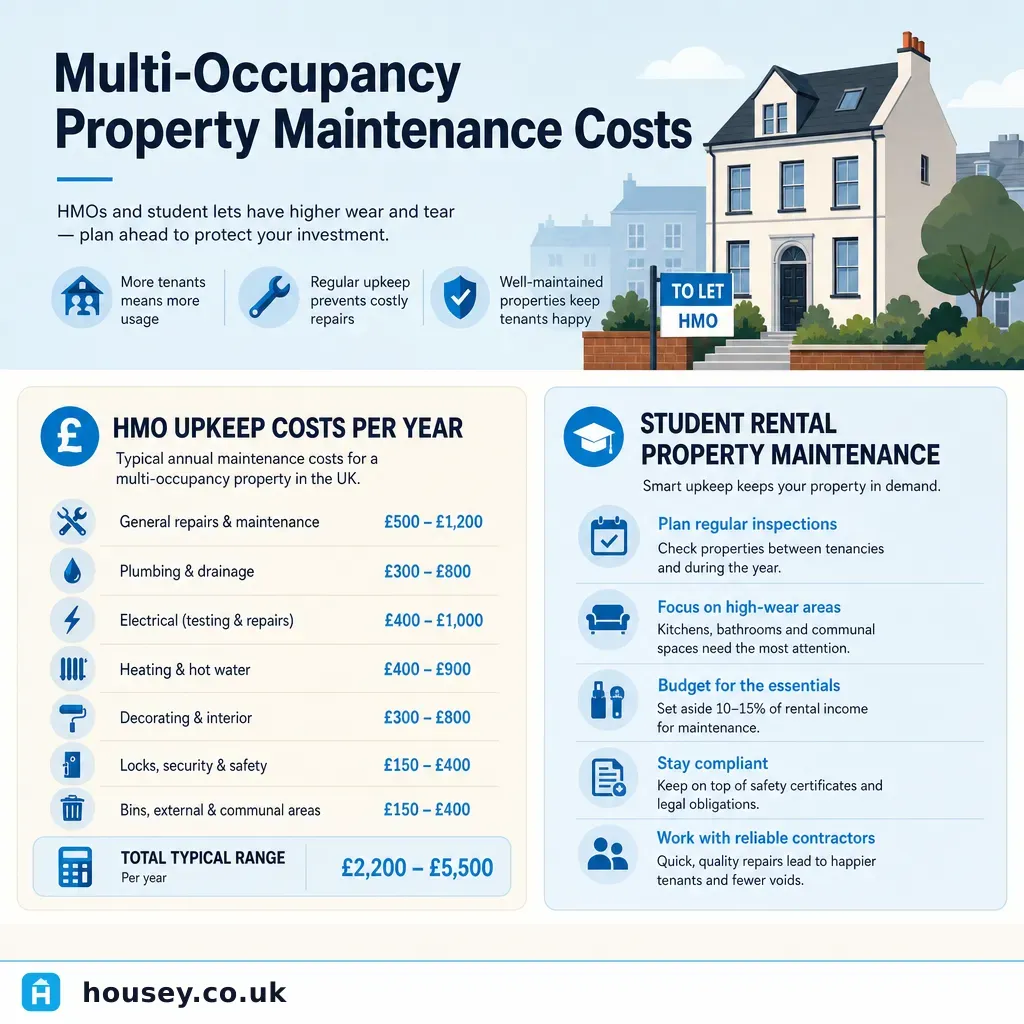
Multi-Occupancy Property Maintenance Costs
Running a house in multiple occupation (HMO) or other multi-occupancy property is operationally different from managing a single-let home. With more occupants sharing kitchens, bathrooms, and communal spaces, wear accelerates rapidly, repair callouts increase, and compliance obligations—particularly around fire safety, gas, and HMO licensing—add a layer of costs that a simple per-bedroom yield calculation can easily underestimate. Whether you own a student house in Nottingham, a professional HMO in Manchester, or a bedsit block in South London, understanding realistic maintenance budgets is essential before setting rent levels and projecting returns.
Key points
- UK landlords should typically budget 15–25% of gross annual rental income for maintenance and compliance on a well-maintained HMO; older stock or large student lets can push this to 30% or more. (Indicative UK figures, last reviewed 2026-05-11.)
- HMO licensing under the Housing Act 2004 requires a mandatory annual gas safety check (CP12) by a Gas Safe-registered engineer and a 5-yearly Electrical Installation Condition Report (EICR) as minimum legal requirements for all licensed HMOs.
- Local authorities can impose additional HMO licence conditions specifying minimum room sizes, décor standards, and appliance replacement timescales; the national minimum sleeping room size for one adult under the Licensing of Houses in Multiple Occupation (Mandatory Conditions of Licences) (England) Regulations 2018 is 6.51 m².
- Shared kitchens and bathrooms in HMOs typically need full refurbishment every 5–8 years—earlier in high-turnover student lets—compared with 10–15 years in a single-let property.
- Standard buy-to-let buildings insurance does not usually cover multi-occupancy risk; specialist HMO insurance is a separate product and typically carries higher premiums and excesses.
What counts as HMO maintenance?
For budgeting purposes, split costs into four categories:
Routine maintenance: Replacing lightbulbs, unblocking drains, fixing door handles, touching up paintwork, and repairing or replacing shared appliances. These small items accumulate rapidly across multiple rooms and communal areas.
Compliance and certification: Annual gas safety certificate (CP12), 5-yearly EICR, PAT testing for landlord-supplied appliances, fire alarm servicing (typically every 6 months), emergency lighting testing, fire extinguisher servicing, and HMO licence renewal fees—typically £500–£1,500 for a 5-year licence, varying by local authority.
Planned preventative maintenance (PPM): Annual boiler service, twice-yearly gutter clearing, external decoration cycles, roof inspection, and periodic damp-proofing review.
Major capital works: Roof repair or replacement, boiler replacement, full rewiring, kitchen or bathroom refurbishment, and structural repairs.
Indicative annual cost benchmarks
Indicative UK costs, last reviewed 2026-05-11. Figures vary significantly by region, property age, and number of occupants.
Property type | Typical annual maintenance (% gross rent) | Key cost drivers |
|---|---|---|
Modern HMO (post-2000), 4–5 beds | 15–18% | Compliance, appliance callouts, minor decoration |
Victorian or Edwardian HMO, 4–6 beds | 20–28% | Damp, ageing plumbing, repointing, roof wear |
Large student HMO, 6–10 beds | 25–35% | Accelerated wear, high annual turnover, more compliance items |
Mixed-use bedsit block | 20–30% | Shared area upkeep, fire system complexity |
Single let vs HMO: maintenance profile comparison
Item | Single-let 3-bed house | 5-bed HMO | Notes |
|---|---|---|---|
Boiler callouts per year | 0.5–1 | 2–4 | More users, more daily strain |
Bathroom refit cycle | 10–15 years | 5–8 years | Higher occupancy, faster wear |
Communal redecorating cycle | 4–6 years | 2–3 years | Higher churn, scuffs, marks |
Annual compliance costs | £100–£200 | £500–£1,200 | EICR amortised, CP12, fire alarm servicing |
Recommended roof inspection frequency | Every 5 years | Every 2–3 years | Leaks reach more occupants before being reported |
HMO maintenance checklist
Use this checklist at the start of each new tenancy and annually during the tenancy:
Fire safety
Gas and boiler
Electrical
Damp and structure
External and roof
What drives costs higher in HMOs
Annual turnover: Student lets typically turn over each July–September, requiring rapid redecorating, carpet cleaning, appliance checks, and minor repairs—every year without exception.
Hard-water areas: Properties in East Anglia, London, and the South East face accelerated limescale build-up in showers, dishwashers, and pipework, reducing appliance lifespans and increasing replacement frequency.
Older stock: Victorian and Edwardian properties—common in university towns such as Oxford, Cambridge, Bristol, and Leeds—bring solid masonry walls prone to damp penetration, original lead pipework, and ageing slate roofs, all of which raise baseline maintenance costs significantly.
Local licence conditions: Some councils impose above-baseline requirements on HMO licence holders, including specific fire door specifications, minimum extinguisher ratings, or prescribed floor finishes in communal areas. Always review your local authority's HMO standards document before finalising a maintenance budget.
Red flags: when maintenance spend is too low
The following signs suggest an HMO is being underfunded on maintenance and problems are accumulating:
- Multiple tenant complaints about the same defect unresolved across a full tenancy period.
- Mould recurring in the same rooms after cleaning, suggesting inadequate ventilation rather than a surface-level issue.
- EICR or gas safety certificate more than 12 months overdue.
- Missing or slipped roof tiles going unrepaired for more than one winter season.
- Gutters visibly overflowing during rain—blocked gutters cause damp penetration to solid-wall properties within 12–18 months.
- Boiler repeatedly breaking down without a replacement plan in place.
When to get professional help
HMO maintenance extends well beyond routine DIY. Engage a qualified tradesperson for:
- Roof repairs or storm damage: Our roofing specialists can inspect and quote for repairs or full roof assessments, which are particularly important after autumn and winter storm seasons.
- Persistent damp: Where damp recurs despite improved ventilation, a specialist assessment from damp proofing specialists can determine whether the cause is rising damp, penetrating damp, or condensation—each requiring a different remedy.
- All gas work: Gas Safe-registered engineers only—this is a legal requirement, not a preference.
- Electrical work beyond like-for-like lamp replacement: NICEIC or NAPIT-registered electricians only.
- Structural concerns: Cracking, sagging floors, or bowing walls require a chartered structural engineer.
How Housey can help
Managing a multi-occupancy property means balancing routine repairs, compliance deadlines, and periodic major works simultaneously. Housey connects landlords and property managers with vetted local tradespeople who understand HMO requirements. Find and compare qualified roofing specialists and damp proofing specialists in your area.
Frequently asked questions
How much should I budget for HMO maintenance per room?
A useful rule of thumb is £500–£1,000 per room per year for routine maintenance and compliance in a well-maintained HMO, rising to £1,200–£2,000 for older properties or hard-water areas. Budgeting as a percentage of gross rent (15–25%) is usually more accurate because it scales with regional income differences. (Indicative UK costs, last reviewed 2026-05-11.)
Is a gas safety certificate legally required for an HMO?
Yes. Under the Gas Safety (Installation and Use) Regulations 1998, landlords must arrange a gas safety check by a Gas Safe-registered engineer every 12 months. A copy of the certificate (CP12) must be given to existing tenants within 28 days and to new tenants before move-in. Failure to comply is a criminal offence.
How often does an HMO need an EICR?
Houses in multiple occupation require an Electrical Installation Condition Report (EICR) at least every 5 years, or at change of tenancy if sooner, under the Electrical Safety Standards in the Private Rented Sector (England) Regulations 2020. Some local authority HMO licence conditions impose shorter intervals, so always check your licence conditions.
Can I claim HMO maintenance costs against tax?
Most routine maintenance and repair costs can be deducted against rental income for UK income tax purposes, provided they are revenue expenditure—like-for-like repairs rather than capital improvements. Capital works such as loft conversions are treated differently. Consult a qualified accountant or tax adviser for advice specific to your circumstances.
Sources and further reading
- Houses in multiple occupation — GOV.UK
- Gas Safety (Installation and Use) Regulations 1998 — legislation.gov.uk
- Electrical Safety Standards in the Private Rented Sector (England) Regulations 2020 — legislation.gov.uk
- Housing Act 2004: HMO licensing — legislation.gov.uk
- Damp and condensation — Energy Saving Trust
Useful next reads
 Improvement & Build
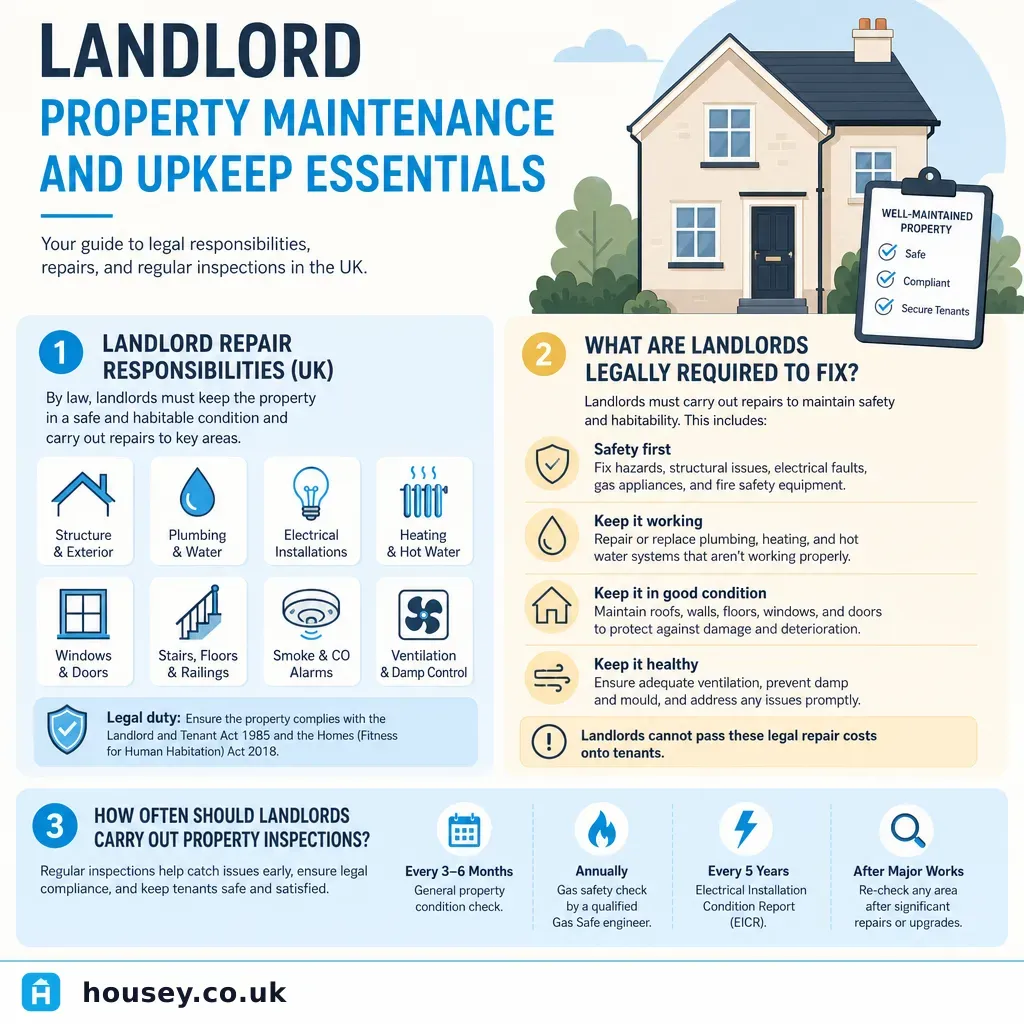
Landlord Property Maintenance and Upkeep Essentials
Landlords in England must maintain the structure and exterior, and gas, water, and electrical installations under the Landlord and Tenant Act 1985.
 Improvement & Build
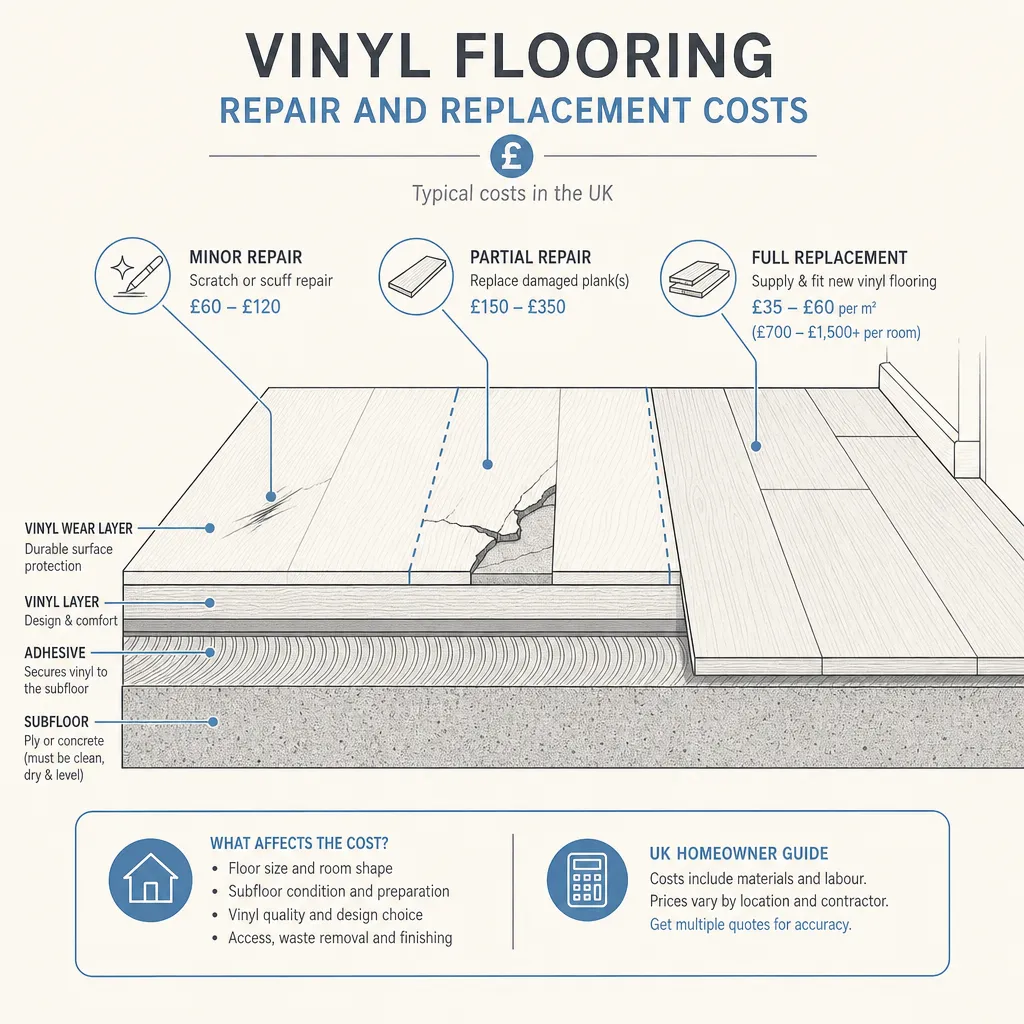
Vinyl Flooring Repair and Replacement Costs
Repairing a small area of vinyl flooring typically costs £50–£200 in the UK, while full replacement runs from £15–£35 per m² for luxury vinyl tile (LVT) plus labour of £10–£25 per m².
 Improvement & Build
Thatched Roof Installation and Repair Costs
A full re-thatch on a typical UK cottage costs £15,000 to £30,000 or more, depending on material, size, and location.
 Improvement & Build
Preventing Deterioration and Cracking in Concrete Driveways and Flatwork
Concrete driveways deteriorate mainly through freeze-thaw cycling, shrinkage cracking, and sub-base failure.
 Improvement & Build
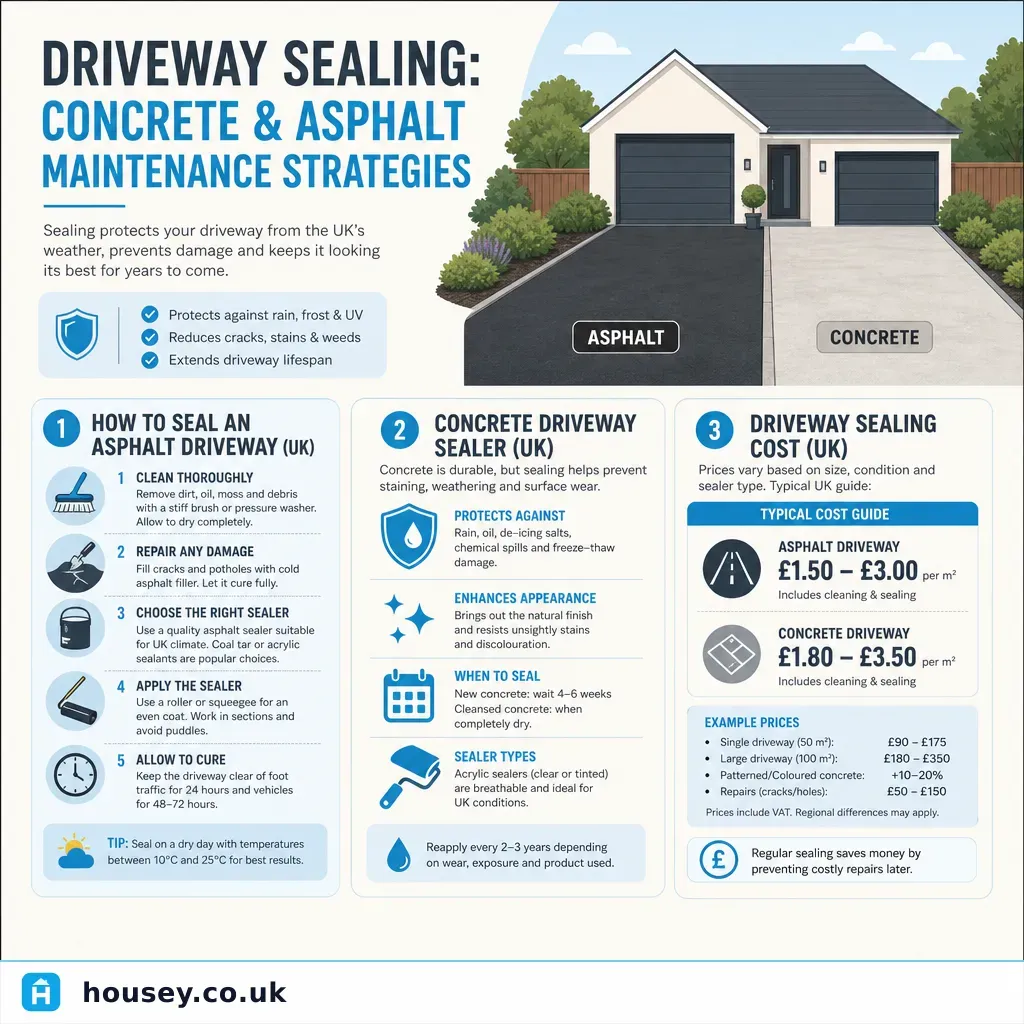
Driveway Sealing: Concrete and Asphalt Maintenance Strategies
Sealing an asphalt driveway every 3–5 years with a bitumen emulsion, or a concrete driveway with a penetrating silane or siloxane sealer, protects against frost damage, UV oxidation, and water ingress.