Expanding Doorways: Planning, Costs, and Building Requirements
By Housey · Last reviewed 19th of May 2026
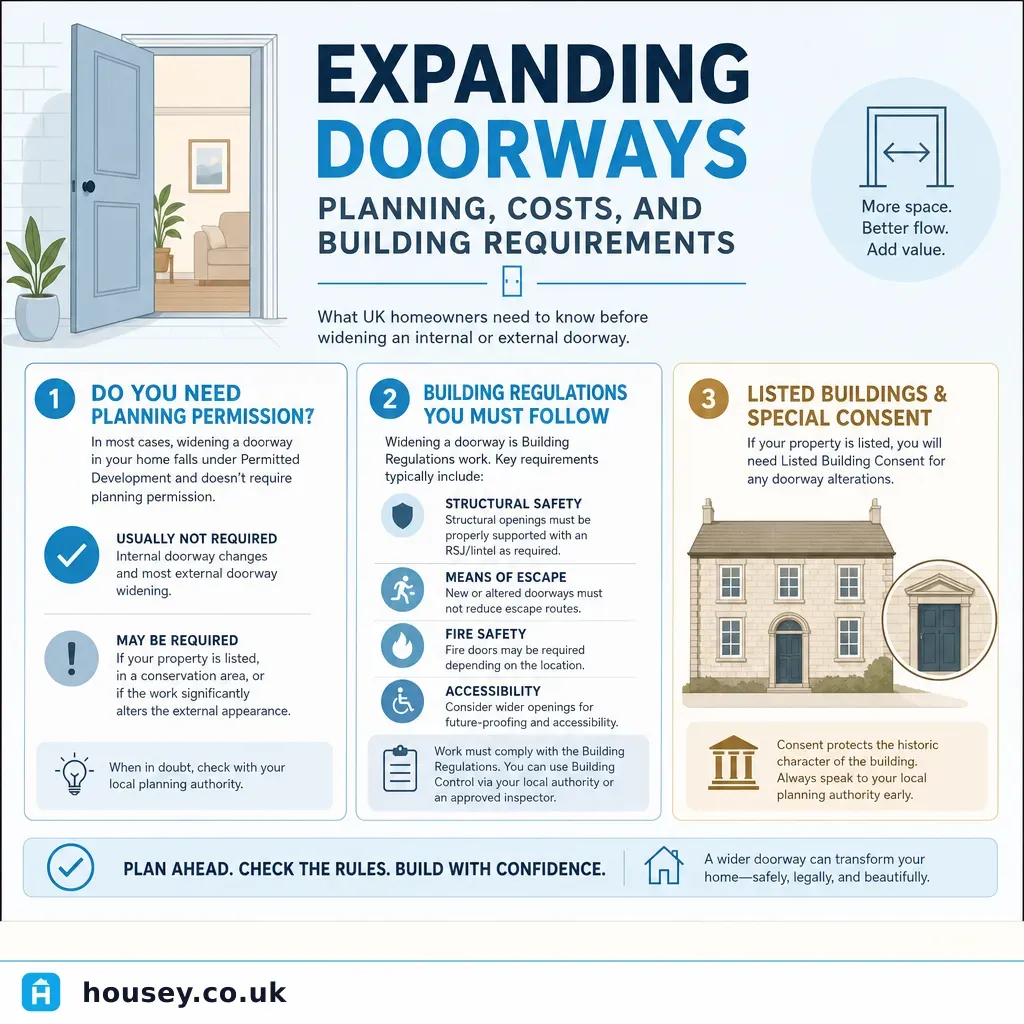
Expanding Doorways: Planning, Costs, and Building Requirements
Many homeowners assume expanding a doorway is purely a builder's job — a bit of demolition and replastering. In practice, the regulatory picture is more nuanced. Depending on whether the wall is load-bearing, whether the property is listed, and whether the work is intended to meet accessibility requirements, you may need Building Regulations approval, listed building consent, or both. Understanding which approvals apply before instructing anyone saves time, money, and potential enforcement problems.
Key points
- Building Regulations approval under Part A (Structure) is required whenever a load-bearing wall is altered — this is entirely separate from planning permission and is almost always needed for structural doorway work.
- Planning permission is generally not required for internal doorway expansion under permitted development rights, but listed buildings and some conservation area properties are important exceptions.
- Listed building consent is required for any internal structural alteration to a listed building, regardless of how minor it appears; breach can result in prosecution under the Planning (Listed Buildings and Conservation Areas) Act 1990.
- Approved Document M requires a minimum 775 mm clear opening for wheelchair-accessible doorways in altered dwellings; best practice for accessible design is 900 mm.
- A building control completion certificate is a legal document you will need to produce at conveyancing when the property is sold — work done without approval creates a gap in this record.
Planning permission vs Building Regulations: what is the difference?
These two approval routes are often confused. They are separate processes with distinct purposes.
Planning permission controls the visual and environmental impact of what you build — primarily external appearance and neighbourhood effect. Internal structural work rarely triggers planning permission.
Building Regulations control how you build — the structural integrity, fire safety, accessibility, and energy performance of the construction. Altering a load-bearing wall almost always requires Building Regulations approval, irrespective of whether planning permission is needed.
For most internal doorway expansions in standard residential properties in England and Wales, the relevant question is not 'do I need planning permission?' but 'which Building Regulations approvals apply and how do I obtain them?'
Which approvals does your project need?
Use this decision tree to identify which approvals apply before instructing anyone:
- Choose Building Regulations (Part A — Structure) if the wall is load-bearing — engage a structural engineer and notify building control before starting work.
- Choose Building Regulations (Part M — Access) in addition to Part A if the project is intended to create a wheelchair-accessible opening — a minimum 775 mm clear opening is required.
- Choose listed building consent if the property is listed — apply to your local planning authority before any internal structural work, regardless of wall type or load-bearing status.
- Ask a party wall surveyor if the wall is shared with a neighbour — the Party Wall etc. Act 1996 requires a formal agreement or award before structural work on a shared wall.
- Check with your local planning authority if the property is in a conservation area — some Article 4 Directions restrict internal structural works; rules vary by authority.
- No formal approval is typically needed if the wall is confirmed non-load-bearing, the property is not listed, and no fire separation is affected — always verify with your local building control office if in any doubt.
The Building Regulations approval process
For load-bearing doorway expansion, Building Regulations approval can be obtained through three routes:
Route | What it involves | Typical fee | Timescale |
|---|---|---|---|
Full Plans (local authority) | Submit drawings and structural calculations for approval before starting; formal approval issued; inspector visits during and after work | £150–£400 application fee | 5 weeks for approval; inspections during build |
Building Notice (local authority) | Notify the council before starting; no drawings pre-approved; inspector visits as work proceeds | Lower upfront fee | Work can begin 2 days after notice |
Approved Inspector (private) | Appoint a private building control body; Initial Notice issued to the council; inspector certifies completion | Often comparable to LA fees | Flexible; often quicker |
Indicative fees, last reviewed 2026-05-19. Fees vary by local authority and project complexity.
For structural doorway work, the Full Plans route is generally preferable — it gives you formal confirmation that the structural engineer's design is acceptable before any masonry is removed, and the approval documentation protects you at conveyancing.
Document preparation checklist
If applying for Building Regulations approval for a load-bearing doorway expansion, gather the following before submitting:
- Existing floor plans showing the wall location, measured and drawn to scale.
- Structural engineer's report and calculations specifying lintel type, size, bearing lengths, and padstone dimensions.
- Proposed drawings showing the widened opening, new lintel position, and any associated works.
- Party wall award or agreement if the wall is shared with a neighbour (Party Wall etc. Act 1996).
- Listed building consent obtained separately from the local planning authority, before any building control application is submitted.
- Freeholder's written consent if you are a leaseholder — check your lease carefully before instructing any structural work.
Keep originals of all approvals, structural engineer's calculations, and building control inspection records. These documents are required at conveyancing and may also be requested by a mortgage lender.
Costs: regulatory fees and professional charges
Beyond the builder's quote, budget for the following (indicative UK costs, last reviewed 2026-05-19):
Item | Indicative cost |
|---|---|
Structural engineer assessment and calculations | £300–£700 |
Building Regulations Full Plans application fee | £150–£400 |
Listed building consent application (householder) | No application fee |
Party wall surveyor (if required) | £700–£1,500 per party |
Architectural technician or architect for drawings | £300–£800 |
Construction — non-load-bearing partition | £500–£1,500 |
Construction — load-bearing wall, including lintel | £1,500–£4,000+ |
Indicative only. Costs vary by region, property type, and project complexity. Obtain at least three written quotes.
Which professional do I need?
Task | Professional to engage | What to check |
|---|---|---|
Confirm wall is load-bearing | Structural engineer or experienced builder | IStructE or ICE chartered membership |
Design the lintel and calculate loads | Structural engineer | Chartered status with IStructE or ICE |
Prepare drawings for building control | Architectural technician or architect | CIAT or RIBA membership |
Carry out the construction work | Builder or general contractor | Public liability insurance; references for structural alteration work |
Listed building consent application | Architect or heritage consultant | Experience with listed buildings and the relevant local planning authority |
Party wall matters | Party wall surveyor | RICS membership or Pyramus & Thisbe Club |
Important limitations
This article provides general guidance on the regulatory framework for doorway expansion in England and Wales. Building Regulations requirements, planning policies, listed building designations, and leaseholder obligations vary by property, tenure, and local authority. Rules in Scotland and Northern Ireland differ — consult the relevant regulatory bodies. Nothing here constitutes legal, structural, or planning advice. A qualified professional should assess your specific property before any work is instructed.
When to get professional help
If the wall is load-bearing, engage a structural engineer before approaching builders — quotes based on a proper structural specification are more accurate and protect you from unexpected costs during construction.
Red flags that mean seek specialist advice before proceeding:
- A builder proposes to remove load-bearing masonry without mentioning structural calculations or building control notification.
- The property is listed and you have not yet received listed building consent.
- You are a leaseholder and have not checked the lease or contacted the freeholder about structural works.
- Existing cracks are present in or near the wall proposed for alteration.
- The proposed opening spans more than approximately 1.2 m in a load-bearing wall — wider openings require more detailed engineering analysis.
- A party wall shared with a neighbour is involved and no party wall notice has been served.
What to ask a qualified professional
Before instructing builders or submitting any applications:
- Is this wall load-bearing, and can you confirm that in writing before any work starts?
- Which Building Regulations route do you recommend — Full Plans or Building Notice — and why?
- Will you prepare and submit the drawings and structural calculations on my behalf?
- Is listed building consent needed, and what is the likely timescale from the local planning authority?
- Does the Party Wall etc. Act 1996 apply, and has notice been served on my neighbour?
- If I am a leaseholder, does my lease require freeholder consent for structural alterations?
- What completion documentation will I receive, and will it be sufficient for future conveyancing?
How Housey can help
Getting the approvals and costings right before work starts is where doorway expansion projects succeed or fail. Use Housey's build cost estimating service to build a realistic budget across structural engineer fees, application charges, and construction costs. For the build itself, our extension builders includes contractors experienced in load-bearing structural alterations. If you need guidance on which approval route to take or help preparing your documentation, our building control consultants can advise on the right process and help ensure your paperwork is complete before work starts.
Frequently asked questions
Do I need to tell my mortgage lender if I expand a doorway?
If the work is structural — involving a load-bearing wall — it is generally advisable to notify your mortgage lender, as many lenders require notification of structural alterations under the mortgage conditions. Also notify your buildings insurer before work starts; structural alterations may affect your cover during construction.
What happens if I expand a doorway without the required Building Regulations approval?
Carrying out structural work without required Building Regulations approval is a breach of the Building Act 1984. You will be unable to obtain a completion certificate, which creates problems at conveyancing. Local authorities can serve enforcement notices. Regularisation is possible in some cases but is more expensive and not guaranteed to succeed.
Does expanding a doorway require an architect?
Not always. A structural engineer and a competent builder are the key professionals for load-bearing work. An architectural technician or architect may be needed to produce drawings required for a Full Plans building control application, particularly where the project is complex or where listed building consent is also being sought.
Sources and further reading
- Approved Document A — Structure — GOV.UK / DLUHC
- Approved Document M — Access to and use of buildings — GOV.UK / DLUHC
- Planning Portal — Do I need permission for internal works? — Planning Portal
- Listed buildings guidance — Historic England
- Party Wall etc. Act 1996 — legislation.gov.uk
Useful next reads
 Improvement & Build
Estimate for Merging Two Properties into a Single Residence
Merging two properties into one typically costs £30,000–£120,000 or more, depending on property type, structural complexity, and professional fees.
 Improvement & Build
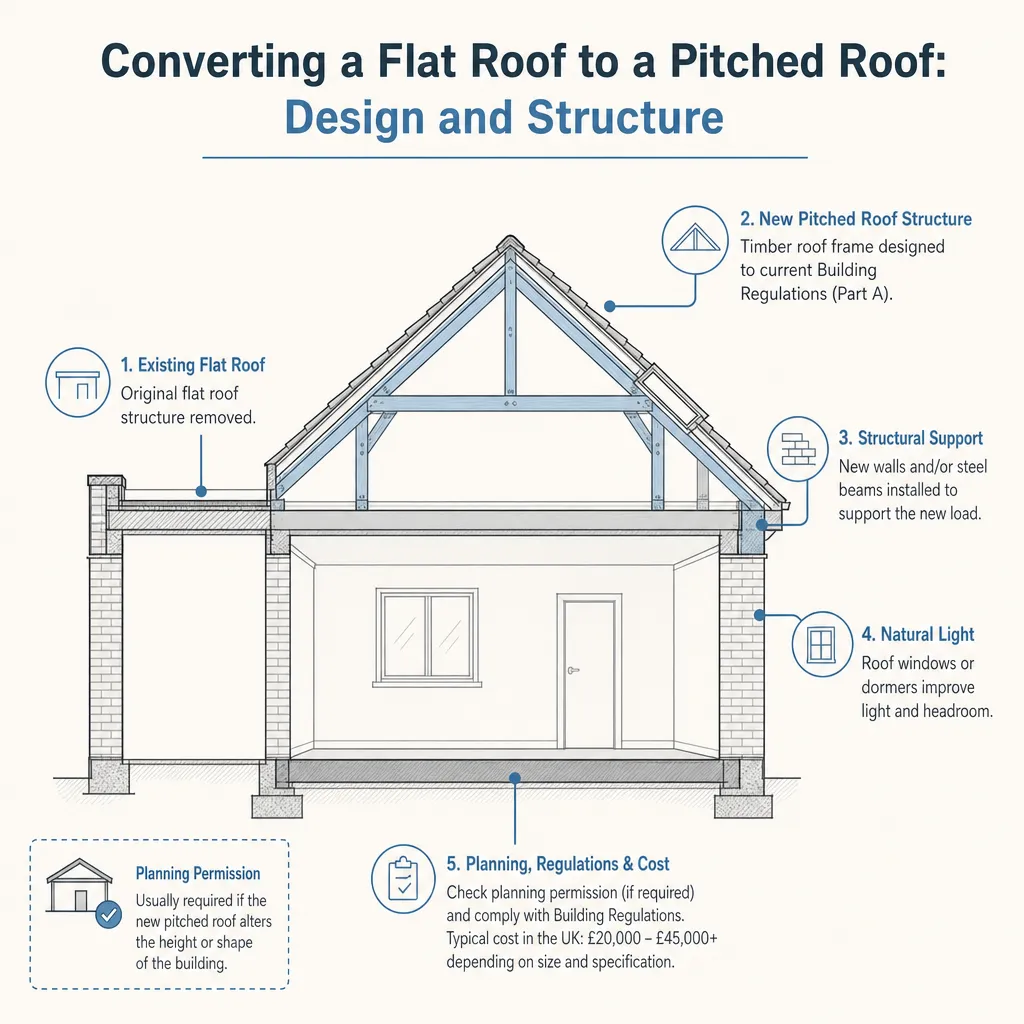
Converting a Flat Roof to a Pitched Roof: Design and Structure
Converting a flat roof to a pitched roof almost always requires Building Regulations approval and a structural engineer's design.
 Improvement & Build
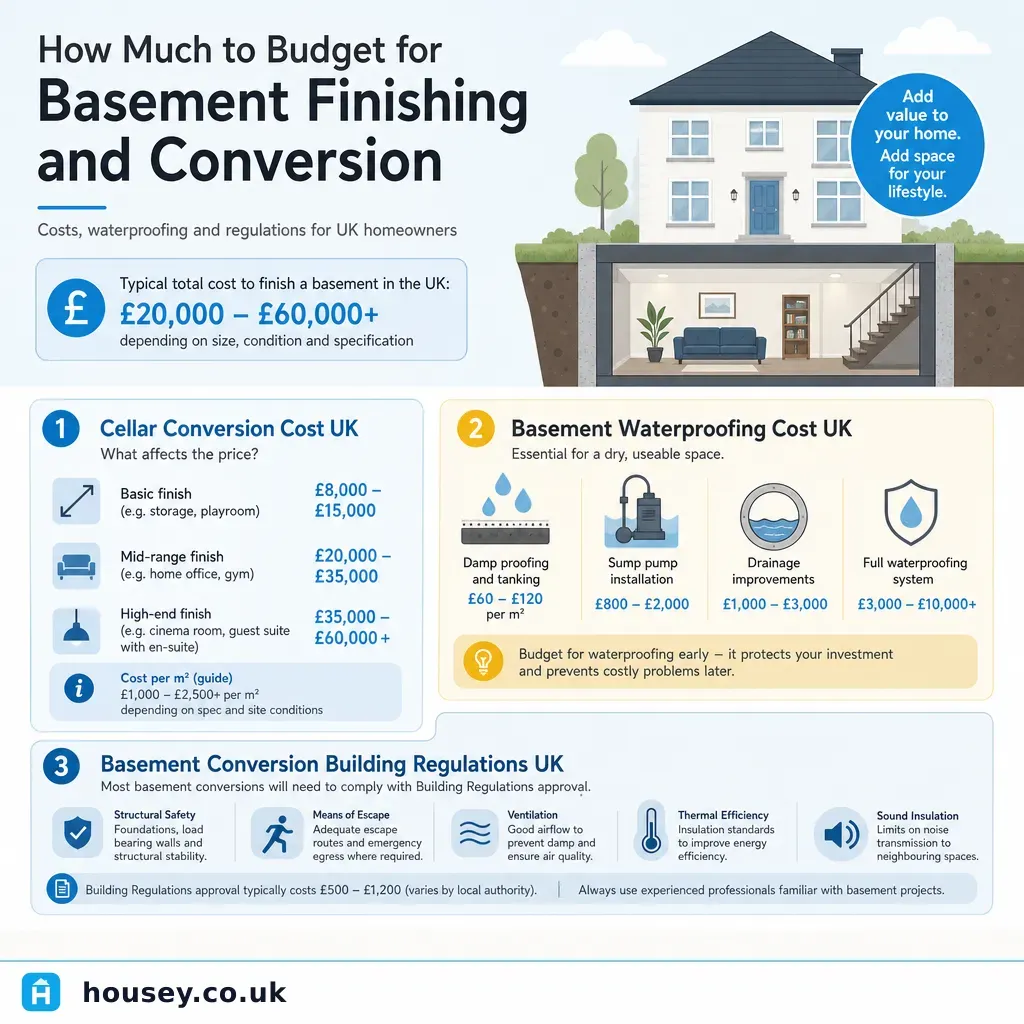
How Much to Budget for Basement Finishing and Conversion
Basement conversions in the UK typically cost £700–£1,500 per square metre for a simple cellar finish with existing headroom, rising to £1,500–£3,500 per square metre for a full conversion with underpinning.
 Improvement & Build
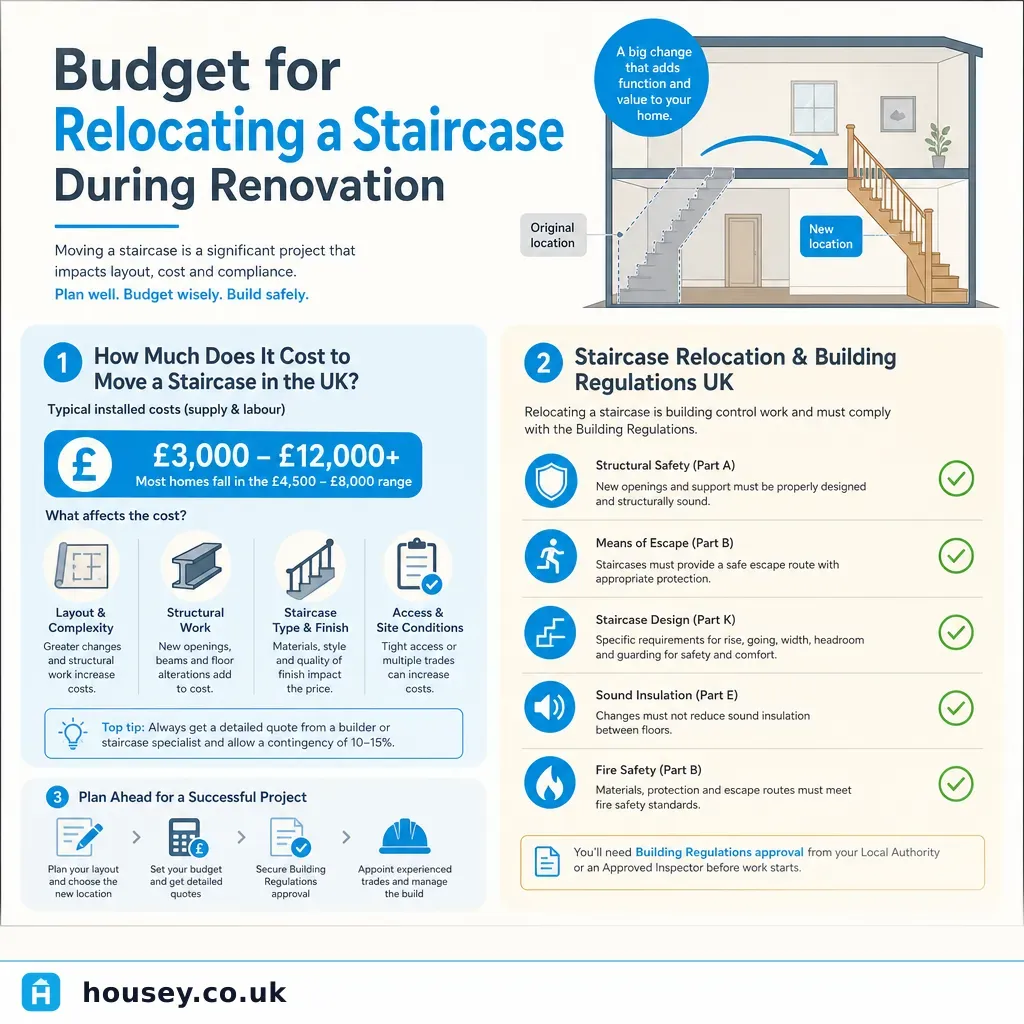
Budget for Relocating a Staircase During Renovation
Relocating a staircase in a UK home typically costs £6,000 to £20,000 or more, depending on structural complexity and staircase design.
 Improvement & Build
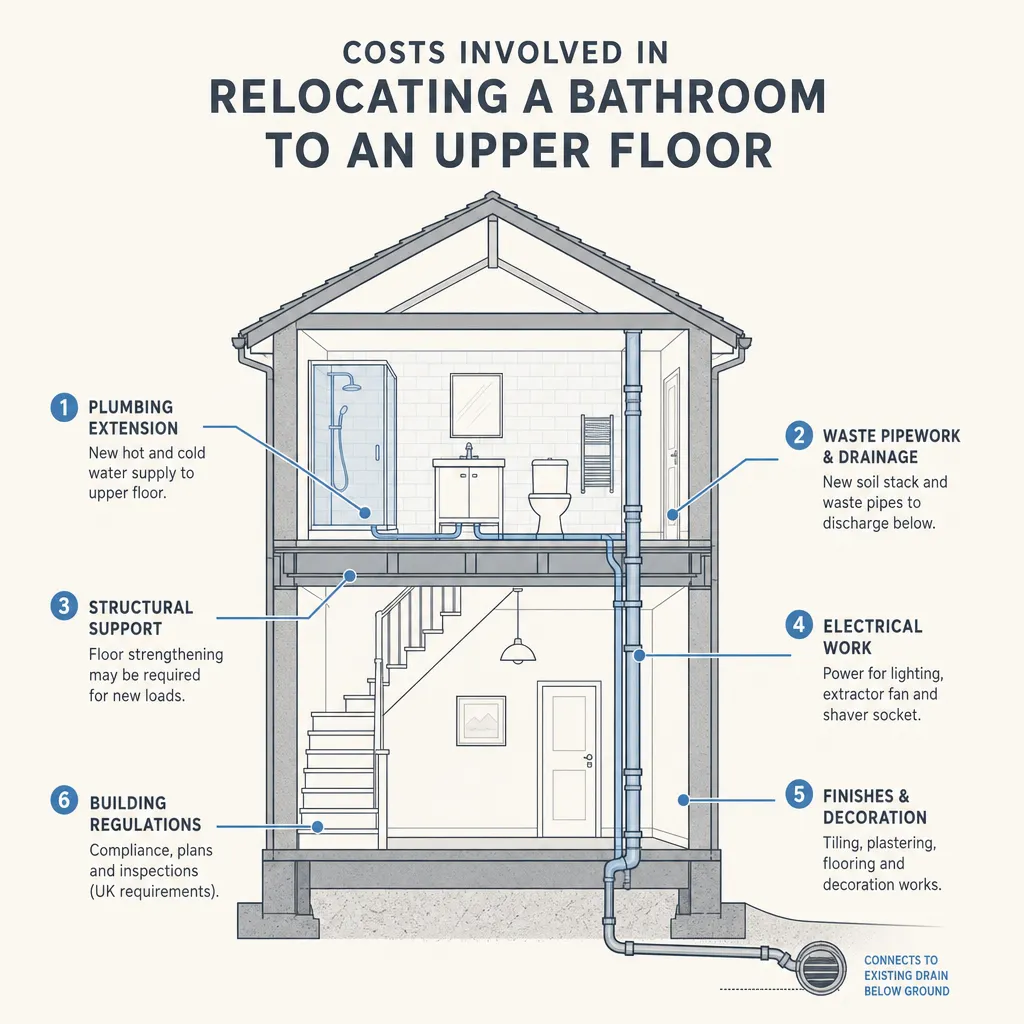
Costs Involved in Relocating a Bathroom to an Upper Floor
Moving a bathroom to an upper floor in a UK home typically costs £7,000 to £20,000 or more, depending on drainage method, structural work required, and finishes chosen.