Landscape Rock and Hardscaping Installation Costs
By Housey · Last reviewed 7th of May 2026
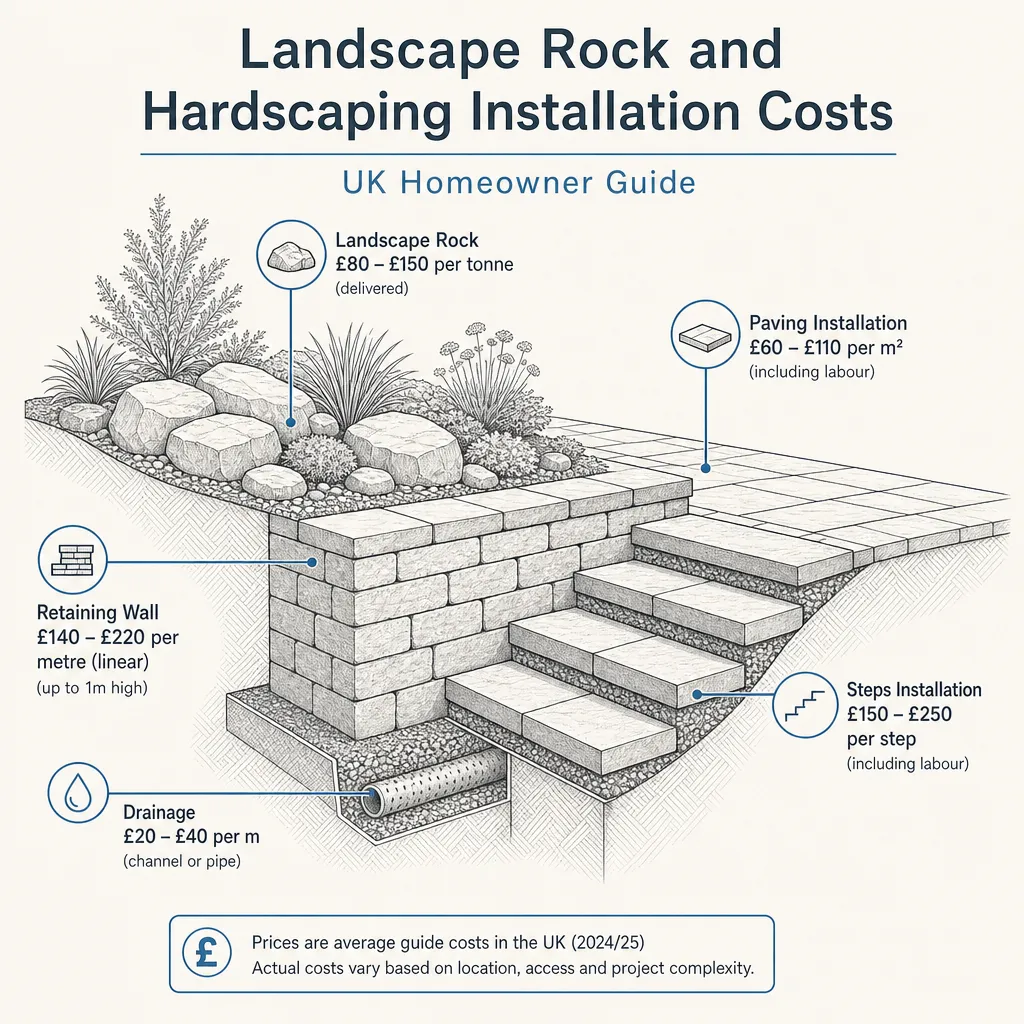
Landscape Rock and Hardscaping Installation Costs
Hardscaping — the hard surfaces, structures, and rock elements of a garden — tends to be the costliest part of a landscaping project, and the part most likely to affect drainage, planning compliance, and long-term maintenance. Whether you are laying a new patio, building a retaining wall, or creating a rock garden on a sloped rear plot, costs vary enormously depending on materials, ground conditions, and the extent of drainage work required alongside the feature itself.
Key points
- A standard patio in the UK typically costs £1,500–£5,000 for a mid-range paving material on a 20–30 sq m area, rising to £8,000–£15,000 or more for large or complex schemes with integrated drainage (indicative UK costs, last reviewed 2026-05-07).
- Retaining walls typically cost £150–£400 per linear metre for block or brick construction; natural stone retaining walls can reach £400–£800 per linear metre (indicative UK costs, last reviewed 2026-05-07).
- Gravel and decorative rock features typically cost £500–£2,500 depending on area, depth of material, and rock type chosen.
- In England, covering more than 5 sq m of a front garden with an impermeable surface requires planning permission; permeable surfaces such as gravel or permeable block paving do not — see GOV.UK guidance on permitted development.
- Retaining walls over approximately 1 metre high may require structural engineer input, particularly where the wall supports a slope adjacent to a building or highway.
What counts as hardscaping?
Hardscaping refers to the non-living elements of landscape design: patios, paths, steps, driveways, retaining walls, raised beds with hard edging, rock features, gravel areas, and paving. It is distinct from softscaping (planting, turf, and soil preparation).
In UK gardens, hardscaping work often involves:
- Excavation and sub-base preparation
- Laying of drainage channels, soakaways, or French drains
- Paving or flagstone installation
- Retaining wall construction
- Importing decorative stone, slate, cobbles, or large boulders
- Creating rock gardens or alpine features with large-format stonework
The structural and drainage elements of this work frequently overlap with groundworks, meaning a specialist landscaper with drainage experience or a dedicated groundworker is often more appropriate than a general garden contractor.
Hardscaping cost comparison
Feature | Typical size | Indicative cost range | Notes |
|---|---|---|---|
Patio (porcelain or natural stone) | 20–30 sq m | £2,500–£8,000 | Includes sub-base, bedding, and pointing |
Patio (concrete or block paving) | 20–30 sq m | £1,500–£4,000 | Lower material cost, similar labour |
Gravel garden or courtyard | 15–25 sq m | £500–£2,000 | Includes membrane, edging, and gravel |
Decorative rock or boulder feature | Feature area | £800–£3,000 | Varies by rock type, weight, and delivery |
Retaining wall (block or brick) | Per linear metre | £150–£400/m | Engineering input required if >1m high |
Retaining wall (natural stone) | Per linear metre | £400–£800/m | Dry-stone or mortared construction |
Garden steps (hard landscaping) | Per flight | £500–£2,000 | Depends on materials and number of risers |
Soakaway installation | Standard domestic | £300–£800 | Required for most substantial new hard surfaces |
Driveway (block paving) | 40 sq m | £3,500–£7,000 | SuDS compliance may apply |
Indicative UK costs, last reviewed 2026-05-07. Prices exclude VAT unless stated. Actual costs vary by region, access, ground conditions, and specification. Obtain at least three itemised quotes.
What drives hardscaping costs?
Materials are the most visible variable. Porcelain and natural stone cost more per sq m than concrete block paving or resin-bound gravel. Imported boulders and large feature rocks carry delivery and specialist lifting costs — Hiab lorry or crane hire — that can equal or exceed the stone price itself.
Ground conditions have an outsized effect. Heavy clay, made ground, or steeply sloping sites require more excavation, deeper sub-base layers, or structural engineering input — all of which add significantly to cost and programme.
Drainage is often underestimated at the quoting stage. Any substantial new hardstanding needs drainage management. Driveways and large patios typically require a soakaway, permeable specification, or connection to an existing drainage system. Failure to address drainage can cause damp problems in adjacent structures and may breach planning conditions or Building Regulations Part H.
Access matters to both cost and programme. A rear garden reachable only through the house, or a site with narrow vehicle access, adds labour time for materials handling and may require specialist equipment such as a mini-dumper.
Structural requirements affect price and timeline. Retaining walls over approximately 1 metre high may require a structural engineer's design, particularly where the wall supports a slope adjacent to a structure, a highway, or a drainage feature.
Regional variation: Labour costs in London and the South East can be 20–40% higher than equivalent work in the Midlands or North of England. Obtain local quotes rather than relying on national averages.
Rock garden and feature boulder installation
Rock gardens and large-boulder features are a popular choice for low-maintenance, drought-tolerant planting schemes. Costs depend on several factors:
- Rock type: Limestone, sandstone, Welsh slate, York stone, and Scottish granite differ significantly in price and regional availability. Locally sourced stone is usually cheaper to deliver.
- Size and weight: A single large limestone boulder can weigh 500 kg or more and requires specialist lifting equipment to place safely and accurately.
- Planting: A rock garden without planting costs less than one with alpine plants, specialist free-draining soil mix, and horticultural mulch.
For a modest rock garden of 10–20 sq m with mid-range limestone, expect to pay £1,500–£4,000 for supply and installation. Focal-point feature boulders used individually can add £200–£1,000 per piece depending on size and type (indicative UK costs, last reviewed 2026-05-07).
Planning permission and hardscaping
Most garden hardscaping is permitted development in England, meaning no planning permission is needed. However, key exceptions apply:
- Front garden hardstanding over 5 sq m: If the surface is impermeable (e.g., solid concrete or tarmac), planning permission is required in England. Permeable alternatives — gravel, permeable block paving with a permeable sub-base — do not require permission.
- Driveways: Governed by the same rules as front garden hardstanding.
- Conservation areas and listed buildings: Works that would affect the character of a listed building or a conservation area may require listed building consent or conservation area consent before starting.
- Conditions removing permitted development rights: Some newer developments or individual planning conditions remove the right to carry out certain works without permission.
Always check with your local planning authority before starting work if there is any doubt. GOV.UK sets out when permission is required for hard surfaces and driveways in full.
Homeowner checklist: before commissioning hardscaping work
Who should carry out the work?
- Choose a landscaper for patios, paths, steps, gravel areas, and rock garden features — most established landscapers hold the skills and plant needed for domestic hardscaping of this type.
- Choose a groundworker alongside or instead of a landscaper for large excavations, significant drainage work, retaining walls, or driveway sub-base construction. Groundworkers typically have the earthmoving plant and drainage experience for larger-scale structural work.
- Involve a structural engineer if a retaining wall is over 1 metre high, is adjacent to a building foundation or highway, or involves retained slopes near a structure.
- Check with your local planning authority before starting if the project involves front-garden hardstanding, sits within a conservation area, or affects a listed structure.
When to get professional help
Most domestic hardscaping is low-risk in structural terms, but some situations warrant input beyond a landscaper alone:
- Retaining walls exceeding 1 metre high — particularly near building foundations, highways, or drainage infrastructure.
- New hardstanding that may direct surface water onto a neighbouring property or into a watercourse.
- Any work in a conservation area, on or near a listed structure, or where permitted development rights may have been removed.
- Sites with unknown underground services, suspected contamination, or made-ground fill conditions.
How Housey can help
Housey connects homeowners with experienced landscapers and groundworkers across the UK who can quote for hardscaping and landscape rock projects of all sizes. Request quotes from multiple providers to compare scope, materials, and price before committing to any contractor.
Frequently asked questions
Do I need planning permission to lay a patio in my garden?
In most cases, no. Permitted development rights allow patios in rear and side gardens without planning permission. However, covering more than 5 sq m of your front garden with an impermeable surface requires planning permission in England unless the surface is permeable. Always check with your local planning authority if in doubt, particularly if you are in a conservation area or your permitted development rights have been removed.
How much does a retaining wall cost per metre in the UK?
A block or brick retaining wall typically costs £150–£400 per linear metre for walls up to about 1 metre high. Natural stone retaining walls cost more — typically £400–£800 per metre. Costs rise significantly for walls over 1 metre high, those requiring structural engineer input, or where complex drainage behind the wall is needed. These are indicative figures, last reviewed 2026-05-07.
Can I add large rocks or boulders to my garden without planning permission?
In most cases, yes — adding decorative boulders or rock features to a garden does not require planning permission. Exceptions include listed buildings, conservation areas, or where permitted development rights have been removed by planning condition. If in doubt, check with your local planning authority before purchasing materials, as retrospective applications can be costly.
How long does a hardscaping project typically take?
A standard patio of 20–30 sq m usually takes two to five days for an experienced team, including preparation, laying, and pointing. Larger projects involving retaining walls, drainage, and multiple surfaces may take two to four weeks. Always agree a realistic programme with your contractor before work starts, and factor in potential delays due to weather or material lead times.
What is the difference between a landscaper and a groundworker?
A landscaper typically handles the full garden project — design, hard and soft landscaping, planting, and finishing. A groundworker specialises in earthmoving, drainage, foundations, and sub-base construction — the structural underpinning of the project. For complex hardscaping involving significant excavation, drainage runs, or retaining structures, both disciplines may be needed on the same project.
Sources and further reading
- When is permission required? — GOV.UK
- Sustainable drainage systems (SuDS) guidance — CIRIA
- Lines Search Before U Dig (LSBUD) — LSBUD
- Find a landscape professional — Landscape Institute
Useful next reads
 Improvement & Build
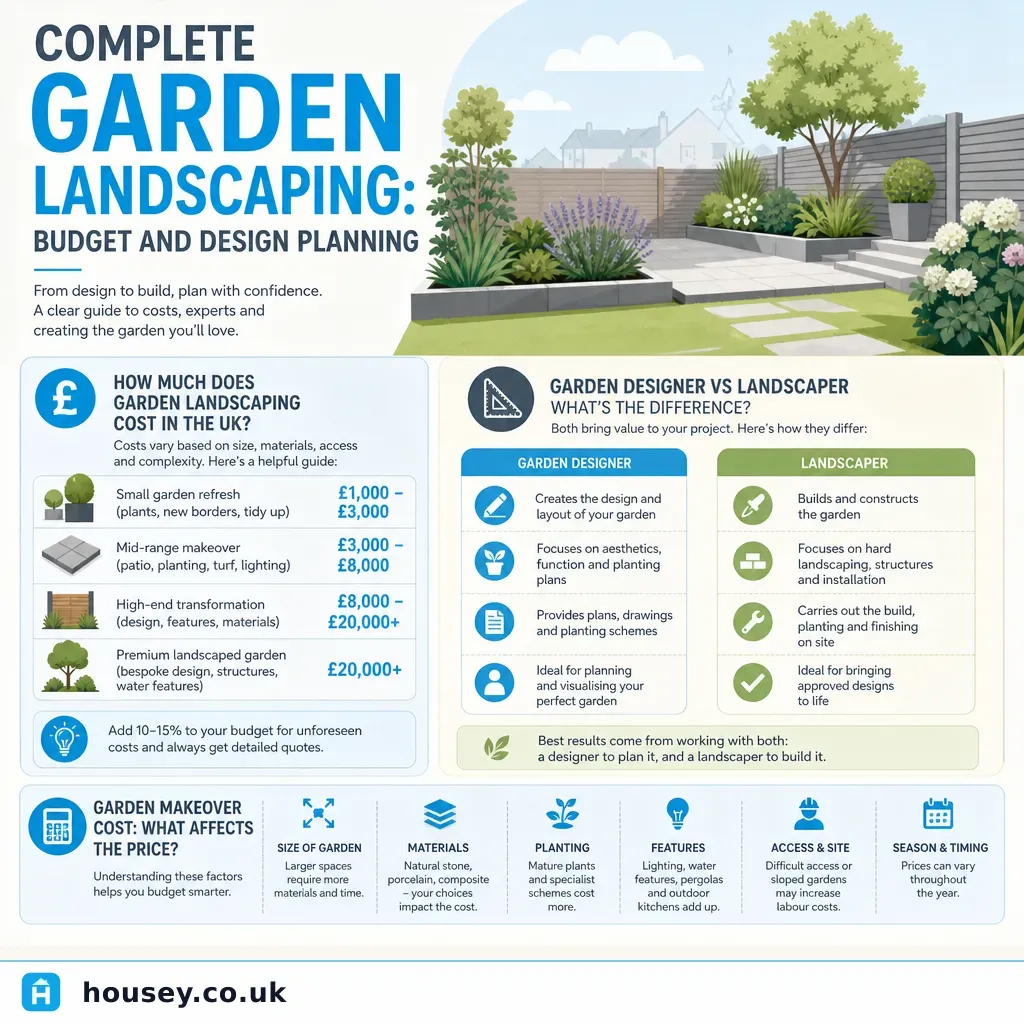
Complete Garden Landscaping: Budget and Design Planning
A mid-range garden landscaping project in the UK typically costs £75–£200 per square metre, covering design, hard landscaping, and planting.
 Improvement & Build
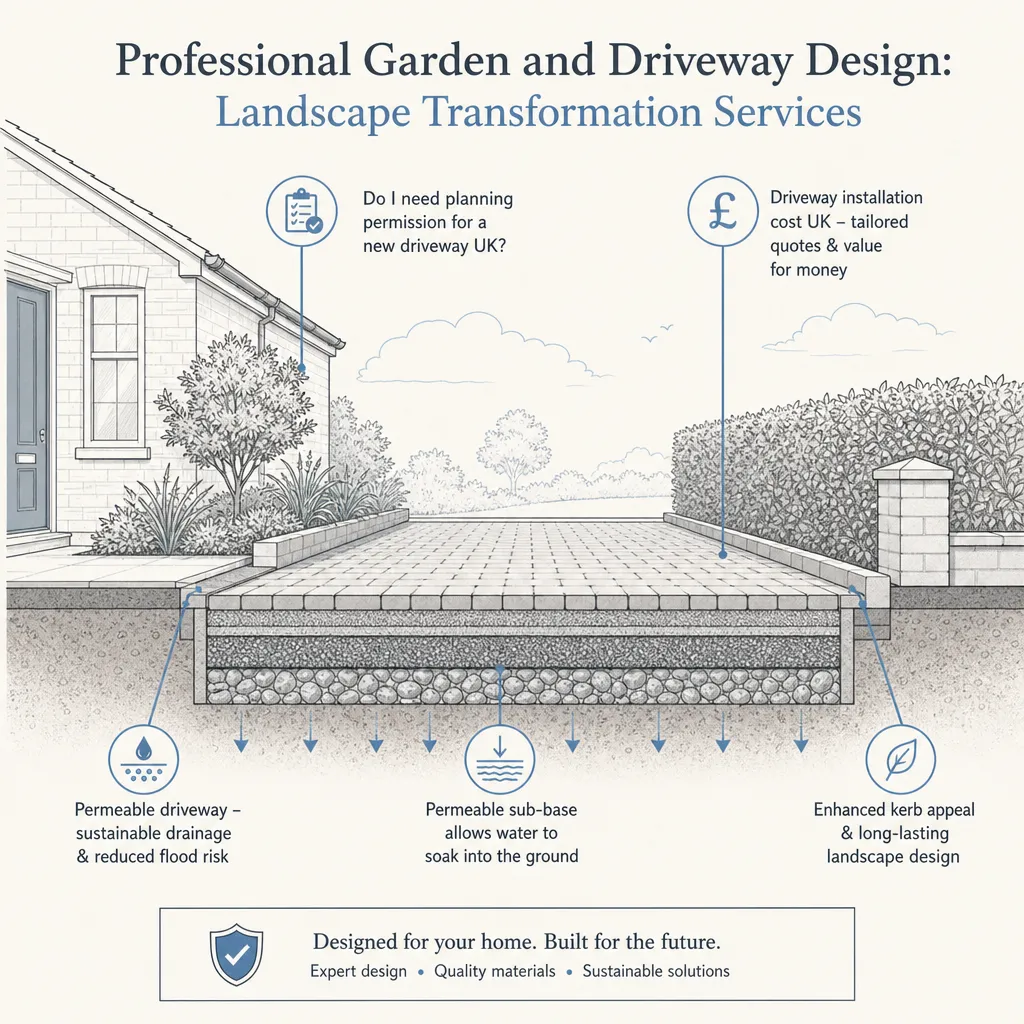
Professional Garden and Driveway Design: Landscape Transformation Services
Garden and driveway design combines hard landscaping — paving, block paving, gravel, resin — with planting and layout to improve kerb appeal and functionality.
 Improvement & Build
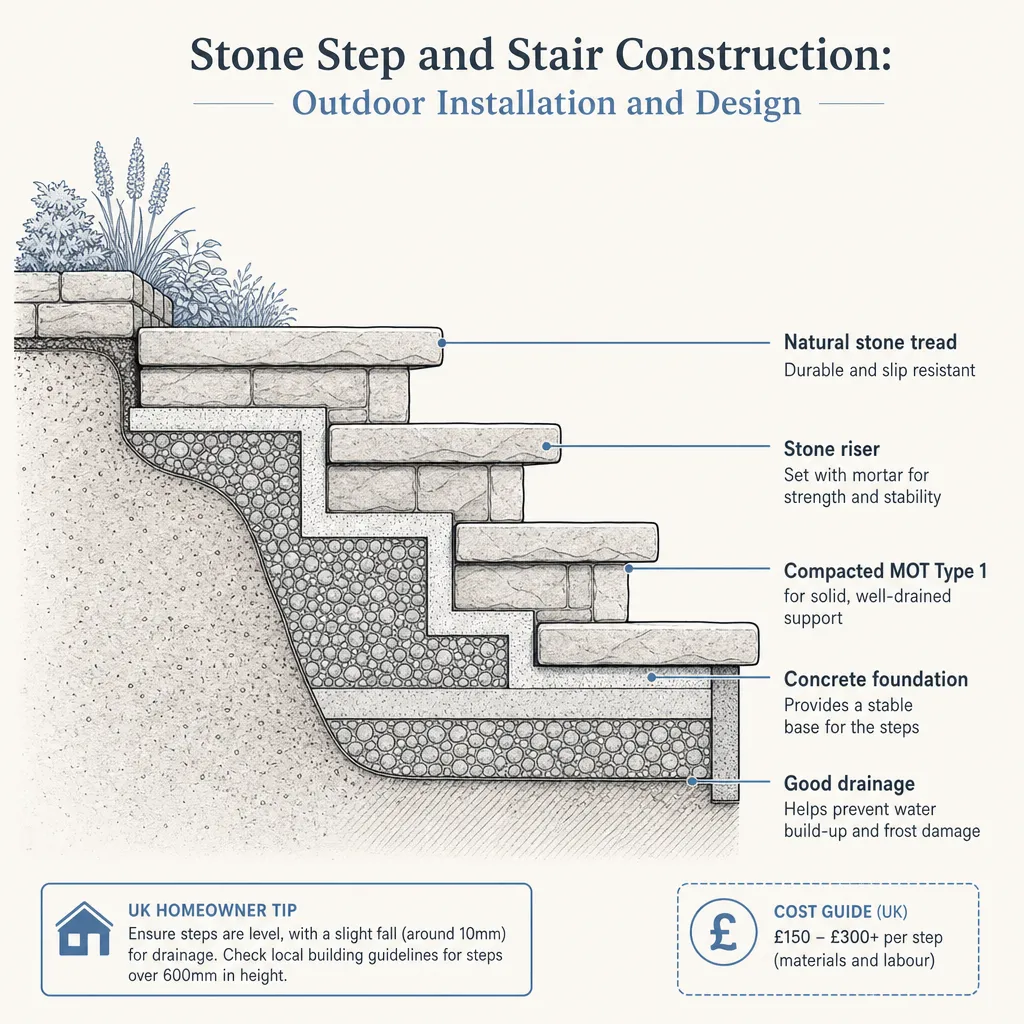
Stone Step and Stair Construction: Outdoor Installation and Design
Outdoor stone steps typically cost £200–£500 per step installed in the UK, depending on stone type, tread depth, riser height, and subbase conditions.
 Improvement & Build
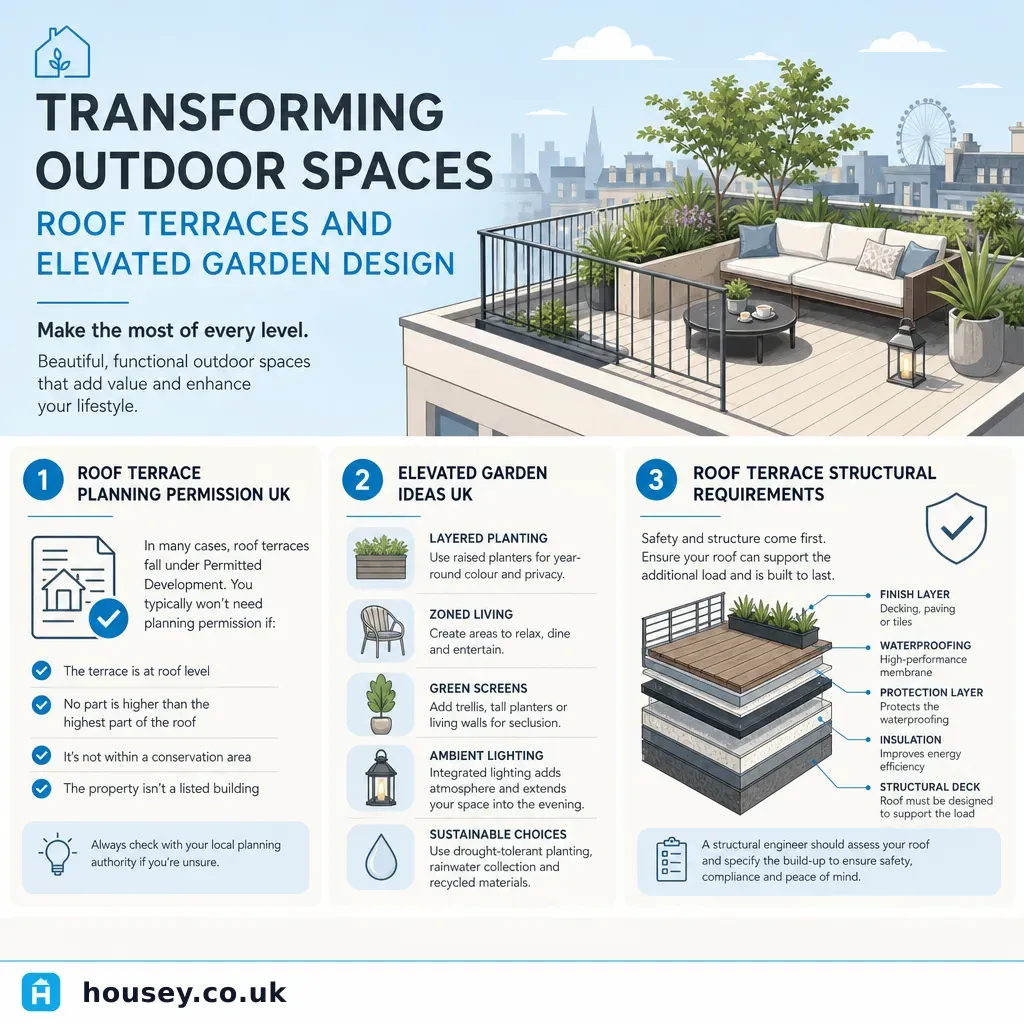
Transforming Outdoor Spaces: Roof Terraces and Elevated Garden Design
Roof terraces in the UK almost always need planning permission and a structural engineer's load capacity assessment before design work begins.
 Improvement & Build
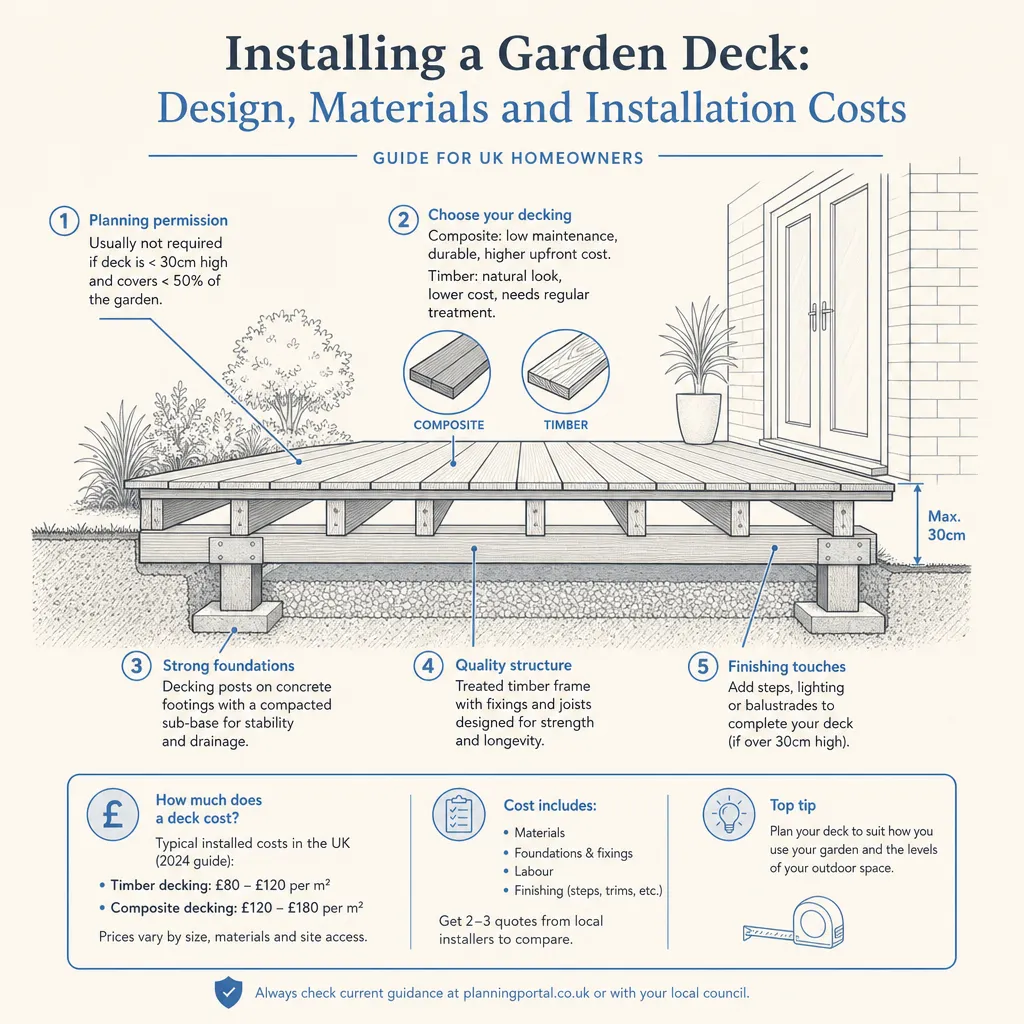
Installing a Garden Deck: Design, Materials and Installation Costs
Garden decking costs £80–250 per m² installed in the UK depending on material — softwood is cheapest, composite the most durable.