Professional Garden and Driveway Design: Landscape Transformation Services
By Housey · Last reviewed 24th of May 2026
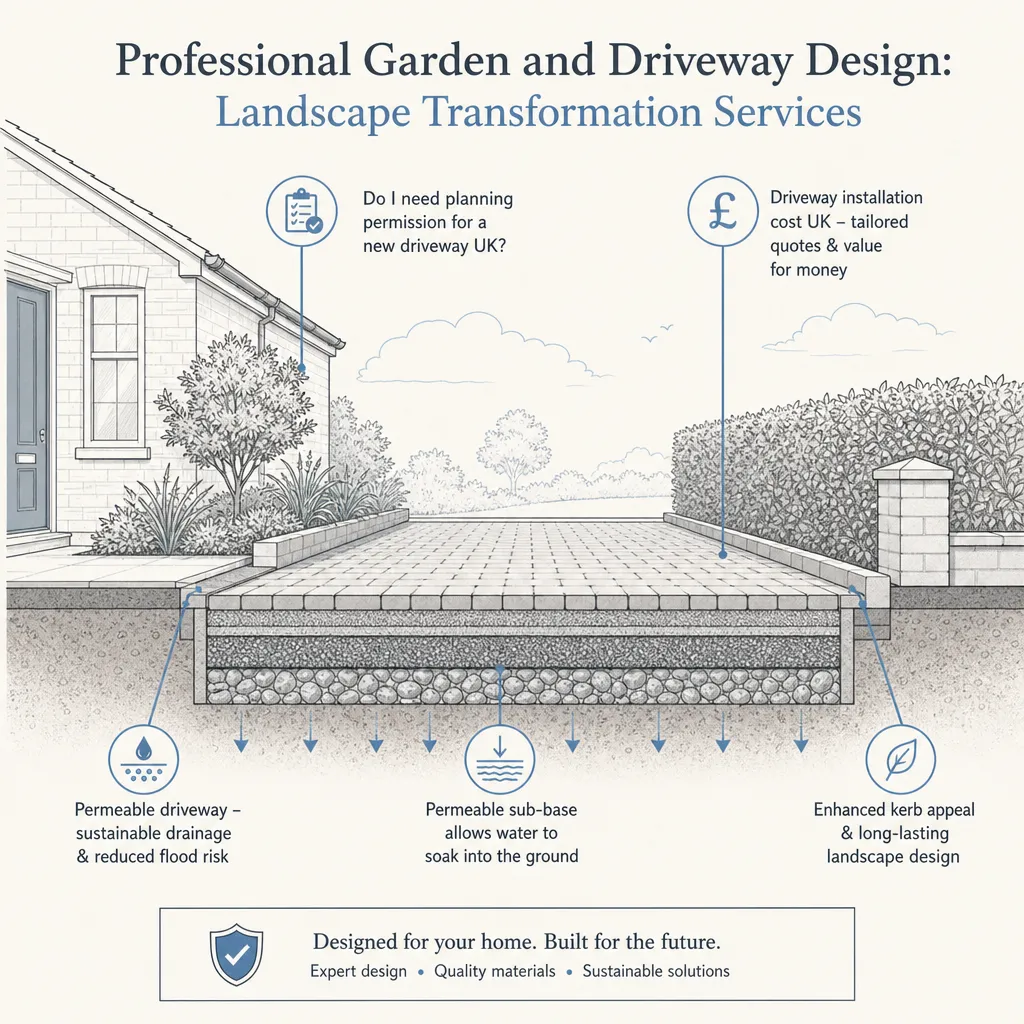
Professional Garden and Driveway Design: Landscape Transformation Services
Most UK homeowners think about their garden and driveway together only when both have become an obvious problem — a cracked concrete apron, overgrown borders, and a patchy lawn all at once. Whether you are improving kerb appeal before a sale, adding off-street parking, or reclaiming an outdoor space that has been neglected for years, a professional landscape transformation typically involves more regulatory choices and material decisions than it first appears.
Key points
- Driveways over 5 m² laid with non-permeable materials (solid concrete, standard tarmac, dense block paving without drainage channels) require householder planning permission in England, under amendments to the Town and Country Planning Act 1990 introduced in October 2008.
- Dropped kerb installation requires highway authority approval — typically from your local council — before any contractor begins work; a licence fee and inspection charge usually apply, and proceeding without approval can lead to enforcement action requiring reinstatement at your cost.
- BALI (British Association of Landscape Industries) and the Association of Professional Landscapers (APL) are the principal trade bodies for accredited landscapers in the UK; membership indicates professional standards and access to a formal complaints process.
- Permeable paving materials — including gravel, permeable block paving, and resin-bound aggregate — do not require planning permission for domestic driveways, making them both a regulatory and a sustainable drainage advantage.
- Any trees in a conservation area with a trunk diameter over 75 mm at 1.5 m height are automatically protected; removal or significant pruning requires prior notification to the local planning authority under the Town and Country Planning (Tree Preservation) (England) Regulations 2012.
Do I need planning permission for my driveway?
This is the question most homeowners get wrong. The answer depends on the material you choose and where the surface water drains.
Decision tree: driveway planning permission in England
- No permission needed if you use permeable materials throughout (gravel, permeable block paving, resin-bound aggregate, grass pavers) — water soaks through to the ground rather than running off.
- No permission needed if you use non-permeable materials but drain surface water to a lawn, border, or soakaway on your own property rather than to a public road or drain.
- Permission required if you use non-permeable materials (solid concrete, standard imprinted concrete, dense tarmac) and surface water runs to a public road or highway drain — this applies to driveways over 5 m².
- Always check first if your property is in a conservation area, is listed, or if permitted development rights have been removed by an Article 4 direction from the local planning authority.
- Contact your local highway authority before any dropped kerb work — this is a separate requirement from planning permission and applies regardless of driveway material.
Scotland, Wales, and Northern Ireland operate under their own planning frameworks; always check with the relevant authority for your location.
Choosing a driveway material
Material | Approx. installed cost per m² | Permeable? | Planning permission likely needed? | Best for | Maintenance |
|---|---|---|---|---|---|
Gravel | £10–£25 | Yes | No | Low cost, traditional look | Annual raking, weed control |
Plain tarmac | £25–£50 | No (standard) | Possibly | Large driveways, durability | Resealing every 5–10 years |
Block paving | £50–£120 | Depends on joint type | Possibly | Kerb appeal, design variety | Re-sanding joints periodically |
Resin-bound aggregate | £40–£80 | Yes | No | Modern finish, low weed growth | Power wash periodically |
Standard concrete | £30–£60 | No | Possibly | Low ongoing maintenance | Crack repair if base fails |
Porcelain or natural stone | £60–£150 | Depends on laying method | Possibly | Premium kerb appeal | Re-pointing joints periodically |
Indicative UK costs, last reviewed 2026-05-24. Costs vary significantly by region, ground conditions, access, and extent of preparatory works. Always obtain at least three comparable quotes.
Garden design: soft and hard landscaping
A full garden transformation typically involves both hard landscaping (patios, paths, walls, raised beds, pergolas) and soft landscaping (planting, turf, borders). The two need to be designed together — drainage levels and access routes determined by the hard elements affect what grows well and where.
What a professional garden designer does
A qualified garden designer will typically:
- Survey the site: existing levels, soil type, aspect, drainage, and features to retain or remove.
- Produce a design proposal: scaled drawings, a planting palette, and a materials schedule.
- Specify contractors or work directly alongside a landscaping team to implement the design.
- Oversee installation or provide a client-facing specification for you to take to multiple contractors for competitive quotes.
Members of the Society of Garden Designers (SGD) or the Landscape Institute hold recognised professional qualifications and are bound by a code of conduct. For larger or more complex projects — sloped sites, significant earthworks, or planning implications — a Landscape Institute-registered landscape architect brings additional technical skills.
What not to assume
- Don't assume the cheapest quote covers the same scope. Ask every contractor to itemise: excavation and disposal, edgings and sub-base specification, planting details (species, pot size, quantity), aftercare, and any remedial drainage work. A low headline price often excludes these line items.
- Don't assume your neighbour's consent is not needed. If shared boundaries, party walls, or neighbouring trees are involved, clarify ownership and responsibility before work begins. The Party Wall etc. Act 1996 may apply if you are excavating within 3 m of a neighbouring building's foundations.
- Don't assume all landscapers are equally qualified. Anyone can call themselves a landscaper. Look for BALI membership, APL accreditation, or equivalent professional evidence before instructing.
- Don't assume a permeable driveway needs no sub-base. Even permeable systems require a correct sub-base depth — typically 150 mm of compacted MOT Type 1 hardcore — to prevent settlement and ponding after heavy rain.
What to ask before accepting a quote
Use this checklist before instructing any landscaper or driveway installer:
- Is the quote based on a site visit, or an estimate from photographs?
- Who is responsible for obtaining planning permission or highway authority approval for a dropped kerb?
- What sub-base specification is included — depth, material type, and compaction method?
- What drainage provision is included, and where does surface water discharge?
- Are existing materials — concrete, slabs, topsoil — removed and disposed of as part of the quoted price?
- What edging, binder, or jointing system is used, and what is the expected lifespan?
- Is planting covered under any maintenance guarantee or replacement policy?
- Is VAT included?
- What are the payment stages — how much upfront, and what triggers the final payment?
When to get professional help
Most garden and driveway projects do not require more than a good landscaper or designer, but professional input matters in these situations:
- Sloped or problematic ground: significant gradients or poor drainage may need a drainage engineer or structural assessment before work begins, particularly close to a building's foundations.
- Protected trees: if mature trees are within or near the project area, check for Tree Preservation Orders (TPOs) or conservation area protection before planning any root-disturbing work. Contact your local planning authority if unsure.
- Shared boundaries and party walls: the Party Wall etc. Act 1996 may apply if you are excavating within 3 m of a neighbouring building's foundations — seek independent advice before committing to a design.
- Planning permission uncertainty: if you are unsure whether permission is needed, submit a householder planning application or request a Pre-Application Enquiry from your local planning authority before work starts.
How Housey can help
Whether you need someone to carry out the physical transformation or a specialist to produce a design first, Housey connects you with vetted professionals. Find landscapers experienced in both hard and soft landscaping, specialist driveway installers for permeable paving, block paving, and resin-bound systems, or a garden designer to produce a professional specification you can put to multiple installers for competitive quotes.
Frequently asked questions
Do I need planning permission for a new garden patio?
A patio at ground level in a rear garden is generally permitted development and does not require planning permission in England, provided it is not raised above ground level. Raised decking or terracing above 300 mm may need permission. Always check with your local planning authority, particularly if your property is in a conservation area or is listed.
How long does driveway installation take?
Most domestic driveway installations take two to five days, depending on the area, material, and amount of preparatory work required. Resin-bound surfaces typically cure within 24–72 hours before vehicle use. Block paving may involve more sub-base preparation and take slightly longer. Full landscaping projects including soft planting and turf may take one to three weeks depending on scope.
Can I get a dropped kerb without planning permission?
You do not usually need planning permission for a dropped kerb, but you do need approval from your local highway authority, which is responsible for the public road and footway. Most councils charge an application fee and require work to be carried out by an approved contractor. Starting work without approval can result in a requirement to reinstate the original kerb at your expense.
What is the difference between a landscape gardener and a garden designer?
A landscape gardener or landscaper typically carries out the physical installation work — hard landscaping, planting, and turf. A garden designer focuses on the design and specification process, producing drawings, planting plans, and material schedules. For complex or larger projects, engaging a designer first and using their drawings to obtain multiple quotes from landscapers is often good value.
Sources and further reading
- Planning permission: when you need it — GOV.UK
- Permitted development rights for householders: technical guidance — GOV.UK
- British Association of Landscape Industries — BALI
- Landscape Institute: find a landscape professional — Landscape Institute
- Society of Garden Designers — Society of Garden Designers
- Party Wall etc. Act 1996: guidance — GOV.UK
Useful next reads
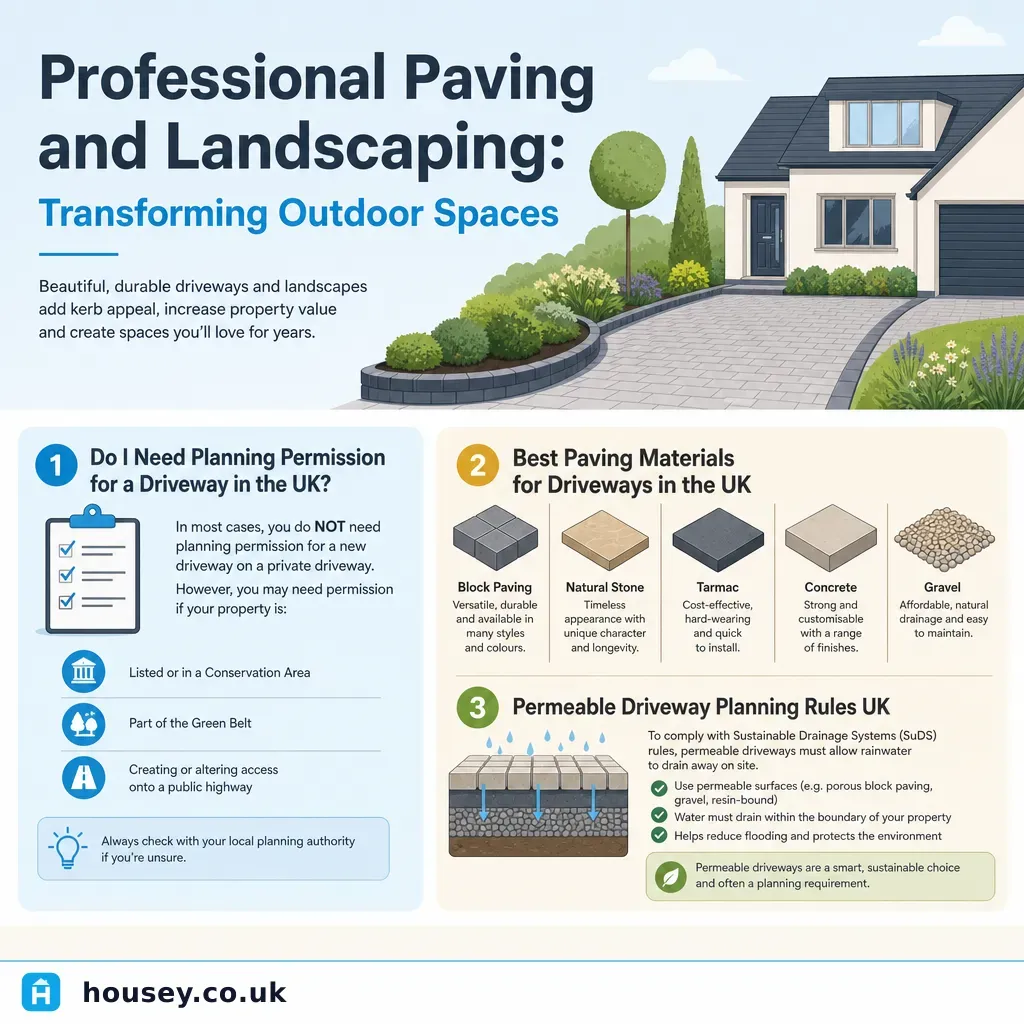 Improvement & Build
Professional Paving and Landscaping: Transforming Outdoor Spaces
Professional paving and landscaping can transform a garden or driveway, improving kerb appeal and adding usable outdoor space.
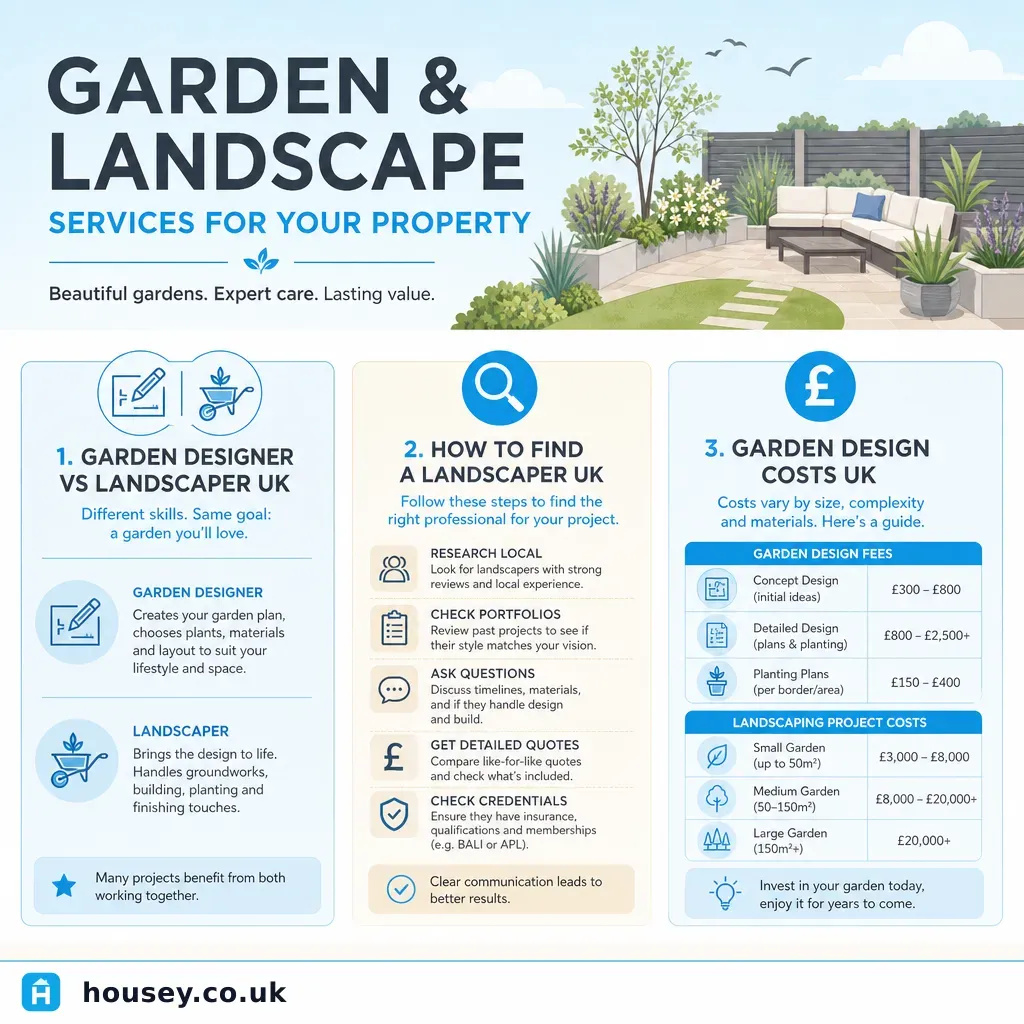 Improvement & Build
Garden and Landscape Services for Your Property
Garden designers and landscapers both improve outdoor spaces but offer different services.
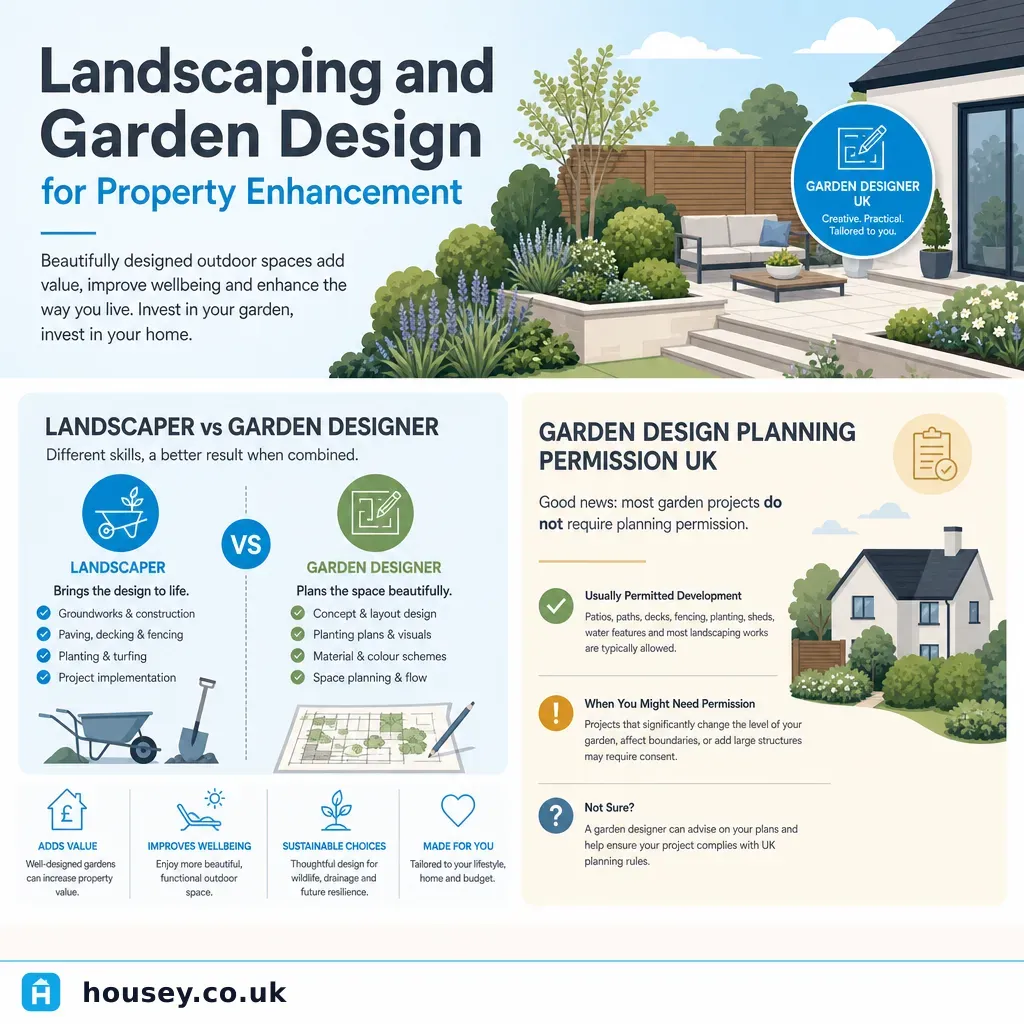 Improvement & Build
Landscaping and Garden Design for Property Enhancement
Landscaping and garden design involve planning and building outdoor spaces — from patios and raised beds to planting schemes and drainage.
 Improvement & Build
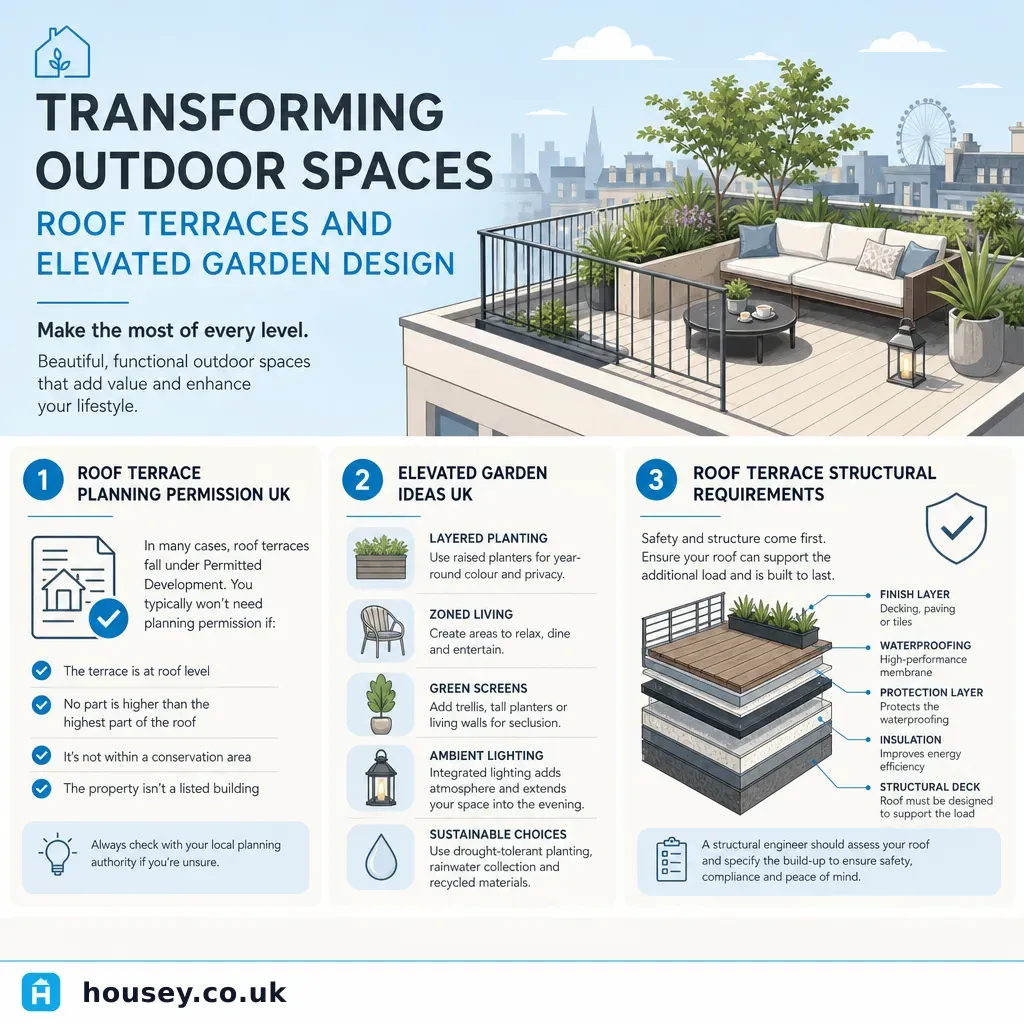
Transforming Outdoor Spaces: Roof Terraces and Elevated Garden Design
Roof terraces in the UK almost always need planning permission and a structural engineer's load capacity assessment before design work begins.
 Improvement & Build
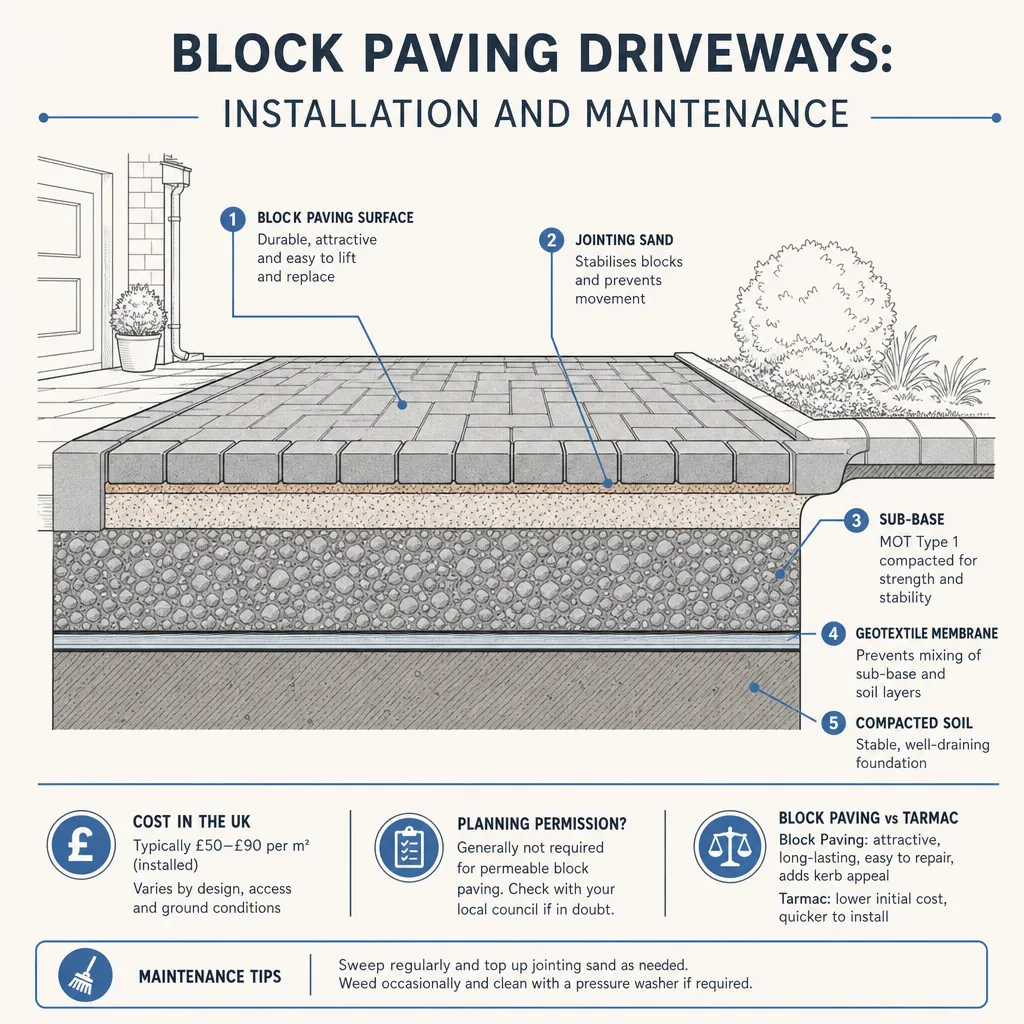
Block Paving Driveways: Installation and Maintenance
Block paving driveways typically cost £50–£120 per m² installed and last 20–30 years with good maintenance.