Loft Boarding: Insulation, Installation, and Storage Options
By Housey · Last reviewed 18th of May 2026
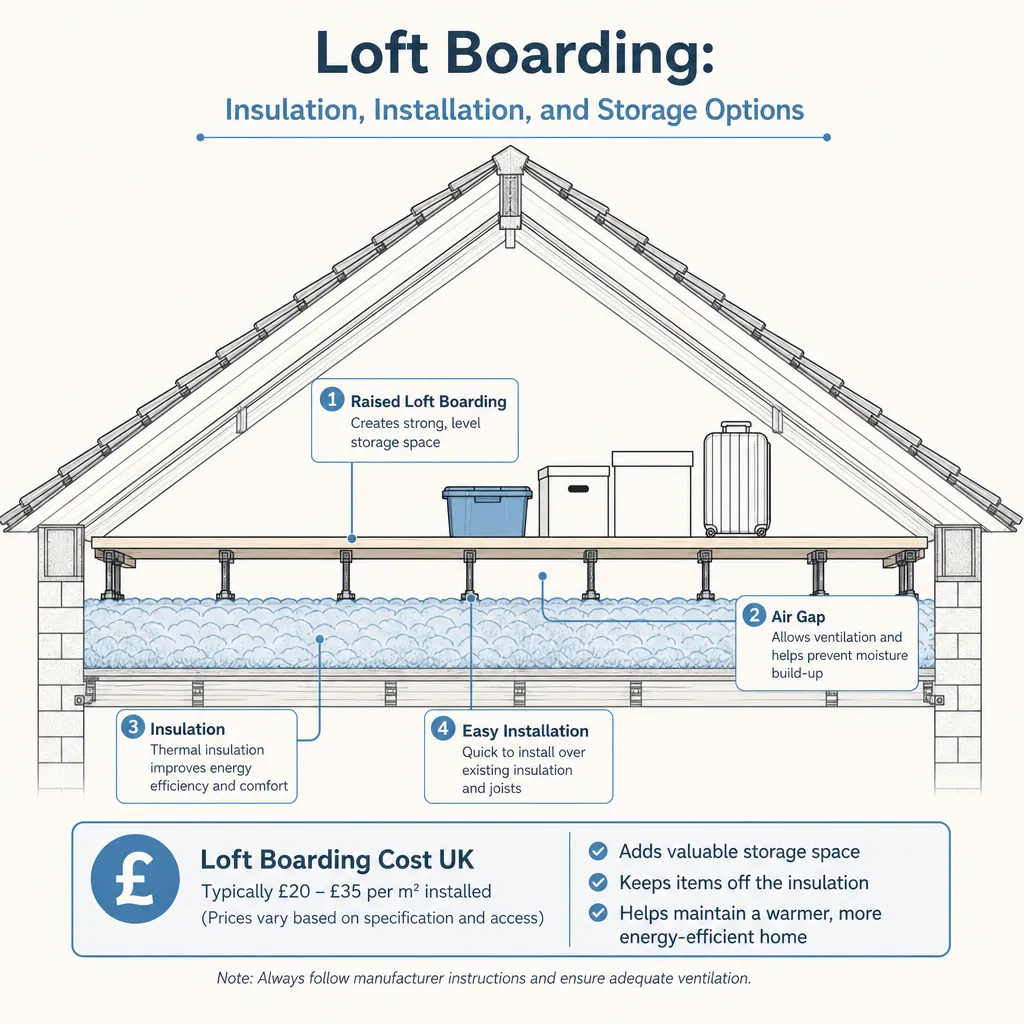
Loft Boarding: Insulation, Installation, and Storage Options
Loft boarding is one of the most practical improvement projects available to UK homeowners — it turns an underused void into accessible storage without the cost and disruption of a full loft conversion. The question typically arises when a growing household runs out of storage space, when insulation is being upgraded, or when a RICS surveyor flags that an existing loft floor is inadequate for safe access. The challenge is doing it correctly: boarding directly onto joists without accounting for the insulation beneath can significantly reduce a home's thermal performance and, in some cases, fall short of what Building Regulations Approved Document L requires.
Key points
- Boarding directly onto loft joists compresses existing insulation and reduces its effectiveness — the recommended approach is a raised boarding system using loft legs to maintain the full insulation depth beneath the boards.
- Approved Document L (Conservation of Fuel and Power) requires loft insulation to reach 270 mm of mineral wool in most UK properties; compressing this below that depth affects EPC ratings and defeats the regulation's intent.
- Standard ceiling joists in most pre-2000 UK homes — typically 47 × 97 mm or 47 × 120 mm — are sized for ceiling loading only and are not designed to carry sustained storage loads; check joist size, span, and condition before boarding.
- Loft boarding for storage does not typically require planning permission, but converting the loft into a habitable room always requires Building Regulations approval and usually requires planning permission.
- Tongue-and-groove chipboard (22 mm) is the most common boarding material; purpose-made loft board panels with pre-formed edges are also widely available and quicker to install.
Why you cannot simply lay boards on the joists
The most common mistake with loft boarding is laying boards directly onto existing ceiling joists, either compressing the insulation below or pushing it aside. In most UK homes built since the 1980s — and in any home where insulation has been upgraded — the recommended depth is 270 mm of mineral wool. This is significantly more than the typical joist depth of 97–120 mm, meaning boards laid at joist level eliminate almost all of the insulation's thermal benefit.
The standard solution is a raised loft boarding system: proprietary plastic or metal legs — often called loft legs, loft stilts, or raised deck legs — fix to the tops of the joists and support the boards at a height of 175–300 mm, maintaining a clear void beneath for the full insulation depth. The Energy Saving Trust specifically recommends this approach to avoid the thermal performance loss that direct boarding causes.
Homeowners in older properties with thinner original insulation face a simpler immediate choice, but upgrading the insulation at the same time as boarding is strongly recommended and may attract grant funding through the ECO4 scheme or the Great British Insulation Scheme (GBIS). Check eligibility at GOV.UK: insulate your home.
Comparing loft boarding approaches
Approach | Best for | Not ideal for | Indicative material cost (10 m²) | Key consideration |
|---|---|---|---|---|
Direct boarding on joists | Lofts with no existing insulation or very thin insulation only | Any loft with insulation at or near 270 mm | £150–£400 (boards only) | Compresses insulation — not recommended as standard practice |
Raised boarding system (loft legs) | Most UK lofts with existing mineral wool insulation | Very shallow void with insufficient headroom for raised legs | £300–£700 (boards and legs) | Preferred approach; protects full insulation depth |
Purpose-made loft board panels | Quick installation; lighter-use storage | Heavy permanent storage; very large areas | £350–£600 | Faster than loose chipboard; proprietary edge systems |
Structural loft platform (engineered) | Heavy storage; loft offices; access for those with limited mobility | Budget projects | £500–£1,200+ | May require structural engineer sign-off |
Indicative UK costs, last reviewed 2026-05-18. Costs vary by region, board specification, access difficulty, and installer. Obtain at least three quotes before proceeding.
A worked UK scenario
A 1970s semi-detached house in the Midlands has 150 mm of existing mineral wool insulation between 100 × 47 mm ceiling joists. The homeowner wants to board roughly 12 m² for general household storage. Laying boards directly at joist level would compress the insulation to near zero, immediately reducing heat retention and likely resulting in a lower EPC band. Instead, an installer fits 175 mm loft legs at 600 mm centres across the joist tops and lays 22 mm tongue-and-groove chipboard above them, preserving the full insulation depth. The job takes around three hours. Material cost: approximately £480. Fitted by a local installer: typically £750–£950 — a modest outlay for a thermally safe, functional storage space with no EPC impact.
DIY versus professional installation
Many homeowners board their own lofts successfully, but several factors make professional installation the better choice:
Factor | Suitable for DIY | Better to use a professional |
|---|---|---|
Joist condition | Joists are clearly sound and span is short | Joists show rot, insect damage, or appear undersized |
Existing insulation | None or minimal; raised legs not required | Full-depth mineral wool in place; raised leg system required |
Loft access | Fixed ladder already fitted; good headroom | No ladder; restricted access; items are heavy |
Area | Under 10–12 m² with a simple layout | Large or complex layout; services in the boarding area |
Warranty | No warranty needed | Product or installer warranty required |
Planning and Building Regulations considerations
Loft boarding for storage — where you are not altering the structure or creating habitable space — does not typically require planning permission or Building Regulations approval in England, Scotland, or Wales. However, there are important exceptions:
- Structural reinforcement: If ceiling joists need sistering or additional timber to carry the intended load, this constitutes structural work that may require Building Regulations notification.
- Habitable room: Any boarding forming part of a loft conversion to a room used for sleeping, working, or regular occupation requires both Building Regulations approval and, in most cases, planning permission.
- Listed buildings: Any alteration, including loft boarding, may require listed building consent from the local planning authority.
- Conservation areas: Structural changes affecting the external appearance of a property may require planning permission.
Check with your local planning authority if you are in any doubt. The GOV.UK planning portal provides guidance on permitted development rights for England.
Homeowner checklist before boarding your loft
When to get professional help
Consider instructing a professional installer if:
- The joists show signs of rot, woodworm (common in older lofts), or appear undersized for the intended load.
- You suspect asbestos-containing materials anywhere in or around the loft void — do not disturb anything until a competent asbestos professional has inspected the space.
- The boarding area exceeds 15–20 m² or requires structural reinforcement such as sistered joists.
- You want the installation to carry a product or installer warranty.
- A new or upgraded loft ladder is needed at the same time — ladder replacement benefits from professional fitting for safety reasons.
How Housey can help
Whether you need straightforward loft boarding or are considering a more ambitious project, Housey can connect you with vetted loft conversion companies who can assess your loft, advise on the right boarding system, and quote for the full job — including insulation upgrades and loft ladder replacement where needed.
Frequently asked questions
Does loft boarding affect my EPC rating?
Boarding itself does not directly affect your EPC rating, but compressing existing insulation reduces the effective depth, which an assessor measures during an EPC inspection. If your insulation is recorded as less than 270 mm as a result, your rating may fall. A raised boarding system avoids this outcome by preserving the full insulation depth beneath the boards.
How much weight can a boarded loft hold?
Standard ceiling joists in most pre-2000 UK homes are sized for ceiling loads only and are not designed to carry sustained storage weight. As a rough guide, they should not bear more than the equivalent of one person walking. Heavy permanent storage — archive boxes, machinery, books — may require a structural assessment before loading. An experienced installer can advise on joist capacity for your specific property.
Is loft boarding a good investment before selling?
Accessible loft storage with a loft ladder and lighting is a genuine selling point frequently mentioned in estate agent particulars. Well-fitted boarding typically costs £700–£1,500 installed and is likely to recoup its cost in perceived value. Poorly fitted boarding that has compressed insulation or blocked ventilation could be flagged in a buyer's survey, so quality of installation matters.
Can I board my loft if I have a flat roof?
Flat-roof properties do not typically have accessible loft voids. A small service void may exist between the ceiling and the flat roof structure, but this is generally not suitable for boarding or storage. If your property has a pitched roof — even over a bungalow or single-storey extension — a loft void may be accessible. Check available headroom before planning any boarding.
Sources and further reading
- Approved Document L: Conservation of Fuel and Power — GOV.UK
- Roof and loft insulation — Energy Saving Trust
- Insulate your home — GOV.UK
- Great British Insulation Scheme — GOV.UK
- Working at height: a brief guide — Health and Safety Executive
Useful next reads
 Improvement & Build
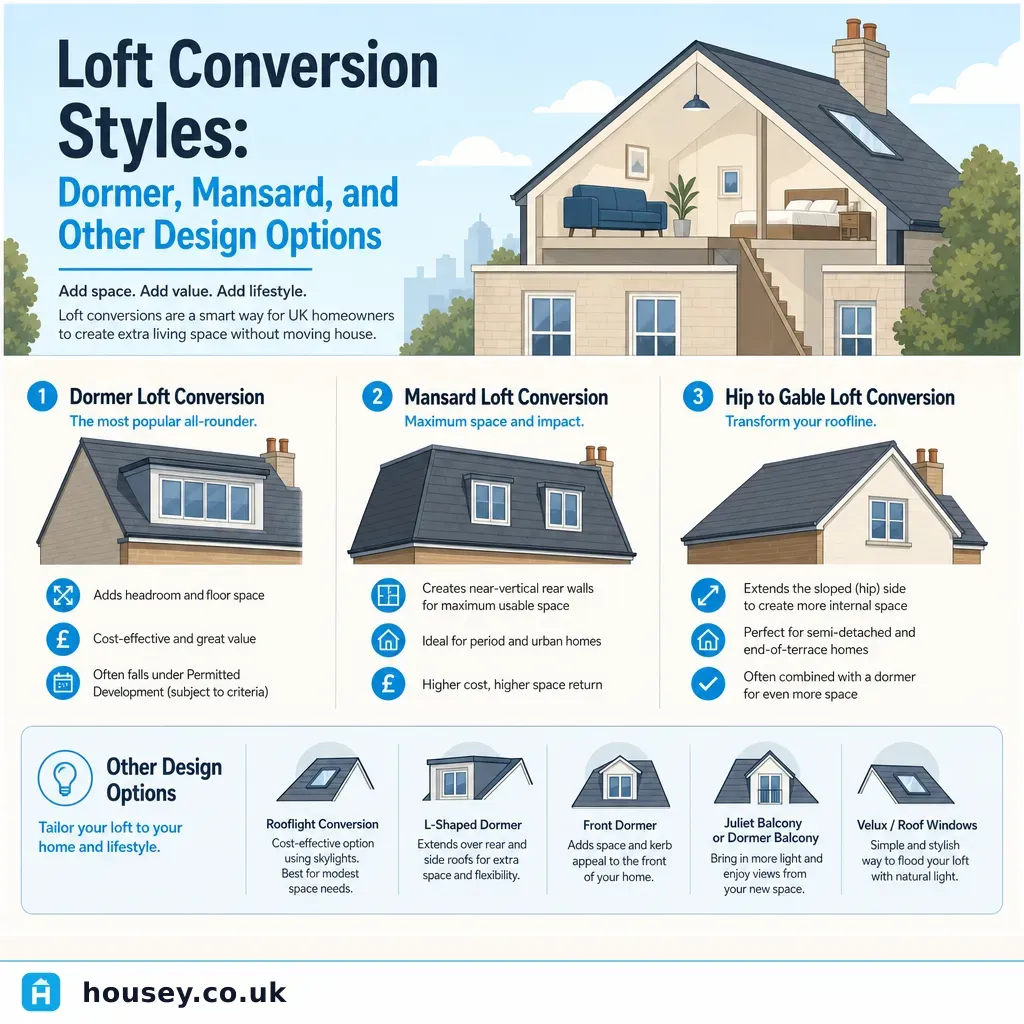
Loft Conversion Styles: Dormer, Mansard, and Other Design Options
The main loft conversion types in the UK are rooflight, dormer, hip-to-gable, and mansard.
 Improvement & Build
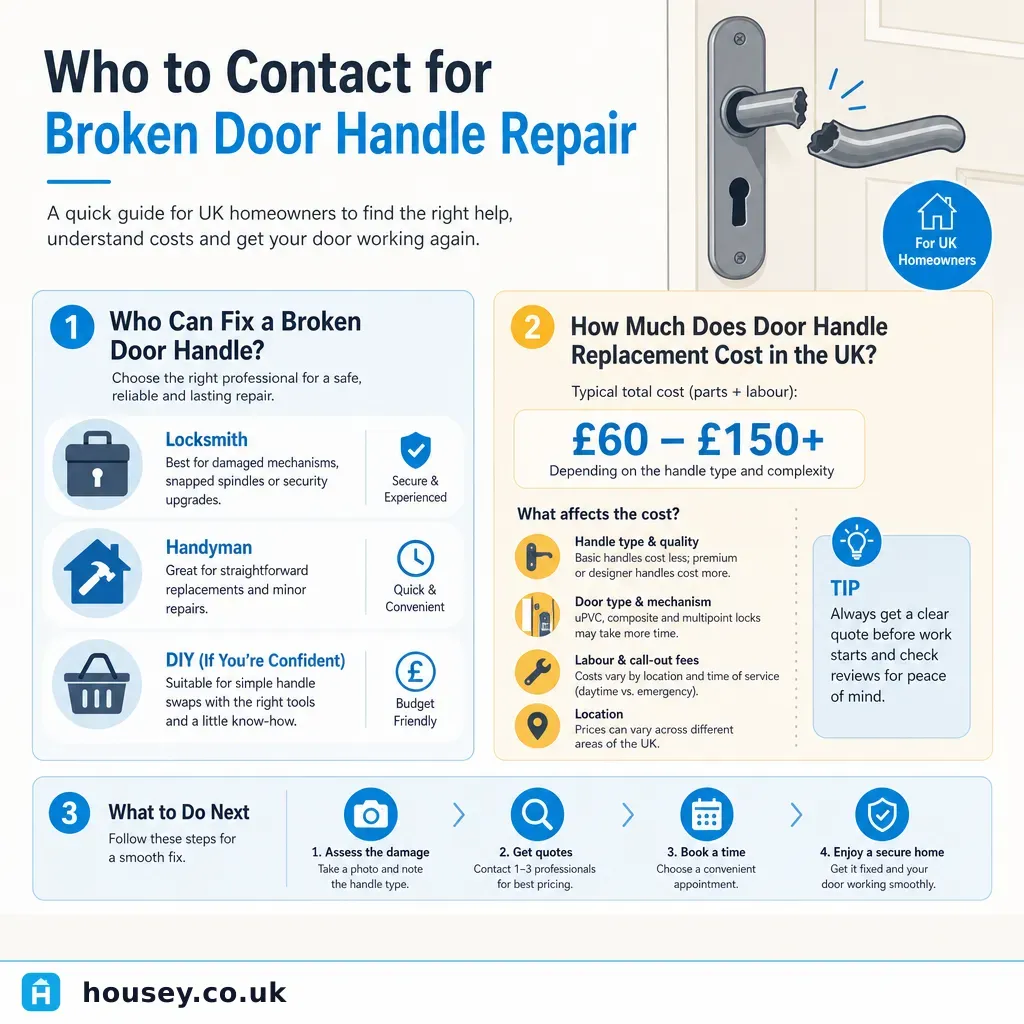
Who to Contact for Broken Door Handle Repair
For a broken door handle, a general handyperson can handle most internal timber door repairs, while a joiner or locksmith is better suited to external doors, particularly if the lock mechanism is affected.
 Improvement & Build
Guide to Replacing Timber Sash Windows with Authentic Restoration
Restoring a timber sash window typically costs £150–£400 per window; full replacement costs £800–£2,500.
 Improvement & Build
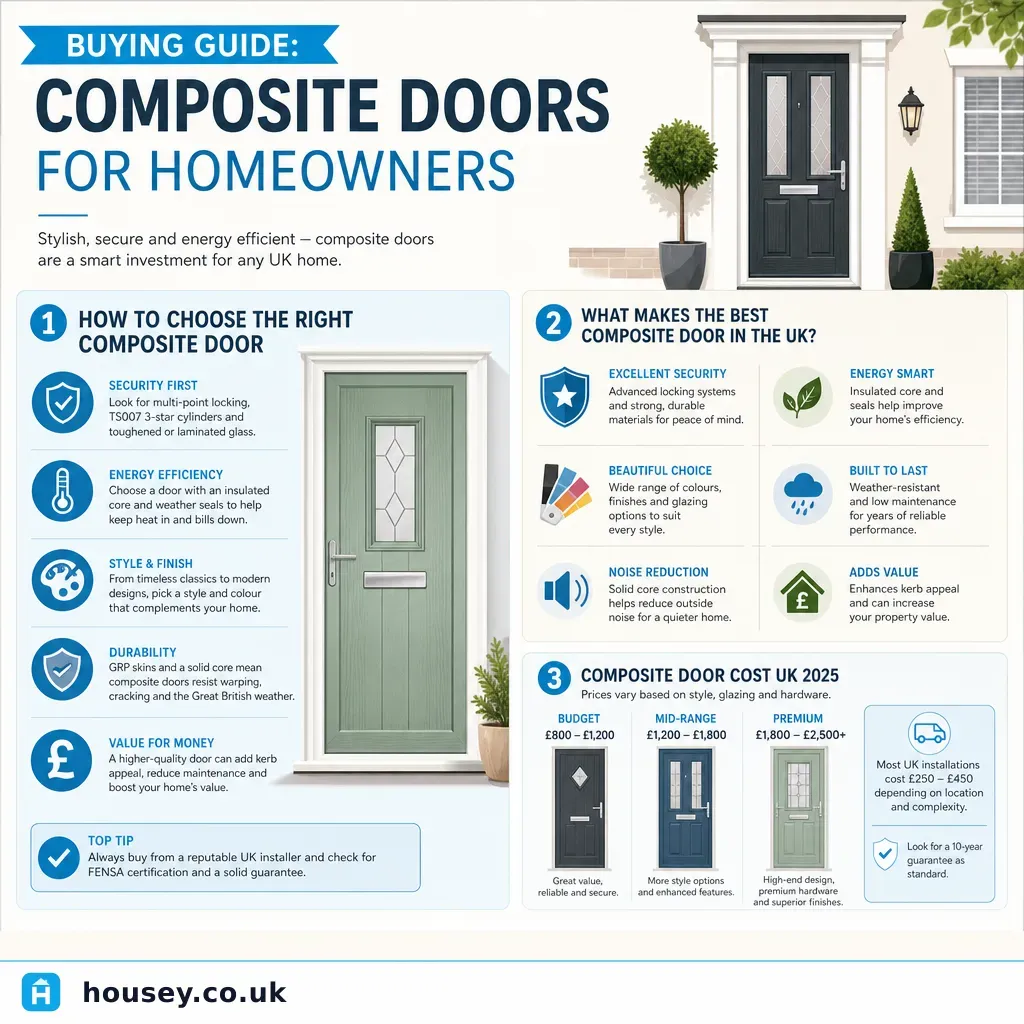
Buying guide: composite doors for homeowners
A composite door is a multi-layer product with a glass reinforced plastic outer skin, solid foam core, and multipoint locking as standard.
 Improvement & Build
Concrete Applications in Residential Landscape Design
Concrete serves multiple roles in residential landscape design: as a surface material for driveways, patios, and paths; as a structural element in retaining walls and foundations; and as prefabricated components including slabs, edging, and copings.