Long-Distance House Removals: Planning and Cost Guide
By Housey · Last reviewed 30th of May 2026
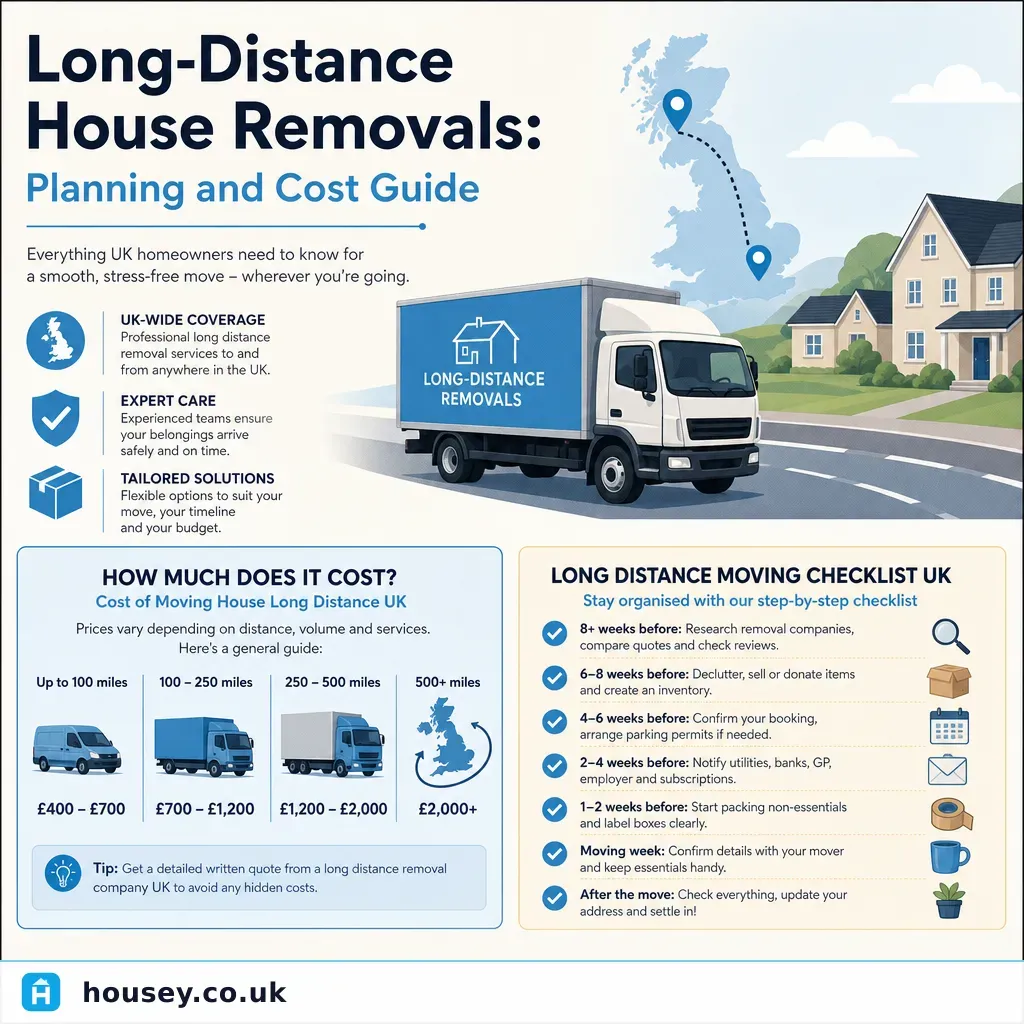
Long-Distance House Removals: Planning and Cost Guide
Long-distance moves — typically those covering 100 miles or more across the UK — demand more preparation than a local van shift. Whether you are relocating from Birmingham to Edinburgh or Bristol to Norwich, the combination of longer driving time, fuel costs, and the logistical complexity of a cross-regional move means that planning and pricing can catch people off-guard. This guide sets out what drives costs, how to prepare, and what to confirm before you sign a booking.
Key points
- Long-distance house removals are generally considered moves of 100 miles or more in the UK; some firms use a 4–5 hour drive as the threshold instead.
- Indicative costs for a 3-bedroom home moving 100–200 miles range from £1,000–£2,500, depending on volume, access, packing services, and timing. Indicative UK costs, last reviewed 2026-05-30.
- Standard removal liability (sometimes called "owned goods" cover) typically compensates at a fixed low rate per item — not replacement value; dedicated transit insurance is a separate arrangement.
- The British Association of Removers (BAR) and the Removals Industry Ombudsman Scheme (RIOS) are the two recognised trade bodies; member firms follow a code of practice and provide access to a formal dispute resolution process.
- Peak removal demand falls in July–August and around school holidays; booking 8–10 weeks ahead during those windows is advisable.
What drives the cost of a long-distance removal?
Mileage is a factor, but it is rarely the primary cost driver. The main variables are:
- Volume of goods: The cubic footage of your belongings is usually the biggest influence. A 1-bedroom flat requires very different resources to a 5-bedroom detached house.
- Packing services: Asking the firm to supply packing materials and pack your home typically adds £200–£600 but reduces breakage risk on a longer journey.
- Access and parking: Long carries — from an upper-floor flat with no lift, or a property at the end of a narrow lane — add time and may attract a surcharge. Disclose access issues at both addresses when requesting quotes.
- Single-load vs shared load: A part-load (groupage) service shares a vehicle with another customer's belongings, reducing cost but extending delivery to a window of one to five days.
- Storage: If completion dates do not align, short-term storage may be needed. Many removal firms offer container or warehouse storage; costs vary widely.
- Date and timing: Fridays and end-of-month dates attract premium rates because they coincide with typical completion days.
Service option | Best for | Typical cost effect | Trade-off |
|---|---|---|---|
Full-pack service | Families with fragile or high-value items | +£200–£600 | Higher cost; less packing control |
Part-pack (valuables only) | Confident packers on a budget | +£50–£150 | You pack most items yourself |
DIY pack, professional move | Budget-conscious movers | No uplift | All packing responsibility falls on you |
Part-load/groupage | Small households moving long distance | Lower base rate | Delivery window of 1–5 days |
Dedicated vehicle | Date-critical moves | Standard or premium rate | Full control over timing |
Indicative UK costs, last reviewed 2026-05-30. Quotes vary by region, firm, and property.
How to plan a long-distance move: a homeowner checklist
8–10 weeks before:
4–6 weeks before:
1–2 weeks before:
Moving day:
Understanding removal insurance
Transit insurance is one of the most misunderstood aspects of a removal. Standard liability under a removal firm's terms of business often covers goods at a set rate per item — such as a fixed amount per kilogramme — rather than at full replacement value. For a long-distance move, where goods are in transit for longer, it is worth asking:
- Whether the firm is a BAR member (BAR members must carry minimum goods-in-transit insurance as a condition of membership).
- What the excess and exclusions are — fragile items packed by the homeowner, for example, may not be covered if they break.
- Whether your existing home contents insurance policy covers goods in transit; many policies include this, but check the limit and conditions carefully.
Shared-load vs dedicated vehicle: which is right for you?
For smaller households, a shared-load (groupage) service can reduce costs considerably — you pay only for the cubic space your goods occupy rather than the whole vehicle. The trade-off is a delivery window of one to five days rather than a fixed date, which can complicate completion-day logistics.
A dedicated vehicle is generally preferable when:
- Your completion date is fixed and a delayed delivery would be disruptive or costly.
- Your volume of goods is large enough to fill most of a standard vehicle anyway.
- You have fragile, high-value, or unwieldy items that benefit from direct loading and unloading without intermediate stops.
When to get professional help
For a standard long-distance move, you are already using a professional service. Some situations, however, warrant specialist firms rather than a general removal company:
- Antiques, fine art, or high-value items: specialist firms use bespoke crating and climate-controlled vehicles; a standard removal firm may limit or decline liability for these categories.
- Pianos: require specialist disassembly and handling equipment not available at all general firms.
- Disputes with a removal firm: contact BAR or RIOS if the firm is a member, or Citizens Advice and Trading Standards if it is not.
How Housey can help
Housey connects you with vetted house removal companies who can provide written quotes for your long-distance move. Compare quotes from local and national firms, check their accreditations, and book with confidence.
Frequently asked questions
How far in advance should I book a long-distance removal?
For moves in July, August, or around bank holidays, aim to book 8–10 weeks ahead. At quieter times, 4–6 weeks is usually sufficient. Many removal firms will hold a provisional date subject to confirmation after exchange of contracts, which protects you if your completion date shifts.
Does a removal firm charge more for stairs or a long carry?
Yes. Access difficulties — including upper-floor flats without lifts, narrow staircases, limited parking, or a long walking distance from door to vehicle — typically attract surcharges. Disclose all access details at both the collection and delivery addresses when requesting quotes, so the price you receive is accurate and comparable.
What happens if my completion date changes at short notice?
This depends on the firm and your booking terms. BAR members are required to follow a code of practice that includes a dispute resolution mechanism. Check cancellation and rescheduling terms before booking; some firms allow free date changes up to a set period before the move, after which charges may apply.
Is a man-and-van cheaper for a long-distance move?
A man-and-van service can be cheaper for very small volumes such as a studio or 1-bedroom move, but for larger households it is often not more cost-effective once you account for vehicle size and multiple trips. Man-and-van operators may also carry less insurance cover than an established removal firm, which matters more over longer distances.
Sources and further reading
- British Association of Removers: Find a Remover — British Association of Removers (BAR)
- Removals Industry Ombudsman Scheme — RIOS
- Tell Us Once — GOV.UK
- Moving home — Citizens Advice
Useful next reads
 Buying & Moving
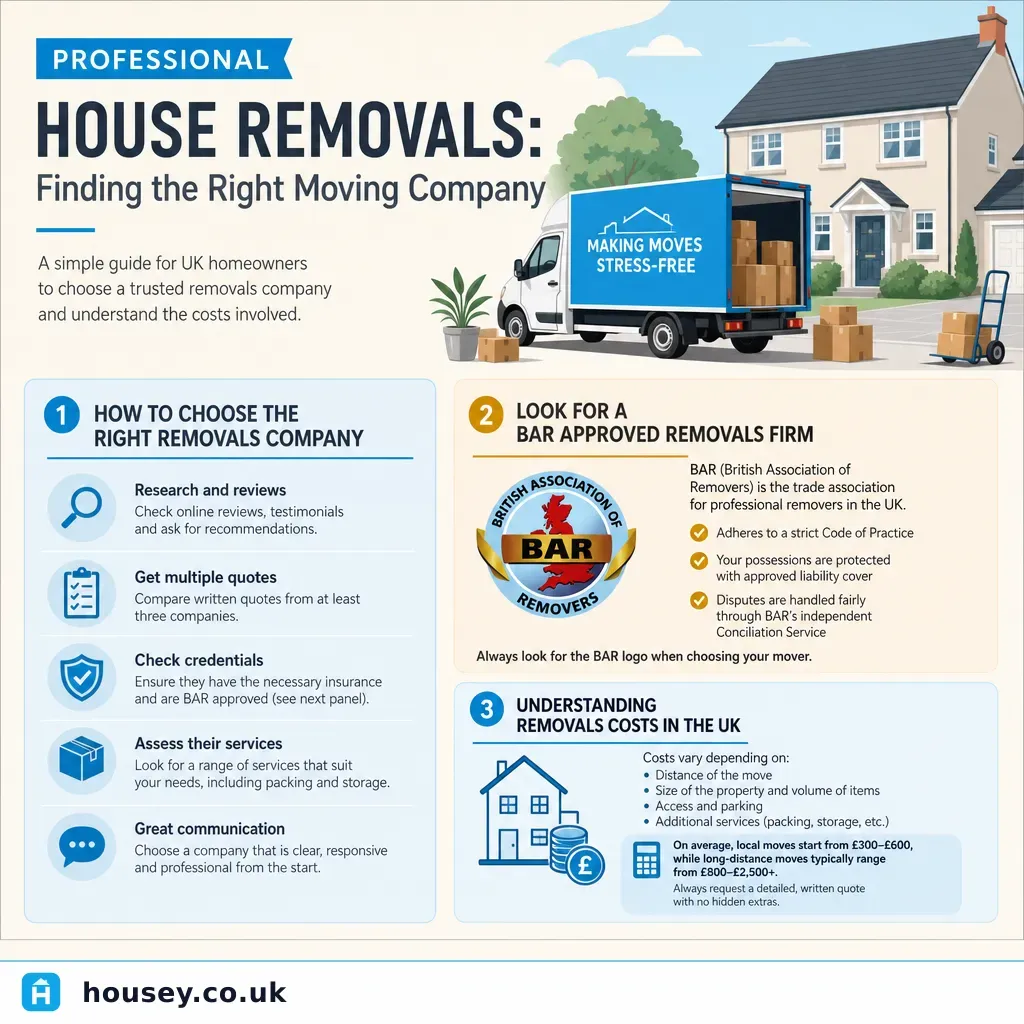
Professional House Removals: Finding the Right Moving Company
Finding the right house removals company involves checking membership of a recognised trade body such as the British Association of Removers (BAR), confirming goods-in-transit insurance cover, and comparing itemised written quotes.
 Buying & Moving
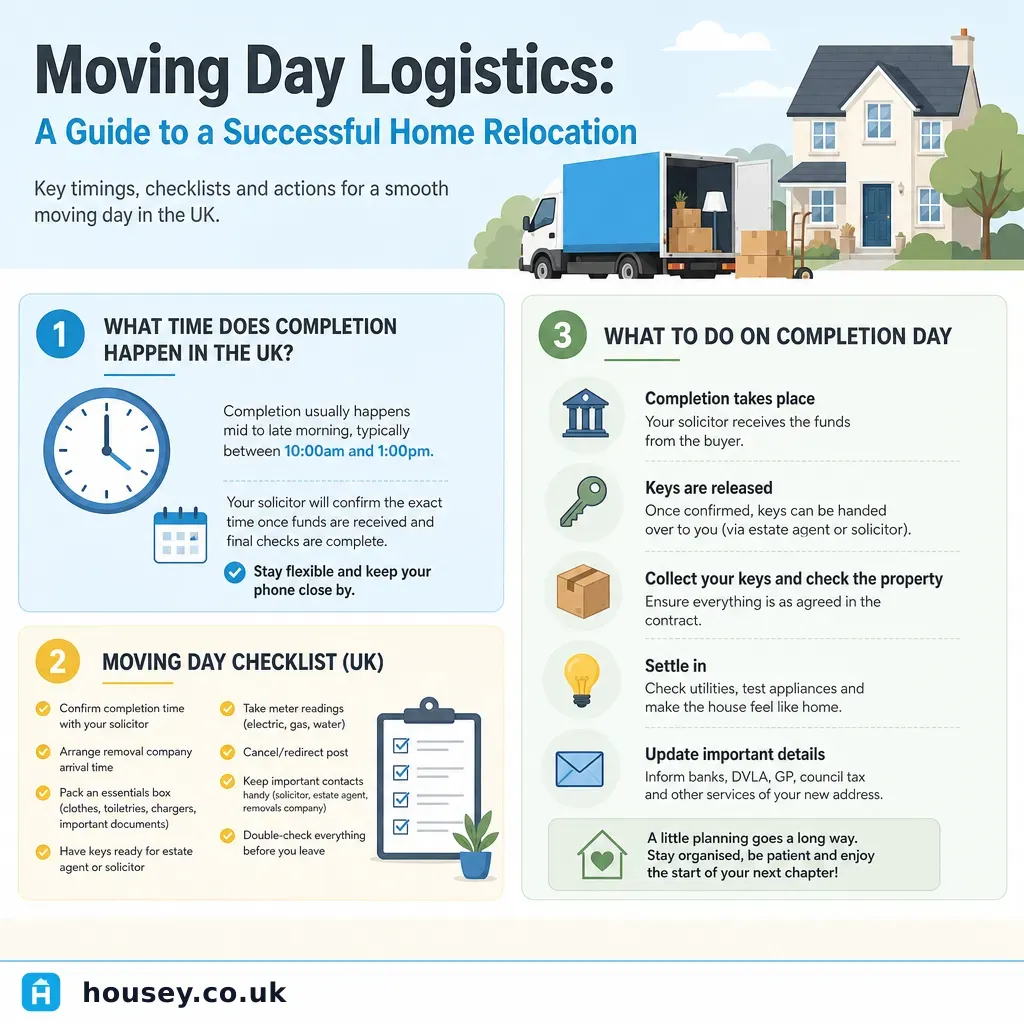
Moving Day Logistics: A Guide to a Successful Home Relocation
On moving day, wait for your solicitor to confirm completion before collecting keys — there is no fixed handover time and most UK completions happen between 11am and 2pm.
 Buying & Moving
Choosing a House Removal Company: What to Look For
Choose a UK removal company that belongs to the British Association of Removers (BAR) or the Removals Industry Ombudsman Scheme (RIOS), carries goods-in-transit and public liability insurance, and provides a written quote after properly surveying your home.
 Buying & Moving
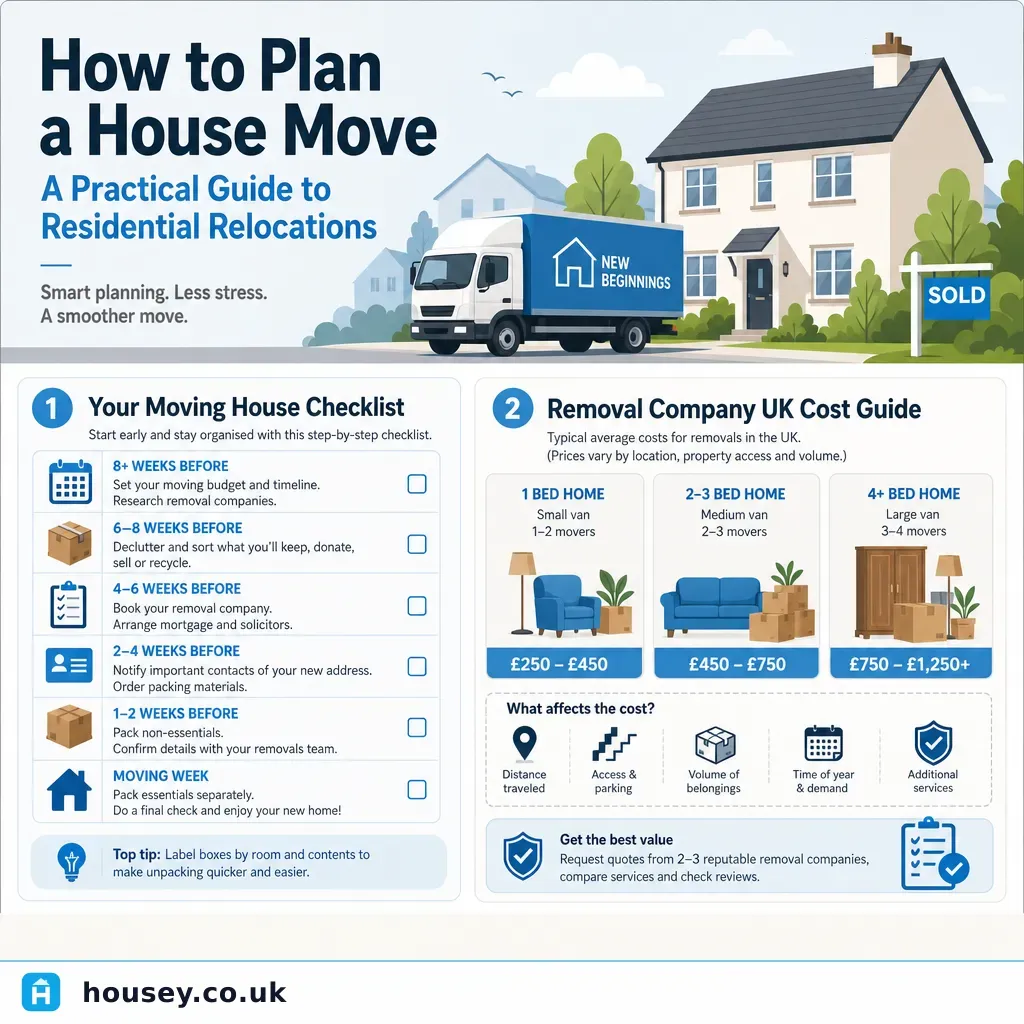
How to Plan a House Move: A Practical Guide to Residential Relocations
A UK house move goes more smoothly with planning that starts 6–8 weeks before moving day.
 Buying & Moving
Managing Property Relocation in Major Urban Centres
Urban house moves require planning beyond a standard removal, particularly around vehicle emission zone compliance, parking bay suspensions, and lift access in purpose-built flats.