Main Sewer Line Repair and Replacement Costs
By Housey · Last reviewed 7th of May 2026
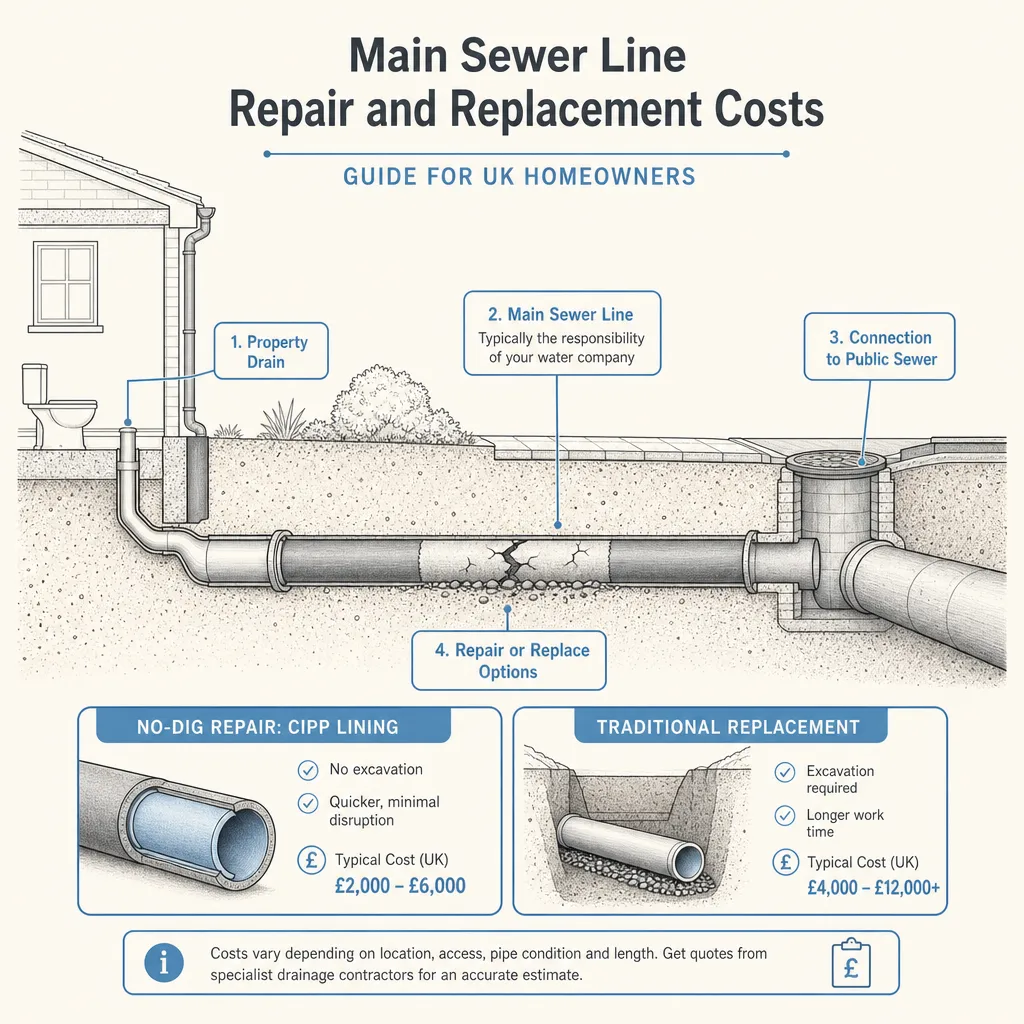
Main Sewer Line Repair and Replacement Costs
A failing main sewer line is one of the more disruptive and costly drainage problems a UK homeowner can face. The issue typically surfaces through recurring blockages, subsidence near the drain run, or a CCTV drain survey carried out before or after a property purchase. Costs and responsibilities vary significantly depending on where the fault lies relative to the property boundary, which repair method is appropriate, and whether your local water company has already adopted the affected sewer section — a distinction that determines whether the repair bill is yours or theirs.
Key points
- Since the Private Sewer Transfer in October 2011, most lateral drains and private sewers shared between two or more properties in England and Wales were adopted by water companies; responsibility for repairs to those adopted sections rests with the water company, not the homeowner.
- Homeowners remain responsible for the drain within their property curtilage — from the internal drainage stack to the point the drain exits the land boundary.
- A CCTV drain survey typically costs £150–£400 and is almost always required before a repair contractor can specify a method or provide an accurate price (Indicative UK costs, last reviewed 2026-05-07).
- No-dig repair methods — patch lining and full CIPP lining — typically cost £500–£4,000; open-cut excavation and pipe replacement usually costs £3,000–£10,000 or more depending on depth, length, and ground conditions.
- Before commissioning any repair, confirm with your water company via their sewer mapping tool whether the affected section is adopted — if it is, the repair cost is the water company's responsibility.
Who is responsible for sewer repairs in the UK?
Responsibility depends on where the fault is located and whether the pipe serves more than one property.
Drains within your boundary: The drain within your property curtilage — from the internal stack to the boundary of your land — is your responsibility as the homeowner. In leasehold properties, the lease should specify whether sewer maintenance is the landlord's or leaseholder's obligation.
Lateral drains and shared sewers: In October 2011, Ofwat-regulated water companies adopted most lateral drains (the section from your boundary to the public sewer) and private sewers shared by more than one property, under the Private Sewer Transfer. Repairs to these adopted sections are now the water company's responsibility at no cost to the homeowner. Rules differ in Scotland, where Scottish Water has its own adoption framework.
Check before commissioning repairs: If you commission and pay for repair work on an adopted sewer, you may not be able to recover the cost. Contact your water company — Thames Water, Severn Trent, Yorkshire Water, and others all provide online sewer mapping tools — and confirm ownership of the affected section before appointing a contractor.
Sewer repair methods compared
Method | How it works | Best for | Typical UK cost (exc. VAT) | Disruption level |
|---|---|---|---|---|
Patch liner repair | A short resin liner is inserted and cured over a localised crack or displaced joint | Single-point defects, minor cracks | £500–£1,500 | Minimal — no excavation |
Full CIPP lining (cured-in-place pipe) | A resin-impregnated sleeve is installed along the full pipe length and cured in place | Widespread defects, root intrusion, deteriorating older pipes | £1,500–£4,000+ | Minimal — no excavation |
Pipe bursting | A bursting head fractures the old pipe outward while drawing new pipe through | Collapsed or severely deformed pipes in accessible ground | £2,000–£5,000 | Moderate |
Open-cut excavation and replacement | Ground is broken open, old pipe removed, and new pipe laid and backfilled | Deep or complex faults, restricted access for no-dig methods | £3,000–£10,000+ | Significant — surface reinstatement required |
Indicative UK costs, last reviewed 2026-05-07. Costs vary significantly by region, pipe depth, access constraints, and ground conditions. Prices exclude VAT, surface reinstatement, and any connection fees.
What drives the cost of sewer line repair?
Pipe depth and ground conditions: Deeper pipes require more excavation and temporary shoring, increasing labour time and cost. Rock or heavily compacted ground adds further expense to open-cut work.
Access: Pipes running beneath a driveway, extension, or garden structure are harder to reach for both no-dig and open-cut methods. Reinstatement of a tiled driveway or concrete slab can equal or exceed the drainage repair cost itself.
Pipe diameter and material: Older UK properties often have vitrified clay (VC) pipes. These can be lined but require careful assessment if joints are badly deteriorated. Modern uPVC systems are generally easier to repair or connect to.
Length of affected run: Longer sections require more liner material and curing time for no-dig methods, or more excavation and backfill for open-cut repairs, both of which increase the final price.
Emergency versus planned works: Emergency call-out rates from drainage contractors are typically 20–40% higher than planned daytime rates. Where possible, confirm the urgency of the situation before accepting an emergency surcharge.
Connection to the public sewer: If the repair involves disconnecting and reconnecting to the water company's public sewer, a notification or consent may be needed under Section 106 of the Water Industry Act 1991. Your contractor should advise on whether this applies.
Red flags: signs your sewer line needs urgent attention
Contact a qualified drainage contractor promptly if you notice any of the following:
- Recurring blockages that return despite rodding or jetting, particularly when multiple fixtures — sinks, toilets, baths — are affected simultaneously.
- Slow drainage throughout the property, not isolated to one room or fixture.
- Persistent foul smell from drains, manhole covers, or soil close to the drain run.
- Visible subsidence, soft spots, or sinkholes in the garden or driveway above the line of the drain.
- Cracking at the junction where the internal drainage stack meets the external drain or underground pipe.
- Damp patches appearing on ground floors or in a cellar near the drain route without another obvious cause.
- A CCTV survey report showing root intrusion, displaced joints, or a collapsed pipe section.
If multiple signs are present simultaneously, or if subsidence is visible above the drain, stop using non-essential drains where possible and seek professional assessment promptly rather than waiting.
When to get professional help
Sewer repair is not DIY territory. Work on drains, sewers, and their connections to the public network must comply with Building Regulations (Approved Document H) and in many cases requires notification to the local authority building control or an appointed inspector. A qualified drainage contractor should carry out any repair or replacement work to mains sewer infrastructure.
If you are unsure where the fault lies, a CCTV drain survey is the standard diagnostic first step — it locates the defect precisely, identifies the pipe material and condition, and produces a written report that any repair contractor can quote from. Attempting a repair without a prior survey risks misdiagnosing the problem and paying for work that does not resolve the underlying fault.
Seek professional assessment as a priority if:
- Subsidence is visible above the drain run — this may indicate a structural issue requiring a structural engineer in addition to a drainage contractor.
- The drain runs beneath a building or shared structure such as a party wall.
- The fault affects a shared sewer serving neighbouring properties.
- Your water company disputes responsibility for what you believe is an adopted sewer section.
How Housey can help
Housey connects UK homeowners with qualified drainage contractors and drainage survey specialists who can assess, diagnose, and repair sewer line problems. You can request quotes from local providers, compare their methods and pricing, and make an informed decision — without relying solely on the assessment of a single contractor who has a commercial interest in the scope of work recommended.
Frequently asked questions
Does home insurance cover sewer line repair in the UK?
Many standard UK home insurance policies do not cover gradual drain deterioration or wear and tear. Some policies include drain cover as an optional add-on, and a small number of comprehensive policies cover drain repair as standard. Check your policy schedule carefully — particularly the drainage or underground services section — and contact your insurer before commissioning any repair work to understand what is and is not covered.
How long does sewer line repair take?
A no-dig patch liner repair can often be completed within a single working day. Full CIPP lining of a longer run may take two to three days. Open-cut excavation, pipe replacement, and surface reinstatement — particularly for longer sections or difficult access — can take one to two weeks. Your contractor should provide a works programme and estimated timeline before starting.
Do I need planning permission for sewer repairs?
In most cases, repairing or replacing a like-for-like drain on your own property does not require planning permission. However, Building Regulations compliance under Approved Document H typically applies, and building control notification may be required. Always confirm with your local authority or appointed building control body before work begins to ensure the work is properly notified.
How do I find out if my sewer is adopted?
Contact your water company directly or use their online drainage mapping tool. Thames Water, Severn Trent, Southern Water, Yorkshire Water, and other regional water companies each provide online maps showing the boundary between privately owned drains and adopted sewers. The drainage responsibility map produced by your water company is the definitive reference for establishing who is responsible for a repair.
Can tree roots cause sewer line failure?
Root intrusion is one of the most common causes of sewer blockage and joint displacement in the UK, particularly in properties with mature trees close to the drain run. It is typically identified via a CCTV drain survey and can often be treated with mechanical root cutting, followed by a CIPP liner to seal the affected joints and prevent re-entry of roots.
Sources and further reading
- Private sewers and lateral drains — GOV.UK
- Approved Document H: Drainage and waste disposal — Ministry of Housing, Communities and Local Government
- Water company responsibilities and regulation — Ofwat
- Find approved drainage contractors — WaterSafe
- Water Industry Act 1991 — legislation.gov.uk
Useful next reads
 Improvement & Build
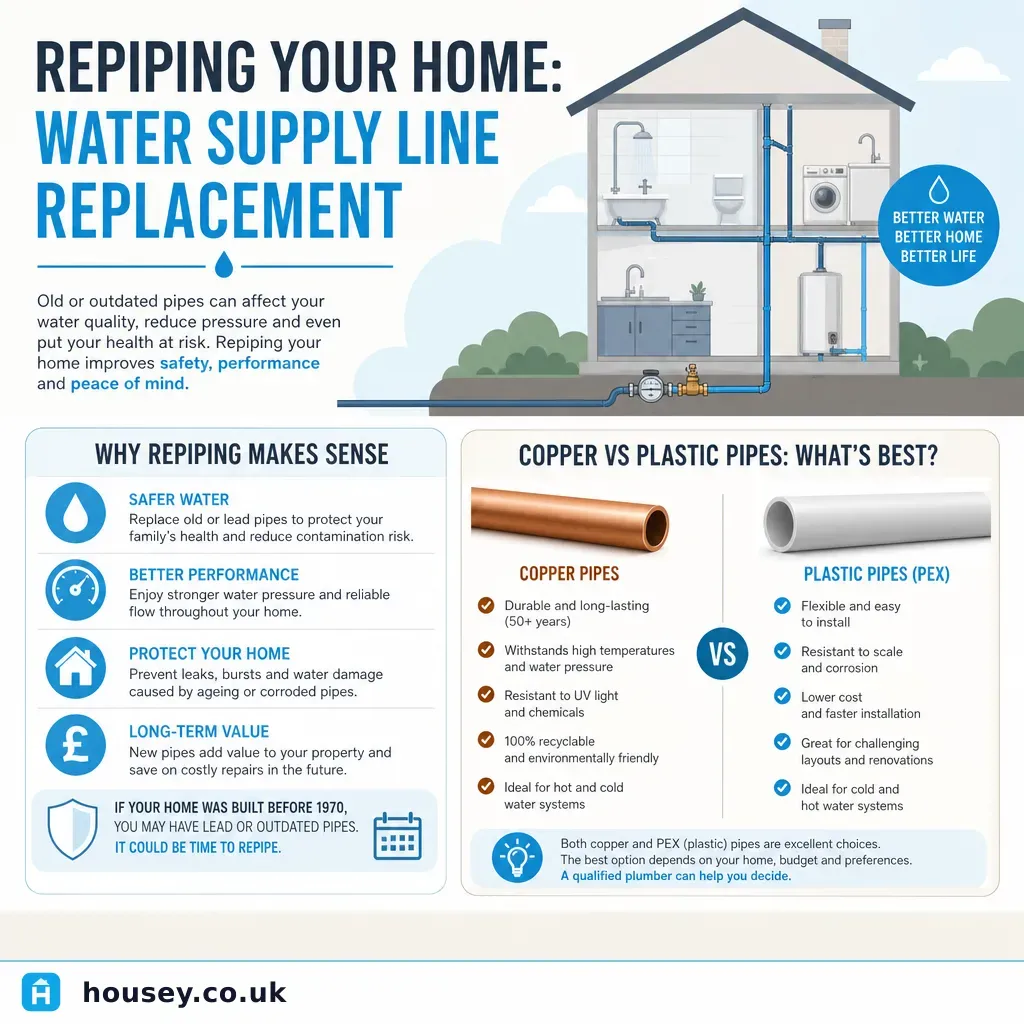
Repiping Your Home: Water Supply Line Replacement
Repiping is typically needed when lead, iron, or early polybutylene pipes corrode, leak, or restrict flow.
 Improvement & Build
Who to Contact for Broken Door Handle Repair
For a broken door handle, a general handyperson can handle most internal timber door repairs, while a joiner or locksmith is better suited to external doors, particularly if the lock mechanism is affected.
 Improvement & Build
UK Construction Sector Outlook: What Industry Confidence Means for Your Build Project
Construction sector confidence data — including PMI readings and CPA output forecasts — signals whether builders are busy and whether lead times are growing.
 Improvement & Build
Roof Repair: Damage Assessment and Costs
Most roof repairs — replacing slipped tiles, re-bedding ridge tiles, or patching flashing — are straightforward maintenance jobs that do not require planning permission.
 Improvement & Build
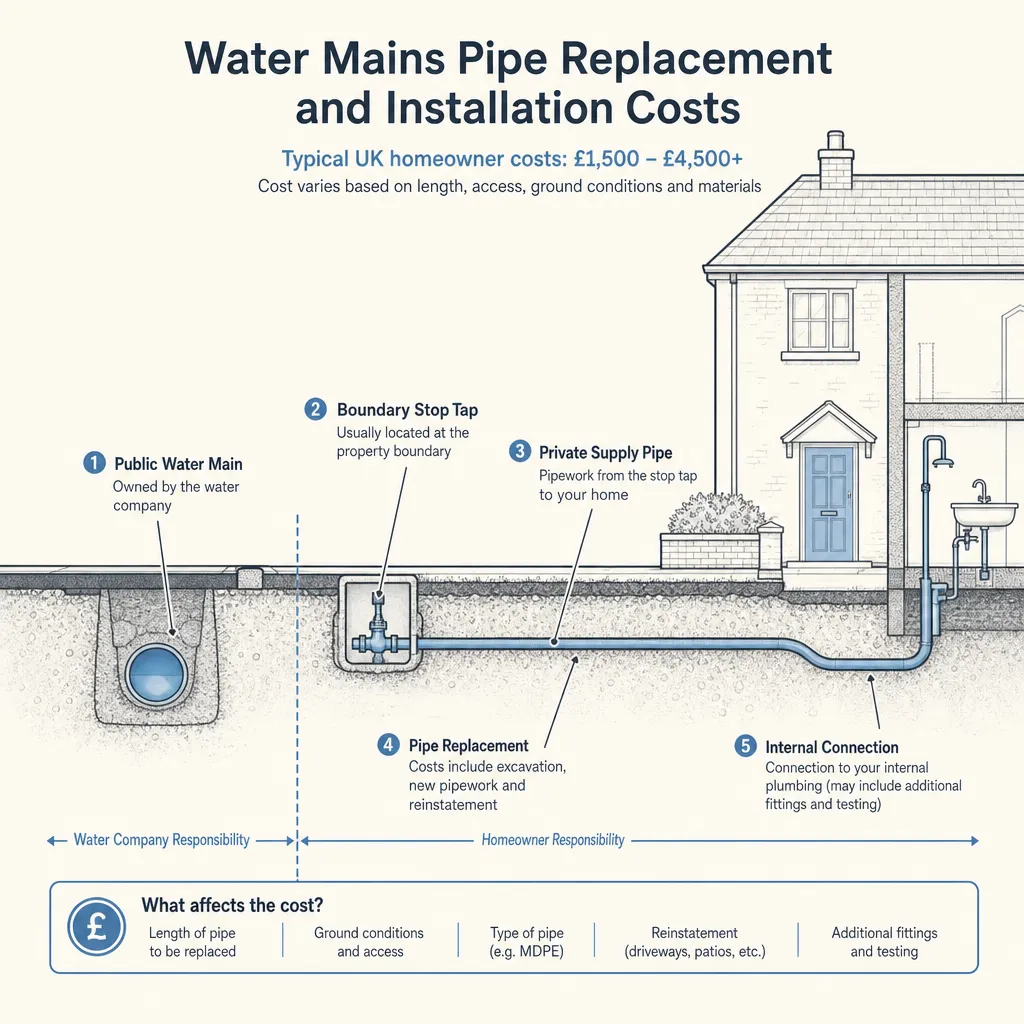
Water Mains Pipe Replacement and Installation Costs
Replacing the supply pipe from the boundary stopcock to your home typically costs £1,500–£3,500 in the UK, depending on pipe length, ground conditions, and whether any hard surfacing must be excavated.