Repiping Your Home: Water Supply Line Replacement
By Housey · Last reviewed 30th of May 2026
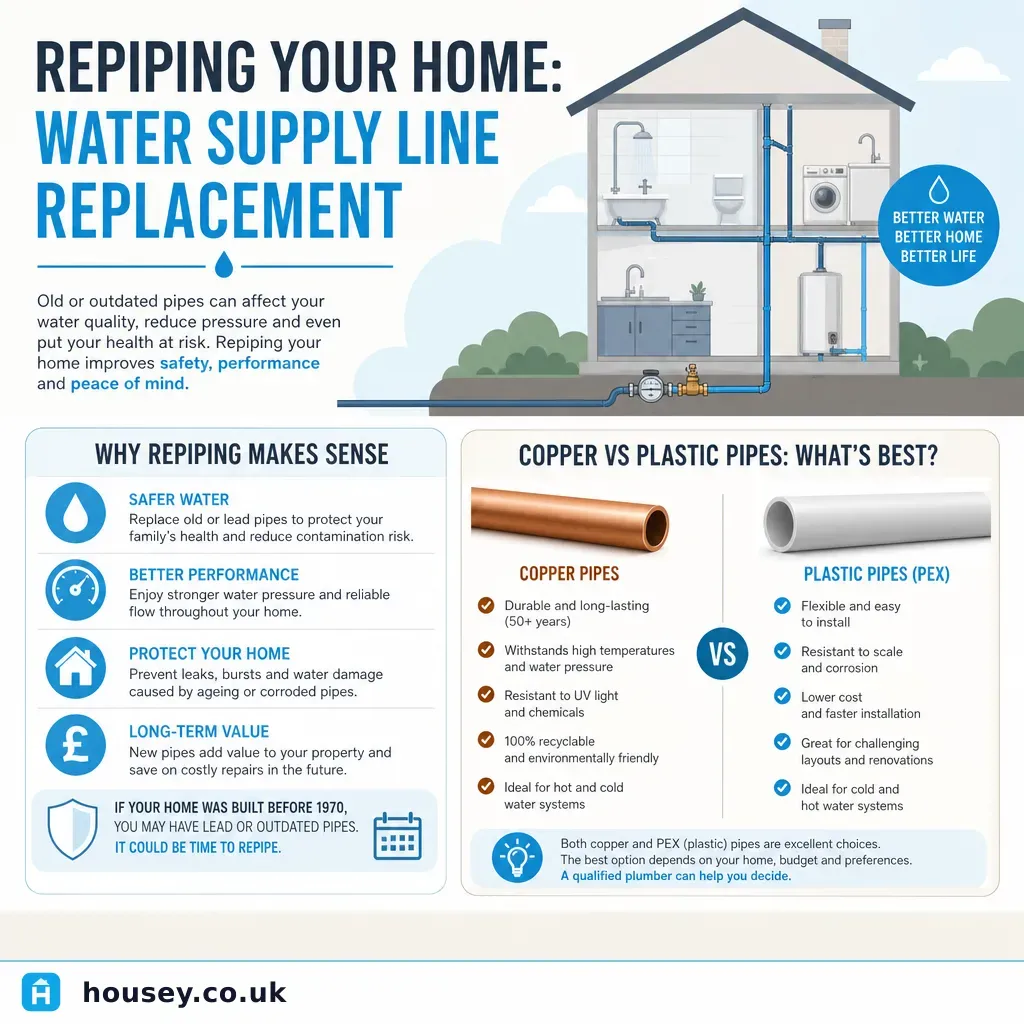
Repiping Your Home: Water Supply Line Replacement
Deteriorating water supply pipes often cause problems that build gradually — reduced pressure, discoloured water, damp patches inside walls, or an unexplained rise on a water meter. UK homes built before 1970 may still contain lead supply pipes, and properties from the late 1970s and 1980s can have early polybutylene plastic pipework that has become brittle over time. Understanding when repiping is genuinely necessary, what materials are now standard, and what the process involves helps homeowners plan and budget rather than react to an emergency.
Key points
- Lead supply pipes must be replaced: the UK drinking water standard for lead is 10 micrograms per litre under the Water Supply (Water Quality) Regulations 2016, and lead pipework in older homes is a common cause of exceedances.
- Your water company is responsible for the supply pipe from the mains to your property boundary; you are responsible for the section from the boundary to your internal stop tap — some water companies offer part-funded schemes covering both sections in a single coordinated visit.
- WRAS-approved (Water Regulations Advisory Scheme) fittings and materials must be used for any pipework connected to the drinking water supply; unapproved materials risk water contamination and may invalidate warranties.
- Copper, MDPE (medium-density polyethylene blue pipe), PEX (cross-linked polyethylene), and CPVC are all used for UK domestic repiping; each has different installation requirements, costs, and expected service lives.
- Full repiping of a typical three-bedroom UK home typically takes two to five working days, depending on floor construction, number of storeys, and accessibility of existing pipe runs.
When does repiping become necessary?
Repiping is not always an all-or-nothing project. Partial replacement — such as replacing only the lead section from the external boundary to the internal stop tap — is common and sometimes part-funded by water companies. Full repiping becomes more likely when:
- Lead pipes are confirmed or suspected throughout the property. A water test can confirm whether lead levels exceed safe thresholds. GOV.UK publishes guidance on testing for lead in drinking water.
- Iron or galvanised steel pipes have corroded extensively, producing rusty or discoloured water or severely restricted flow.
- Early polybutylene pipe (often grey or white plastic) has become brittle and shows repeated pinhole leaks; this material was widely installed from the late 1970s and is considered past its design life in many UK properties.
- Repeated localised leaks at multiple points suggest systemic pipe degradation rather than isolated failures.
- Persistently low water pressure throughout the property, not explained by supply-side issues, may indicate bore restriction from scale or internal corrosion buildup.
Pipe material comparison
Material | Typical UK use | Expected service life | Key advantages | Considerations |
|---|---|---|---|---|
Copper | Internal hot and cold supply, heating circuits | 50+ years | Durable, antimicrobial, long track record in UK homes | Higher material cost; requires skilled jointing |
MDPE (blue, external) | Supply from boundary to property; underground runs | 50+ years | Flexible, frost-resistant, low cost | Not suitable for hot water; primarily external or underground use |
PEX (cross-linked polyethylene) | Internal supply replacement, underfloor runs | 25–50 years | Flexible, freeze-tolerant, easy to run through tight spaces | Relatively newer in UK domestic use; some fittings require specialist tools |
CPVC | Hot and cold internal supply | 25–50 years | Higher temperature tolerance than standard PVC | Less common in UK domestic use than copper or PEX |
Lead | Pre-1970 supply pipes | Past service life | None — must be replaced | Health risk when lead levels exceed regulatory threshold |
Material specification should be confirmed by a qualified plumber based on your property's water supply type, pressure zone, and layout. Indicative service lives, last reviewed 2026-05-30.
The repiping process: what to expect
A domestic repiping project typically follows these stages:
- Survey and scoping. A qualified plumber assesses the existing pipework — by inspection, water quality testing, and checking accessible pipe runs — and identifies which sections require replacement and what access will be needed (lifting floorboards, entering ceiling voids, chasing walls).
- Written quotation. You should receive a written scope of works, material specification, and a fixed or estimated price. Clarify whether the price includes making good — reinstating floorboards, patching plaster, and retiling disturbed areas.
- Water isolation. The supply is isolated at the external stop tap or meter. You will be without mains water for portions of the working period; the plumber should advise on expected interruption times in advance.
- Removal and replacement. Old pipes are removed and new runs installed. Complex layouts — particularly Victorian terraces with solid floors or 1930s semis with inaccessible roof spaces — can add significantly to the programme.
- Pressure testing. The completed installation should be pressure-tested before commissioning. Confirm in writing that WRAS-approved materials have been used throughout.
- Making good. Floors, walls, and ceilings disturbed for access are reinstated. Agree responsibility for decoration before work begins.
What to ask before accepting a quote
- Is the price fixed, or subject to change if additional pipework problems are uncovered during works?
- What materials and fittings will be used, and are they WRAS-approved?
- Does the price include making good to flooring, plasterwork, and tiling?
- How many days will the mains water supply be interrupted?
- What qualifications does the plumber hold — for example, membership of the Chartered Institute of Plumbing and Heating Engineering (CIPHE)?
- Will any of the work require a Building Regulations notification, and if so, who is responsible for submitting it?
- Is VAT included in the quoted price?
Lead pipe replacement: water company involvement
If your home has lead supply pipework on the external section running from the street main to the property boundary, your water company may offer a part-funded replacement scheme. Ofwat expects water companies to work towards lead pipe elimination as part of their regulatory commitments under the Water Industry Act 1991. Contact your water company's lead pipe replacement team directly — some offer coordinated visits where the internal section (your responsibility) and the external section (their responsibility) are replaced simultaneously, minimising excavation and total disruption. Water UK maintains a summary of member company schemes.
When to get professional help
Repiping should always be carried out by a qualified plumber — it is not suitable as a DIY project. The Water Supply (Water Fittings) Regulations 1999 require that work on supply pipes connected to the mains is carried out to a standard that prevents contamination, waste, or misuse of water. Unapproved installations can be required to be removed at the homeowner's expense.
If the failing pipework extends underground — particularly the supply pipe running from the street boundary into the property — this constitutes groundwork rather than standard internal plumbing. Housey connects homeowners with experienced drainage contractors and groundworkers experienced in supply pipe replacement who handle excavation, laying, and reinstatement of external supply lines.
How Housey can help
If your repiping project involves underground supply pipes or connection works at the boundary, Housey connects you with qualified drainage contractors and groundworkers experienced in supply pipe replacement across the UK. Submit a request to compare quotes from local specialists.
Frequently asked questions
Does my water company contribute to lead pipe replacement costs?
Many UK water companies offer part-funded schemes for properties with confirmed lead supply pipes, particularly for the section from the street main to the property boundary, which is the water company's responsibility. Some run coordinated programmes replacing both the external and internal sections in a single visit. Contact your water company directly or check the Water UK website for details of schemes in your area.
Do I need Building Regulations approval for repiping?
Like-for-like internal pipe replacement often does not require a separate Building Regulations application. However, installing a new unvented hot water cylinder or making substantial alterations to cold water storage falls within Part G of the Building Regulations. Your plumber should advise on notifiable work; if the scope is complex, contact your local Building Control body for guidance before work begins.
How long does repiping a typical three-bedroom UK house take?
Full repiping of a three-bedroom semi-detached or terraced property typically takes two to five working days. This varies with the number of storeys, the condition and accessibility of existing pipe runs, and whether solid floors or inaccessible ceiling voids need to be opened. Victorian terraces and properties with multiple extensions can take longer. Your plumber should provide an estimated programme before work begins.
Sources and further reading
- Lead in drinking water — GOV.UK
- Water Supply (Water Fittings) Regulations 1999 — legislation.gov.uk
- WRAS – Water Regulations Advisory Scheme — WRAS
- Lead pipe replacement schemes — Water UK
- Approved Document G – Sanitation, Hot Water Safety and Water Efficiency — GOV.UK
Useful next reads
 Improvement & Build
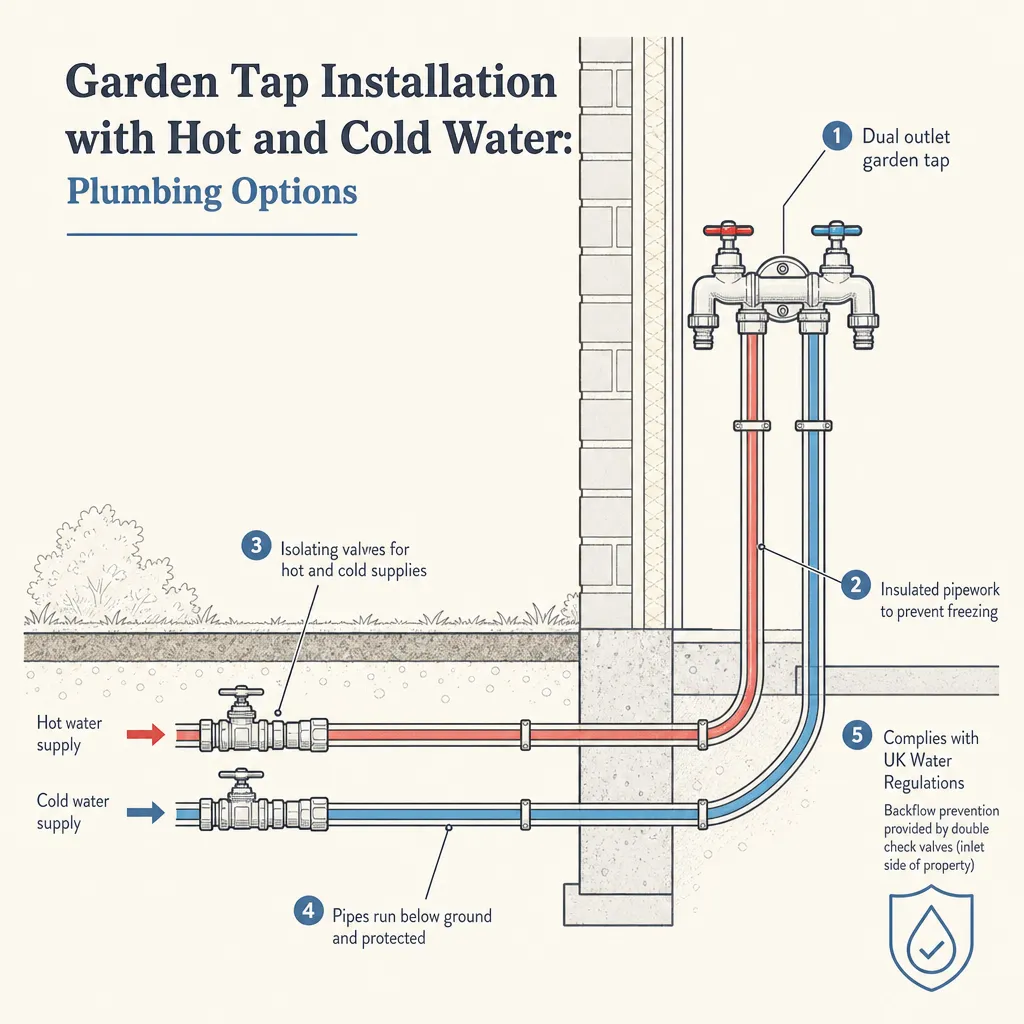
Garden Tap Installation with Hot and Cold Water: Plumbing Options
Adding a cold garden tap is a common DIY project, but routing hot water outdoors requires a plumber to connect to your domestic hot water system and comply with the Water Supply (Water Fittings) Regulations 1999.
 Improvement & Build
UK Construction Sector Outlook: What Industry Confidence Means for Your Build Project
Construction sector confidence data — including PMI readings and CPA output forecasts — signals whether builders are busy and whether lead times are growing.
 Improvement & Build
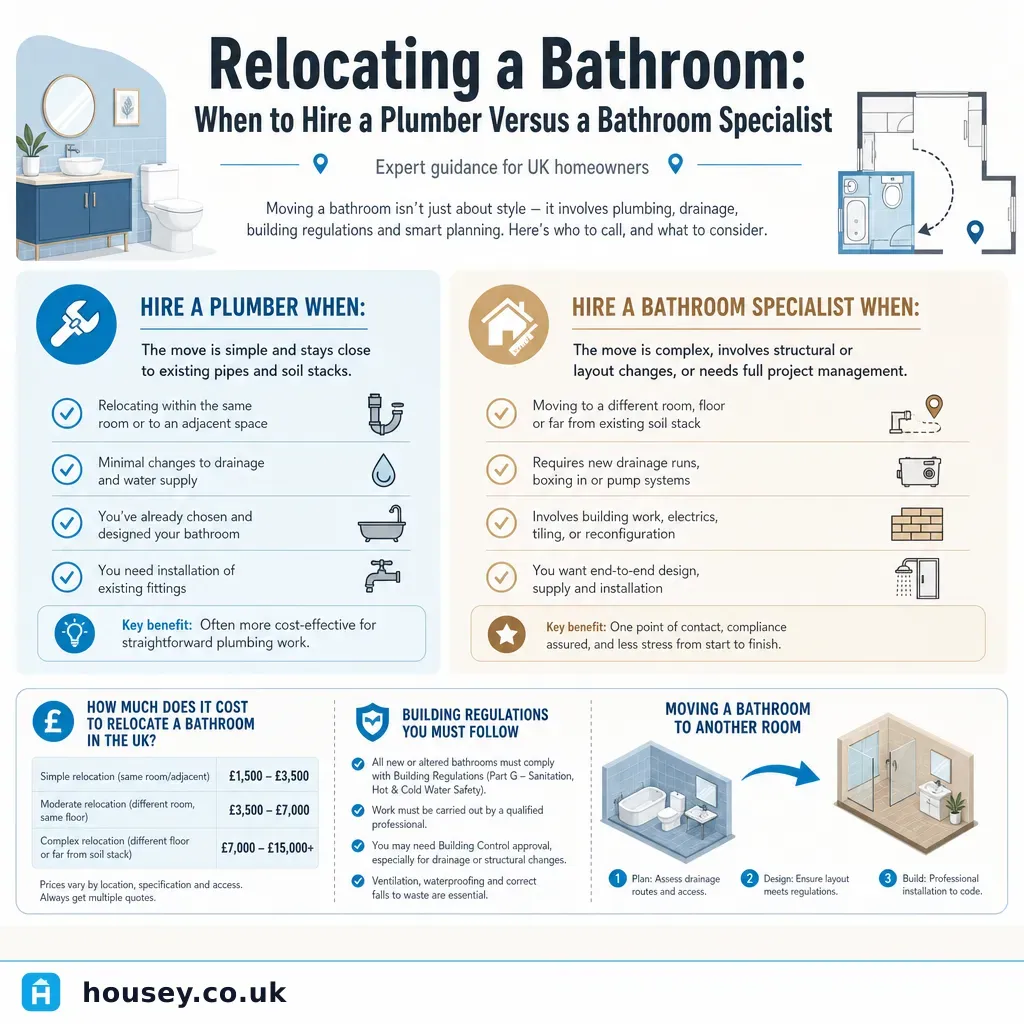
Relocating a Bathroom: When to Hire a Plumber Versus a Bathroom Specialist
Relocating a bathroom usually requires both a qualified plumber for pipework and drainage and other specialist trades for electrics, tiling, and finishes.
 Improvement & Build
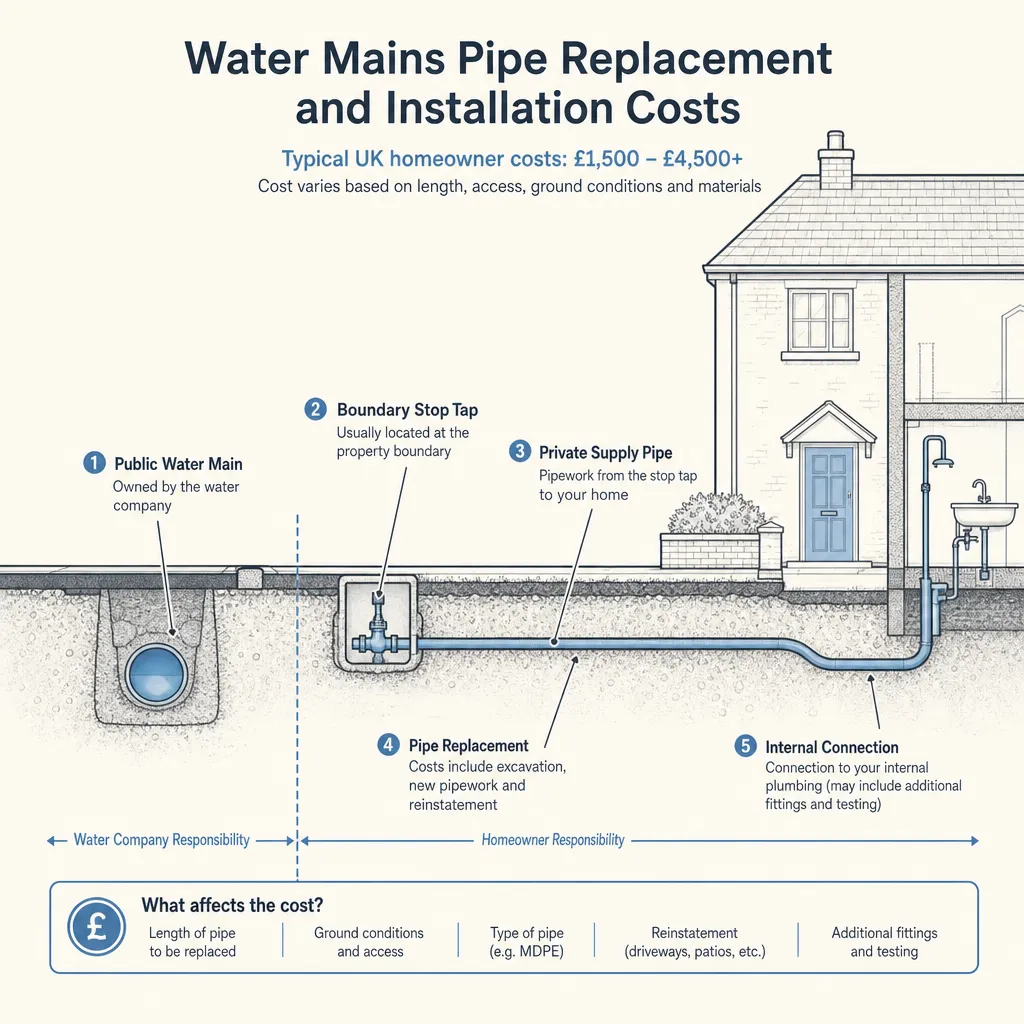
Water Mains Pipe Replacement and Installation Costs
Replacing the supply pipe from the boundary stopcock to your home typically costs £1,500–£3,500 in the UK, depending on pipe length, ground conditions, and whether any hard surfacing must be excavated.
 Improvement & Build
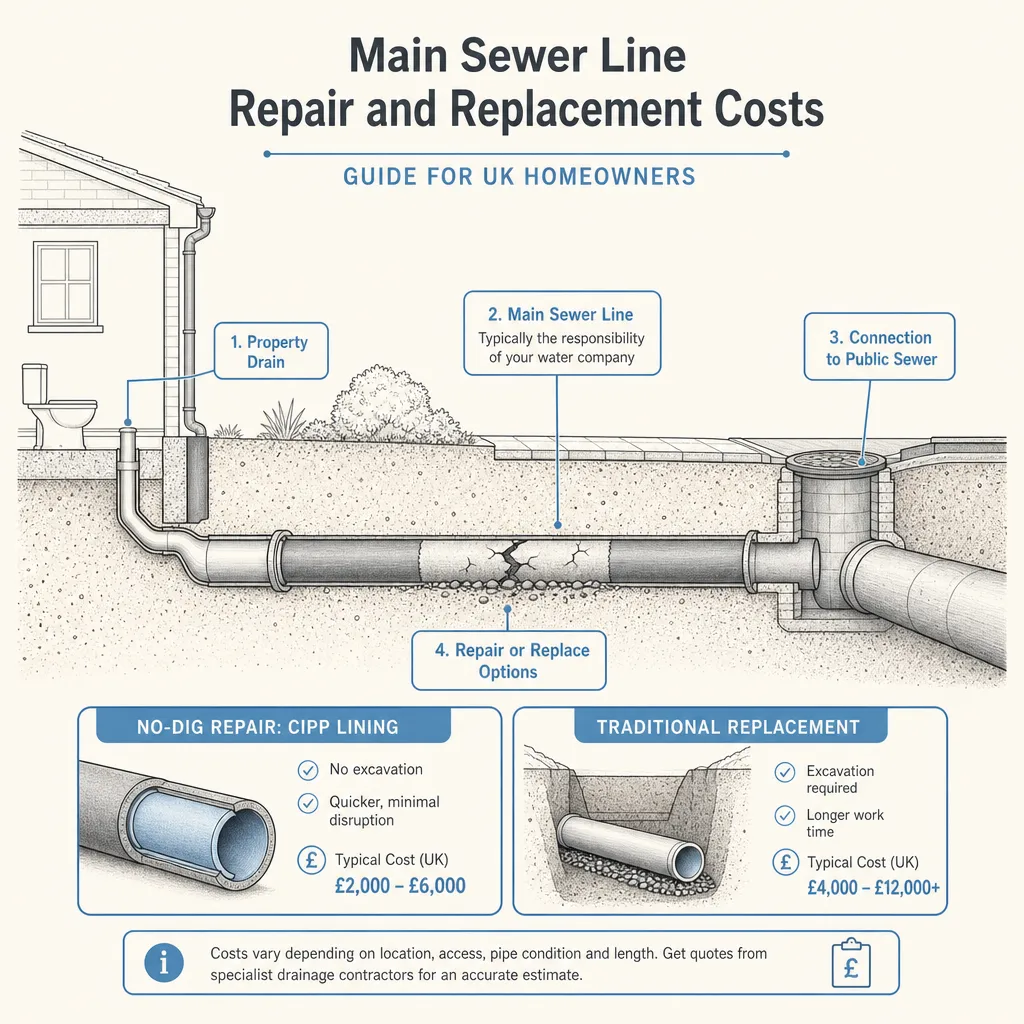
Main Sewer Line Repair and Replacement Costs
Main sewer line repair in the UK costs roughly £500–£2,500 for no-dig methods such as patch lining or full CIPP lining, and £3,000–£10,000 or more for open-cut excavation and pipe replacement.