Essential Moving Checklist for Student Accommodation
By Housey · Last reviewed 30th of May 2026
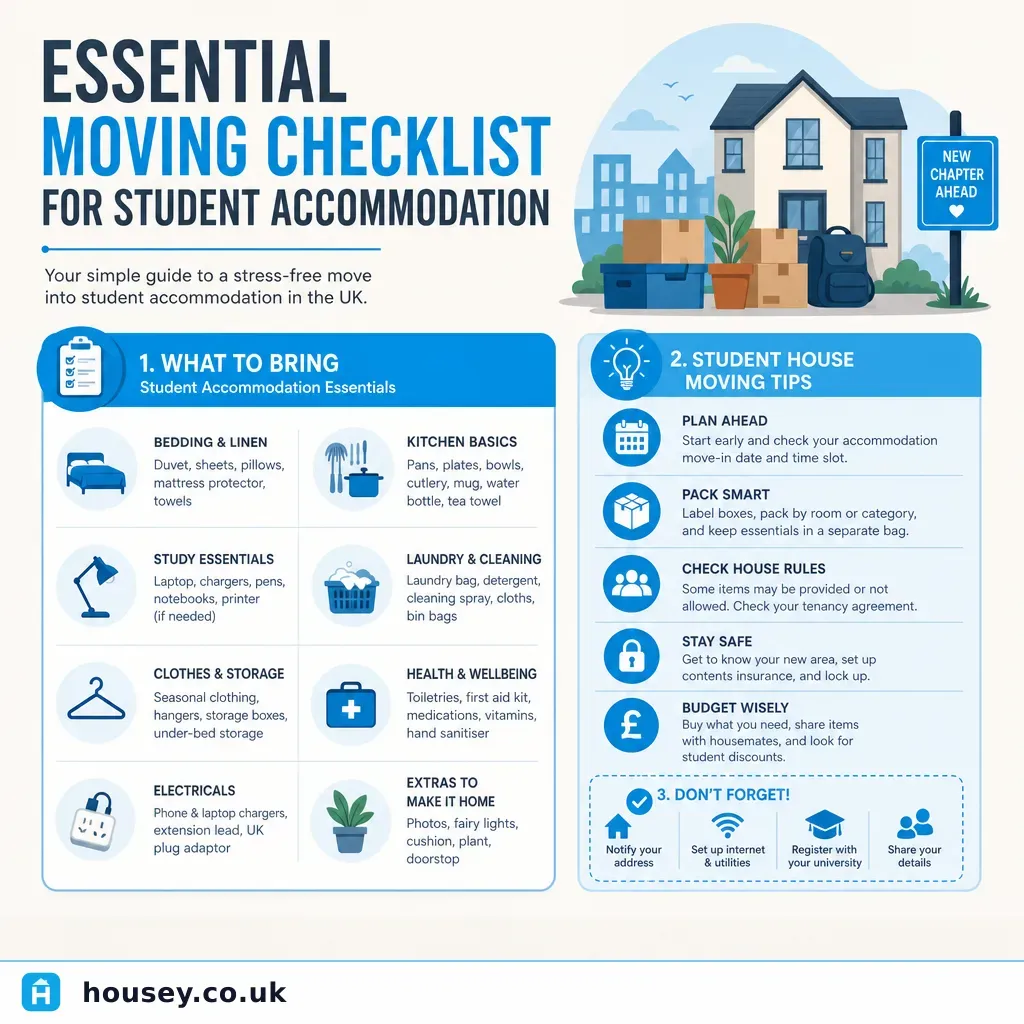
Essential Moving Checklist for Student Accommodation
The weeks before moving into student accommodation — whether a university hall of residence or a private rented house — involve a cluster of practical tasks that are easy to underestimate if it is your first time renting independently in the UK. From tenancy agreements and deposit protection to utility accounts and contents insurance, getting organised early reduces the chance of a costly or stressful oversight on move-in day.
Key points
- Private student tenancies in England are governed by the Housing Act 1988 (as amended): landlords must protect deposits in a government-approved scheme — DPS, MyDeposits, or TDS — within 30 days of receipt and must provide Prescribed Information to the tenant.
- Full-time students in the UK are exempt from Council Tax under the Local Government Finance Act 1992, but exemption is not automatic: you must obtain a certificate from your university and submit it to your local council.
- For private rentals, landlords are legally required to provide a valid gas safety certificate annually under the Gas Safety (Installation and Use) Regulations 1998 and an Electrical Installation Condition Report (EICR) dated within the last five years.
- The Minimum Energy Efficiency Standards (MEES) require most private rented properties in England and Wales to hold an EPC rating of E or above; landlords must provide an EPC before or at the start of the tenancy.
- A signed room inventory (check-in report) completed on move-in day is your primary protection against unfair deposit deductions at checkout.
Six weeks before moving in
Confirm your accommodation and review the tenancy agreement
- Confirm your tenancy start date and key collection arrangements in writing.
- Read the tenancy agreement carefully — note the deposit amount, rent due dates, notice period, permitted occupiers, and any restrictions on alterations or pets.
- Check whether utilities (gas, electricity, broadband) are included in the rent or whether you are responsible for setting up accounts.
Verify deposit protection
Confirm that your landlord or letting agent has registered your deposit in a government-approved scheme: the Deposit Protection Service, MyDeposits, or the Tenancy Deposit Scheme. You must receive a Prescribed Information document within 30 days of paying the deposit.
Apply for Council Tax exemption
Contact your university's student services office to obtain a council tax exemption certificate. Submit this to your local council promptly — you will not receive automatic exemption, and unpaid council tax accrues late-payment penalties.
Four weeks before moving in
Book your transport
Decide whether you will use a removal company, van hire, or a man-with-a-van service. For a single room's worth of belongings, a man-with-a-van is often the most cost-effective option. Book early: popular student move-in weekends at the start of September and January fill up weeks in advance.
Set up utility accounts (private rented only)
Contact current utility suppliers to register as the new account holder, or compare and switch using an Ofgem-regulated comparison service. Arrange broadband early — installation of a new line can take two to four weeks in some areas.
Check your contents insurance position
Verify whether your parents' home contents insurance already extends to student accommodation; many policies include a child studying away from home up to a specified limit. If not, obtain a standalone student contents insurance policy before move-in.
Update your address
Notify HMRC (if you are employed or have a National Insurance record), your bank, GP surgery, and any subscription services. Register to vote at your new address via GOV.UK's online registration service — students can be registered at both their home and university addresses.
What to bring: packing checklist
Essential documents
Kitchen and bathroom
Bedding and laundry
Study and workspace
Move-in day: decision guide
Use this guide to prioritise your first actions on arrival.
- Moving into a university hall? → Check in at the accommodation office, collect your key, and request the room inventory form to inspect, annotate with any pre-existing damage, and return.
- Moving into a private rented house? → Conduct a thorough walk-through with the landlord or agent using the written inventory. Photograph and video every room — including behind furniture and inside appliances — and email your evidence to the landlord the same day as a timestamped record.
- Visible damage or missing items on arrival? → Note everything on the inventory before signing. Do not sign a clean inventory if the property is damaged — this document determines what deductions are justified at checkout.
- Something is missing (furniture, appliances, spare keys)? → Report in writing immediately and keep a copy of your message.
- No inventory provided by the landlord? → Create your own photographic record and email it to the landlord the same day to establish a timestamped baseline.
Meter readings: Take gas, electricity, and (where metered) water readings on move-in day. Photograph each meter. Send readings to the relevant supplier as soon as accounts are active to avoid being billed for a previous tenant's usage.
What to ask your landlord or letting agent before moving in
- Is the property licensed under a mandatory or selective licensing scheme operated by your local council?
- Does the property have a valid gas safety certificate, as required annually under the Gas Safety (Installation and Use) Regulations 1998?
- Is there an Electrical Installation Condition Report (EICR) dated within the last five years, as required under the Electrical Safety Standards in the Private Rented Sector (England) Regulations 2020?
- Has an Energy Performance Certificate (EPC) been provided, and is the rating E or above?
- What is the procedure for reporting repairs, and what are the landlord's expected response timescales?
- Who is responsible for communal areas, bins, and garden maintenance if applicable?
When to get professional help
If you discover serious disrepair — persistent damp, mould, structural problems, or a failing boiler — report these to your landlord in writing immediately. If there is no adequate response within a reasonable period, contact your local council's housing enforcement team, which can issue improvement notices under the Housing Health and Safety Rating System (HHSRS). Citizens Advice and your university's student union welfare team both offer free guidance on tenant rights, deposit disputes, and enforcement options.
How Housey can help
If your move involves transporting furniture, equipment, or a significant volume of boxes, Housey connects you with vetted house removals companies near your destination, making it easy to compare quotes and book a service that fits your timeline and budget.
Frequently asked questions
Do students have to pay Council Tax in the UK?
Full-time students are exempt from Council Tax under the Local Government Finance Act 1992. However, exemption is not automatic — you must obtain a certificate from your university and submit it to your local council. If your household includes a non-student, they may be liable for a reduced bill. Part-time students may not qualify for full exemption, so check with your local council directly.
How do I get my deposit back at the end of a student tenancy?
Your landlord must return your deposit within ten days of you both agreeing the final amount. At checkout, request a final inspection, compare the property's condition against the move-in inventory, and ask for an itemised statement of any proposed deductions. If you dispute deductions, raise a free adjudication through the relevant deposit protection scheme — adjudicators base decisions on the signed inventory and photographic evidence.
Is student contents insurance worth getting?
For most students, yes. University hall buildings insurance covers the structure, not your belongings. The combined value of a laptop, smartphone, bicycle, and course equipment often exceeds the limit of a parent's home policy for children away from home. Dedicated student contents insurance is widely available; costs vary by cover level, location, and insurer — always compare policies before purchasing.
When should I book a removal van or man-with-a-van?
Aim to book at least four weeks before your move-in date. If you are moving at the start of September or January — the main student intake periods — demand peaks sharply and last-minute bookings are often unavailable or significantly more expensive. Booking early also gives you flexibility to rearrange if your move-in date changes.
Sources and further reading
- Tenancy deposit protection — GOV.UK
- Council Tax: who has to pay — GOV.UK
- Private renting: your rights and responsibilities — Citizens Advice
- Electrical safety in the private rented sector — Electrical Safety First
- Energy Performance Certificates — Energy Saving Trust
Useful next reads
 Buying & Moving
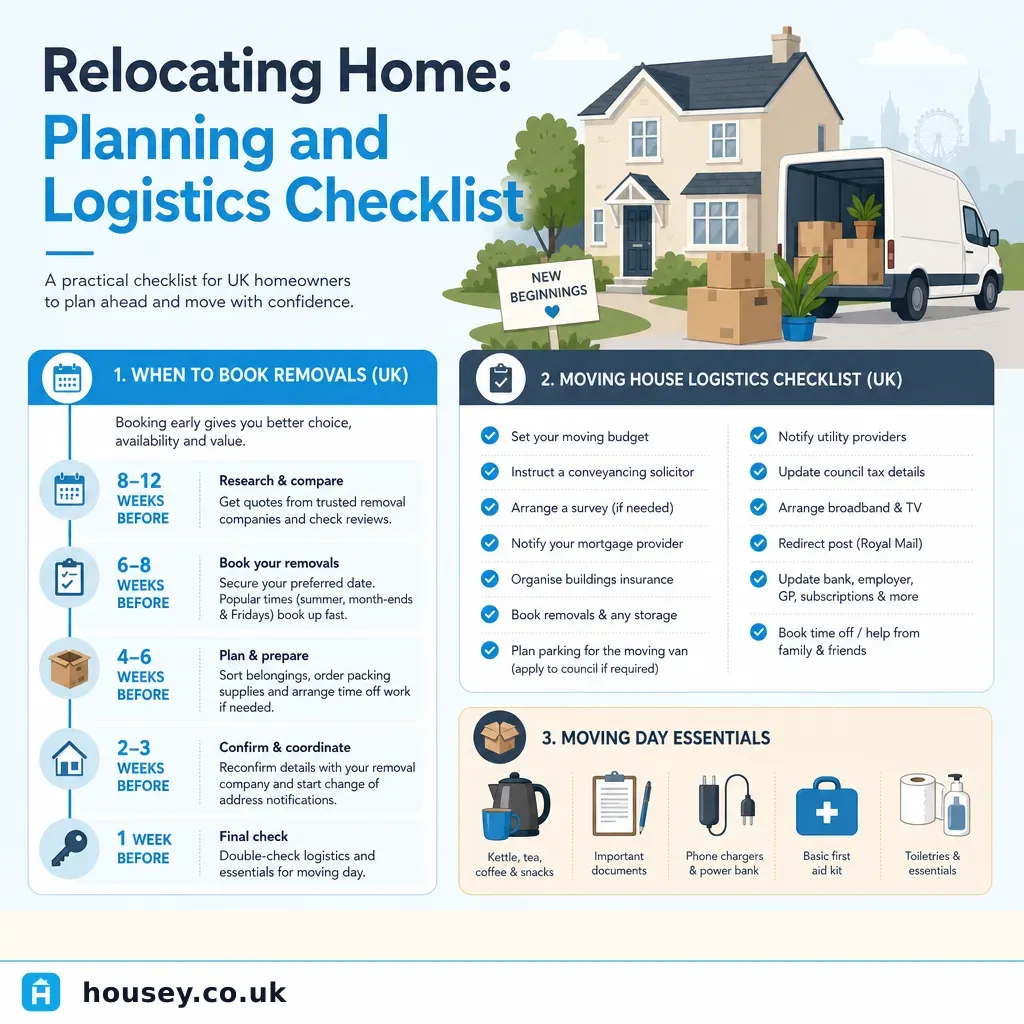
Relocating Home: Planning and Logistics Checklist
Successful home relocation in the UK typically requires 8–12 weeks of advance planning.
 Buying & Moving
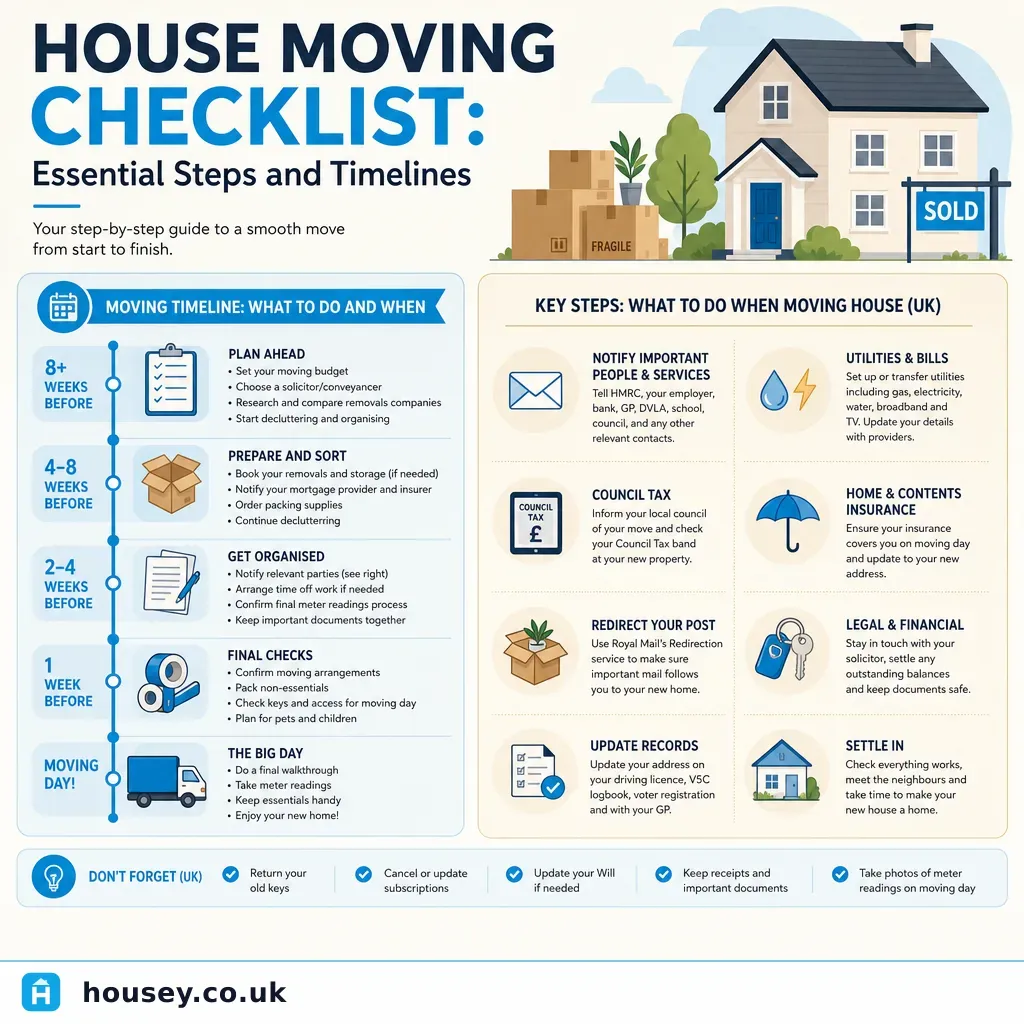
House Moving Checklist: Essential Steps and Timelines
A UK house move typically spans 8–12 weeks of preparation: book removals 4–6 weeks out, notify the DVLA, HMRC, and utilities as exchange approaches, take meter readings on moving day, and update Council Tax and the electoral register on arrival.
 Buying & Moving
Planning A House Move In The New Year: A Complete Relocation Checklist
Planning a house move in the new year means coordinating removals, utilities, address changes, and legal completions across multiple parties.
 Buying & Moving
Choosing a House Removal Company: What to Look For
Choose a UK removal company that belongs to the British Association of Removers (BAR) or the Removals Industry Ombudsman Scheme (RIOS), carries goods-in-transit and public liability insurance, and provides a written quote after properly surveying your home.
 Buying & Moving
Storage Solutions and Container Rental Options for House Moves
When moving house in the UK, temporary storage options include self-storage units, portable storage containers delivered to your door, and removal company storage vans.