What House Removers Do: Services, Process, and Costs
By Housey · Last reviewed 31st of May 2026

What House Removers Do: Services, Process, and Costs
Most people think of a removal company as a van and a few pairs of hands, but the range of services on offer — from full packing and specialist item handling through to temporary storage and furniture reassembly — varies considerably between firms. Understanding what is included as standard, what costs extra, and how a professional removal works in practice helps you compare quotes accurately and avoid surprises on the day.
Key points
- A standard removal service covers loading, transporting, and unloading your belongings; packing, unpacking, specialist item handling, and storage are almost always optional extras charged separately.
- BAR (British Association of Removers) members must provide a written agreement before moving day and hold Goods in Transit and Public Liability insurance under a CTSI-approved code of practice.
- Removal costs vary primarily by volume of goods (cubic footage), distance, floor level, and access difficulty — not simply by the number of bedrooms in your home.
- A pre-move survey — conducted in person or by video — is standard practice for any move of significant size; avoid firms that quote a fixed price without assessing volume and access.
- Mid-week and mid-month moves typically cost less than Friday or end-of-month slots, when demand peaks around property completion dates.
What services do removal companies offer?
Removal companies offer a spectrum of services. Knowing what is included in your quote — and what is not — prevents disputes on moving day.
Core services (usually included in the base quote)
Service | Typically included? | Notes |
|---|---|---|
Loading and unloading | Yes | Core of every removal job |
Transportation to destination | Yes | Van size matched to assessed volume |
Basic furniture dismantling (beds, flat-pack) | Often included | Confirm in writing before moving day |
Goods in Transit insurance | Yes (BAR members) | Check per-item liability limits |
Placement of items in named rooms | Usually | Agree a labelling system in advance |
Optional and add-on services
Service | Typically extra? | Notes |
|---|---|---|
Full packing service | Yes | Company packs all items; materials usually included |
Partial packing (fragile or specialist items only) | Yes | Useful for china, glassware, artwork, or mirrors |
Unpacking and packing debris removal | Yes | Available on request from most firms |
Specialist item handling (piano, artwork, antiques) | Yes | May require a specialist sub-contractor |
Short or long-term storage | Yes | Ask about minimum periods and access arrangements |
End-of-tenancy cleaning | Sometimes | Usually a separate provider; confirm when booking |
International shipping | Yes | Separate regulated service requiring specific accreditation |
How the removal process works
1. Pre-move survey
For all but the smallest moves, a reputable company will conduct a pre-move survey — in person or by video — to assess volume, access difficulties, and any specialist requirements. This survey drives the final quote. A firm that quotes solely on a bedroom count or a verbal description risks significantly under- or over-estimating the job.
2. Written quotation
After the survey you should receive an itemised written quote covering:
- Number of crew and vehicles.
- Services included and excluded.
- Travel and waiting-time charges.
- Insurance details (Goods in Transit and Public Liability).
- Payment terms and cancellation policy.
- VAT treatment.
BAR members are required to provide a written agreement before the move takes place.
3. Packing day (if selected)
If you have opted for a packing service, the crew typically arrives one or two days before moving day to wrap, box, and label your belongings. Packing materials — boxes, tissue paper, bubble wrap, wardrobe boxes — are usually included in the cost of a full packing service.
4. Moving day
On moving day, the crew loads the van in a planned sequence — heavy and large items first, fragile items secured last. At the destination, items are unloaded and placed in the rooms you specify. Agree a colour-coding or room-labelling system in advance to speed up unloading and minimise the need to move items twice.
5. Sign-off and completion
Once unloading is complete, you will usually be asked to inspect and sign off that goods have arrived. Note any visible damage before signing. Keep your copy of all paperwork, including any inventory produced at loading.
Worked example: a 3-bedroom 1930s semi in Leeds
Indicative UK costs, last reviewed 2026-05-31. Costs vary significantly by firm, distance, access, and date — always obtain at least three surveyed quotes.
The Ahmed family are moving from a 3-bedroom 1930s semi in Headingley to a similar property in Chapel Allerton — approximately 4 miles. They have a moderate volume of furniture and boxes, no piano or specialist items, and plan to self-pack.
Cost element | Indicative range |
|---|---|
Basic removal (load, transport, unload) | £600–£950 |
Pre-move survey | Usually free |
Self-packing materials (boxes, tape, paper) | £70–£130 |
Estimated total | £670–£1,080 |
Adding a full packing service for this volume would typically add £250–£500. A longer-distance move — for example, Leeds to Bristol at around 180 miles with the same property size — might cost £1,300–£2,000 for basic removal.
Figures are indicative only. Request quotes from multiple BAR-registered firms and compare like-for-like services.
Homeowner checklist: preparing for a removal company
Cost drivers: why quotes vary
Several factors explain why two firms can quote very differently for what appears to be the same move:
- Volume: the cubic footage of goods loaded is the primary cost driver — not the number of rooms.
- Distance: fuel, driver time, and overnight costs on longer routes.
- Access: flights of stairs, no lift, a narrow street, or a long carry from door to van.
- Date: Fridays, end-of-month slots, and school holiday periods command premium rates.
- Packing and materials: self-pack is cheaper; full-pack adds crew time and materials cost.
- Specialist items: pianos, large sculptures, fine art, and antiques require specialist handling and may increase insurance requirements.
- Storage: if your new property completion is delayed, overnight or short-term storage adds to the overall cost.
When to get professional help
For most domestic moves, a BAR-registered removal company with adequate insurance is sufficient. Consider specialist services if:
- You are moving high-value antiques or fine art that exceed the standard Goods in Transit liability limit.
- Your move is international — cross-border removers may need FIDI accreditation (Fédération Internationale des Déménageurs Internationaux) or BAR International Group membership.
- You face significant access difficulties such as a very narrow street requiring a relay vehicle, a high-floor flat without a lift, or a listed building with restrictions on vehicle access.
How Housey can help
Housey connects homeowners with vetted, reviewed removal companies across the UK. Whether you need a local house removals firm for a straightforward domestic move or a specialist in international removals, you can compare quotes and read verified reviews in one place.
Frequently asked questions
Do removal companies pack for you?
Most offer an optional full or partial packing service at an additional cost. If you want the company to pack your belongings, agree this in writing before moving day and confirm whether packing materials are included in the quoted price. Partial packing — for fragile or specialist items only — is also available from many firms.
How far in advance should I book a removal company?
For Friday moves or those at the end of the month, when property completions cluster, aim to book 4–8 weeks ahead. Mid-week and mid-month slots are often cheaper and more readily available. In some areas a short-notice mid-week booking may be possible with a week or two of lead time.
Are removal companies insured?
BAR members are required to carry Goods in Transit insurance. Check the maximum liability per item — standard policies may cap cover at a set figure, which could be insufficient for high-value antiques. Ask for a copy of the policy schedule before moving day and consider supplementary cover if needed.
What happens if I need to cancel or change my move date?
This depends on your contract. Most companies charge a cancellation fee if you cancel within a set period — commonly 5–10 working days. If your completion date changes, notify the remover as soon as possible; many will rebook without a full fee if given sufficient notice and the new date is available.
Sources and further reading
- British Association of Removers — trade body standards, code of practice, and member search
- Consumer Rights Act 2015 — legislation.gov.uk
- The Furniture Ombudsman — ADR scheme covering BAR members
- Citizens Advice: buying a service — Citizens Advice
Useful next reads
 Buying & Moving
Planning Your Home Removal: What to Expect from Professional Services
A professional removal company loads, transports, and unloads your household belongings between properties.
 Buying & Moving
How to Plan a House Move: A Practical Guide to Residential Relocations
A UK house move goes more smoothly with planning that starts 6–8 weeks before moving day.
 Buying & Moving
Managing Property Relocation in Major Urban Centres
Urban house moves require planning beyond a standard removal, particularly around vehicle emission zone compliance, parking bay suspensions, and lift access in purpose-built flats.
 Buying & Moving
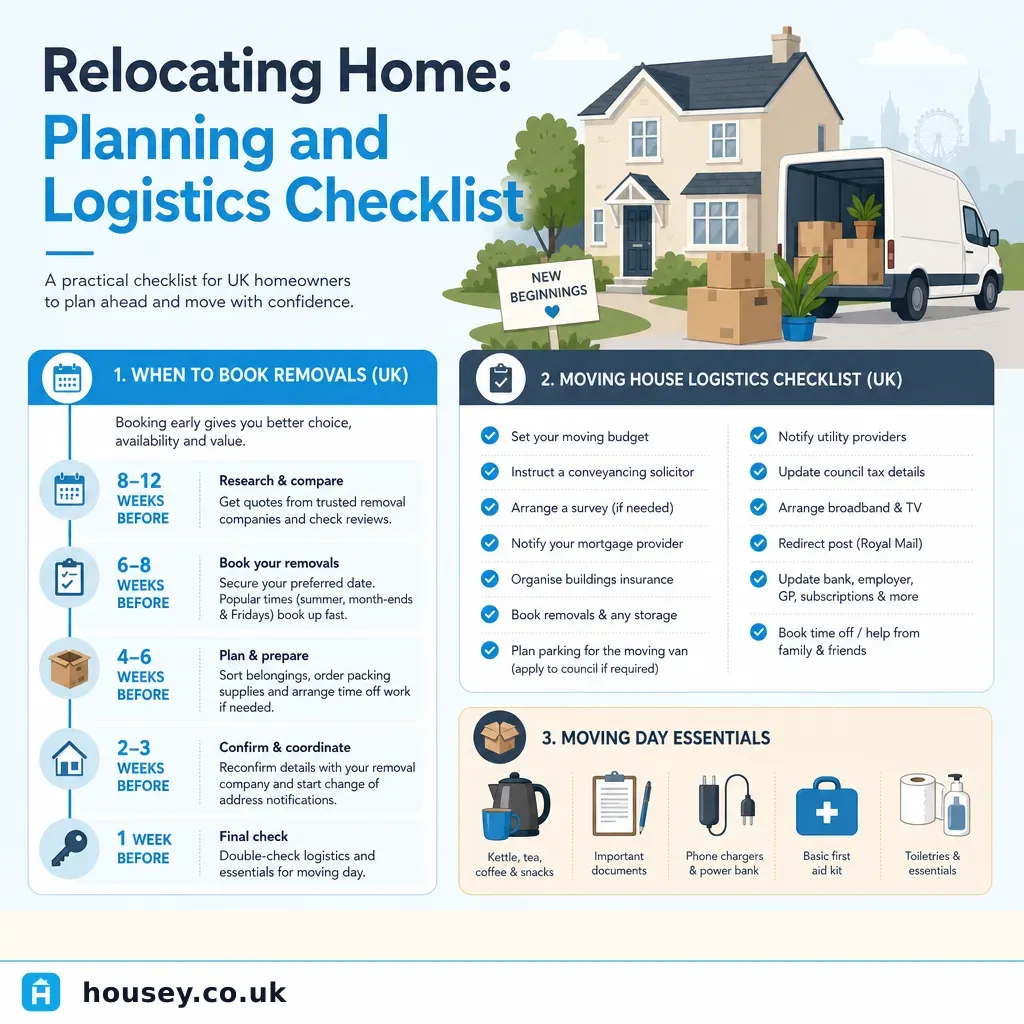
Relocating Home: Planning and Logistics Checklist
Successful home relocation in the UK typically requires 8–12 weeks of advance planning.
 Buying & Moving
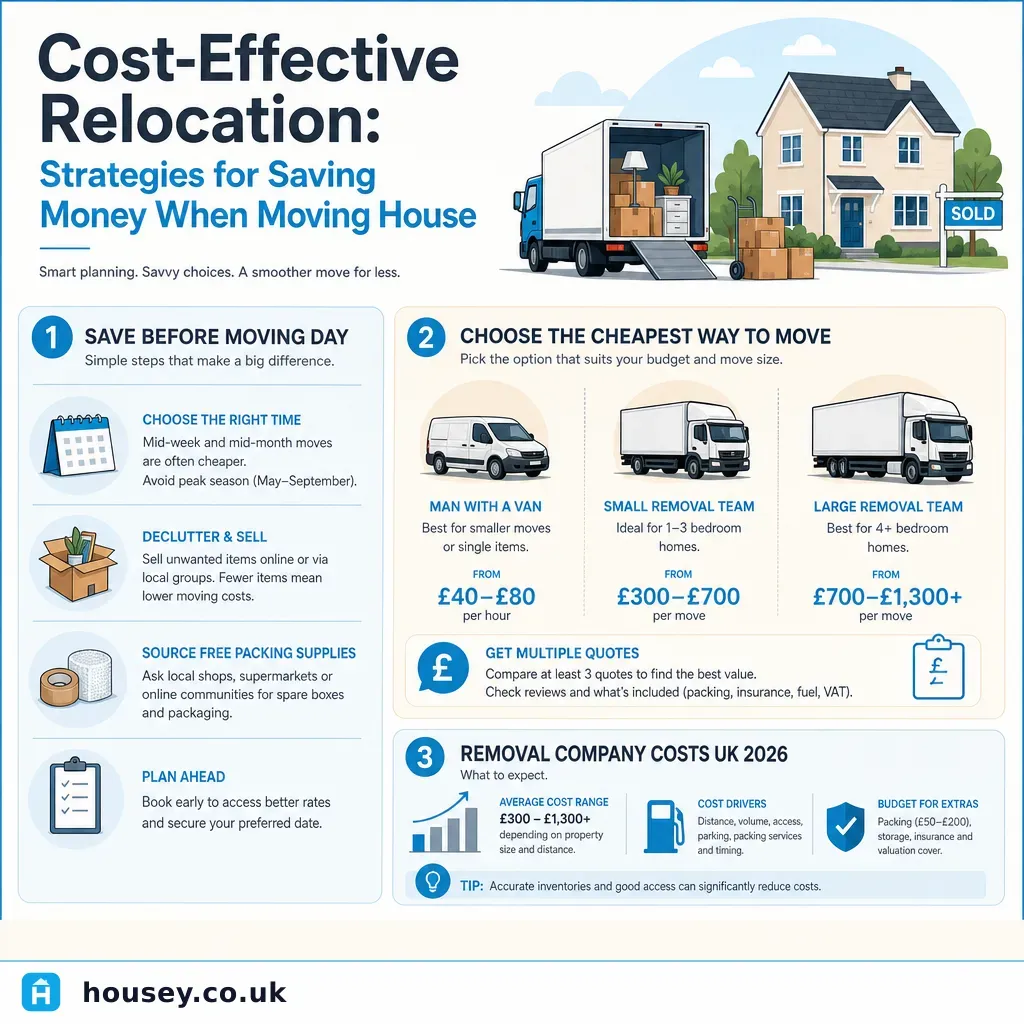
Cost-Effective Relocation: Strategies for Saving Money When Moving House
Moving house in the UK involves costs well beyond the removal van — stamp duty, conveyancing, surveys, and storage all add up.