Planning your house move before the festive season: timing and logistics
By Housey · Last reviewed 7th of May 2026

Planning your house move before the festive season: timing and logistics
The final weeks of the calendar year are among the trickiest in the UK property calendar. Conveyancing firms reduce capacity or close entirely over Christmas, removal companies fill their diaries well before December, and utility providers slow down over bank holiday periods. A transaction that was on track in October can slip past the point of no return with little warning — pushing completion into January with potential cost and logistical consequences.
Key points
- Most solicitors and licensed conveyancers in England and Wales close from 24–27 December, and many for the full week between Christmas and New Year; exchange or completion cannot proceed while either firm is closed.
- Removal companies in popular moving areas often book up 4–6 weeks in advance for early December dates; leaving the booking until after exchange significantly limits choice and increases cost.
- Stamp Duty Land Tax (SDLT) in England and Land and Buildings Transaction Tax (LBTT) in Scotland are assessed on the completion date — if a rate threshold matters, confirm your completion date in writing with your solicitor.
- HM Land Registry operates reduced services over bank holidays, which can affect final registration steps and delay the completion process.
- Completing before 12 December rather than 19 December typically provides enough buffer to absorb a one- to two-week delay without falling inside the closure window.
Why the festive period creates specific risks for movers
Unlike a standard spring or autumn move, the festive period involves multiple external parties — solicitors, mortgage lenders, HM Land Registry, utility providers — all operating on reduced capacity at the same time. A single delayed response from any one party can push exchange past Christmas, converting an early-December completion into a January one.
The legal calendar is the binding constraint. Exchange of contracts and completion require both sets of solicitors to be active. Many firms issue closure notices from 20–24 December, with some not reopening until 2 or 3 January. If a firm is closed, exchange cannot take place regardless of what the parties themselves want.
The practical calendar adds further pressure. Removal companies serving high-volume moving markets can be fully booked for early December dates from mid-October. If you wait until exchange before making enquiries, you may find no availability on your chosen date at any reasonable price.
Timing decision tree
Complete by 12 December if:
- You are in a short or chain-free transaction.
- Your conveyancer has confirmed availability for your target date.
- Removal quotes are already obtained and a firm is provisionally available.
- You have a day or two of flexibility if completion shifts slightly.
Consider targeting January (from 5 January) if:
- Your chain has three or more properties and has already experienced delays.
- Your target completion falls in the last two weeks of December.
- There is no Stamp Duty threshold or other financial deadline driving the year-end timing.
- Short-term rental or storage is available to bridge any gap without major disruption.
Seek professional advice if:
- You are relying on completing before a specific Stamp Duty rate-change date.
- A delayed completion would have material financial consequences such as bridging finance costs or loss of rental income.
- You are in a chain where other parties have conflicting motivations about timing.
A worked UK scenario: the November offer and the December deadline
Consider a couple in Swansea who accept an offer on their home on 3 November, targeting completion on 17 December. Their chain consists of three properties.
- Weeks 1–2 of November: Solicitors instructed, local authority searches ordered (typical turnaround: 2–4 weeks).
- Weeks 3–4 of November: Searches returned; mortgage valuation completed; enquiries raised.
- First week of December: Enquiries resolved; contracts prepared for exchange.
- 10 December: Exchange of contracts; completion set for 17 December.
- 17 December: Completion — utilities transferred, keys collected, removal team arrives.
This is achievable in a straightforward chain with no complications. But if searches take four weeks rather than two, or if one party raises a late enquiry, exchange slips to 15 December and completion moves to 22 December — inside most firms' closure windows. The couple would then face a choice between completing on 23 December (very limited removal availability, high risk of further slippage), deferring to January, or arranging temporary accommodation over the holiday period.
The lesson: a November offer acceptance needs to move at pace. Instruct a conveyancer on day one, chase searches proactively, and book removals provisionally before exchange.
Comparison table: early December vs. late December vs. January completion
Timing | Pros | Risks | Removal availability | Conveyancing risk |
|---|---|---|---|---|
Complete by 12 December | Clear buffer before closures; utilities transfer before holiday period | Requires fast conveyancing from offer to exchange | High demand — book well before exchange | Manageable if chain is short |
Complete 15–23 December | Technically possible in a short, fast chain | Very high risk of slipping into closure window; near-zero removal flexibility | Very limited; may be unavailable or expensive | High — a single delay can cancel the move |
Complete from 5 January | Better removal availability; solicitors fully open; lower costs | Misses year-end Stamp Duty threshold if relevant; requires seller agreement | Good availability, especially from mid-January | Lower risk overall |
Practical checklist: moving before the festive season
What to ask your removal company before the festive season
- Are you available on my target completion date, and is that a provisional or confirmed hold?
- What is your policy if completion is delayed by one or two days?
- Do you charge a premium for December dates?
- Can you provide secure overnight storage if completion is delayed past 5pm?
- Are you a member of the British Association of Removers (BAR)?
When to get professional help
For most festive-period moves, the key professional is your conveyancer. Seek additional guidance in these situations:
- If your completion date falls close to a Stamp Duty threshold change, ask your solicitor to confirm in writing the financial effect of missing that date.
- If you are selling a leasehold property, freeholder consent and management pack requests can add unpredictable weeks — start these as early as possible.
- If your chain includes a party whose conveyancer is known to close early for the Christmas period, ask for written confirmation of their last active working day before agreeing a completion date.
How Housey can help
Housey can connect you with conveyancers and removal companies experienced with time-sensitive moves. If you are working to a December deadline, getting conveyancing quotes in place as soon as an offer is accepted gives you the best chance of meeting it. When your completion date is confirmed, booking house removals well before exchange — particularly for a December date — protects you against the limited availability that characterises the pre-Christmas market.
Frequently asked questions
Can exchange of contracts take place over Christmas if both parties agree?
Exchange requires both sets of solicitors to be active and available. If either firm is closed, exchange cannot proceed. Some firms arrange emergency cover for the holiday period, but this is not standard and cannot be relied upon. Confirm your solicitor's exact closure dates before agreeing a completion timeline that falls close to Christmas.
What happens to my Stamp Duty if completion slips past a threshold change date?
SDLT in England is assessed on the completion date. If completion slips past a date on which rates increase, you pay the higher rate. Ask your solicitor to advise you in writing on the financial exposure if your completion date is at risk of missing a relevant Stamp Duty threshold.
Is it cheaper to move house in January than in December?
Removal company pricing typically drops from mid-January as demand falls after the festive period. If you have flexibility, early-to-mid January often offers better availability and more competitive quotes. Indicative UK costs vary significantly by region and volume — obtain at least three quotes before committing to a firm.
Do utility companies operate normally over Christmas?
Most energy and water suppliers process transfers over the holiday period but with reduced staffing. Broadband installations are frequently suspended on bank holidays. Submit transfer notifications at least two weeks before your completion date to reduce the risk of a gap in service at the new property.
What if my removal company cancels at short notice over Christmas?
Ensure your contract includes a clear cancellation and rescheduling policy before you commit. Consider arranging short-term storage as a contingency. Using a removal company that is a member of the British Association of Removers (BAR) gives you access to an alternative dispute resolution scheme if something goes wrong.
Sources and further reading
- Stamp Duty Land Tax — GOV.UK — UK Government
- Land and Buildings Transaction Tax — Revenue Scotland — Revenue Scotland
- HM Land Registry — GOV.UK — HM Land Registry
- British Association of Removers — BAR — British Association of Removers
- Buying a home: conveyancing — Citizens Advice — Citizens Advice
Useful next reads
 Buying & Moving
Moving House Before Christmas: Preparation and Timing Considerations
Completing a house move before Christmas is achievable if your offer was accepted by September and your chain is short, but it requires early action.
 Buying & Moving
How to Plan a House Move: A Practical Guide to Residential Relocations
A UK house move goes more smoothly with planning that starts 6–8 weeks before moving day.
 Buying & Moving
Managing Property Relocation in Major Urban Centres
Urban house moves require planning beyond a standard removal, particularly around vehicle emission zone compliance, parking bay suspensions, and lift access in purpose-built flats.
 Buying & Moving
What House Removers Do: Services, Process, and Costs
House removers load, transport, and unload your belongings between properties.
 Buying & Moving
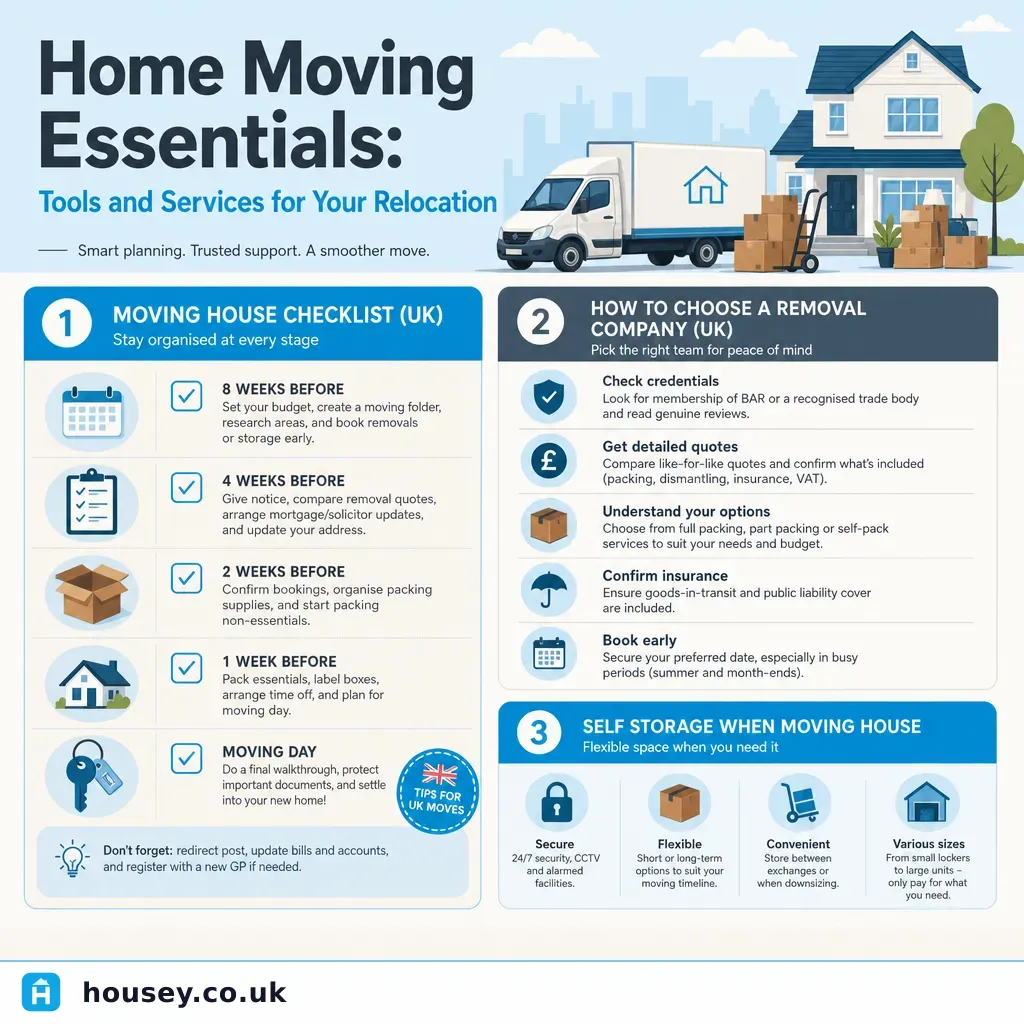
Home Moving Essentials: Tools and Services for Your Relocation
Moving house in the UK involves far more than hiring a removal van.