Moving to Stockport: Location Guide and Property Information
By Housey · Last reviewed 31st of May 2026

Moving to Stockport: Location Guide and Property Information
Stockport sits at the southern edge of Greater Manchester, where the urban sprawl of the city gives way to the Cheshire Plain and the first slopes of the Peak District. For buyers priced out of South Manchester or seeking more space within easy commuting distance of the city, it is one of the most practical options in the north-west — and the Heatons and Bramhall have become well-established names among buyers relocating from London and further afield.
Key points
- Stockport railway station offers direct services to Manchester Piccadilly in approximately 8–15 minutes and to London Euston in around 1 hour 50 minutes via Avanti West Coast.
- The Metropolitan Borough of Stockport covers postcodes SK1–SK8, SK12, and parts of SK6, ranging from Victorian terraces near the town centre to large detached properties in Bramhall.
- Average sold prices for semi-detached houses across Stockport borough ranged from approximately £220,000 to £340,000 in 2024, based on HM Land Registry data, with significant variation between neighbourhoods.
- Stockport Metropolitan Borough Council administers planning, Council Tax, and local services independently — planning applications go to the council directly, not to Greater Manchester Combined Authority.
- Parts of the borough near Marple and Romiley sit in areas with historical coal mining activity, which triggers a coal mining search requirement during conveyancing.
Stockport's neighbourhoods at a glance
Stockport is not a single place — it is a borough of distinct neighbourhoods that attract very different buyer profiles. Understanding which area suits your priorities is one of the most valuable decisions you can make before starting your property search in earnest.
Neighbourhood | Character | Typical property type | Commuter appeal | Approximate price range* |
|---|---|---|---|---|
Edgeley | Urban, close to town centre | Victorian and Edwardian terraces | High (near Stockport station) | £150,000–£250,000 |
The Heatons (Heaton Moor, Heaton Norris, Heaton Chapel) | Popular, village feel, independent shops and cafés | Edwardian and inter-war semis | High (multiple rail stations) | £250,000–£450,000 |
Cheadle / Cheadle Hulme | Suburban, family-friendly | Post-war and 1970s semis and detacheds | Good (rail and M56/M63) | £220,000–£400,000 |
Bramhall | Premium, leafy, quiet | 1930s–1970s detacheds and large semis | Good (Bramhall station) | £350,000–£700,000+ |
Hazel Grove | Good value, practical | Post-war semis and 1960s estates | Good (A6 corridor, Hazel Grove station) | £180,000–£320,000 |
Marple / Romiley | Semi-rural village feel | Victorian cottages and post-war semis | Moderate (rail to Manchester Piccadilly) | £200,000–£400,000 |
*Indicative price ranges, last reviewed 2026-05-31. Based on HM Land Registry sold price data for 2024. Individual properties vary significantly; verify current market evidence with local estate agents.
Transport: getting in and out of Stockport
Stockport railway station is one of the busiest on the West Coast Main Line outside London, giving it a transport advantage over comparable Greater Manchester towns. Approximate journey times from Stockport station:
- Manchester Piccadilly: 8–15 minutes by train (Northern and TransPennine services, very frequent throughout the day)
- Manchester Airport: approximately 20 minutes by direct TransPennine service
- Sheffield: approximately 45–55 minutes by train
- London Euston: approximately 1 hour 50 minutes via Avanti West Coast
By road, the M60 orbital motorway passes through the northern part of the borough. The M56 (towards Manchester Airport and Chester) is accessible via the A34 through Cheadle, and the A6 runs south through the town centre towards Hazel Grove, Disley, and the Peak District National Park.
Stockport town centre is not currently served by Greater Manchester's Metrolink tram network. Rail and Bee Network bus services are the main public transport options for most parts of the borough.
Property types and what to expect
Stockport's housing stock reflects its development across the late Victorian, Edwardian, inter-war, and post-war periods, with significant variation between neighbourhoods.
Victorian and Edwardian terraces are prevalent in Edgeley, Heaton Norris, and Heaviley — typically two- or three-bedroom properties in red brick, often with small rear yards rather than large gardens. Many have been extended or loft-converted over the years. Confirm with your solicitor that any structural alterations have building regulations approval, not just planning permission.
Inter-war semis and detacheds are the character housing of the Heatons, Cheadle, and Bramhall. These 1920s–1940s properties typically have cavity walls (though early cavity walls may have little or no insulation fill), larger gardens, and off-street parking. Most are considered good candidates for cavity wall insulation if it has not already been installed.
Post-war and 1960s–1970s estates are found across Hazel Grove, Offerton, and parts of Cheadle Hulme. These are generally more straightforward to mortgage and maintain, though some may have non-standard construction — concrete panels or timber frame — which can affect mortgage availability. Always confirm construction type with your surveyor and mortgage lender before exchange.
New-build developments are active on several sites across the borough, primarily in Cheadle, Hazel Grove, and near Stockport town centre's regeneration zones.
What to check before buying in Stockport
Before exchanging contracts, work through the following checklist with your surveyor and conveyancer:
- Building regulations for extensions and loft conversions. Many Victorian and Edwardian terraces have been altered by previous owners. Ask your solicitor to confirm building regulations approval exists for any visible works — not just planning permission.
- Conservation area status. Stockport has several conservation areas, including parts of Heaton Moor. Properties in these areas face additional restrictions on external alterations that would otherwise be permitted development. Check Stockport Council's conservation area maps and the planning register.
- Coal mining search. Properties in the eastern parts of the borough — particularly near Marple, Romiley, and Bredbury — sit in historical mining areas. Your solicitor should confirm whether a coal mining search is required based on the property's postcode.
- Flood risk. Stockport town centre and lower-lying areas near the Rivers Mersey and Goyt have experienced flooding historically. Check the Environment Agency flood risk map before making an offer and review the seller's property information form for any disclosed flood history.
- Insulation status and EPC. Particularly for Victorian and Edwardian stock, ask whether cavity wall or loft insulation has been installed, under what scheme, and whether documentation exists.
What not to assume when moving to Stockport
- Do not assume all parts of the borough are similar in price or character. The difference between a two-bedroom terrace in Edgeley and a four-bedroom detached in Bramhall — in price, lifestyle, and buyer profile — is very large. Research individual postcodes before drawing conclusions about the borough.
- Do not assume Metrolink serves Stockport town centre. It does not currently. Rail and bus are the main public transport options for the majority of residents.
- Do not assume cavity wall insulation has been installed in 1930s and 1940s semis. Many were fitted under older grant schemes but some were not. Where records are absent, a professional insulation assessment is worthwhile before budgeting retrofit works.
- Do not assume planning history is clean without checking. Extensions and loft conversions by previous owners may predate the current seller's purchase. Ask your solicitor to review the planning register and check for any outstanding enforcement notices.
- Do not assume leasehold is unusual in Stockport. Many purpose-built flats across the borough are leasehold. If buying leasehold, check lease length, service charge, and ground rent terms carefully, particularly in light of the Leasehold and Freehold Reform Act 2024.
When to get professional help
For any property purchase in Stockport:
- Commission a RICS Level 2 Home Survey for post-war properties in reasonable condition, or a RICS Level 3 Building Survey for Victorian and Edwardian terraces, properties with visible cracking or damp, and any home that has been significantly altered.
- Instruct a conveyancing solicitor familiar with Stockport and Greater Manchester searches — particularly important for properties near conservation areas, in eastern mining-risk postcodes, or with complex planning histories.
- Consider an independent energy assessment for solid-wall Victorian properties where insulation options are more limited and the EPC may not fully reflect actual thermal performance.
How Housey can help
Housey connects buyers and sellers with professionals serving the Stockport area, including conveyancing solicitors familiar with Greater Manchester transactions, and property photography and floorplan services for those selling in the borough. Use Housey to compare quotes and credentials from local professionals at each stage of your move.
Frequently asked questions
Is Stockport a good place to live?
Stockport consistently attracts buyers seeking better value than central or South Manchester, with strong rail connectivity. The Heatons in particular have developed a reputation for independent cafés, restaurants, schools, and community feel over the past decade. As with any large borough, the experience varies significantly by area — research individual neighbourhoods rather than drawing broad conclusions about Stockport as a whole.
How far is Stockport from Manchester city centre?
Stockport town centre is approximately 7–8 miles south-east of Manchester city centre by road. By train from Stockport station to Manchester Piccadilly, the journey typically takes 8–15 minutes, with very frequent services throughout the day.
What are Council Tax rates in Stockport?
Stockport Metropolitan Borough Council sets its own rates annually, banded by property value. Council Tax bills combine the borough council element, the Greater Manchester Combined Authority precept, and the Greater Manchester Police precept. Check current banding and rates on Stockport Council's website before finalising your budget.
What does the Leasehold and Freehold Reform Act 2024 mean for Stockport flat buyers?
If you are buying a leasehold flat in Stockport, the Leasehold and Freehold Reform Act 2024 has amended rules around lease extension rights, ground rent caps, and service charge transparency. Ask your conveyancer to explain the current lease terms and what rights the legislation gives you before exchange of contracts.
Sources and further reading
- UK House Price Index — HM Land Registry — HM Land Registry
- Check your long-term flood risk — Environment Agency — Environment Agency
- Coal Authority property searches — GOV.UK — Coal Authority
- Leasehold and Freehold Reform Act 2024 — legislation.gov.uk — UK Parliament
- Stockport Council planning portal — Stockport Metropolitan Borough Council
Useful next reads
 Buying & Moving
Moving to Harrogate: Location Guide and Property Information
Harrogate is a North Yorkshire spa town approximately 21 miles from Leeds, with direct rail links to Leeds (30–45 mins) and York.
 Buying & Moving
Moving to Taunton: location guide and property overview
Taunton is Somerset's county town with direct rail links to London Paddington in under two hours, M5 motorway access, and property prices below the South West regional average.
 Buying & Moving
Moving to Glastonbury: Location Guide and Property Overview
Glastonbury is a small Somerset market town of around 9,000 people, offering Victorian terraces, stone cottages, and modern homes at prices typically below the national average.
 Buying & Moving
Properties and Relocation Guide for the Home Counties Region
The Home Counties — Surrey, Hertfordshire, Kent, Essex, Berkshire, Buckinghamshire, and East and West Sussex — offer a wide range of property types, with rail connections to London typically taking 20–60 minutes.
 Buying & Moving
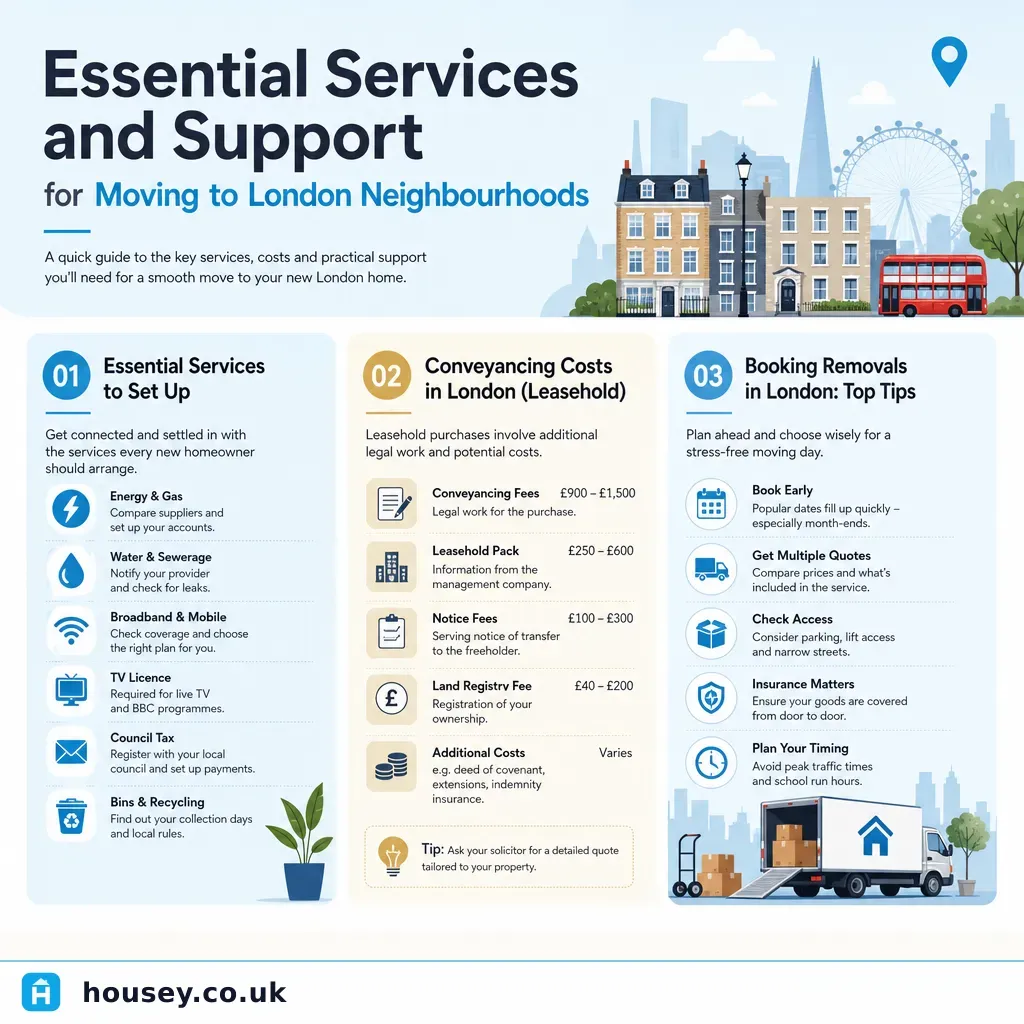
Essential Services and Support for Moving to London Neighbourhoods
Moving to London requires coordinating conveyancing, surveys, and removal logistics within tight timeframes.