New-Build Snagging and Defect Identification: A Guide for UK Buyers
By Housey · Last reviewed 30th of May 2026
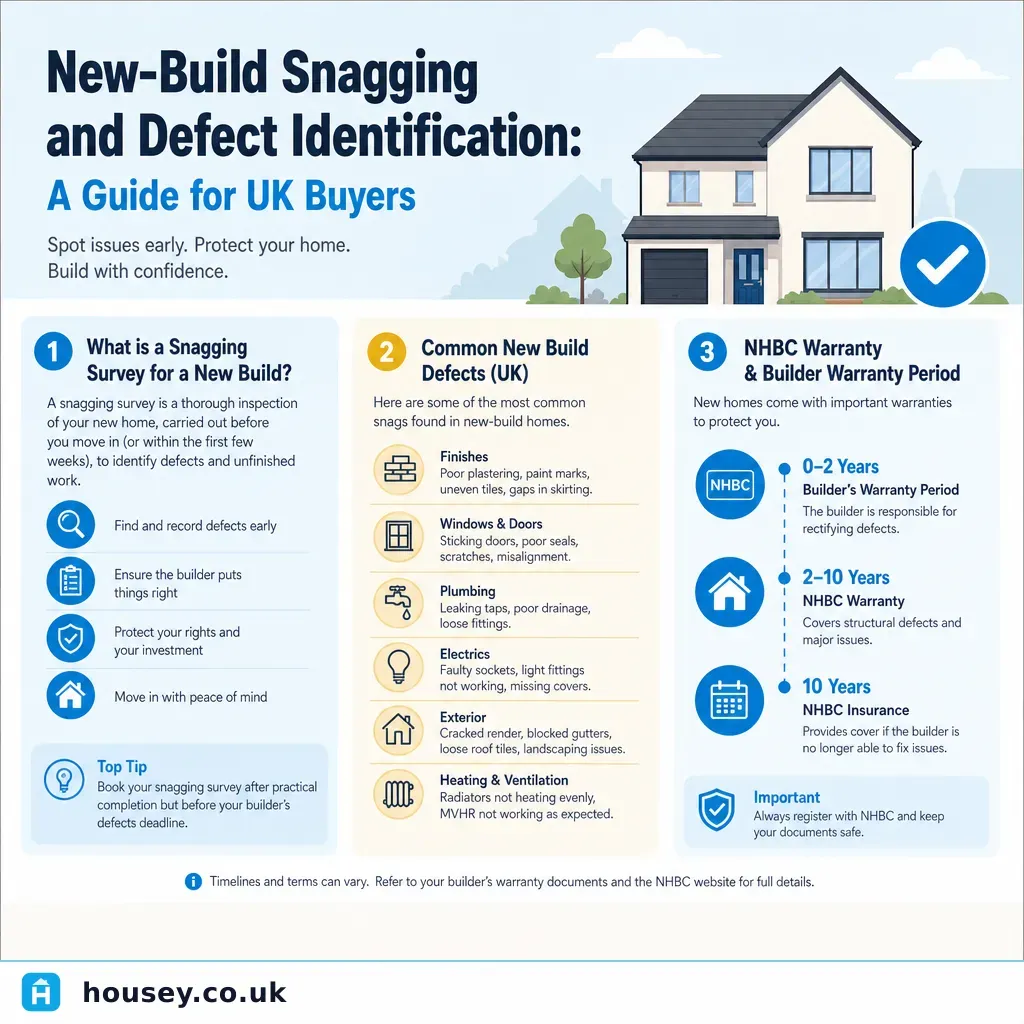
New-Build Snagging and Defect Identification: A Guide for UK Buyers
New-build properties are commonly assumed to be defect-free by virtue of being brand new. In practice, most newly built homes in the UK contain a range of issues — from minor cosmetic blemishes to more serious concerns such as poorly fitted windows, inadequate ventilation, or incorrectly installed electrical components. Whether you are buying a two-bedroom flat off-plan in Manchester or completing on a detached house on a new estate in the South East, identifying defects in writing at the right stage protects your rights under your builder's warranty and under consumer law.
Key points
- The NHBC Buildmark warranty covers the first 2 years as the builder period — the developer must fix notified defects; years 3–10 cover major structural defects under the insurance-backed element.
- The New Homes Quality Code (NHQC, launched 2023) and the New Homes Ombudsman Service (NHOS) give buyers of registered developers a formal escalation route for unresolved complaints.
- A professional snagging inspector typically identifies 100–150 defects on a standard new-build property — many of which a buyer would not notice on a standard walkthrough.
- Under the New Homes Quality Code, buyers have the right to a pre-completion inspection; registered developers should not pressure buyers to complete before an independent inspection has taken place.
- A Building Regulations Completion Certificate confirms minimum regulatory standards were met — it does not guarantee workmanship quality; snagging is a separate process from building control sign-off.
What is a snagging survey?
A snagging survey is a detailed inspection of a newly built property, typically carried out before legal completion or within the defects liability period (usually the first 2 years). The inspector examines workmanship, finishes, and fit-out against the building specification, Building Regulations Approved Documents, and accepted industry standards. The findings are documented in a snagging report — a written schedule of defects you can submit to the developer for remediation.
Snagging surveys can be carried out by independent snagging specialists, or by a chartered surveyor as part of a RICS Home Survey — though specialist snagging inspectors typically provide more granular coverage of new-build-specific defects.
Professional snagging survey vs buyer walkthrough
Aspect | Professional Snagging Survey | Buyer Walkthrough |
|---|---|---|
Average defects identified | 100–150+ | 10–30 (mostly cosmetic) |
Technical and compliance checks | Yes — ventilation, DPC, drainage, commissioning records | Unlikely |
Formal written report for developer | Yes — itemised schedule | Usually informal notes |
Timing | Pre-completion (ideal) or within 2-year builder period | Typically at key handover |
Indicative cost | £300–£600 depending on property size | Free |
Legal and warranty weight | High | Low |
Indicative UK costs, last reviewed 2026-05-30. Costs vary by property size, location, and inspector.
When to arrange a snagging survey
Before legal completion is the ideal time. Defects are formally recorded before you take ownership, and the developer must address them before or shortly after you move in. Under the New Homes Quality Code (2023), registered developers must allow buyers a pre-completion inspection.
After completion is also valid: the builder period under NHBC Buildmark runs for 2 years from legal completion regardless of when defects are first noticed. However, it becomes harder to establish when a defect arose once you have moved in and begun using the property.
After 2 years but before 10 years: only major structural defects fall under NHBC's insurance-backed cover. A general snagging survey is less appropriate at this stage; consider a RICS Level 1 survey for a broader condition overview.
What a snagging survey checks
A thorough inspection covers the following areas:
Exterior
- Brickwork and mortar: cracking, inconsistent pointing, missing perpends
- Roof covering: slipped or missing tiles, poorly sealed flashings at abutments and chimney stacks
- Guttering and downpipes: adequate falls, secure fixings, correct discharge points
- Windows and doors: smooth operation, draught seals, locking hardware
- Damp-proof course: continuity and correct clearance from ground level
Interior — fabric
- Plasterwork: hollow spots, cracks, poorly formed reveals and angles
- Paintwork and decoration: runs, missed areas, inconsistent coverage
- Flooring: squeaks, gaps between boards, lips at floor-type transitions
- Joinery: door alignment, ironmongery, skirting and architrave gaps
Services
- Heating: boiler commissioning record (Benchmark certificate), radiator balance and operation
- Ventilation: MVHR or MEV commissioning records, trickle vent installation in habitable rooms per Approved Document F
- Electrics: socket and switch operation, consumer unit labelling, electrical installation certificate
- Plumbing: supply and waste connections, shower flow and drainage, silicone seals around sanitaryware
Compliance checks
- Building Regulations Completion Certificate: present and correct
- SAP energy calculations: EPC rating consistent with the specification
- Smoke and carbon monoxide detectors: fitted and tested per Approved Document J
- Fire doors: where required, correctly installed with appropriate gap tolerances and self-closing devices
Red flags that warrant urgent attention
The following issues should be escalated immediately rather than left to the standard snagging-list process:
- Visible structural cracking in blockwork, concrete, or steelwork at first inspection
- Roof covering incomplete or poorly dressed at abutments and parapets
- Signs of water ingress — staining, mould growth, or damp odour — in a brand-new property
- Heating system not commissioned: no Benchmark certificate or Gas Safe engineer sign-off
- Missing or blocked trickle vents: absence is a Building Regulations non-compliance under Approved Document F
- No Completion Certificate from building control: without one, future sale or remortgage may be complicated
What to ask before and during handover
Before accepting keys from your developer, ask:
- Can you provide the NHBC Buildmark (or equivalent) warranty documents and policy number?
- Is the Building Regulations Completion Certificate available, and can I have a copy?
- Has the heating system been commissioned by a Gas Safe-registered engineer, and can I see the Benchmark certificate?
- Can I commission an independent snagging survey before legal completion?
- What is the process and timeframe for reporting and resolving defects after I move in?
- Are you registered with the New Homes Quality Code and the New Homes Ombudsman Service?
- Has the ventilation system been tested and commissioned, and are commissioning records available?
- What are the management arrangements for any communal areas, and are service charge accounts set up?
When to get professional help
Beyond a standard snagging survey, seek specialist advice if:
- The snagging report identifies possible structural movement, roof failure, or major water ingress — these warrant a structural engineer or specialist defect survey.
- The developer refuses to address serious defects within a reasonable timeframe — escalate to the NHBC or NHOS.
- The property does not have a Completion Certificate from building control.
- Energy performance appears significantly worse than the SAP-calculated EPC suggests.
- The NHBC warranty period is approaching expiry and you want a condition record before structural cover ends.
How Housey can help
Housey works with specialist inspectors who carry out new-build snagging surveys across the UK, providing detailed, itemised defect schedules you can submit directly to your developer. If you want a broader condition assessment alongside your snagging check, our network includes qualified surveyors offering RICS Home Surveys for new and recently completed properties.
Frequently asked questions
Can I do my own snagging, or do I need a professional?
You can note cosmetic defects such as scratched paintwork, misaligned tiles, or loose ironmongery. However, a professional inspector checks technical and compliance elements requiring specialist training — including ventilation adequacy, structural cracking patterns, roof detailing, and services commissioning records. Most buyers who use a professional find significantly more defects than they identified independently.
Can the developer refuse to allow a pre-completion snagging survey?
Developers registered with the New Homes Quality Code cannot refuse a pre-completion inspection. If a developer is not NHOS-registered and refuses access, document the refusal in writing and seek legal advice before proceeding to legal completion. You should not complete on a property you have not been allowed to inspect.
What happens if the developer does not fix defects on my snagging list?
During the first 2 years under NHBC Buildmark (the builder period), the developer is obliged to address notified defects within a reasonable time. If they fail to, raise a formal complaint with the NHBC or, for NHOS-registered developers, escalate to the New Homes Ombudsman. Keep full written records of all correspondence and responses.
Does instructing a snagging surveyor affect my building warranty?
No. Commissioning an independent snagging survey does not affect your NHBC Buildmark or equivalent warranty in any way. The warranty runs from legal completion regardless of whether an independent inspection was carried out, and developers cannot use a snagging survey as grounds to limit their warranty obligations.
Sources and further reading
- NHBC Buildmark warranty — NHBC
- New Homes Quality Code — New Homes Quality Board
- New Homes Ombudsman Service — New Homes Ombudsman Service
- Consumer Code for Home Builders — Consumer Code for Home Builders
- Building Regulations Approved Documents — GOV.UK
Useful next reads
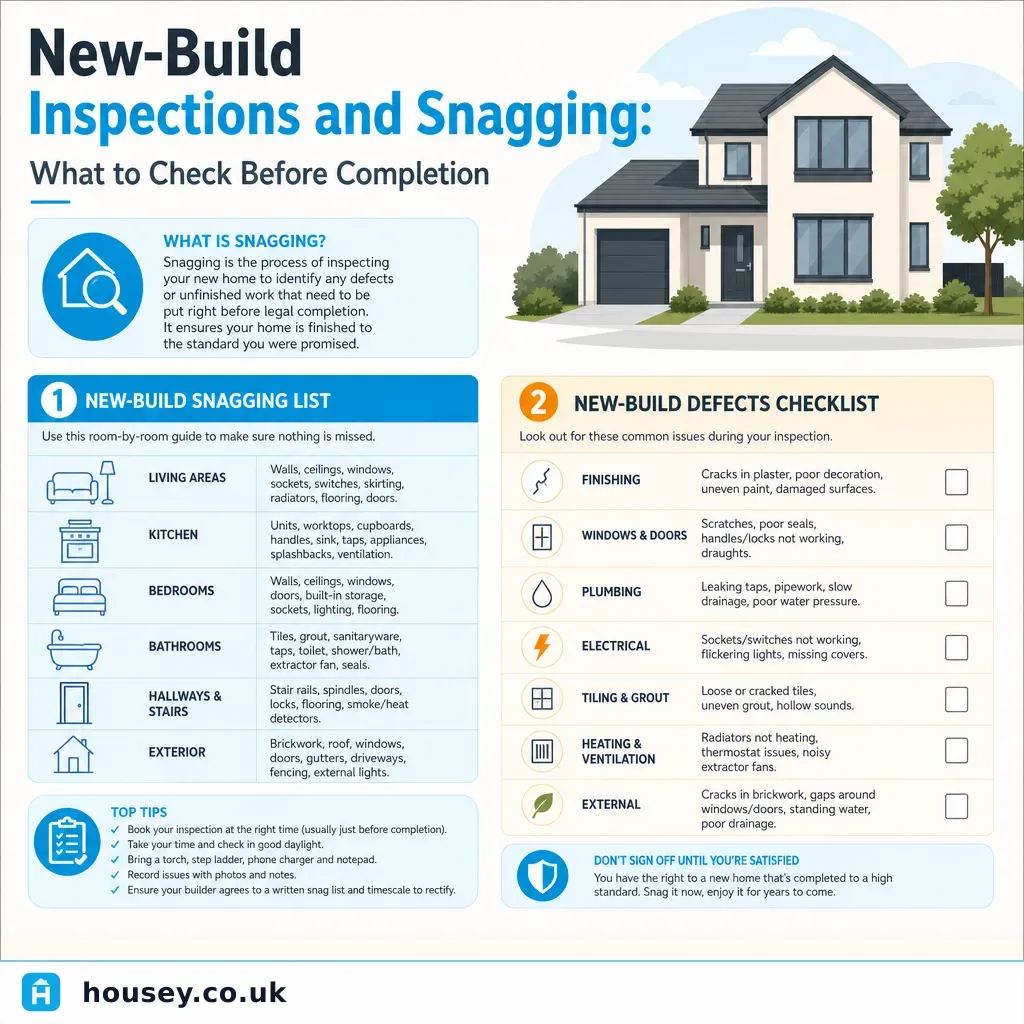 Buying & Moving
New-Build Inspections and Snagging: What to Check Before Completion
A professional snagging survey inspects a new-build home for workmanship defects, incomplete finishes, and Building Regulations compliance issues before or shortly after legal completion.
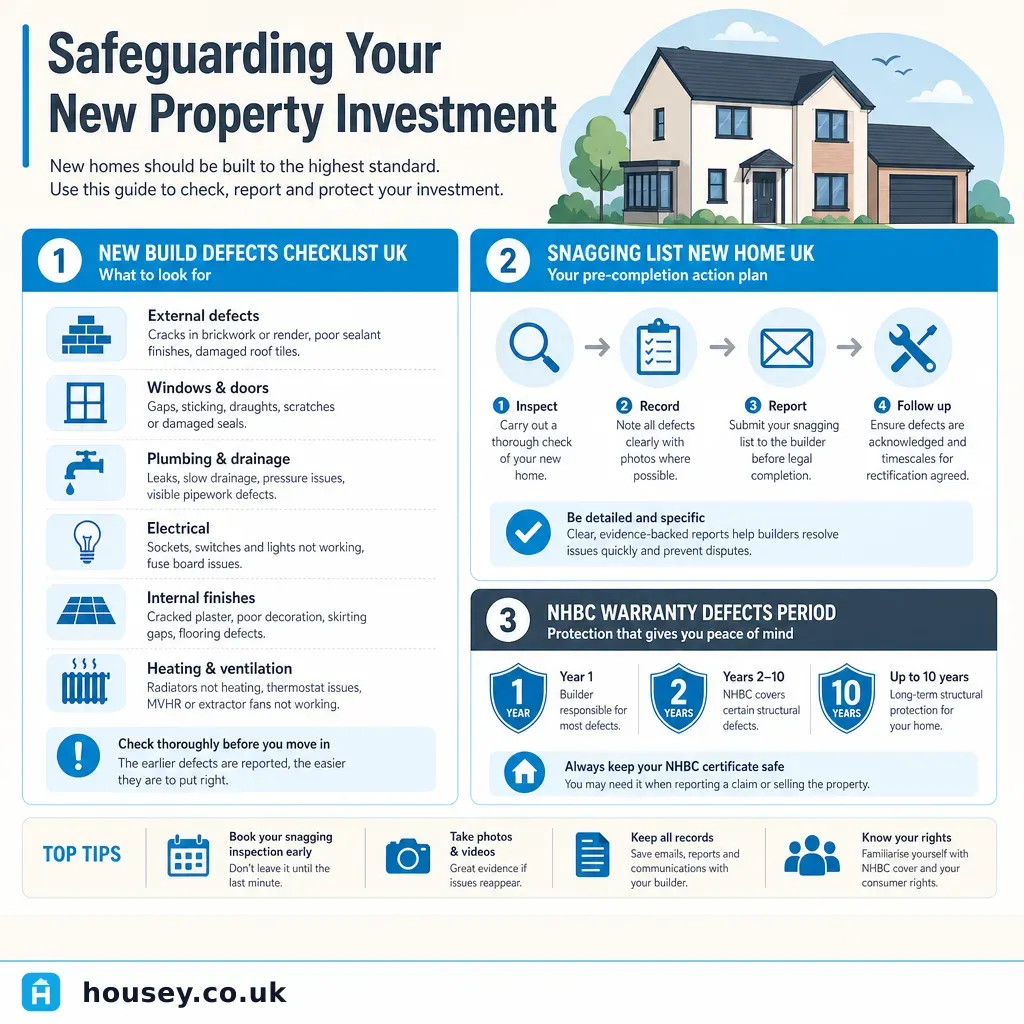 Buying & Moving
Safeguarding Your New Property Investment
A new-build snagging inspection identifies cosmetic and minor construction defects before or shortly after legal completion.
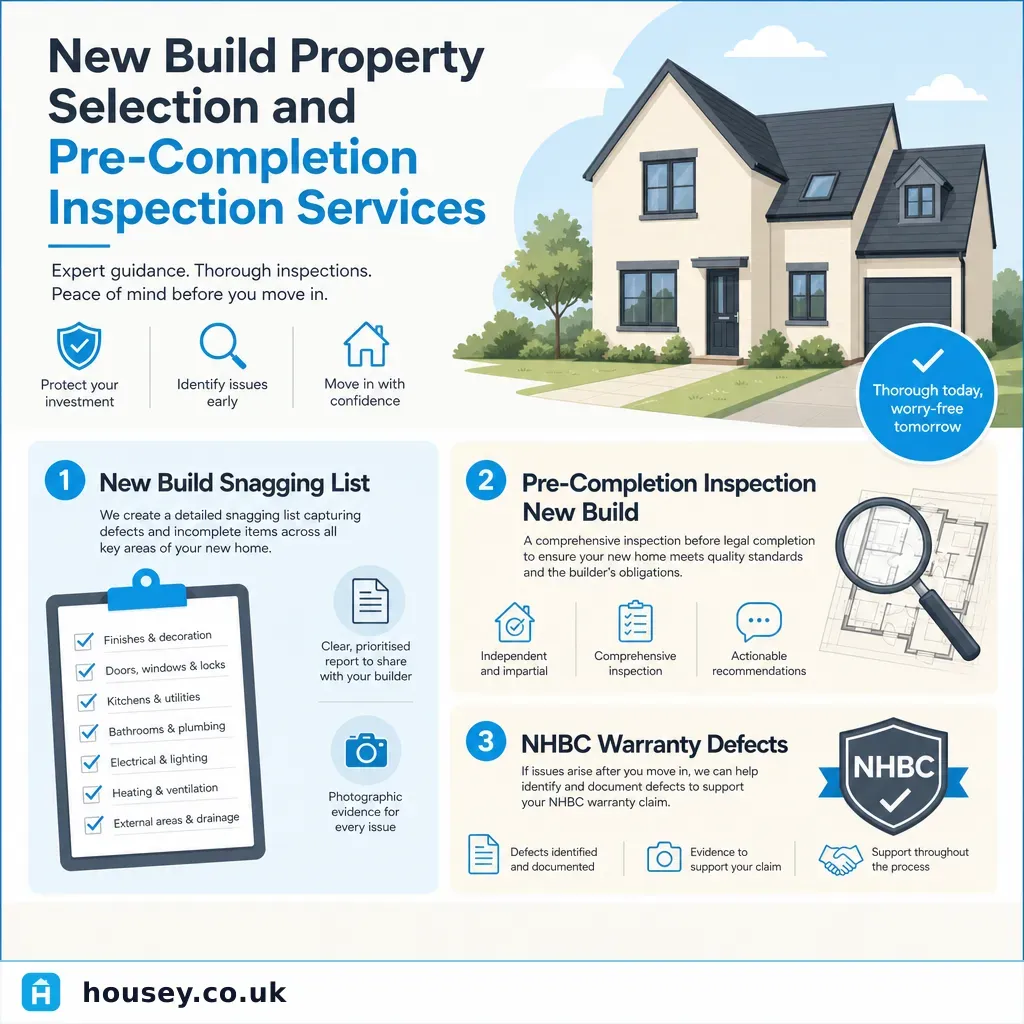 Buying & Moving
New Build Property Selection and Pre-Completion Inspection Services
A new-build snagging survey is a professional inspection carried out before or shortly after legal completion that identifies defects, unfinished work, and specification deviations.
 Buying & Moving
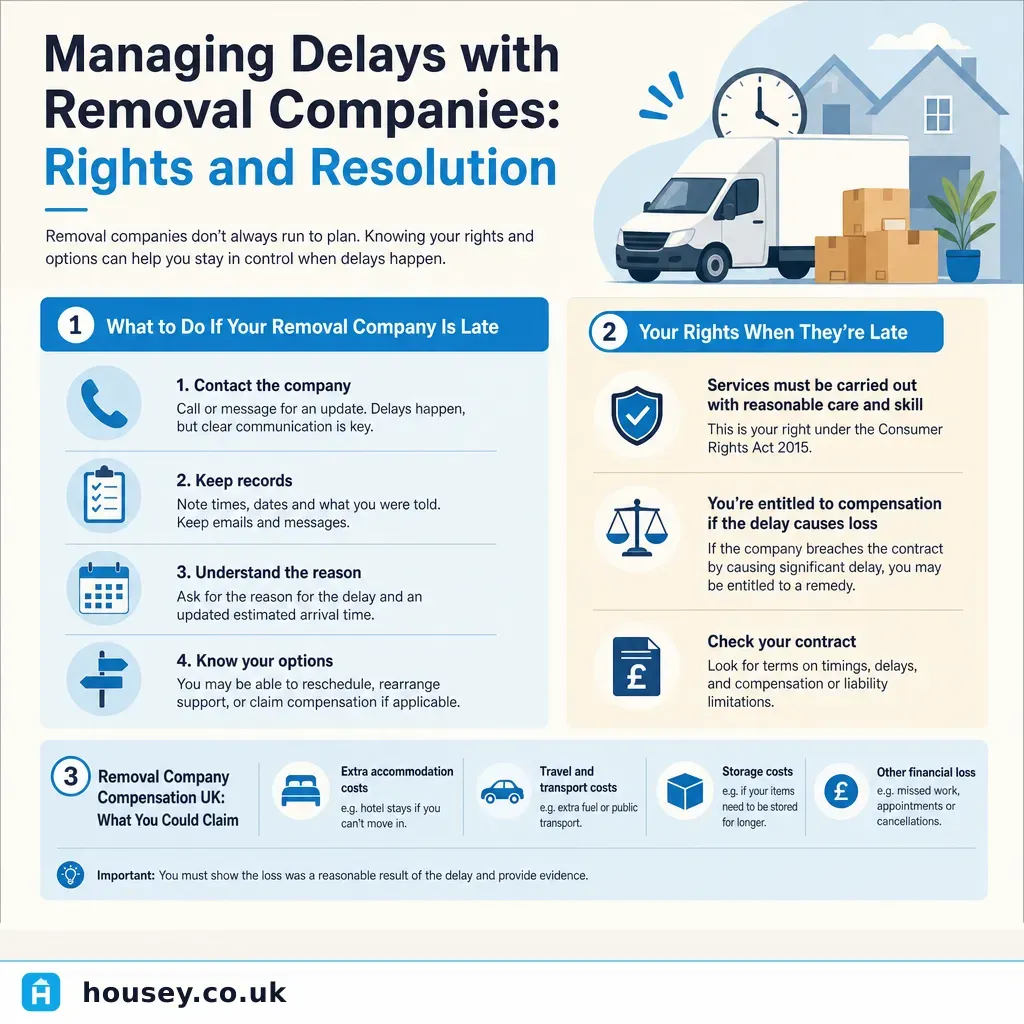
Managing Delays with Removal Companies: Rights and Resolution
If a removal company is late, your rights depend on your contract and whether the company is BAR-registered.
 Buying & Moving
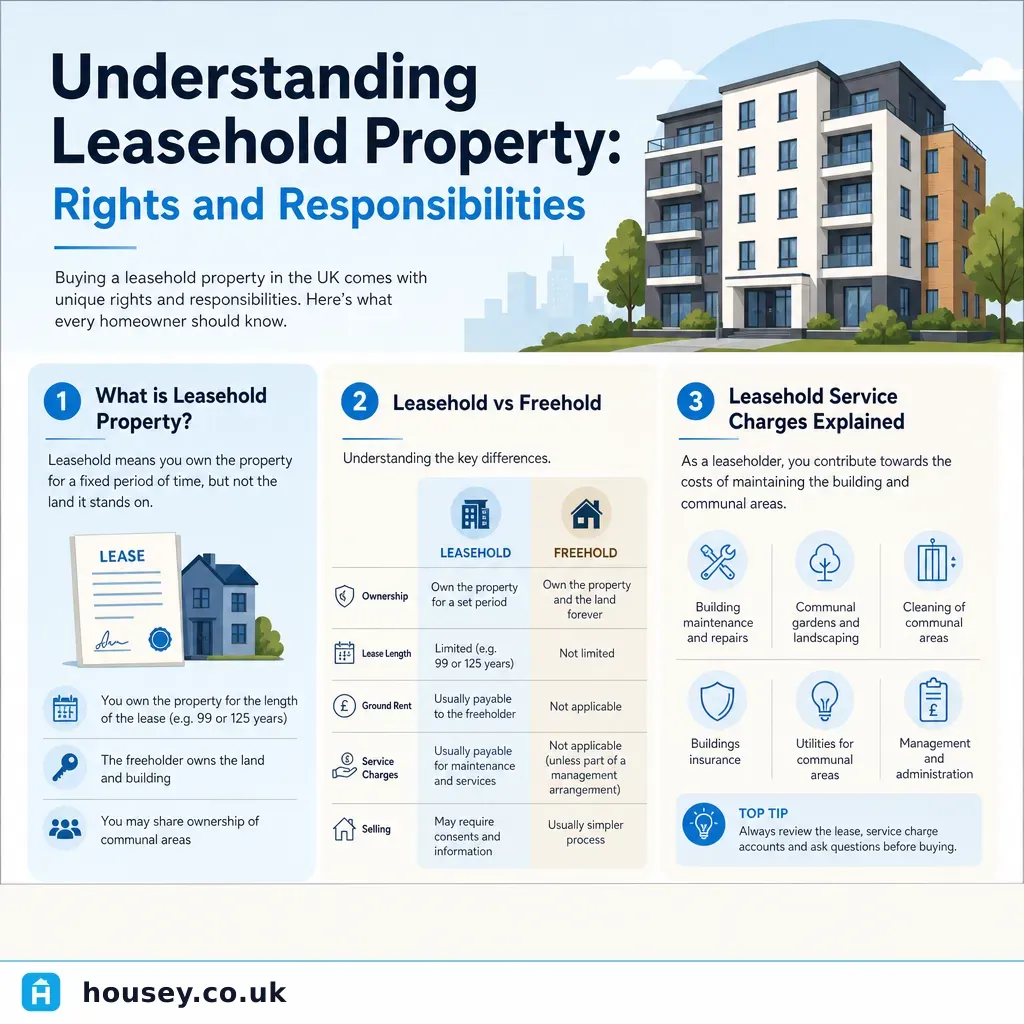
Understanding Leasehold Property: Rights and Responsibilities
Leasehold means you own a time-limited interest in a property while the freeholder owns the land and building.