Safeguarding Your New Property Investment
By Housey · Last reviewed 30th of May 2026
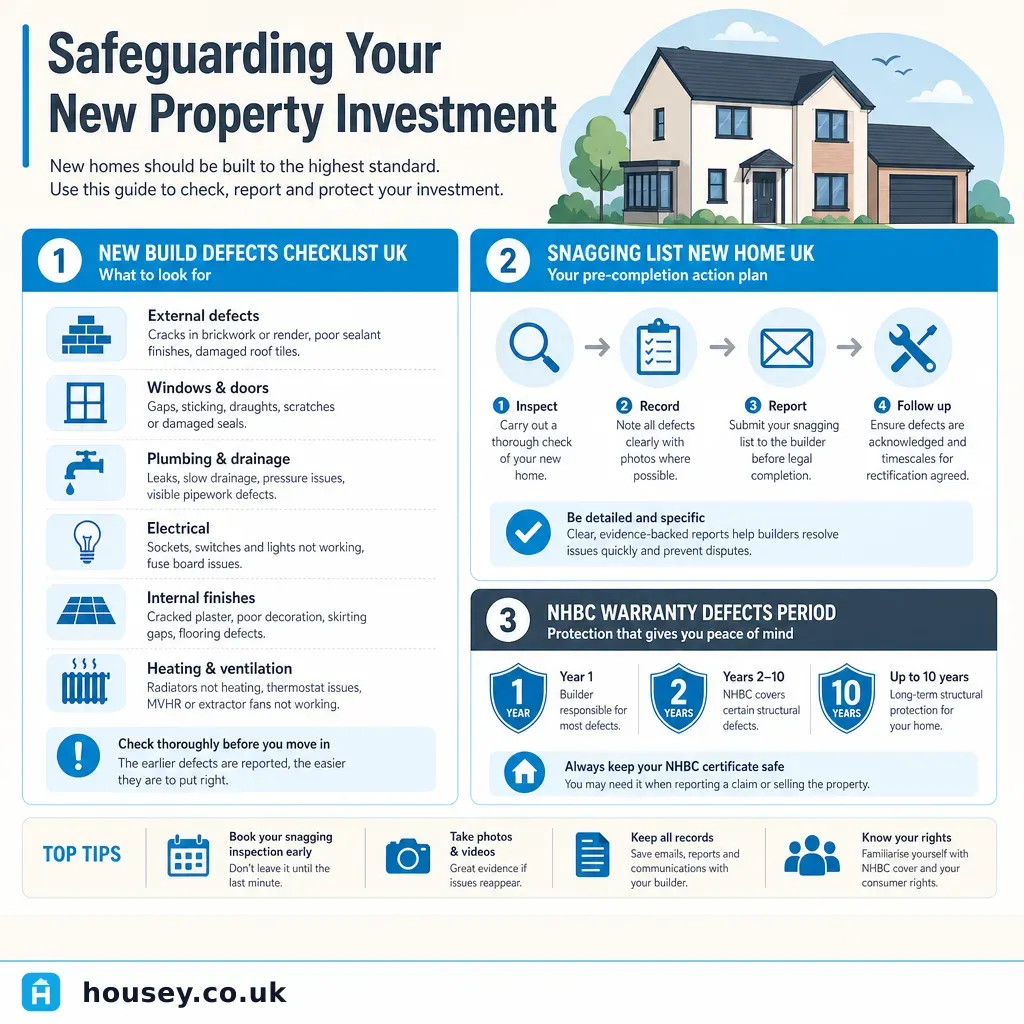
Safeguarding Your New Property Investment
Many buyers assume that because a property is newly built, it will be defect-free. In practice, most new-build homes contain a significant number of minor — and sometimes more serious — defects at the point of handover, a consequence of pressurised construction schedules, multiple sub-contractors, and limited quality-control time on site. Understanding how to protect yourself before and immediately after legal completion can make a substantial difference to your first years in a new home.
Key points
- The NHBC Buildmark warranty provides 2-year builder warranty cover (years 1–2) and 10-year structural defect insurance (years 3–10) for most new-build homes registered with NHBC.
- Under the Consumer Code for Home Builders, developers must give buyers at least a 2-year defects period in which reported snags must be rectified at no cost to the buyer.
- A snagging survey should ideally be arranged before legal completion — many developers allow access for an independent inspector 5–7 days prior to exchange.
- Building Regulations completion certificates are issued by building control (a local authority or an Approved Inspector); confirm this document exists before legal completion.
- The New Homes Quality Board (NHQB) Code of Practice came into force in 2023, introducing an independent New Homes Ombudsman and stronger consumer protections for buyers of registered new-build homes.
What is snagging, and why does it matter?
Snagging is the process of identifying incomplete work, cosmetic defects, and minor construction errors in a new-build property — commonly recorded as a snag list. Examples range from poorly fitted doors and cracked tiles to inadequate insulation at junction points and missing ventilation covers.
The importance of a formal snag list is twofold. First, it creates a dated, written record of defects that the developer is contractually obliged to address. Second, it prevents disputes later about whether a defect was present at handover or arose during your occupation.
A professional snagging inspector — often RICS-affiliated or accredited through a recognised new-build inspection scheme — will produce a written report with photographs for each item, making it straightforward to submit to the developer's after-sales team.
When to arrange a snagging inspection
The optimal time for an independent snagging inspection is before legal completion. This gives you the strongest negotiating position: defects identified pre-completion can be raised with your solicitor, and in some cases completion may be delayed until material issues are resolved.
If your developer does not grant pre-completion access — which some developers refuse — book an inspection within the first few weeks of moving in. Most NHBC Buildmark warranties and developer defect policies require defects to be reported within the first 2 years, so there is no advantage in waiting.
Which timing is right for you?
- Choose a pre-completion inspection if your developer allows access 5–7 days before exchange and you have time to instruct an inspector.
- Choose a post-completion inspection (within 4 weeks of moving in) if pre-completion access is refused.
- Instruct a RICS-accredited structural surveyor or chartered structural engineer if you see widening cracks, significant settlement, or drainage failures shortly after moving in — these are distinct from cosmetic snagging.
- Check with NHBC or your warranty provider if you are unsure what your warranty covers; conditions differ between NHBC, Premier Guarantee, LABC Warranty, and BOPAS.
What a snagging inspector checks
A thorough snagging inspection covers the full fabric of the property, inside and out. The checklist below reflects typical scope; a professional report should address most of these categories.
Snagging checklist
External
- Roof tiles, ridge, and verge for damage or misalignment
- Brickwork, render, and pointing quality
- Windows and external doors: operation, seals, and hardware
- Gutters, downpipes, and drainage channels
- Driveway, paths, and external landscaping
- Meter boxes and external service penetrations sealed
Internal — structure and fabric
- Plasterwork and ceiling finish: cracks, hollows, and uneven surfaces
- Floor levels and floor coverings
- Door and window frames: square, level, and fully operational
- Loft insulation: coverage and depth (minimum 270 mm for mineral wool per Building Regulations Part L)
- Ventilation: trickle vents, extractor fans, and MVHR if fitted
Services
- Boiler commissioning and central heating balance
- Electrical installation: socket and switch alignment, consumer unit labelling (NICEIC or NAPIT certificate should be provided)
- Plumbing: pressure, leaks, and silicone seals around baths and showers
- Smart meters and energy performance documentation
Finishes
- Kitchen and bathroom unit alignment and fixings
- Tiling grout and silicone
- Paint quality on walls, ceilings, and woodwork
- Staircase: balustrade fixing and tread condition
Common new-build defects: what the inspection may find
Defect type | Where found | Typical severity | Who rectifies |
|---|---|---|---|
Cracked or hollow plaster | Walls and ceilings | Low–medium | Developer (years 1–2) |
Poorly fitted doors or windows | Throughout | Low | Developer |
Condensation risk at thermal bridges | Window reveals, roof junctions | Medium | Developer / building control |
Inadequate loft insulation depth | Loft space | Medium | Developer |
Poor drainage falls | Driveways, patios | Medium | Developer |
Hairline settlement cracking | External walls | Usually low; monitor | Developer / NHBC if structural |
Significant structural movement | Walls, floors | Requires professional assessment | Structural engineer; NHBC |
Indicative categories only. Professional inspection is required to assess severity and liability.
NHBC Buildmark warranty: what it covers
The NHBC Buildmark warranty is the most common new-build warranty in England and Wales. It operates in two phases:
- Years 1–2 (builder warranty): The developer is responsible for fixing defects arising from failure to build to NHBC Technical Standards. Report defects promptly in writing.
- Years 3–10 (NHBC insurance): NHBC's own insurance applies if the developer is unable or unwilling to remedy structural and weatherproofing defects.
Not all new-build warranties are NHBC. Premier Guarantee, LABC Warranty, and BOPAS are recognised alternatives with broadly similar structures. Check your title documents and warranty certificate to confirm which scheme applies and what its exclusions are.
The New Homes Quality Board's Code (2023) adds a further layer: buyers can refer unresolved complaints to the New Homes Ombudsman after following the developer's internal complaints process.
When to get professional help
Cosmetic snagging is low risk, but certain findings call for a specialist beyond the snagging inspector:
- Cracks that widen over weeks, are diagonal, or run through brickwork mortar joints — instruct a RICS-accredited structural surveyor or chartered structural engineer.
- Water ingress or damp within the first year — report to the developer in writing immediately and consider a damp and timber survey if the source is not obvious.
- Electrical or gas concerns — do not investigate these yourself; contact an NICEIC-registered electrician or Gas Safe registered engineer.
- Building control queries — if you have doubts about whether certain work was properly certified, consult your local building control authority or a building control consultant.
- Disputed defects — if a developer refuses to acknowledge a defect, a RICS condition report provides independent evidence before escalating to NHBC or the New Homes Ombudsman.
How Housey can help
Housey connects you with qualified professionals for new-build snagging inspections so you can enter your first home with a clear, written defect record. If building control queries arise during the snagging process, our building control consultants can advise on whether works have been properly certified. For properties showing signs of structural movement or significant defects, our network of structural survey specialists can provide the independent assessment your warranty claim may require.
Frequently asked questions
Do I legally need a snagging survey for a new-build?
There is no legal requirement to commission a snagging survey. However, a professional inspection creates a dated, independent record of defects that the developer is contractually obliged to address. Without one, disputes about whether a defect was present at handover are harder to resolve, and you may miss issues that are difficult to detect without specialist equipment.
Can I carry out snagging myself?
You can create your own snag list, and this is better than nothing. A professional inspector will typically identify significantly more defects — particularly in insulation, drainage, and services — than a non-specialist. Many homeowners find that the inspector's fee is effectively covered by the value of defects the developer then fixes at no charge.
What if my developer refuses pre-completion access?
Some developers refuse access before legal completion. In this case, instruct an inspector within the first few weeks of moving in and submit the resulting report to the developer's after-sales team in writing. Keep copies of all correspondence. Unresolved disputes can be referred to NHBC or the New Homes Ombudsman.
How long does a snagging inspection take?
For a typical two- to three-bedroom new-build house, allow 2–4 hours for the inspection. Larger or more complex properties take proportionally longer. The written report with photographs is usually delivered within 24–48 hours, giving you time to submit defects to the developer before or shortly after moving day.
Is a snagging survey the same as a structural survey?
No. A snagging survey focuses on visible defects, finish quality, and compliance with the developer's specification. A structural survey (RICS Level 3) assesses the building fabric and structural integrity in considerably greater depth. If structural concerns arise during snagging, a separate assessment by a RICS-accredited surveyor or chartered structural engineer is advisable.
Sources and further reading
- NHBC Buildmark warranty guidance — NHBC
- New Homes Quality Board Code of Practice — New Homes Quality Board
- Consumer Code for Home Builders — Consumer Code for Home Builders
- Building Regulations Approved Documents — GOV.UK
- Find a RICS-accredited surveyor — RICS
Useful next reads
 Buying & Moving
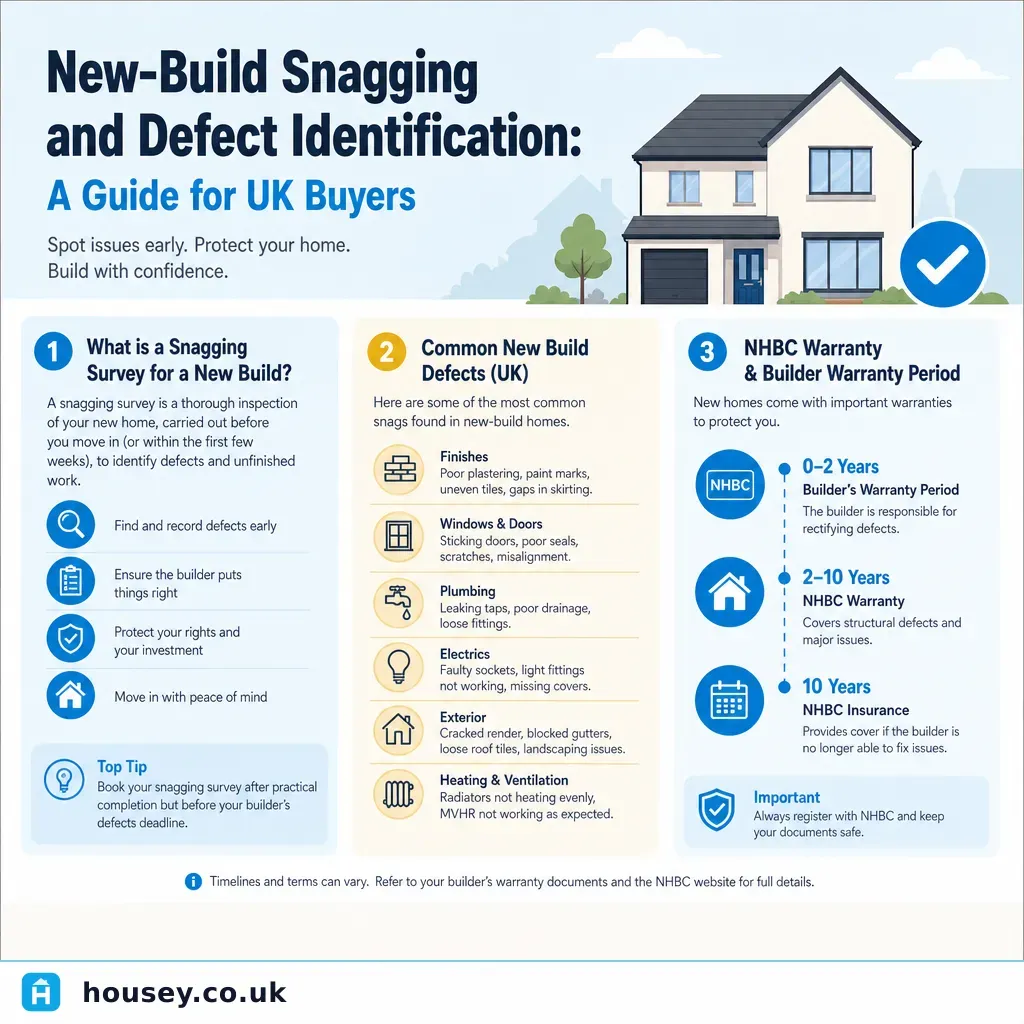
New-Build Snagging and Defect Identification: A Guide for UK Buyers
A new-build snagging survey is a detailed inspection carried out before or shortly after legal completion to identify defects in workmanship and finishes.
 Buying & Moving
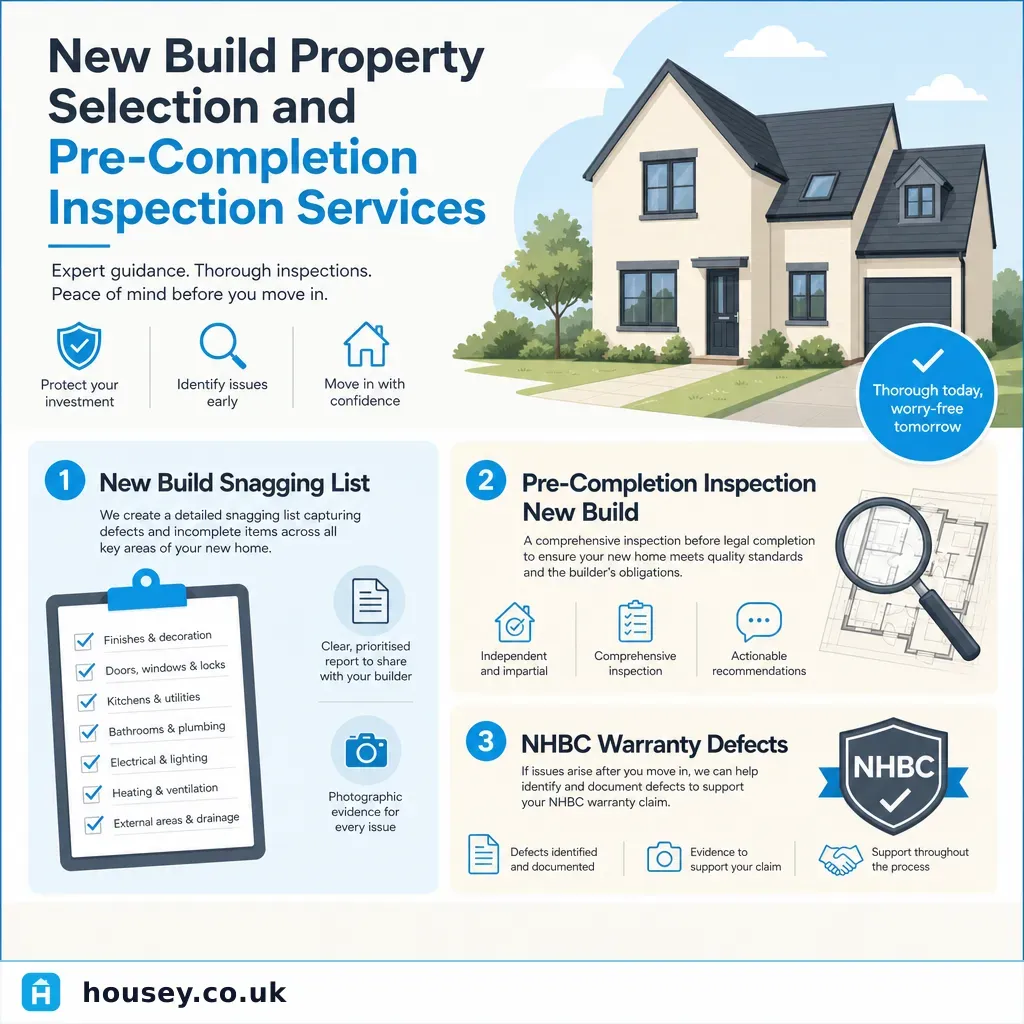
New Build Property Selection and Pre-Completion Inspection Services
A new-build snagging survey is a professional inspection carried out before or shortly after legal completion that identifies defects, unfinished work, and specification deviations.
 Buying & Moving
New homes, lasting friendships: how development choices shape neighbourhoods
The design choices made before a new-build estate is built — street layout, Section 106 contributions, and planning policies — determine whether a development becomes a genuine community or just a collection of houses.
 Buying & Moving
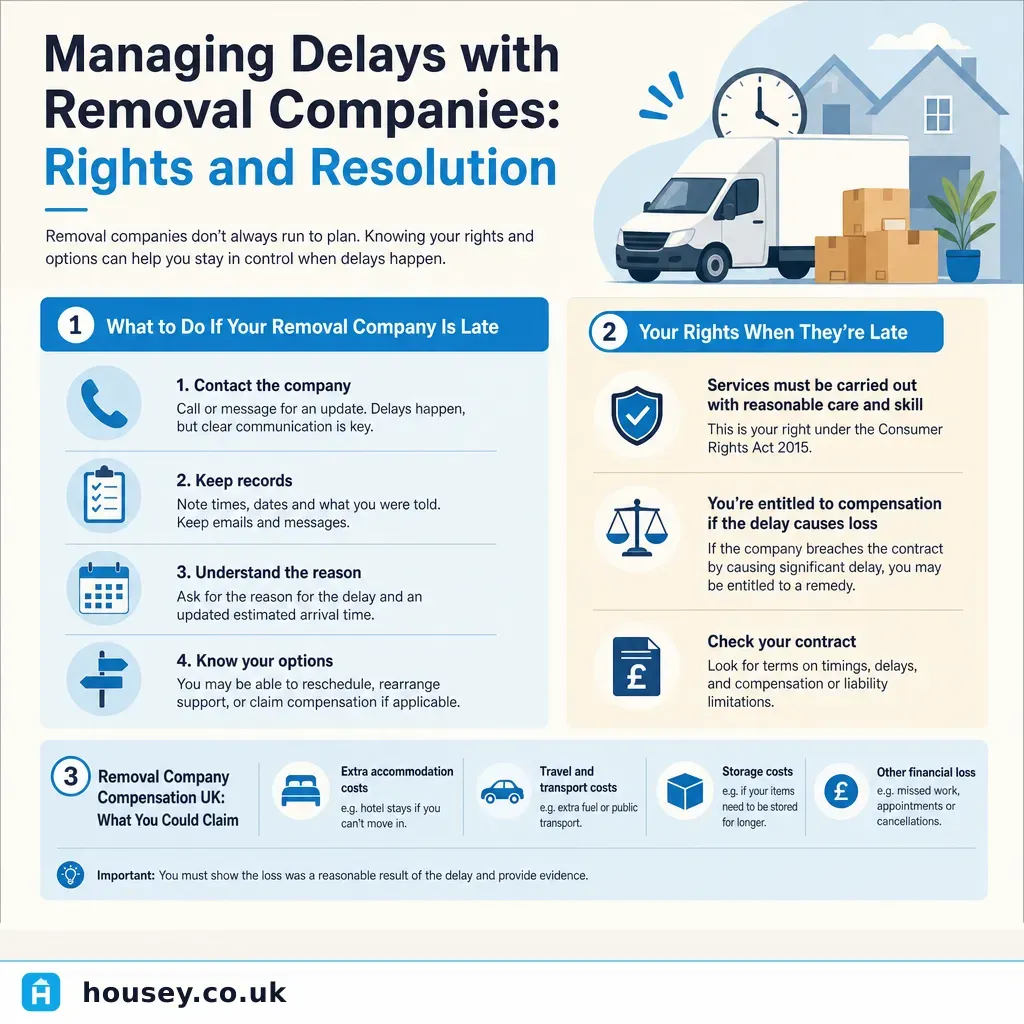
Managing Delays with Removal Companies: Rights and Resolution
If a removal company is late, your rights depend on your contract and whether the company is BAR-registered.
 Buying & Moving
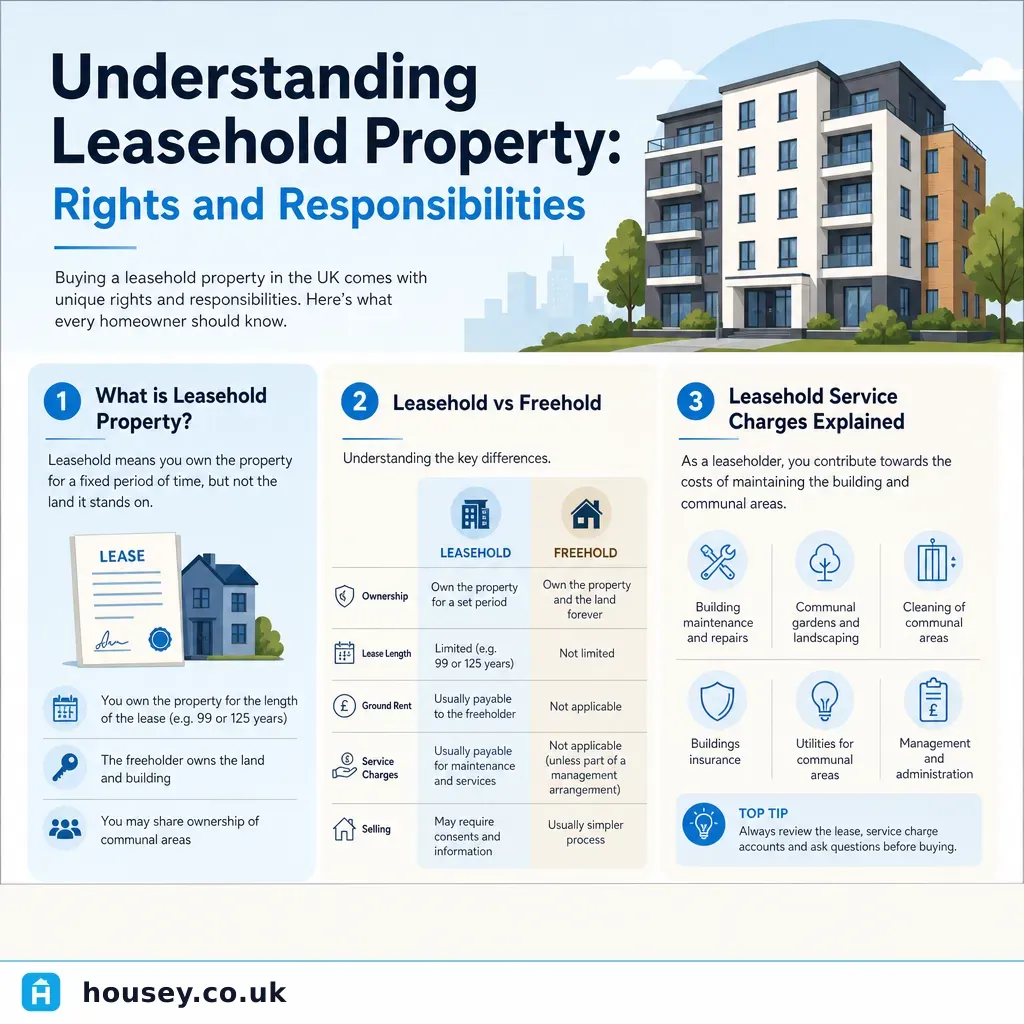
Understanding Leasehold Property: Rights and Responsibilities
Leasehold means you own a time-limited interest in a property while the freeholder owns the land and building.