New Build Property Selection and Pre-Completion Inspection Services
By Housey · Last reviewed 9th of May 2026
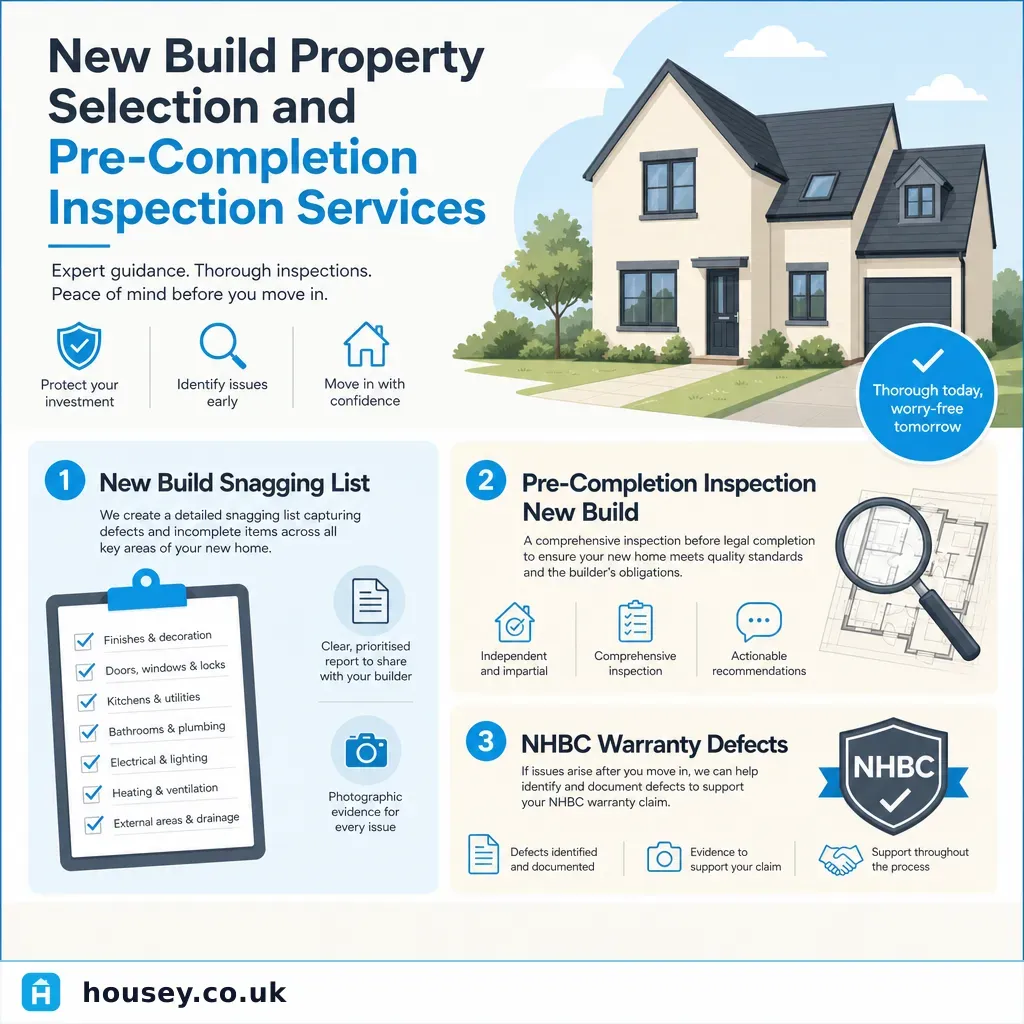
New Build Property Selection and Pre-Completion Inspection Services
Buying a new-build home in the UK is a fundamentally different process from purchasing an existing property, and the pre-completion stage carries particular importance for protecting a buyer's position. Unlike a second-hand home where a RICS survey is the standard pre-exchange recommendation, new builds arrive with a developer's warranty and a legal completion date that can move quickly — leaving buyers with limited time to identify defects before keys are handed over. Understanding what a pre-completion inspection involves, and who should carry it out, helps buyers protect their legal rights and hold developers to account before problems become harder to remedy.
Key points
- The New Homes Quality Code (2022), overseen by the New Homes Quality Board (NHQB), gives buyers the right to a pre-completion inspection and requires registered developers to permit access for this purpose.
- NHBC Buildmark warranty covers builder defects for the first 2 years from legal completion (the builder period) and structural defects for 10 years from completion.
- Building Regulations approval confirms compliance with minimum statutory standards — it does not guarantee workmanship quality or the standard of internal finishes.
- A professional snagging inspector should carry professional indemnity (PI) insurance and ideally hold RICS, CIOB, or a recognised snagging accreditation.
- The Consumer Code for Home Builders requires registered developers to provide buyers with clear information about outstanding works and the property's condition before legal completion.
What is a snagging survey?
A snagging survey — formally called a new-build inspection or pre-completion inspection — is a systematic check of a newly constructed home for defects, unfinished work, and deviations from the agreed specification or Building Regulations requirements. Inspectors work to a structured checklist covering structure, roofing, external walls, windows and doors, internal finishes, plumbing, electrics, ventilation, and drainage.
The output is a written snagging list, usually numbered and accompanied by photographs, which the buyer presents to the developer for remediation before or after taking ownership.
When to arrange a snagging inspection
Timing is critical. The ideal window is after the home is substantially complete but before legal completion takes place — allowing defects to be remediated before you take ownership and preserving your leverage as a buyer.
Decision tree: when and how to use a snagging inspection
- Before legal completion (ideal): Arrange a professional snagging survey 1–2 weeks before your agreed completion date. Submit the written list to the developer and agree which items will be resolved before you move in.
- At completion if no pre-completion access was given: Begin your own walk-through on the day and submit a written defects list to the developer; the NHBC builder period runs from the date of legal completion.
- After moving in (within 2 years): You can still instruct a snagging inspector. Report all defects in writing to the developer; they remain liable for builder-period defects throughout this period.
- After 2 years but within 10 years: Structural defects remain covered under the NHBC Buildmark structural warranty, but cosmetic or minor workmanship defects are not.
- If the developer refuses pre-completion access: Contact the New Homes Ombudsman or the NHQB if the developer is a registered member; check your reservation agreement for any stated access rights.
What a professional snagging inspector checks
A thorough pre-completion inspection covers all of the following areas:
- Structural and roofing: tiles, ridge lines, flashings, eaves details, cavity closers, and lintels above openings
- External envelope: brickwork pointing, render finish, window and door reveals, and damp proof course (DPC) integrity at ground level
- Windows and doors: smooth operation, weather seals, locks, and glazing unit quality (condensation between panes indicates a failed sealed unit)
- Internal finishes: plastering quality, paint coverage, skirting boards, architraves, floor coverings, and wall and floor tiling
- Plumbing: all outlets and drainage, water pressure, bath and shower seals, under-sink pipe connections, and stop valve accessibility
- Electrical: socket and switch alignment, consumer unit labelling and protection, smoke and CO detector installation to BS 5839 and BS 50291
- Ventilation: MVHR (mechanical ventilation with heat recovery) commissioning, kitchen and bathroom extractor operation, and trickle vents fitted to window frames
- Heating: boiler commissioning certificate, radiator operation throughout, and thermostat and timer programming
- Drainage: rodding access points, inspection chamber covers, and external gullies free from debris
Red flags on a new-build snagging inspection
The following items warrant particular attention or escalation beyond the standard developer snagging process:
- Stepped cracking in brickwork — may indicate differential settlement in the early post-construction period; consider involving a structural engineer rather than relying solely on the developer's assessment
- Damp patches on internal walls or ceilings — may indicate a roof, flashing, or plumbing leak; a cosmetic repaint is not an adequate remedy and the source must be found
- Missing or damaged cavity wall insulation — often only detectable with a borescope inspection or thermographic survey; directly affects the property's energy performance and EPC rating
- Failed sealed glazing units (condensation visible between panes) — units must be replaced under warranty, not simply cleaned or resealed
- Inadequate ventilation provision — missing trickle vents or non-functioning extractors constitute a Building Regulations non-compliance matter, not a cosmetic issue
- Consumer unit not labelled or not fitted with RCDs/AFDDs — a requirement under BS 7671 and Building Regulations Part P; treat as a regulatory non-compliance
- Missing commissioning certificates for the boiler or MVHR system — manufacturer warranties on these appliances may be void without them
New-build warranties: what they cover
Warranty | Builder period (defects) | Structural cover | What it does NOT cover |
|---|---|---|---|
NHBC Buildmark | 2 years from completion | 10 years | Cosmetic wear, condensation in unventilated rooms, damage caused by the occupant |
Premier Guarantee | 2 years | 10 years | Routine maintenance items per policy schedule |
LABC Warranty | 2 years | 10 years | Items excluded in the individual policy schedule |
No warranty (rare, small developer) | Contract-dependent | None | Significant legal risk — take conveyancing advice before exchanging |
Most mortgage lenders require an NHBC Buildmark or equivalent structural warranty before lending on a new-build property.
Do you need a professional inspector or can you snag yourself?
You are entitled to carry out your own walk-through, and many buyer guides include basic checklists. However, professional inspectors bring knowledge of Building Regulations requirements, specialist equipment (damp meters, plug testers, spirit levels, and borescopes), a formal written report that carries weight in any developer dispute, and independence from the developer's own site team.
Instructing a professional is particularly worthwhile on higher-value properties, apartment buildings with shared services, or where the developer has a history of disputed defect claims.
Homeowner checklist: your own new-build walk-through
Use this alongside — not instead of — a professional inspection:
When to get professional help
A professional snagging inspector is strongly advisable if:
- Your completion date is approaching and the developer is refusing or delaying a pre-completion inspection request
- You have identified structural-looking cracks, significant damp, or visible signs of water ingress into the fabric of the building
- The developer is disputing items on your snagging list without providing adequate remediation or explanation
- You intend to escalate a complaint to the New Homes Ombudsman, the NHQB, or the NHBC Resolution Service
For electrical concerns, request a copy of the Electrical Installation Certificate (EIC) and verify the installer is registered with NICEIC or NAPIT. For gas, request the Building Regulations Completion Certificate and the boiler commissioning record — the installing engineer must be Gas Safe registered.
How Housey can help
Housey connects new-build buyers with qualified professionals who carry out new-build snagging inspections across the UK. If you are approaching completion, requesting quotes early gives you time to compare inspectors and book at the right point in your completion timeline. Housey also offers property photography and floorplans for buyers who want a comprehensive dated visual record of their new home at the point of handover.
Frequently asked questions
Can I refuse to complete if a snagging survey reveals major defects?
This depends on your reservation and purchase contract, and on the nature of the defects. If the developer has failed to build to the agreed specification or Building Regulations requirements, you may have grounds to delay completion. Seek advice from your conveyancing solicitor before taking action — do not rely on a snagging list alone as grounds to rescind a contract.
How long does a new-build snagging survey take?
Typically 2 to 4 hours for an average three-bedroom house, depending on the inspector and the property's size and condition. A detailed written report with photographs is usually provided within 24 to 48 hours of the inspection. Larger homes or apartment buildings with communal areas will take proportionally longer to inspect thoroughly.
What does a snagging survey cost in the UK?
Indicative UK costs, last reviewed 2026-05-09. Professional snagging surveys typically range from £300 to £600 for a mid-sized new-build home, varying by property size, location, and the inspector's qualifications and experience. Always verify that your chosen inspector carries professional indemnity (PI) insurance before instructing them to proceed.
Is the NHBC warranty the same as building regulations approval?
No. Building Regulations approval confirms the build meets minimum statutory standards as assessed by a building control body. The NHBC Buildmark warranty is a separate commercial product providing financial protection if the developer becomes insolvent or refuses to remedy defects during the warranty periods. Both are independent of each other and serve different purposes.
Should I wait until after moving in to arrange a snagging survey?
Ideally, arrange the survey before legal completion to maximise your leverage with the developer. Developers are often more responsive to snagging lists before purchase is legally complete. If pre-completion access is refused, arrange the survey as soon as possible after moving in to document all defects within the NHBC two-year builder period.
Sources and further reading
- New Homes Quality Code — New Homes Quality Board
- NHBC Buildmark warranty: what is covered — NHBC
- New Homes Ombudsman — GOV.UK
- Consumer Code for Home Builders — Consumer Code for Home Builders
- Building regulations approval — GOV.UK
Useful next reads
 Buying & Moving
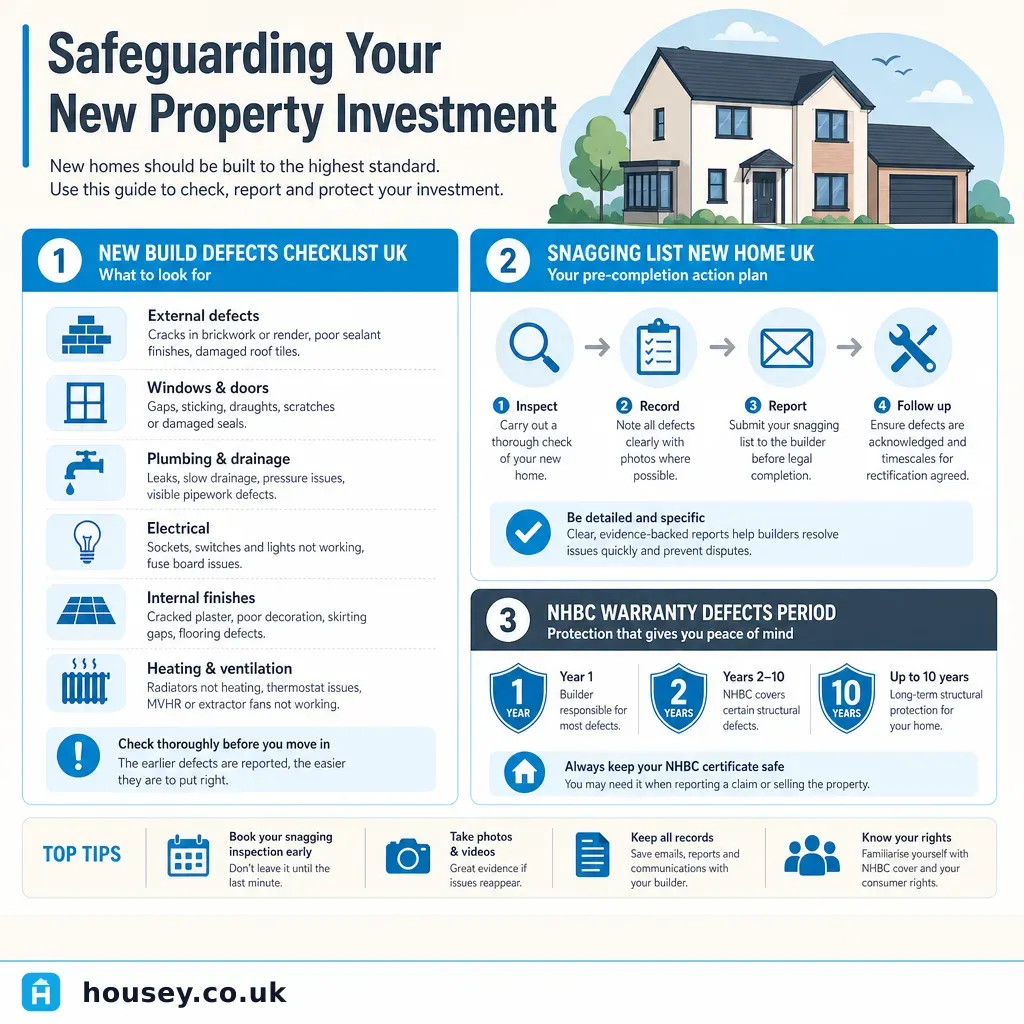
Safeguarding Your New Property Investment
A new-build snagging inspection identifies cosmetic and minor construction defects before or shortly after legal completion.
 Buying & Moving
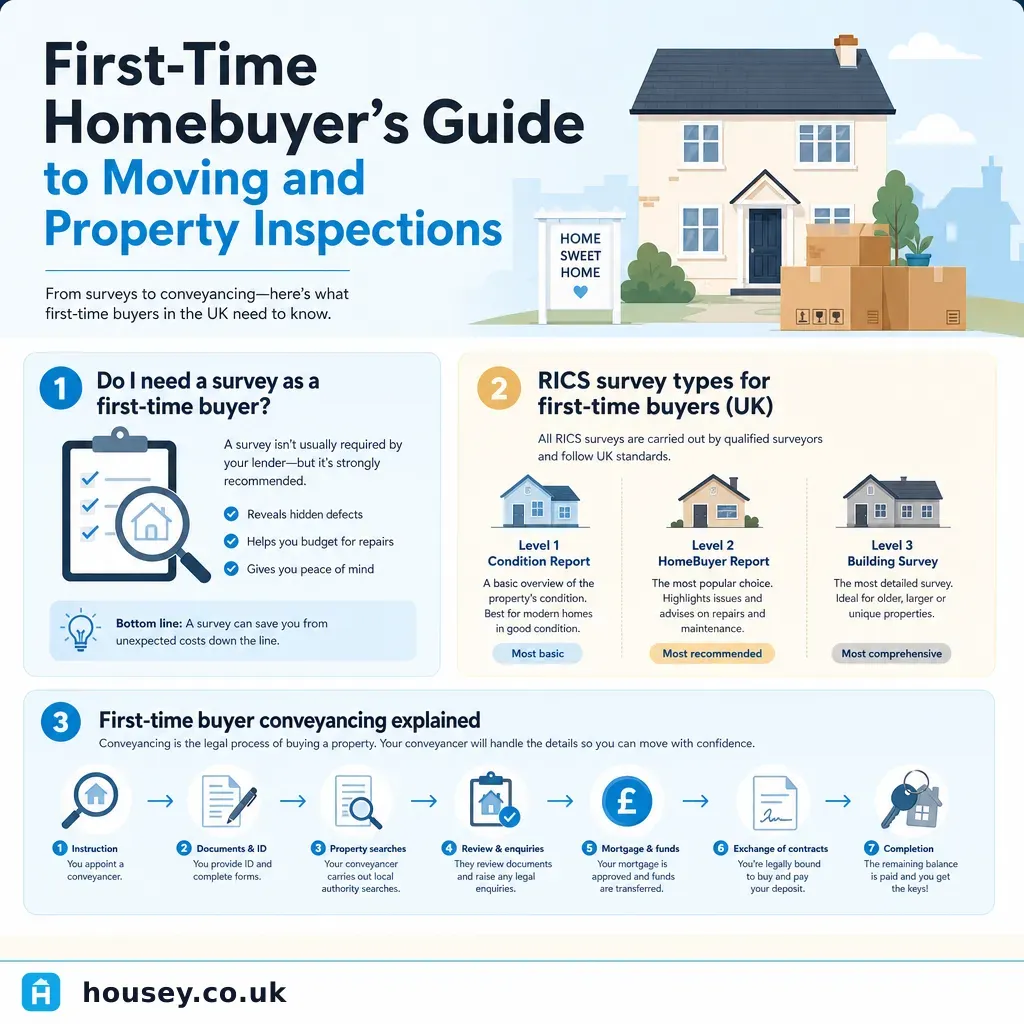
First-Time Homebuyer's Guide to Moving and Property Inspections
First-time buyers in the UK should know that a lender's mortgage valuation is not a property survey and does not protect the buyer.
 Buying & Moving
New homes, lasting friendships: how development choices shape neighbourhoods
The design choices made before a new-build estate is built — street layout, Section 106 contributions, and planning policies — determine whether a development becomes a genuine community or just a collection of houses.
 Buying & Moving
Essential guidance for first-time property owners in the UK
As a new UK homeowner, your first responsibilities are buildings insurance from exchange, utility transfers, council tax registration, and gathering key documents including the title register and EPC.
 Buying & Moving
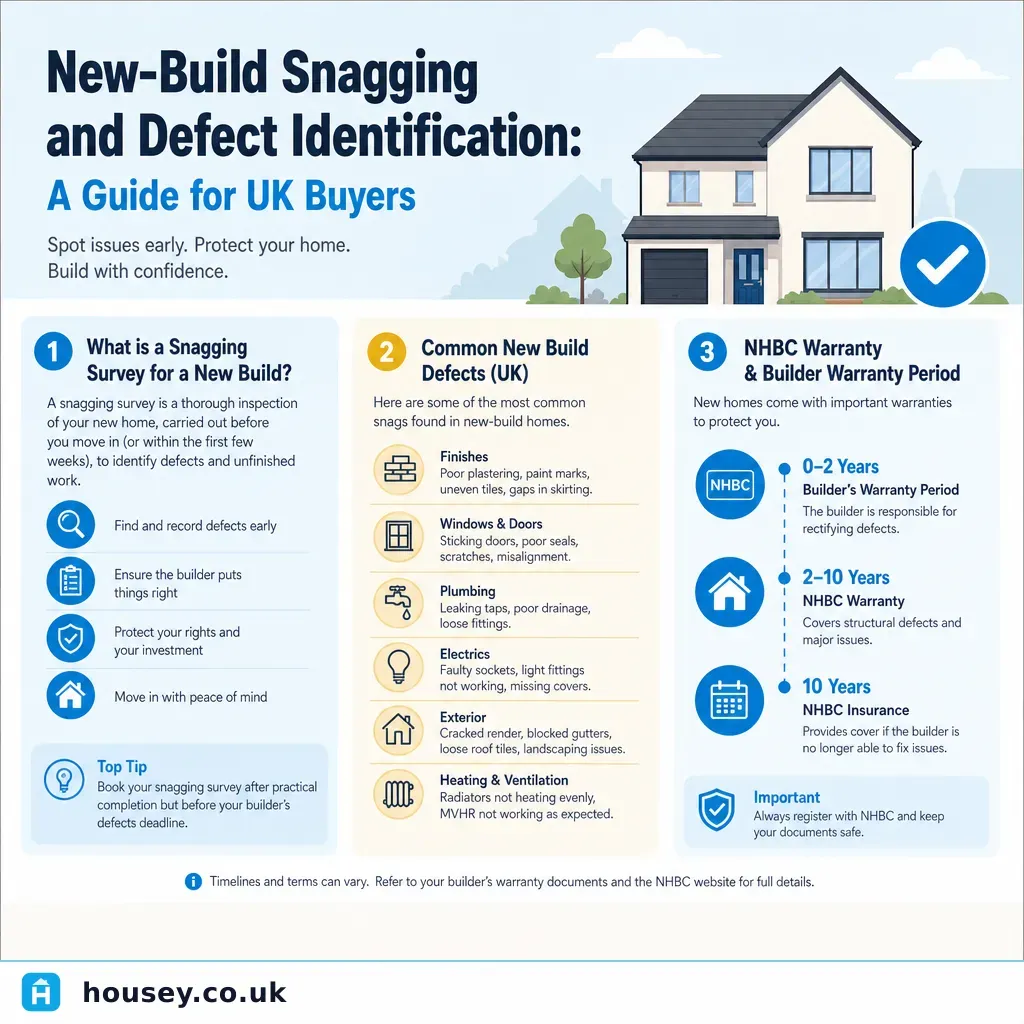
New-Build Snagging and Defect Identification: A Guide for UK Buyers
A new-build snagging survey is a detailed inspection carried out before or shortly after legal completion to identify defects in workmanship and finishes.