No Sale, No Fee Conveyancing: How This Service Model Works
By Housey · Last reviewed 25th of May 2026
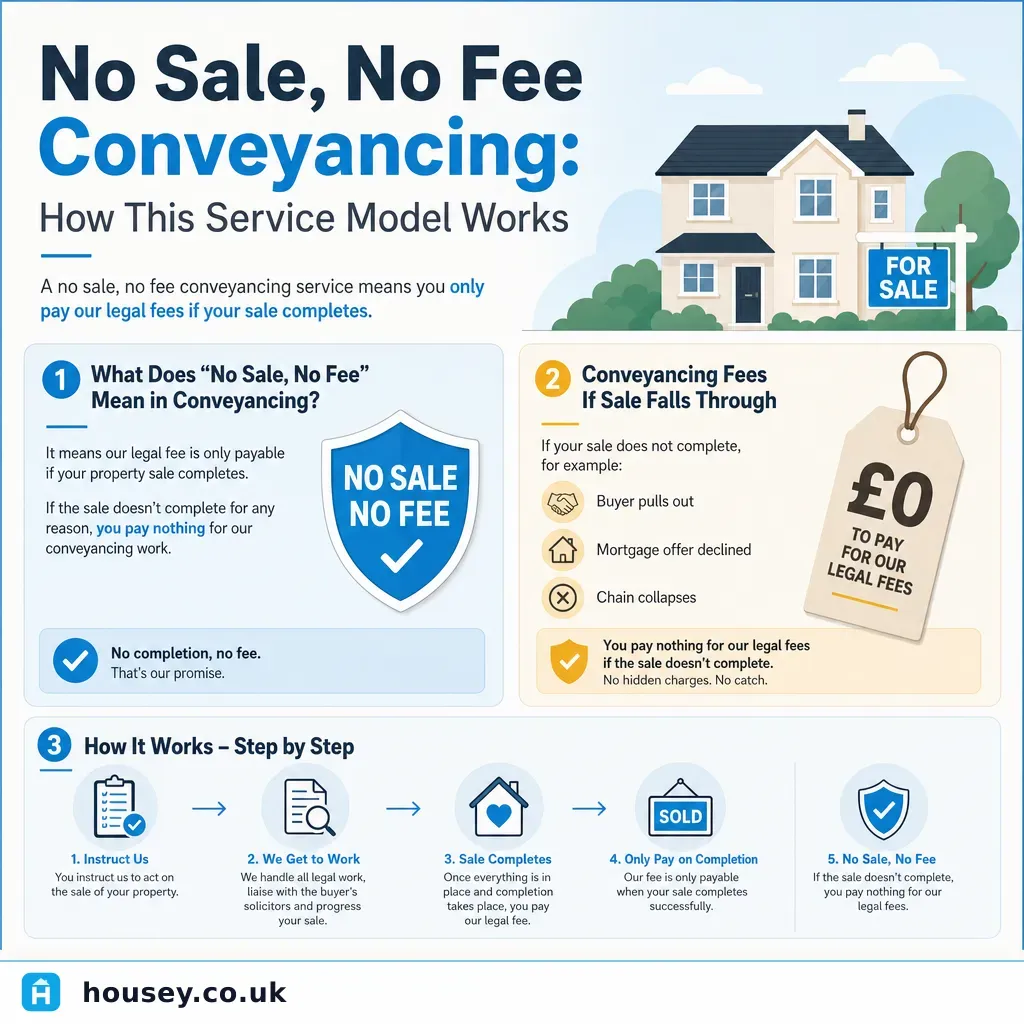
No Sale, No Fee Conveyancing: How This Service Model Works
A significant proportion of agreed sales in England and Wales fall through before completion — estimates from property industry sources typically range from one in four to one in three of all agreed sales. No sale, no fee conveyancing is a pricing model designed to reduce the financial cost if your purchase or sale collapses before completion. Understanding precisely how these arrangements work — and where the small print commonly limits the protection — helps you decide whether the model suits your circumstances.
Key points
- "No sale, no fee" (also marketed as "no completion, no fee" or "conditional fee conveyancing") means the firm does not charge its professional legal fee if the transaction does not reach completion.
- Disbursements already paid on your behalf — principally search fees totalling around £250–£450 — are almost always still payable, because those costs have been incurred with third parties.
- Firms offering this model typically price their professional fee slightly higher than comparable standard quotes to offset the risk of abortive matters across their caseload.
- The precise definition of "no sale" varies between firms: some waive fees if the matter aborts at any stage before exchange; others apply the waiver only after a specific trigger point is reached.
- Always read the client care letter carefully before instructing — no sale, no fee wording in advertising does not guarantee that all costs are waived.
How the model works in practice
In a standard conveyancing instruction, a firm begins accruing costs the moment you instruct them. If the transaction falls through before exchange — the point at which the contract becomes legally binding in England and Wales — the firm may charge an abortive fee for work already carried out.
Under a no-sale-no-fee arrangement, the firm agrees to absorb those abortive professional costs. In return, the quoted fee is typically set at a level that allows the firm to remain commercially viable across all its matters, including those that do not complete.
What is usually waived: The professional legal fee — the firm's charge for its own time and expertise.
What is usually NOT waived: Disbursements the firm has already paid out on your behalf — most commonly search fees, and in some cases an ID verification charge or bankruptcy search fee. "No fee" does not mean "no cost."
Standard conveyancing vs. no-sale-no-fee: a comparison
Feature | Standard conveyancing | No-sale-no-fee conveyancing |
|---|---|---|
Professional fee on completion | Paid | Paid (usually slightly higher) |
Professional fee if transaction aborts | May be partially charged | Waived (subject to terms) |
Disbursements if transaction aborts | Usually payable | Usually still payable |
Typical price premium | None | £50–£150 more on professional fee |
Best for | Straightforward, low-risk transactions | Buyers or sellers with higher fall-through concern |
Watch out for | Abortive fee clauses in standard terms | Disbursement exclusions and trigger-point definitions |
Indicative UK costs, last reviewed 2026-05-25.
Which model should you choose?
- Choose no-sale-no-fee if you have had an abortive purchase previously; you are buying in a competitive market where gazumping or chain collapse is a realistic risk; or the property carries features that increase fall-through risk, such as a complex leasehold structure, structural issues under investigation, or a long chain.
- Choose a standard fixed-fee quote if the transaction is straightforward, the chain is short with motivated parties, and you are confident the purchase will proceed.
- Ask the firm directly which disbursements remain payable and at what point in the process they are typically incurred, before signing any letter of engagement.
- Be cautious if a no-sale-no-fee offer appears materially cheaper than comparable standard quotes — very low pricing may be offset by broader disbursement exclusions or a narrower trigger definition.
What the small print typically says
The client care letter governs exactly what you pay and when. Key clauses to check before signing:
Trigger point: Some firms define "no completion" as the matter aborting before exchange; others apply the waiver only if completion has been scheduled and then fails. If you withdraw after exchange of contracts — which is uncommon and carries separate legal costs — most no-sale-no-fee arrangements do not apply.
Disbursement liability: Search fees already ordered are the most common excluded cost. A combined local authority, water/drainage, and environmental search package typically costs £250–£450.
Who withdraws: Some firms apply the waiver only when the other party withdraws. If you withdraw without qualifying reason, an abortive charge may still arise even under a no-sale-no-fee arrangement. Clarify this before instructing.
Repeat instructions: Starting a purchase on a different property after an abortive matter is typically treated as a new instruction at the new property's quoted rate.
What to ask before accepting a no-sale-no-fee quote
- At what stage in the transaction does the no-fee protection take effect?
- Which disbursements remain payable if the transaction does not complete, and when are searches typically ordered?
- What happens to any funds I have already paid if the matter aborts?
- If I withdraw rather than the other party, does the protection still apply?
- Is the professional fee fixed, or can it increase in certain circumstances such as leasehold or new build?
- Who is my named contact, and how will they keep me informed of progress?
Red flags to watch for
- A no-sale-no-fee firm quoting significantly below the market rate without a clear explanation of how disbursements are treated — the headline saving may be offset by wide exclusions.
- Terms that define the waiver trigger at a very late stage in the process, leaving the buyer exposed for most of the transaction's duration.
- No written client care letter clearly setting out when and how the protection applies.
- A firm that cannot clearly answer the questions above before you instruct them.
Important limitations
This article describes how no-sale-no-fee conveyancing models typically work; specific terms vary between firms and are governed by the client care letter you sign on instruction. The arrangement does not protect against all costs if a transaction aborts. Conveyancing is a regulated legal service — always check that your firm is authorised by the CLC or SRA before instructing. This article does not constitute legal advice.
What to ask a qualified professional
Before deciding whether no-sale-no-fee conveyancing is appropriate for your situation, ask a regulated conveyancing solicitor or licensed conveyancer:
- What are the main reasons a transaction of this type might fall through, and how common is that in your experience?
- What disbursements are typically incurred before exchange in transactions like mine?
- Would the professional fee difference between a standard and no-sale-no-fee quote be proportionate given the risk profile of this transaction?
- What steps can be taken to reduce fall-through risk — for example, the timing of searches, the survey, or enquiries?
When to get professional help
Seek independent advice before proceeding if:
- You are unsure whether you are financially or practically ready to proceed and do not want to incur disbursements prematurely.
- The transaction has become contentious or involves a legal dispute; a no-sale-no-fee model may not be appropriate once litigation risk arises.
- You are considering withdrawing after exchange of contracts, which carries substantial legal and financial consequences regardless of your conveyancing fee model.
How Housey can help
Housey makes it straightforward to compare standard and no-sale-no-fee conveyancing quotes from regulated solicitors and licensed conveyancers. Our compare conveyancing quotes page shows itemised quotes with disbursements clearly separated, so you can assess the real difference before you commit.
Frequently asked questions
Does no-sale-no-fee conveyancing cover all costs if the purchase falls through?
No. The professional legal fee is usually waived, but disbursements your conveyancer has already paid — principally search fees — are almost always still charged. Searches typically cost £250–£450 in total, so a bill is likely even under a no-sale-no-fee arrangement. The exact disbursements excluded depend on the firm's terms.
Is no-sale-no-fee conveyancing more expensive overall?
Usually slightly. Firms absorb abortive risk across their caseload and price their professional fee accordingly. The premium is typically modest — often £50–£150 over a comparable standard fixed fee — but it varies by firm and property type. Obtain and compare itemised quotes to judge whether the premium is proportionate to your fall-through risk.
Can sellers as well as buyers use no-sale-no-fee conveyancing?
Yes. The model is available to sellers, and the same principles apply: the professional fee is waived if the sale does not complete, but disbursements already incurred are usually still payable. For sellers, fall-through risk can be significant — particularly on properties that have had previous sales collapse.
What is the difference between exchange and completion in England and Wales?
Exchange of contracts is the point at which both buyer and seller sign identical contracts and solicitors exchange them — typically by telephone under Law Society protocol. Until exchange, either party can withdraw without legal penalty, though costs may have been incurred. After exchange, both parties are legally bound. Completion typically follows one to four weeks later.
Sources and further reading
- Law Society — conveyancing guidance — Law Society
- Council for Licensed Conveyancers — consumer guidance — CLC
- SRA — buying and selling property — SRA
- Citizens Advice — buying a home — Citizens Advice
Useful next reads
 Buying & Moving
Managing Delays with Removal Companies: Rights and Resolution
If a removal company is late, your rights depend on your contract and whether the company is BAR-registered.
 Buying & Moving
Understanding Leasehold Property: Rights and Responsibilities
Leasehold means you own a time-limited interest in a property while the freeholder owns the land and building.
 Buying & Moving
The Complete Property Buying Guide: From Search to Purchase
Buying a property in England and Wales typically takes 3–6 months from accepted offer to completion.
 Buying & Moving
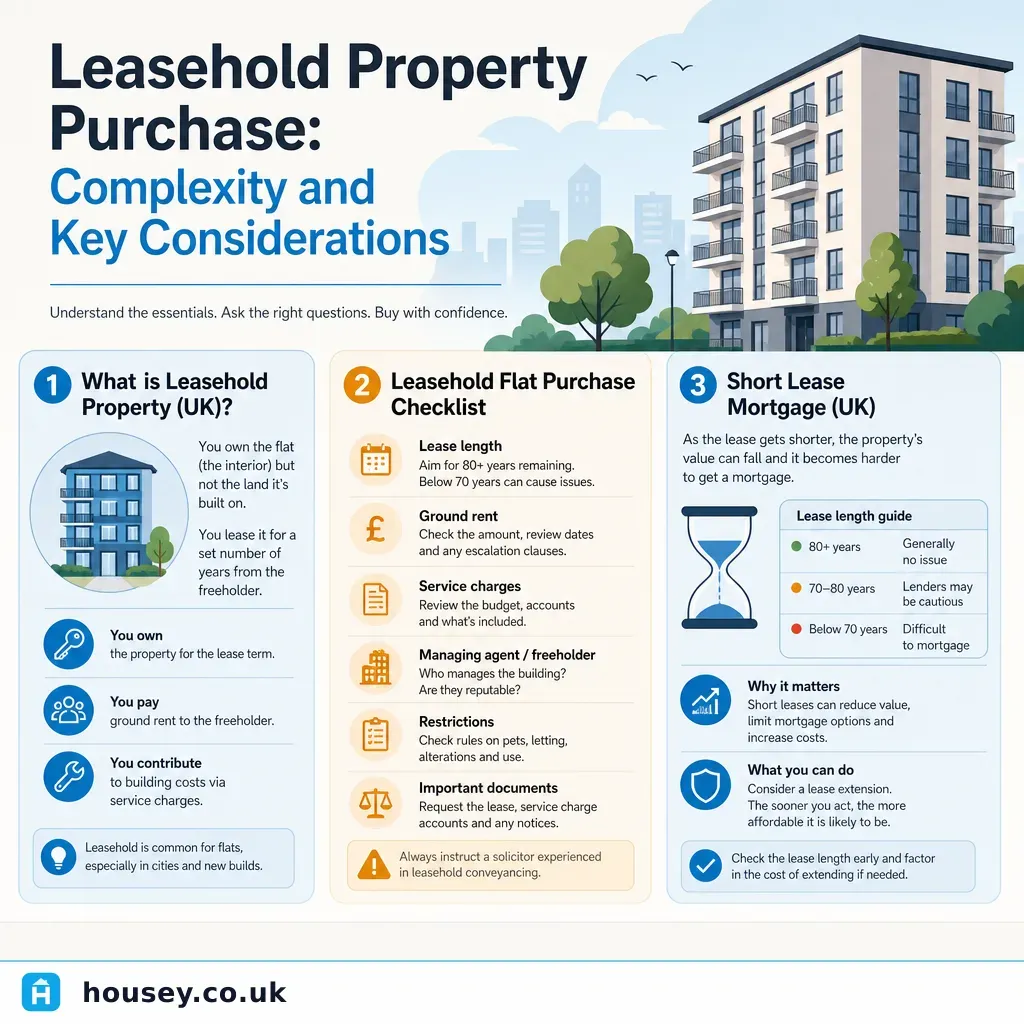
Leasehold Property Purchase: Complexity and Key Considerations
Buying a leasehold property means purchasing the right to occupy for a fixed term rather than owning the land outright.
 Buying & Moving
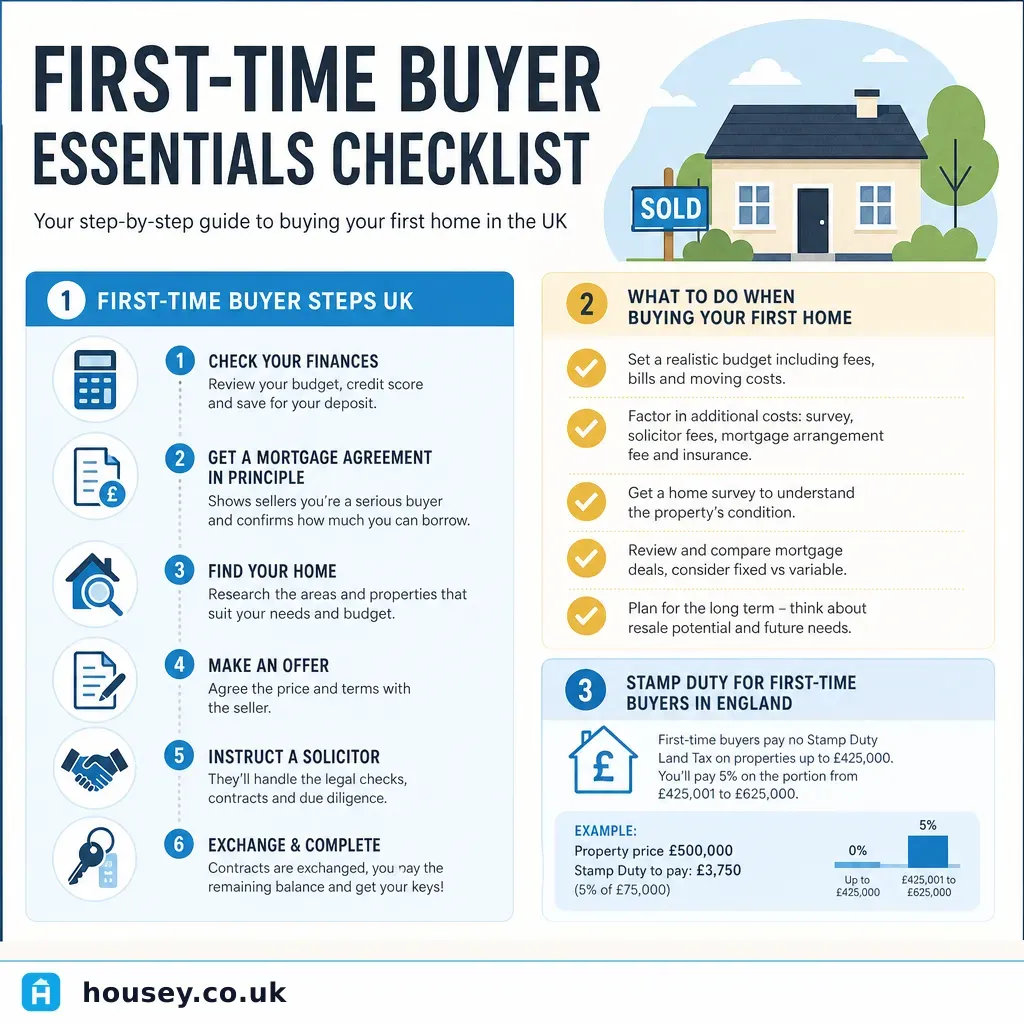
First-Time Buyer Essentials Checklist
Buying your first home involves obtaining a mortgage in principle, making an offer, instructing a solicitor, arranging a survey, and exchanging contracts before completion.