Gas vs Electric Heating: Installation and Running Cost Comparison
By Housey · Last reviewed 7th of May 2026
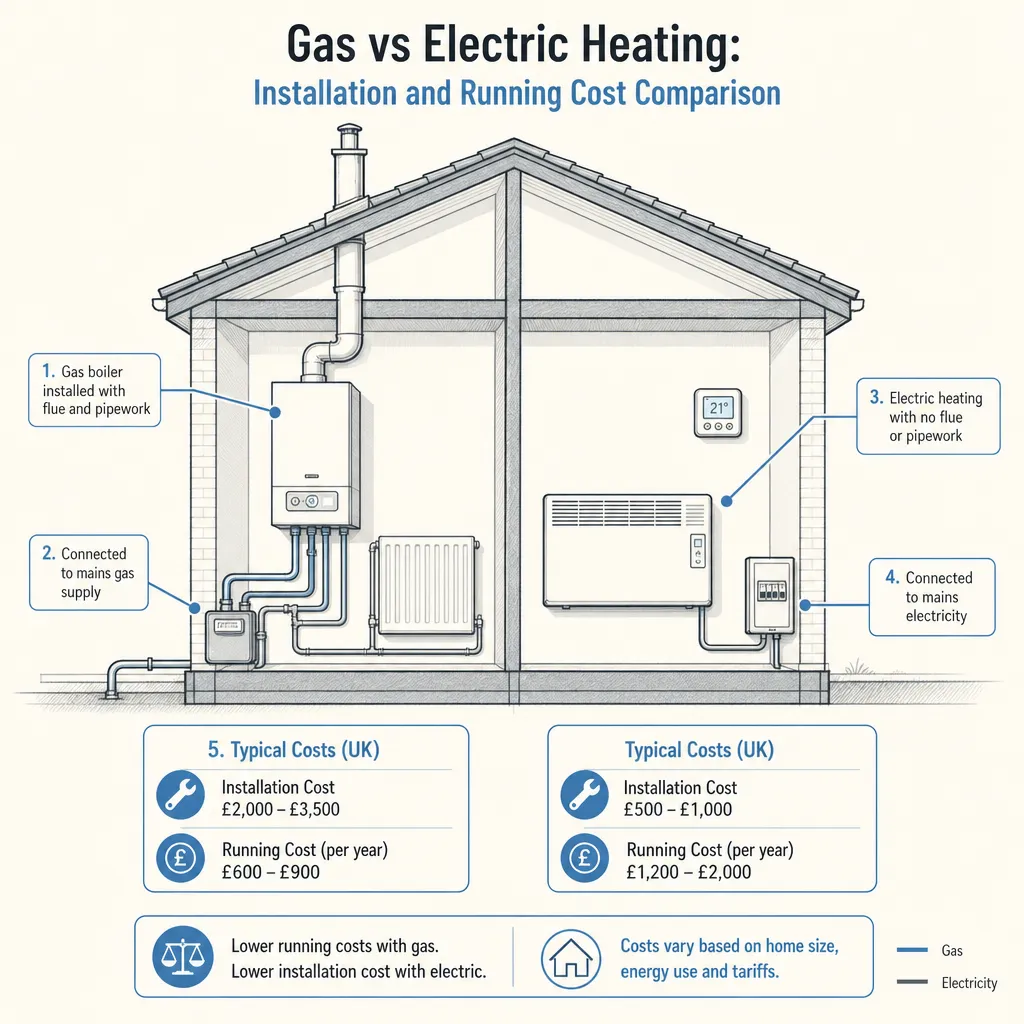
Gas vs Electric Heating: Installation and Running Cost Comparison
Choosing a heating system is one of the most consequential financial decisions a UK homeowner can make — one that often arises unexpectedly when a boiler fails, during a property purchase, or when planning energy improvements. With the Boiler Upgrade Scheme offering £7,500 toward heat pump installations and gas boilers facing a long-term phase-out in new-build homes, the case for reviewing your options has become more pressing for millions of UK households.
Key points
- The Ofgem energy price cap (April 2026) sets electricity at approximately 24.5p/kWh and gas at approximately 6.2p/kWh — direct electric heating costs around four times more per unit of energy than gas.
- Air source heat pumps (ASHPs) achieve a Coefficient of Performance (CoP) of 2.5–4.0, delivering 2.5–4 units of heat per unit of electricity consumed, significantly closing the running-cost gap with gas.
- The Boiler Upgrade Scheme (BUS) provides a £7,500 grant toward an ASHP or ground source heat pump in England and Wales, available through MCS-certified installers registered via GOV.UK.
- Gas combi boiler replacement costs £1,500–£4,000; an ASHP system costs £8,000–£18,000 before grants (indicative UK costs, last reviewed 2026-05-07).
- Building Regulations Part L requires all new heating installations to meet minimum efficiency standards; installations funded through government schemes must comply with PAS 2035.
Running costs compared
The comparison depends heavily on which type of electric system you are considering. Direct electric heating converts one unit of electricity into one unit of heat — the most expensive option per kWh. Heat pumps extract heat from outdoor air or the ground and concentrate it indoors, achieving efficiencies that make them genuinely competitive with gas in a well-insulated property.
Heating system | Approximate delivered heat cost | Efficiency | Notes |
|---|---|---|---|
Gas combi boiler | ~7–9p/kWh | 85–93% (ErP A-rated) | Condensing boilers required by Building Regs |
Direct electric (panel/storage heaters) | ~24–25p/kWh | ~100% | Simple to install; highest running cost |
Air source heat pump | ~6–10p/kWh (effective) | 250–400% (CoP 2.5–4.0) | Best in well-insulated homes |
Ground source heat pump | ~5–8p/kWh (effective) | 300–500% (CoP 3.0–5.0) | Highest install cost; most stable seasonal performance |
Indicative UK costs, last reviewed 2026-05-07. Actual costs depend on insulation level, tariff, and system operation.
For a typical 3-bedroom semi-detached home with 12,000 kWh annual heat demand: a gas boiler costs approximately £840–£1,080/year; direct electric approximately £2,940–£3,000/year; an ASHP at CoP 3.0 approximately £980–£1,000/year.
Installation costs compared
Installation costs vary by property type, existing infrastructure, and system complexity.
System | Typical cost before grants | Key variables |
|---|---|---|
Gas combi boiler (replacement) | £1,500–£4,000 | Flue type, brand, location |
Gas system boiler with cylinder | £2,500–£5,500 | Pipework condition, cylinder size |
Air source heat pump | £8,000–£18,000 | Outdoor unit siting, radiator upgrades |
Ground source heat pump | £15,000–£35,000 | Borehole depth, available land |
Direct electric (whole home) | £1,000–£5,000 | Room count, panel vs underfloor |
Indicative UK costs, last reviewed 2026-05-07. Obtain at least three quotes from qualified installers.
The BUS reduces the net cost of an ASHP or ground source heat pump by £7,500 for eligible properties in England and Wales. Scotland has the Home Energy Scotland grant scheme; Northern Ireland operates its own Boiler Replacement Scheme.
Switching from gas to a heat pump often requires radiator upgrades, improved insulation, and sometimes cylinder replacement. These associated works can add £2,000–£10,000 and should be included in any whole-system comparison.
Which system suits your property?
- Choose a gas boiler if your home is on the mains gas grid, insulation is moderate to poor, and you are not planning a full energy retrofit.
- Choose an air source heat pump if your home has good insulation (or you plan to upgrade), you qualify for the BUS grant, and you have space for an outdoor unit.
- Choose direct electric if your property is off-grid or you are heating a low-demand annexe or outbuilding.
- Ask an energy-efficiency consultant if your home has solid walls, unusual construction, or you are unsure whether your fabric is heat-pump ready without significant works.
- Check EPC requirements if you are a landlord — rental properties in England and Wales must achieve at least EPC band E.
Off-gas-grid properties
Around 4 million UK homes have no mains gas connection, concentrated in rural areas. For these households, air source heat pumps — particularly with BUS grant support — are increasingly the preferred retrofit choice. Oil and LPG boilers remain options where heat pump installation is impractical. Combining a heat pump with solar PV reduces effective running costs further.
Homeowner checklist before choosing a system
Important limitations
Running cost estimates depend on Ofgem tariff rates, system efficiency, occupancy patterns, and insulation levels — all of which vary between properties. Cost figures cited are indicative as of 2026-05-07 and will change as energy prices fluctuate.
All gas system work must be carried out by a Gas Safe registered engineer. Do not allow unregistered individuals to work on gas appliances or pipework.
Heat pump sizing must be based on a room-by-room heat loss calculation to BS EN 12831 or equivalent, not rules of thumb or the output rating of the boiler being replaced. For government-funded installations, your installer must hold MCS certification.
What to ask a qualified professional
- Are you Gas Safe registered (gas work) or MCS certified (heat pump installation)?
- Can you provide a room-by-room heat loss calculation to correctly size the system?
- Are radiator or emitter upgrades included in your quote?
- What building regulations certifications or notifications will be provided on completion?
- What is the expected system CoP at design outdoor temperature for this property?
- What warranty covers the equipment and the installation?
When to get professional help
Seek professional assessment before deciding if: your home has solid walls or non-standard construction; you are switching fuel type and unsure whether your fabric or emitters are adequate; you need to meet EPC compliance requirements as a landlord; or your boiler has failed and you are making decisions under pressure. Always use a Gas Safe registered engineer for any gas work.
How Housey can help
An energy-efficiency consultant can give an unbiased assessment of your property's readiness. Where a heat pump may suit, a heat pump survey assesses siting, sizing, and likely performance before you commit. For a full fabric-first review, a retrofit assessment is the right starting point.
Frequently asked questions
Is gas or electric heating cheaper to run in the UK?
Gas central heating is generally cheaper to run per unit of heat than direct electric heating. At Ofgem's April 2026 price cap rates, gas costs around 6.2p/kWh versus electricity at 24.5p/kWh. An air source heat pump at a CoP of 3.0 effectively delivers heat at around 8p/kWh — competitive with gas in a well-insulated home.
Will I need to replace my radiators if I switch to a heat pump?
Often yes. Heat pumps work best at lower flow temperatures (35–45°C) than gas boilers (60–80°C). Older radiators designed for high-temperature systems may not deliver sufficient output at these lower temperatures. Your installer should carry out a room-by-room heat loss calculation and identify which radiators need upsizing. Include this cost in your whole-system comparison.
Can I still install a gas boiler in an existing UK home?
Yes. There is no current ban on gas boilers in existing UK homes. The government aims to phase out new gas boiler installations in existing homes from 2035, subject to future legislation. New-build homes in England must not connect to the gas grid from 2025 under the Future Homes Standard, but existing properties are not currently affected.
What is the Boiler Upgrade Scheme and how do I apply?
The BUS provides £7,500 toward an air source or ground source heat pump for eligible properties in England and Wales. You must use an MCS-certified installer who applies for the grant voucher on your behalf — you do not apply directly. Check current eligibility and availability on GOV.UK before instructing an installer.
Does a heat pump work well in an older UK home?
Heat pumps can work in older homes, but performance depends heavily on insulation quality. Solid-wall Victorian and Edwardian properties typically need fabric improvements before a heat pump is cost-effective. A retrofit assessment under PAS 2035 will identify the right sequence of works. Some older homes with good cavity wall and loft insulation are already heat-pump ready.
Sources and further reading
- Energy price cap: check if it affects you — Ofgem
- Apply for the Boiler Upgrade Scheme — GOV.UK
- Heat pumps: how they work and their costs — Energy Saving Trust
- PAS 2035: Retrofitting dwellings for improved energy efficiency — BSI Group
- Approved Document L: Conservation of fuel and power — GOV.UK
Useful next reads
 Energy & Retrofit
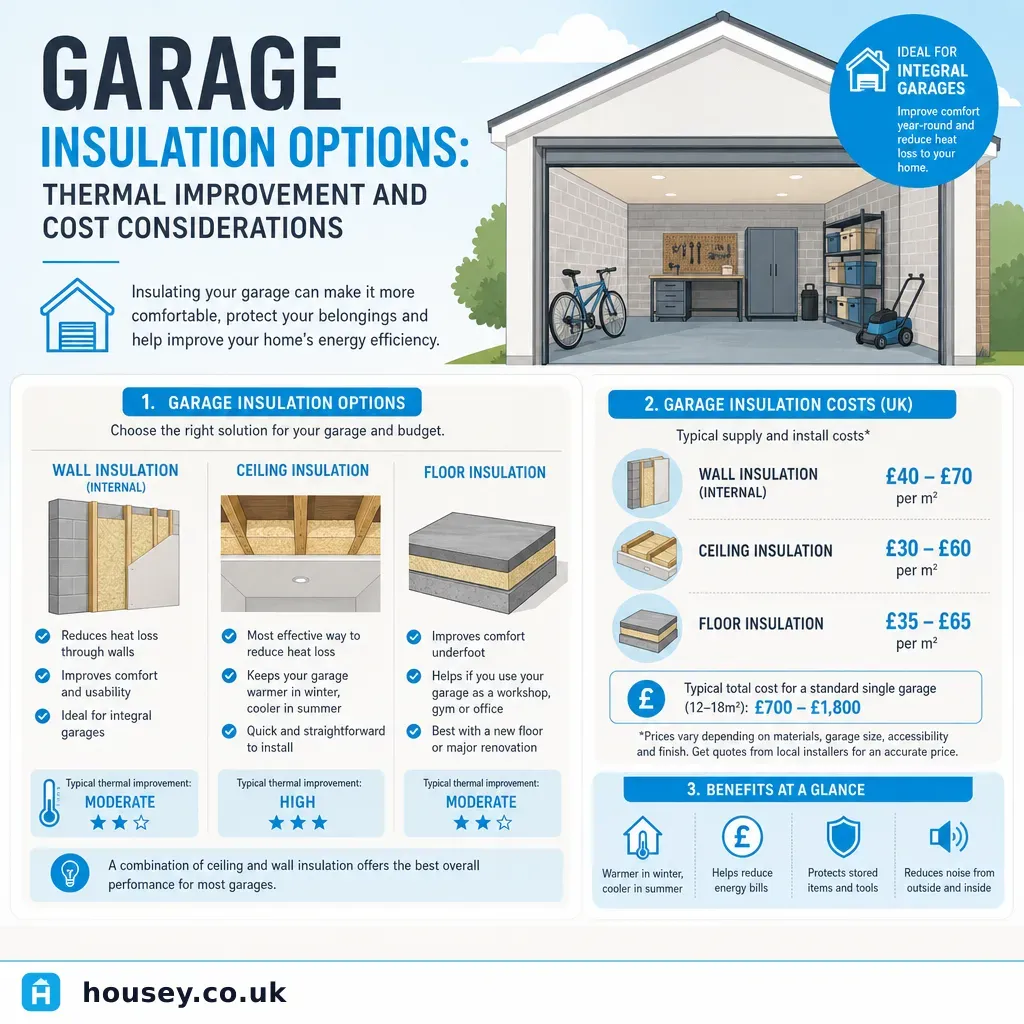
Garage Insulation Options: Thermal Improvement and Cost Considerations
Garage insulation options in the UK include mineral wool batts, rigid foam boards (PIR or EPS), and insulated garage doors.
 Energy & Retrofit
Electric Heating Systems: Options and Comparisons
Electric heating in the UK ranges from direct-acting radiators and storage heaters to heat pumps and electric boilers.
 Energy & Retrofit
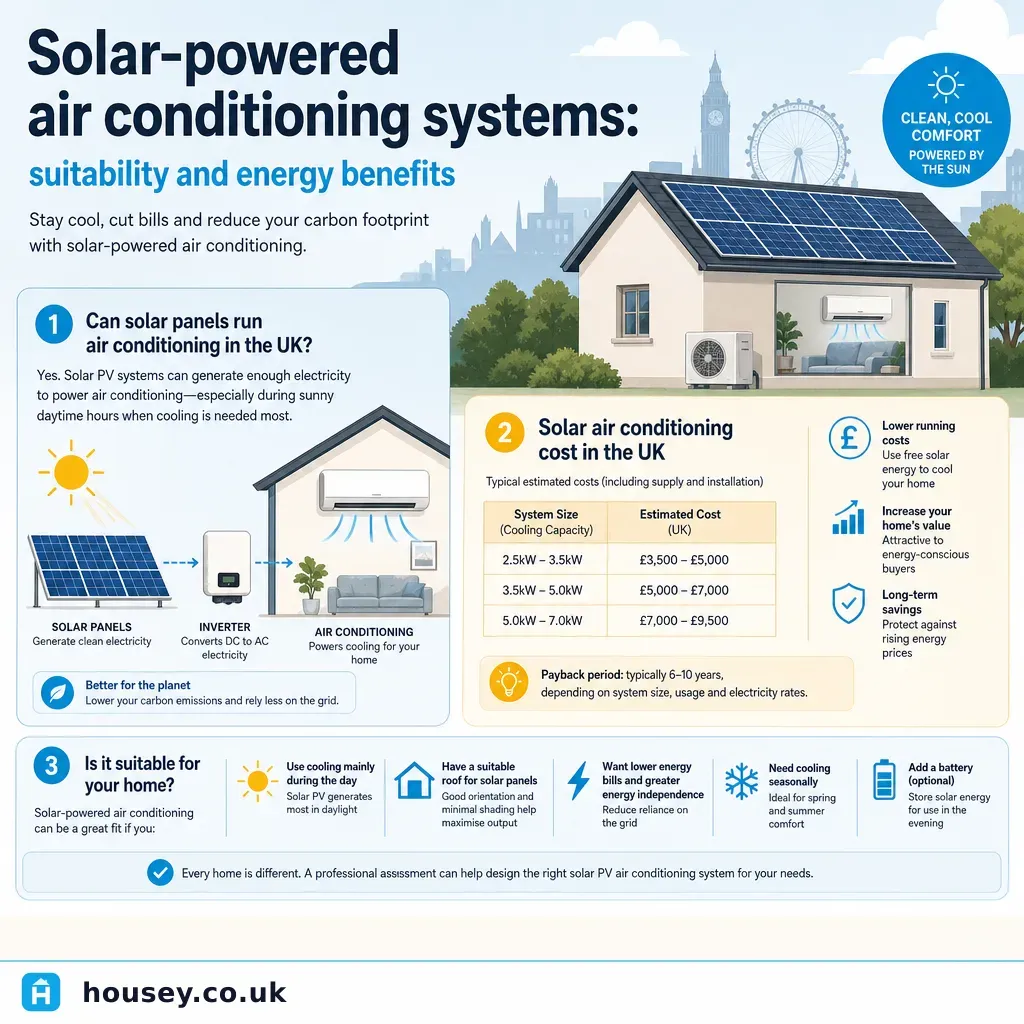
Solar-powered air conditioning systems: suitability and energy benefits
Solar-powered air conditioning pairs photovoltaic panels with an inverter-driven air conditioning unit to cool a home using renewable electricity.
 Energy & Retrofit
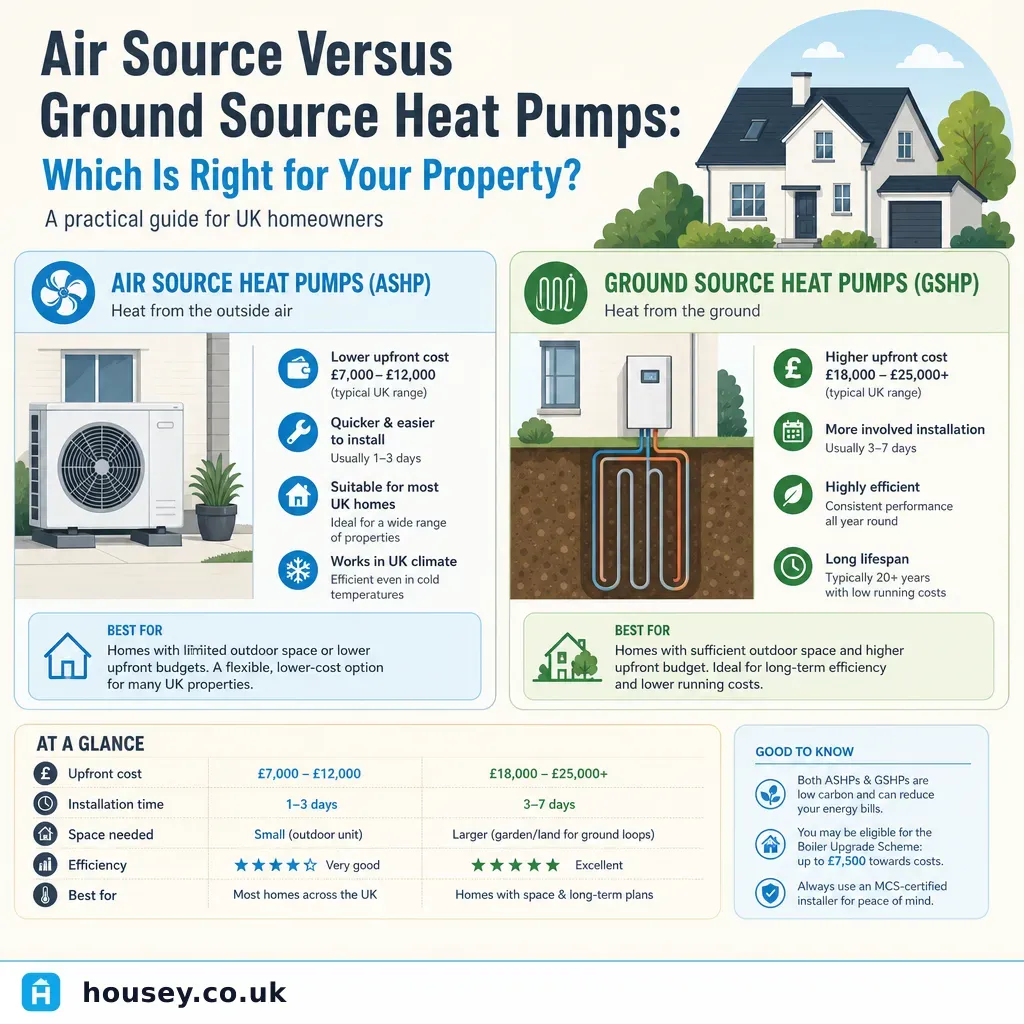
Air Source Versus Ground Source Heat Pumps: Which Is Right for Your Property?
Air source heat pumps (ASHPs) suit most UK properties with modest land requirements and faster installation, while ground source heat pumps (GSHPs) offer higher year-round efficiency but need significant land or borehole drilling and cost considerably more.
 Energy & Retrofit
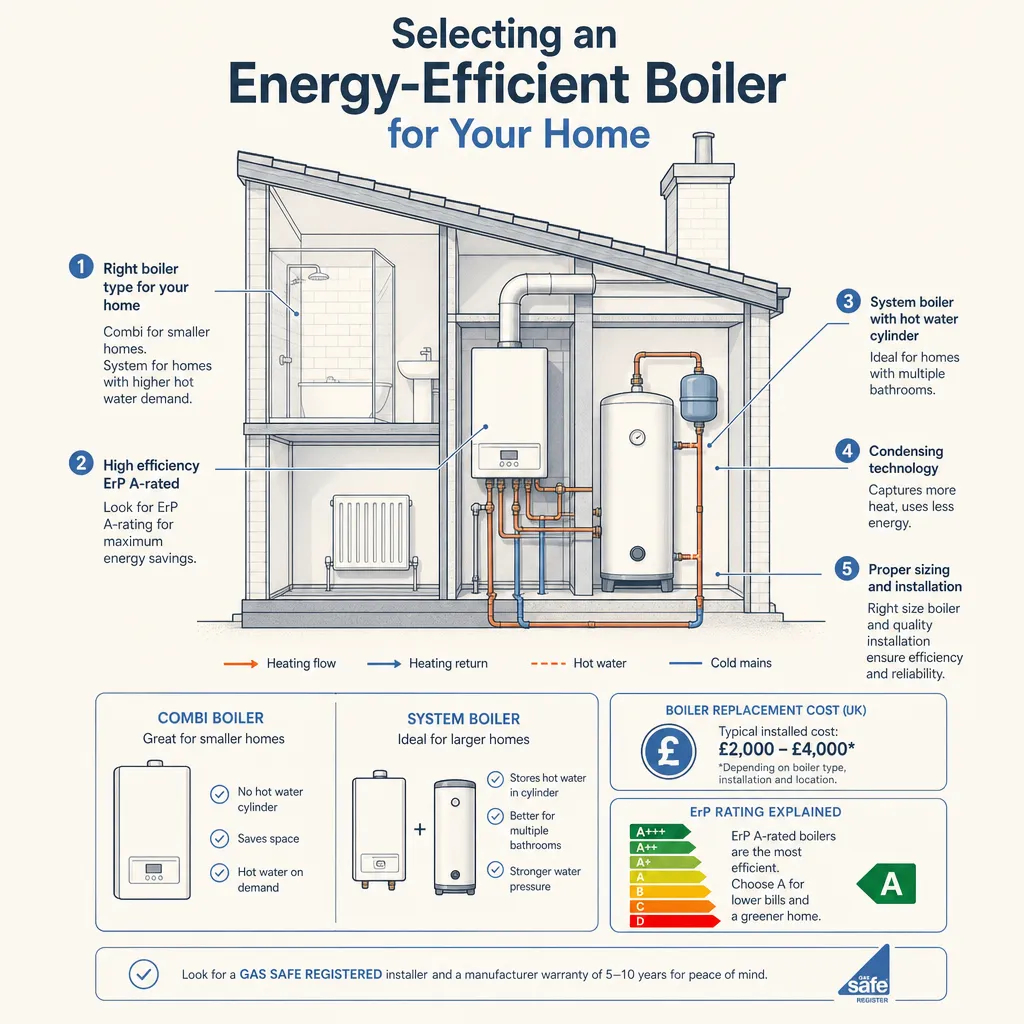
Selecting an Energy-Efficient Boiler for Your Home
For most UK homes, an A-rated condensing combi boiler is the most efficient and space-saving replacement.