Planning a Patio Project: Questions for Your Garden Contractor
By Housey · Last reviewed 18th of May 2026
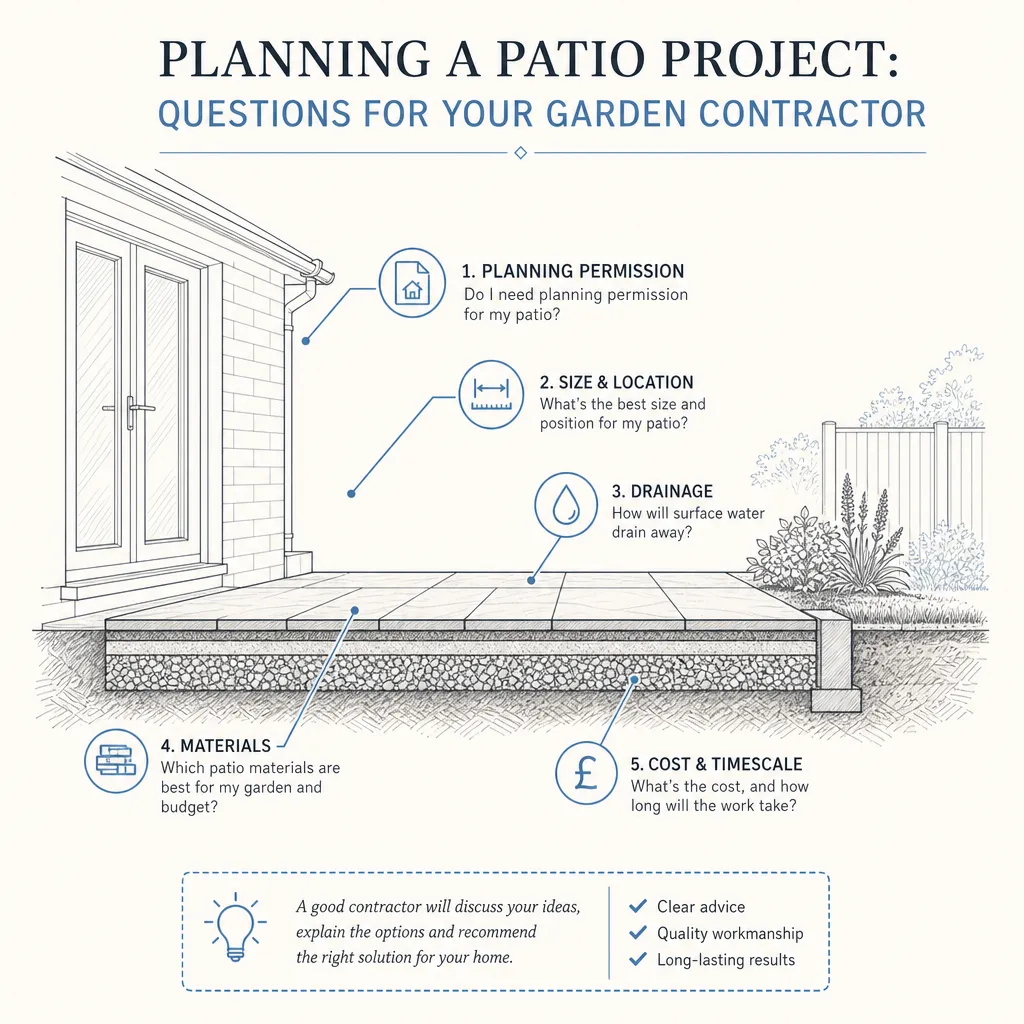
Planning a Patio Project: Questions for Your Garden Contractor
A new patio can transform how a garden is used, create practical outdoor living space, and in some cases improve a property's saleability — but poor planning, the wrong materials, or inadequate drainage can lead to pooling water, cracking, and expensive remediation. Whether you are replacing a tired concrete slab at a 1970s semi or creating a new entertaining terrace at a Victorian terrace, the questions you ask a garden contractor before work begins will shape the outcome as much as any material you choose.
Key points
- Patios laid at ground level in England generally fall under permitted development and do not require a planning application — but conservation areas, listed buildings, and raised terraces over 300 mm above natural ground level adjacent to the house are important exceptions.
- Under Building Regulations Part H, hard surfaces that drain towards a public sewer must be managed — permeable paving or a drainage channel directing water to a soakaway or surface-water drain is usually required.
- Natural stone and porcelain paving should be laid on a full cement mortar bed or a specialist adhesive system, not on a sand bed alone, to prevent rocking, cracking, and long-term movement.
- A drainage fall of approximately 1:60 (around 17 mm per metre) away from the house is the standard minimum to prevent surface water pooling near the foundations or damp-proof course.
- For outdoor paving exposed to UK winters, look for frost-resistant materials certified to EN 12372, or for porcelain, a slip-resistance rating of R11 or above for areas prone to wet conditions.
Does a patio need planning permission?
For most UK homeowners, patio work at ground level is permitted development — no planning application is required. There are, however, important exceptions worth checking before instructing a contractor.
- Conservation areas and Article 4 directions: Local authorities can withdraw permitted development rights within conservation areas. Check with your local planning authority (LPA) before starting any hard landscaping.
- Listed buildings: Any works to a listed building or its curtilage may require listed building consent, even if they appear minor. Contact Historic England or your LPA for guidance before proceeding.
- Raised terraces: A patio raised more than 300 mm above natural ground level adjacent to a dwelling may need planning permission because of potential privacy and overlooking impacts on neighbouring properties.
If you are uncertain, check with your local planning authority directly or consult the Planning Portal for permitted development guidance before instructing a contractor.
Comparing patio materials
Different paving materials carry very different maintenance requirements, durability, and cost profiles. This table covers the most common choices for UK residential patios:
Material | Best for | Maintenance | Typical cost (per m²) | Key risk |
|---|---|---|---|---|
Porcelain | Low-maintenance modern look, frost-resistant | Low — jet wash only | £60–£120 supply and lay | Slippery if not R11 rated; precise laying required |
Natural sandstone | Traditional look, warm tones | Sealing recommended annually | £50–£110 supply and lay | Staining, moss growth, requires periodic repointing |
Precast concrete slab | Budget-conscious projects, uniform finish | Low | £30–£70 supply and lay | Can look utilitarian; cracking risk if sub-base is thin |
Concrete block paving | Flexible, repairable surface | Moderate (weed control, re-sanding) | £50–£100 supply and lay | Weed ingress if not properly bedded and jointed |
Natural limestone | Elegant finish, durable | Sealing required; acid-sensitive | £65–£130 supply and lay | Slippery if polished; avoid near BBQs (acid etching risk) |
Indicative UK costs, last reviewed 2026-05-18. Prices vary by region, access, ground conditions, and contractor. Obtain at least three itemised quotes.
Homeowner checklist: before the contractor arrives
Use this checklist to prepare before hard landscaping work begins on your property.
What to ask your garden contractor
About qualifications and experience
- Can you provide references or photographs from comparable patio projects completed in the last 12 months?
- Are you a member of the British Association of Landscape Industries (BALI) or the Association of Professional Landscapers (APL)?
- Do you carry public liability insurance of at least £1 million, and can you share a current certificate?
About the specification
- What sub-base depth are you proposing, and why? (Typically 100–150 mm compacted MOT Type 1 hardcore for domestic patios.)
- What bedding method will you use — full mortar bed, semi-dry mix, or an adhesive system?
- How will drainage be handled, and is a channel or soakaway connection included in the quoted price?
- What drainage gradient away from the house are you building to?
- Will joints be filled with cement mortar, a resin-based jointing compound, or polymeric sand?
About the contract
- Is VAT included in the quoted price?
- What are the payment stages, and what deposit is required?
- How long will the project take, and what happens in the event of weather delays?
- What defects liability period do you offer, and what does it cover?
Red flags to watch for
- Proposing to lay paving directly on a sand bed without a proper sub-base or mortar bed — a reliable indicator of future movement and cracking.
- No discussion of drainage — a contractor who does not address where surface water will go is missing a critical element of any paved surface specification.
- No written quote or contract — for any project costing more than a few hundred pounds, verbal agreements are wholly inadequate.
- Quoting an implausibly short timeframe for a large or complex area — quality paving work cannot be rushed without increasing the risk of failure.
- Inability to specify the frost-resistance or slip-resistance rating of the proposed paving material.
When to get professional help
A competent landscaping contractor with hard landscaping experience should handle most domestic patio projects. Consider additional specialist input if:
- You want a raised terrace with structural retaining walls — an engineer or architect may need to review the structural design before work begins.
- The project is near a listed building or within a conservation area — consult your LPA or Historic England before committing to a specification.
- The site has persistent waterlogging or poor drainage — a drainage specialist should diagnose the underlying cause before paving over it.
- You are uncertain about the location of underground services — always check with LSBUD before any excavation.
How Housey can help
Housey connects homeowners with experienced landscapers and garden designers who specialise in hard landscaping and patio installation across the UK. For more substantial groundwork or drainage, you can also find groundworkers through the platform. Get up to four itemised quotes from local professionals and compare credentials before committing.
Frequently asked questions
Do I need to notify my neighbour before laying a patio?
For a patio within your own property boundary, no formal consent is normally required from a neighbour. However, if work will affect a shared or boundary wall, the Party Wall etc. Act 1996 may apply. Check your property boundaries carefully before starting, and consult a party wall surveyor if you are uncertain about any shared structures or boundary features.
How long should a new patio last?
With correct sub-base preparation, proper bedding, and effective drainage, a quality patio should last 20–30 years before significant remediation is needed. Porcelain and natural stone are particularly durable options. Budget precast concrete slabs may show noticeable wear within 10–15 years, especially in areas of heavy use or where drainage has not been adequately addressed.
Can I lay a patio myself?
Small, simple patios on level ground with straightforward drainage may be manageable as a DIY project for a careful and capable homeowner. However, inadequate sub-base preparation and poor drainage are the most common causes of patio failure, and mistakes are costly to undo. For larger areas, complex drainage situations, or premium materials such as porcelain or natural stone, using a qualified contractor typically offers better long-term value.
What is the difference between a landscaper and a groundworker for patio work?
A landscaper typically handles design, planting, and hard landscaping including patios and garden paths — the right choice for most domestic patio projects. A groundworker specialises in earthworks, drainage, and sub-base construction. For significant groundworks such as deep drainage runs, retaining structures, or large-scale excavation, a specialist groundworker may be needed alongside or instead of a general landscaper.
Sources and further reading
- Planning Portal — permitted development guidance — Planning Portal
- Building Regulations Approved Document H (drainage and waste disposal) — GOV.UK
- British Association of Landscape Industries (BALI) — BALI
- Linesearch Before U Dig (LSBUD) — LSBUD
- Historic England — listed buildings and planning — Historic England
Useful next reads
 Improvement & Build
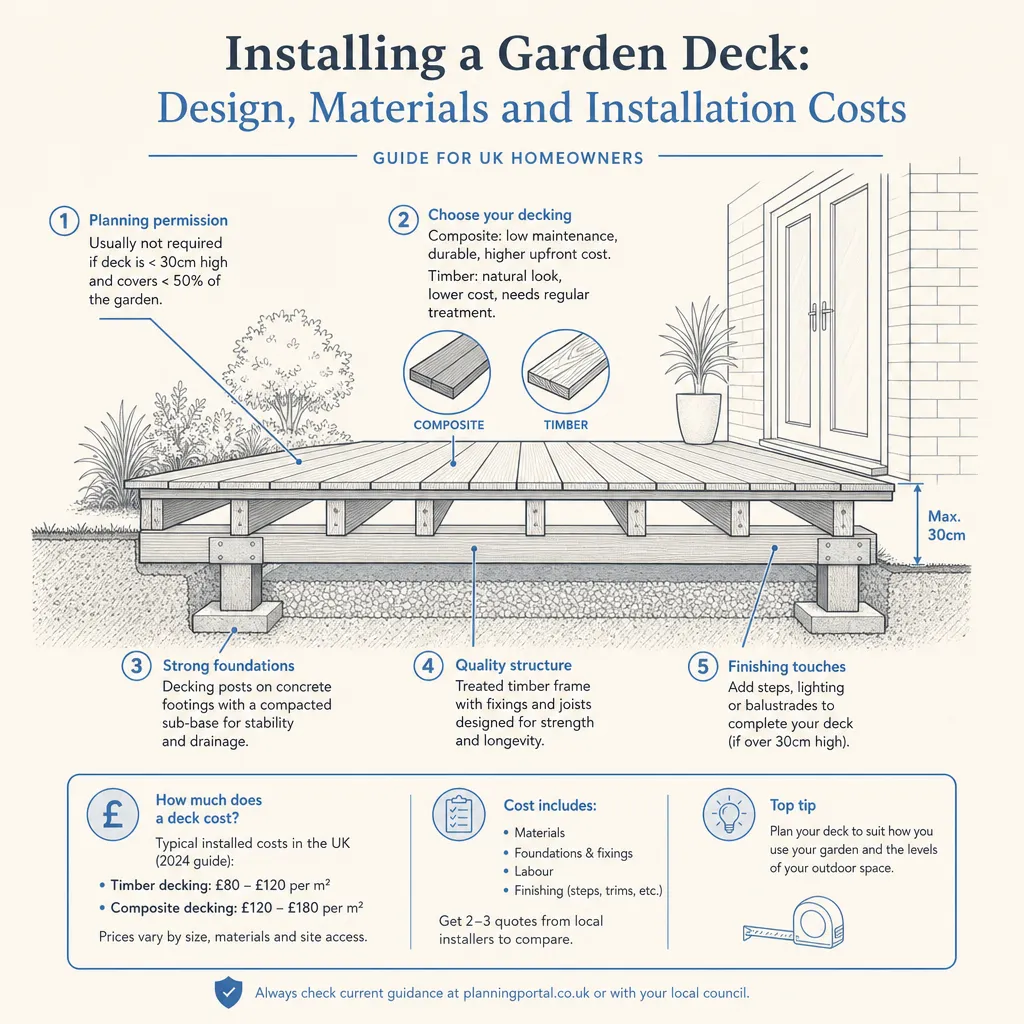
Installing a Garden Deck: Design, Materials and Installation Costs
Garden decking costs £80–250 per m² installed in the UK depending on material — softwood is cheapest, composite the most durable.
 Improvement & Build
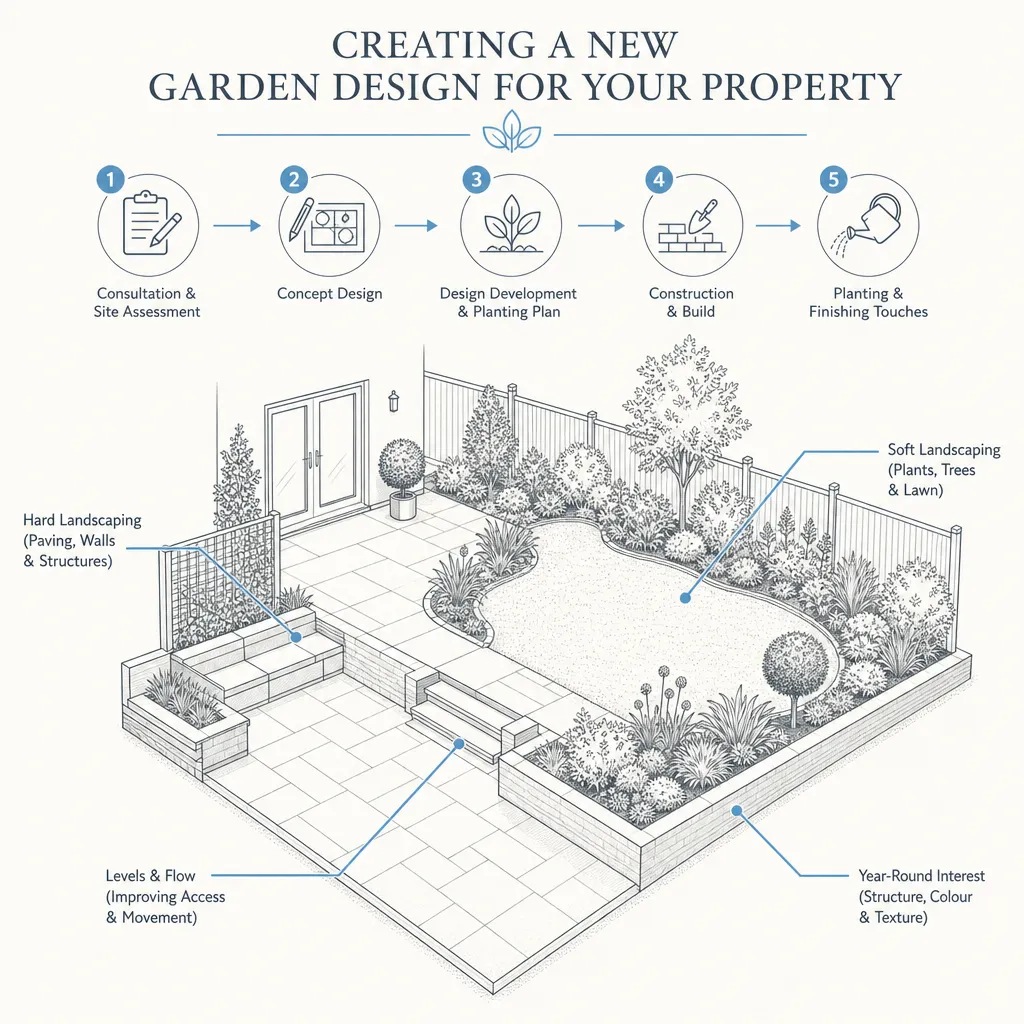
Creating a New Garden Design for Your Property
Creating a new garden design involves assessing your space, setting a realistic budget, deciding on hard and soft landscaping, and choosing a planting scheme suited to your soil and aspect.
 Improvement & Build
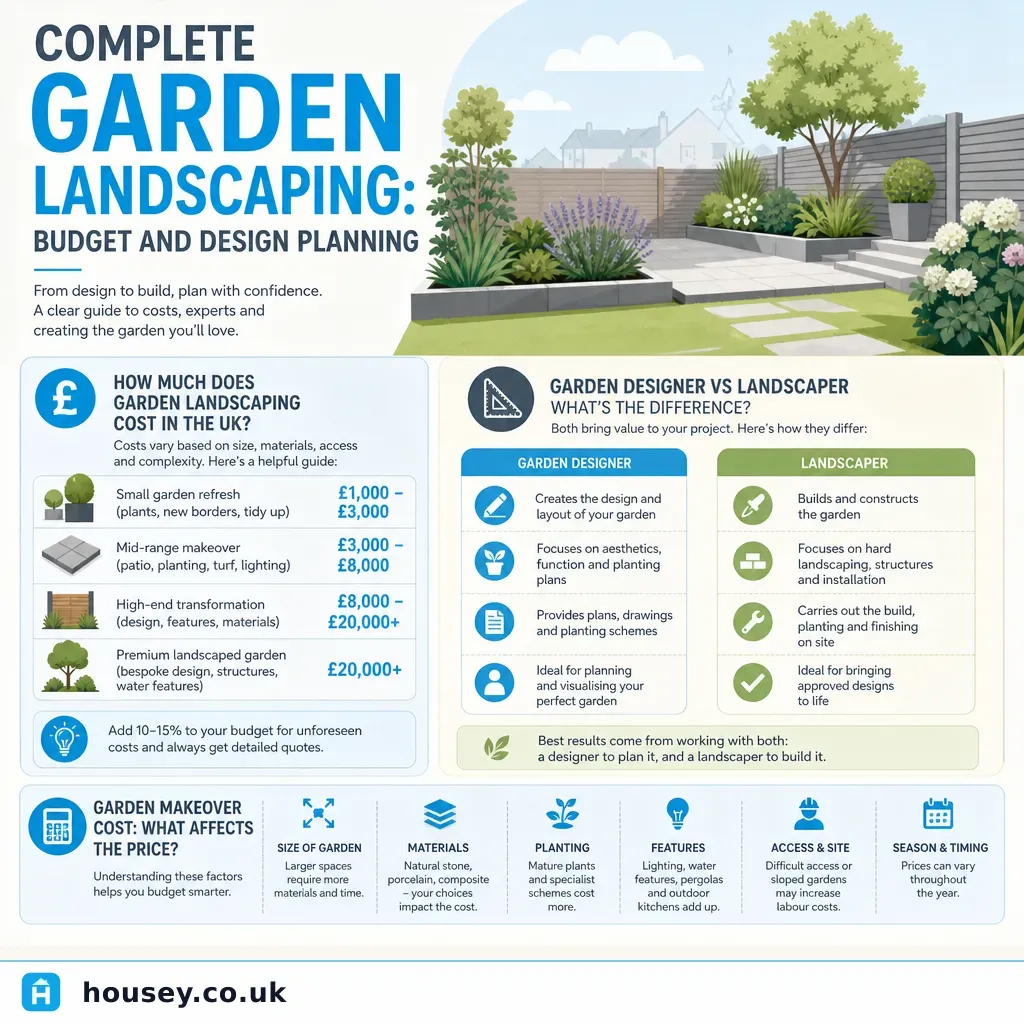
Complete Garden Landscaping: Budget and Design Planning
A mid-range garden landscaping project in the UK typically costs £75–£200 per square metre, covering design, hard landscaping, and planting.
 Improvement & Build
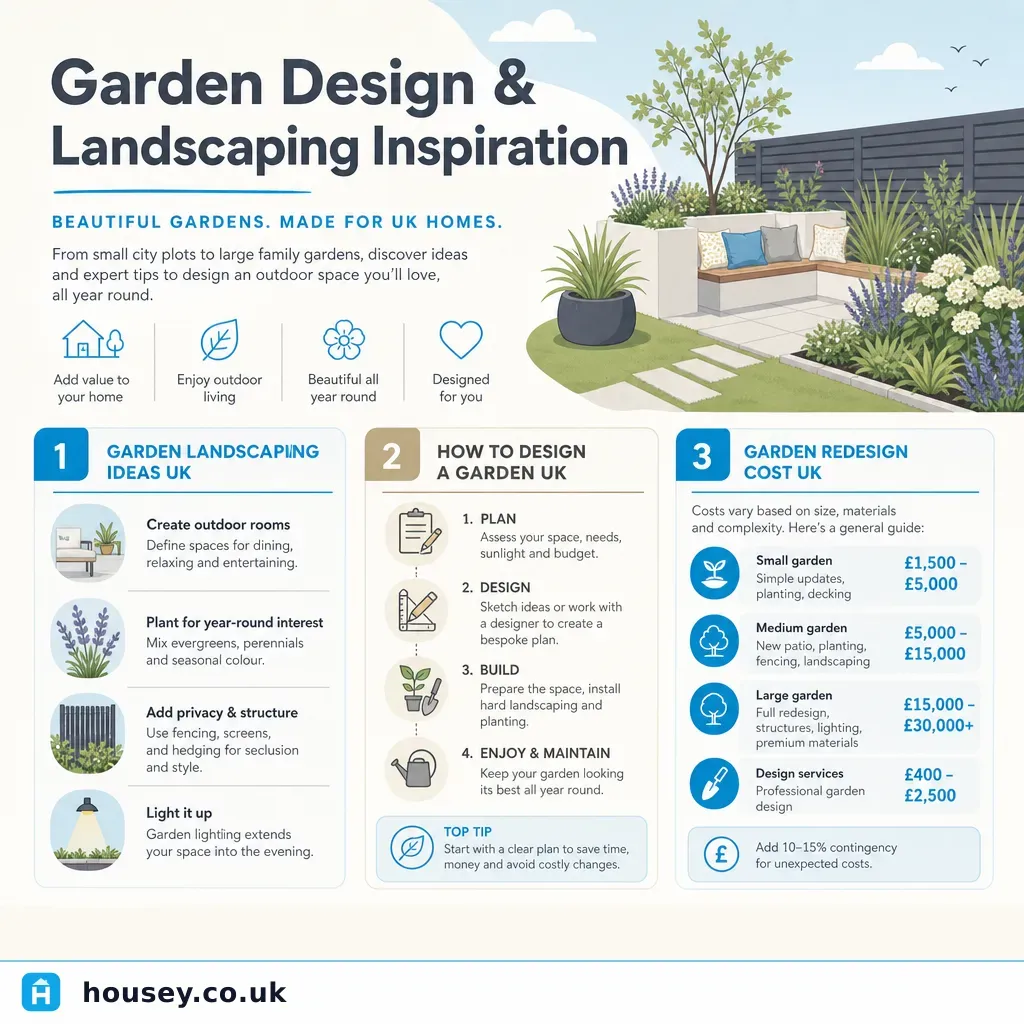
Garden Design and Landscaping Inspiration
Effective garden design starts with assessing your aspect, soil type, and existing features before commissioning any planting or hard landscaping.
 Improvement & Build
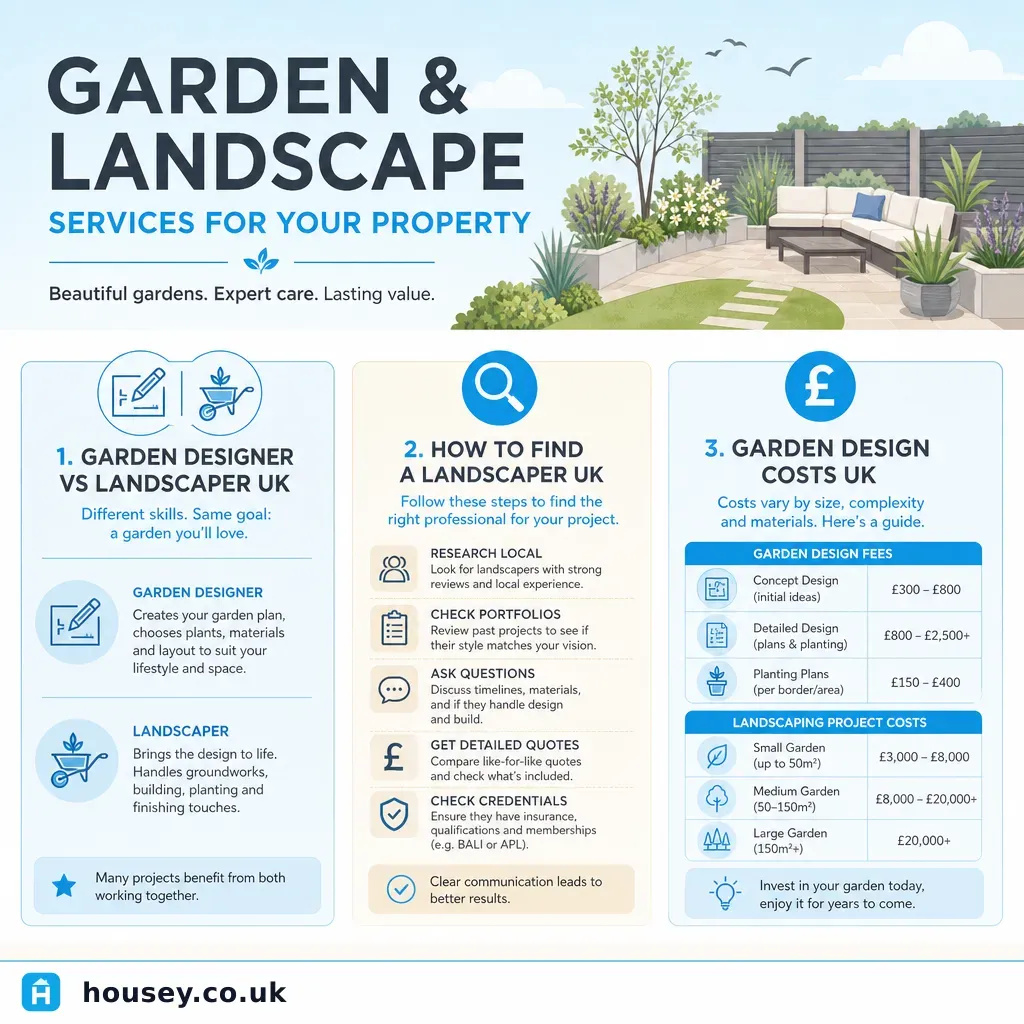
Garden and Landscape Services for Your Property
Garden designers and landscapers both improve outdoor spaces but offer different services.