Garden and Landscape Services for Your Property
By Housey · Last reviewed 24th of May 2026
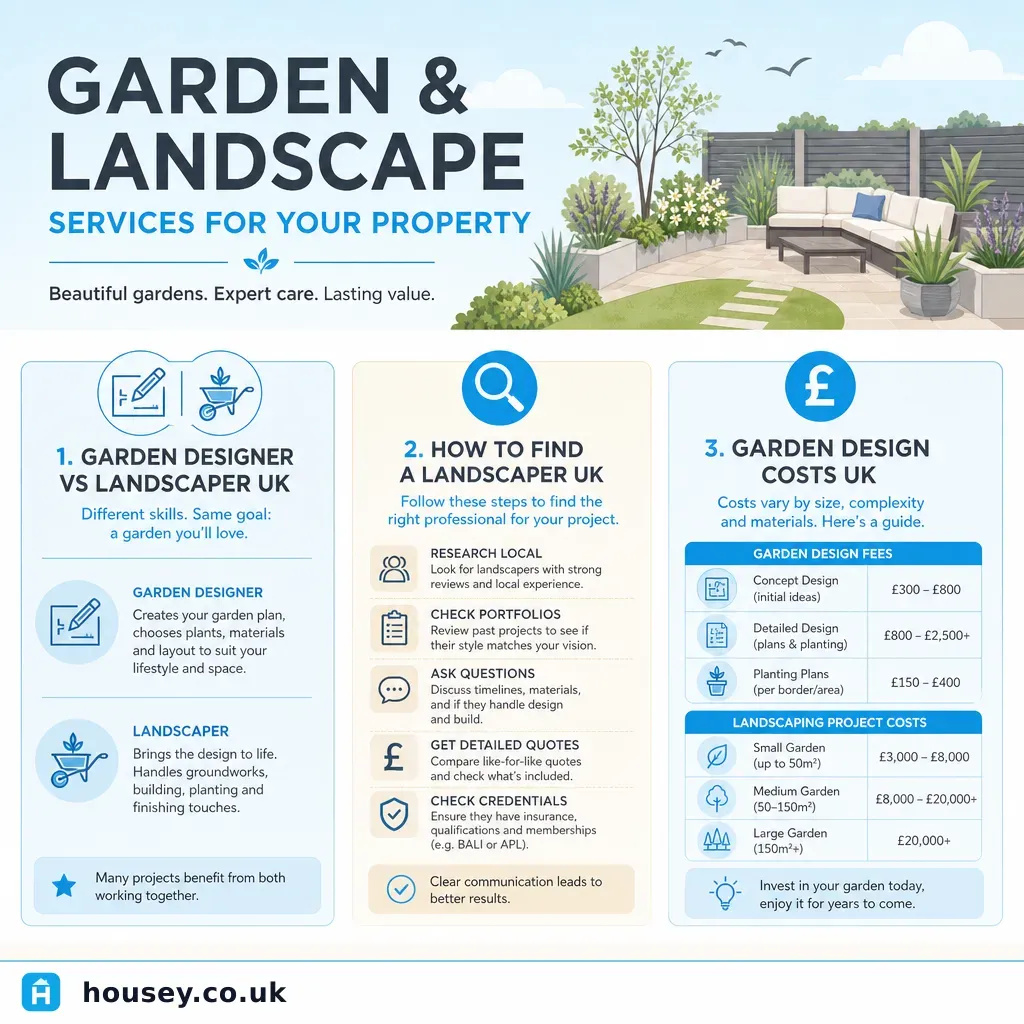
Garden and Landscape Services for Your Property
A well-designed garden adds usable space, improves kerb appeal, and can meaningfully contribute to a property's market value — but getting there usually requires the right professional for the job. Whether you are tackling an overgrown plot after moving into a new home, planning hard landscaping on an urban courtyard, or looking for a full garden redesign, understanding who does what — and when to bring them in — makes the whole process considerably more straightforward.
Key points
- Garden designers typically focus on spatial planning, planting schemes, and design vision; the Society of Garden Designers (SGD) is the main professional body, with Registered Members having demonstrated assessed competence.
- Landscapers carry out physical construction work — patios, walls, paths, drainage, decking, and planting; the British Association of Landscape Industries (BALI) is the principal trade association for the sector.
- Trees covered by a Tree Preservation Order (TPO) require written consent from the local planning authority before any pruning or removal — carrying out unauthorised TPO work is a criminal offence.
- Permitted development rights cover many garden structures, but size, height, and proximity to boundaries are governed under Schedule 2, Part 1 of the Town and Country Planning (General Permitted Development) (England) Order 2015.
- Significant excavations or wall construction near a shared boundary may engage the Party Wall etc. Act 1996 — check before starting work close to a neighbour's property or foundations.
Which professional do you need?
Professional | What they do | Professional body | When to hire |
|---|---|---|---|
Garden designer | Creates concept drawings, planting plans, and detailed design; may project-manage installation | Society of Garden Designers (SGD) | At the start of a significant redesign, before ground is broken |
Landscape gardener / landscaper | Carries out physical works: patios, walls, paths, planting, turf, drainage | British Association of Landscape Industries (BALI) | To implement a design, or for straightforward practical works without a full design brief |
Chartered landscape architect | Complex projects involving planning, ecology, large earthworks, or public space elements | Landscape Institute (LI) | Major projects, planning-sensitive sites, or where a landscape statement is required for a planning application |
Arborist / tree surgeon | Tree surveys, pruning, removal, TPO applications, BS 5837 surveys | Arboricultural Association | Any tree work, TPO queries, or pre-development tree surveys |
Most residential garden projects use either a garden designer alone (who then oversees a landscaper), a landscaper alone for simpler works, or both working together from the outset.
Types of garden and landscape service
Hard landscaping
Hard landscaping covers fixed structural elements: patios in natural stone, porcelain, or block paving; pathways; retaining walls; steps; raised beds; water features; fencing; and boundary walls. Depending on complexity, this work often involves sub-contractors for drainage, groundworks, or brickwork.
Soft landscaping
Soft landscaping covers living elements: turf laying, planting of shrubs, trees, and perennials, wildflower meadows, hedging, and green roofs. A garden designer prepares the planting plan specifying species, quantities, and spacing; the landscaper then implements it on site.
Garden maintenance
Separate from design and construction, ongoing maintenance covers mowing, pruning, weeding, feeding, and seasonal planting. Many landscaping companies offer maintenance contracts; specialist garden maintenance firms focus exclusively on upkeep rather than installation.
Garden rooms and structures
Garden rooms, summer houses, and outbuildings are popular additions to UK properties. Many fall within permitted development, but building regulations can apply if the structure is to be used as habitable space, includes electrical installations, or exceeds specified floor area thresholds. A garden room specialist or your local building control team can clarify what applies to your project.
Planning and legal considerations
Landscaping work can require permissions that homeowners sometimes overlook:
Tree Preservation Orders: Any pruning or removal of a tree covered by a TPO requires written consent from the local planning authority first. Your landscaper or arborist should check for TPOs before starting — you can also search your local council's planning portal. In a conservation area, you must give the local planning authority six weeks' notice before carrying out significant work to a tree above a specified size threshold, even without a TPO.
Permitted development for structures: Garden buildings, sheds, and pergolas may qualify as permitted development, but limits apply. Generally, structures within 2 m of a boundary must not exceed 2.5 m in height, and the total footprint of outbuildings must not cover more than 50% of the curtilage. Rules differ in designated areas such as National Parks and Areas of Outstanding Natural Beauty — check with your local planning authority.
Party wall and boundary works: Significant excavations or wall construction close to a shared boundary may engage the Party Wall etc. Act 1996. A party wall surveyor can advise if you are planning works within 3 m of a neighbour's foundations or intend to build on or at a boundary line.
Drainage and hard surfacing: Significant hard landscaping that increases surface water run-off may have drainage implications, particularly in flood-risk areas. Permeable paving options — such as gravel, permeable block paving, or open-joint paving — can reduce this risk and may be required or encouraged by some local planning authorities.
Homeowner checklist: before hiring a garden or landscape professional
Work through the following before requesting quotes:
When to get professional help
Most garden and landscaping work carries low risk, but professional advice is essential in these situations:
- Tree work: Always use an Arboricultural Association-approved contractor for any significant tree work. Working at height with chainsaws without proper training is dangerous. If there is any possibility of a TPO, check with the council before touching the tree.
- Drainage problems: Persistent waterlogging or seasonal flooding suggests an underlying drainage issue that should be diagnosed before landscaping masks the cause.
- Retaining walls: Walls holding back a significant mass of earth are structural elements. An experienced retaining wall specialist or structural engineer should be involved in the design where walls exceed a modest height.
- Significant changes in level: Large earthworks that could affect neighbouring properties or surface water drainage require careful assessment by a landscape architect or engineer before works commence.
How Housey can help
Housey helps homeowners find and compare trusted local professionals for the full range of outdoor projects. Whether you need garden designers to develop a concept and planting plan, or landscapers to carry out physical works, you can request quotes, review credentials, and compare professionals in your area through Housey.
Frequently asked questions
Do I need planning permission for a garden patio or decking?
In most cases, a patio or decking area in England does not need planning permission as permitted development, provided it is at ground level or no more than 300 mm above it, does not cover more than 50% of the garden, and is not in front of the principal elevation. Listed buildings and some conservation areas may have additional restrictions — check with your local planning authority if in doubt.
What qualifications should a landscaper have?
There is no single mandatory qualification for landscape gardeners in the UK. However, membership of the British Association of Landscape Industries (BALI) indicates a contractor has been assessed against professional standards. For design-led work, look for membership or registration with the Society of Garden Designers (SGD). Always ask to see examples of comparable previous projects and contact references before hiring.
How long does a typical garden landscaping project take?
Duration depends heavily on scope. A straightforward patio installation might take two to five days. A full garden redesign including hard and soft landscaping, drainage, and planting could take several weeks, with some planting best completed in autumn or spring. Your designer or landscaper should provide a project programme at the quote stage so you can plan accordingly.
Can a garden designer manage the build as well?
Many garden designers offer a project management service covering appointment of landscapers, site supervision, and snagging. This adds to the overall cost but can significantly reduce the homeowner's workload on complex projects. Clarify at the outset whether design, project management, and installation are quoted separately or as a package, and what the designer's involvement is during the construction phase.
Sources and further reading
- Society of Garden Designers (SGD) — SGD
- British Association of Landscape Industries (BALI) — BALI
- Landscape Institute — Landscape Institute
- Tree Preservation Orders and trees in conservation areas — GOV.UK
- Permitted development rights for householders — GOV.UK
- Party Wall etc. Act 1996 — legislation.gov.uk
Useful next reads
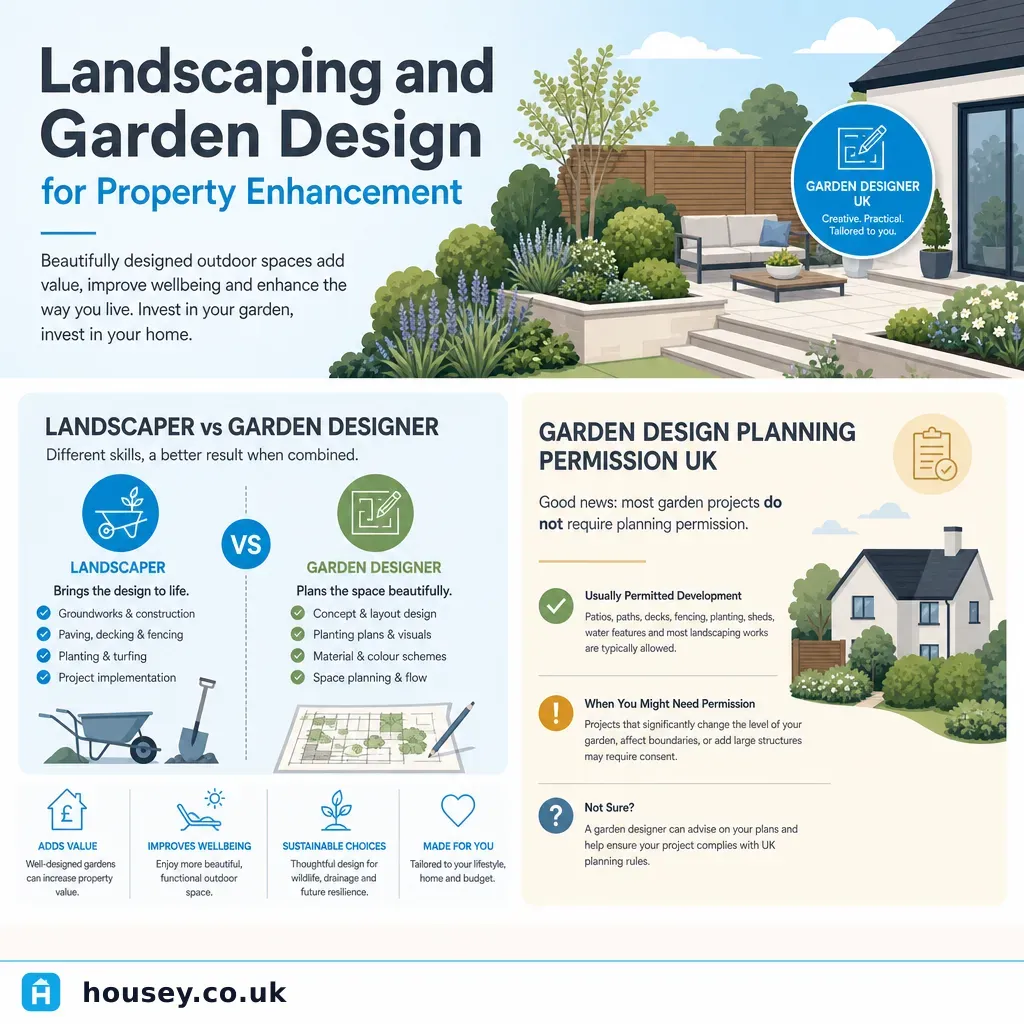 Improvement & Build
Landscaping and Garden Design for Property Enhancement
Landscaping and garden design involve planning and building outdoor spaces — from patios and raised beds to planting schemes and drainage.
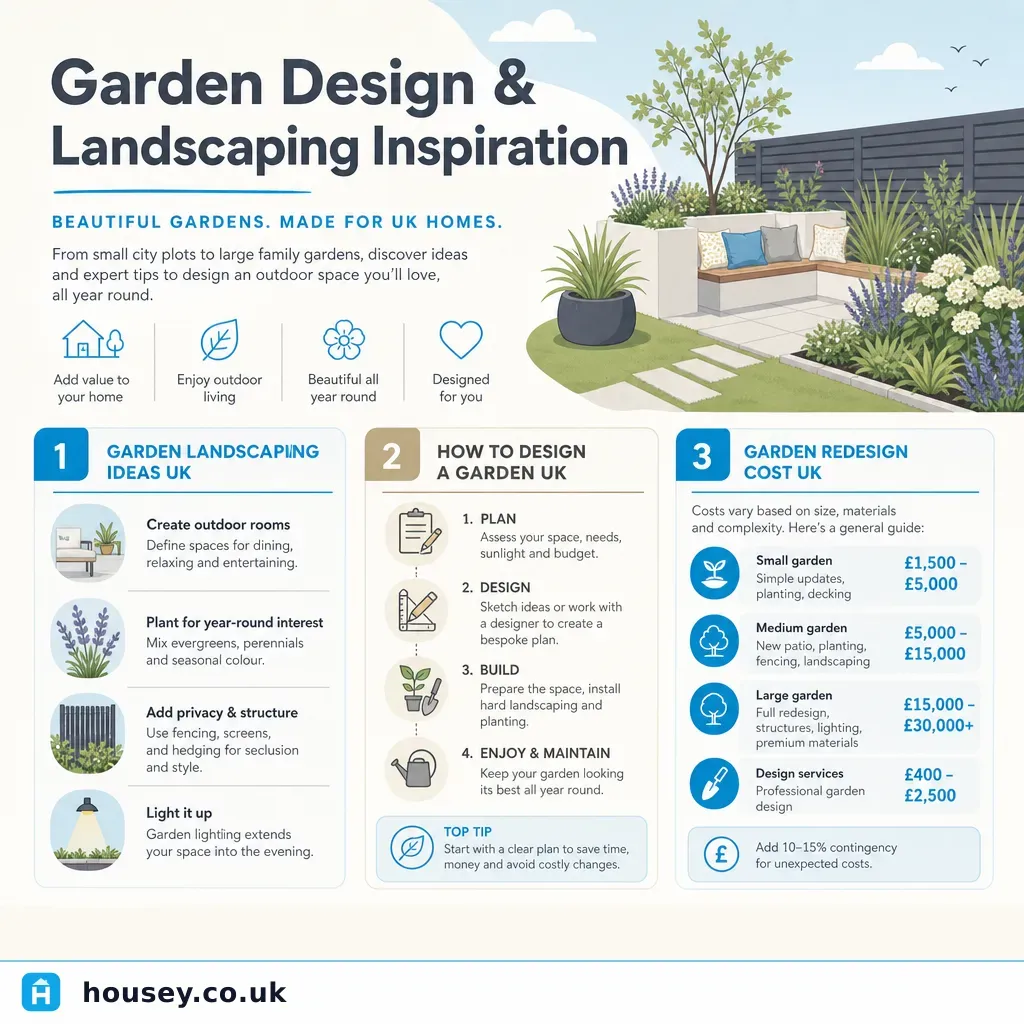 Improvement & Build
Garden Design and Landscaping Inspiration
Effective garden design starts with assessing your aspect, soil type, and existing features before commissioning any planting or hard landscaping.
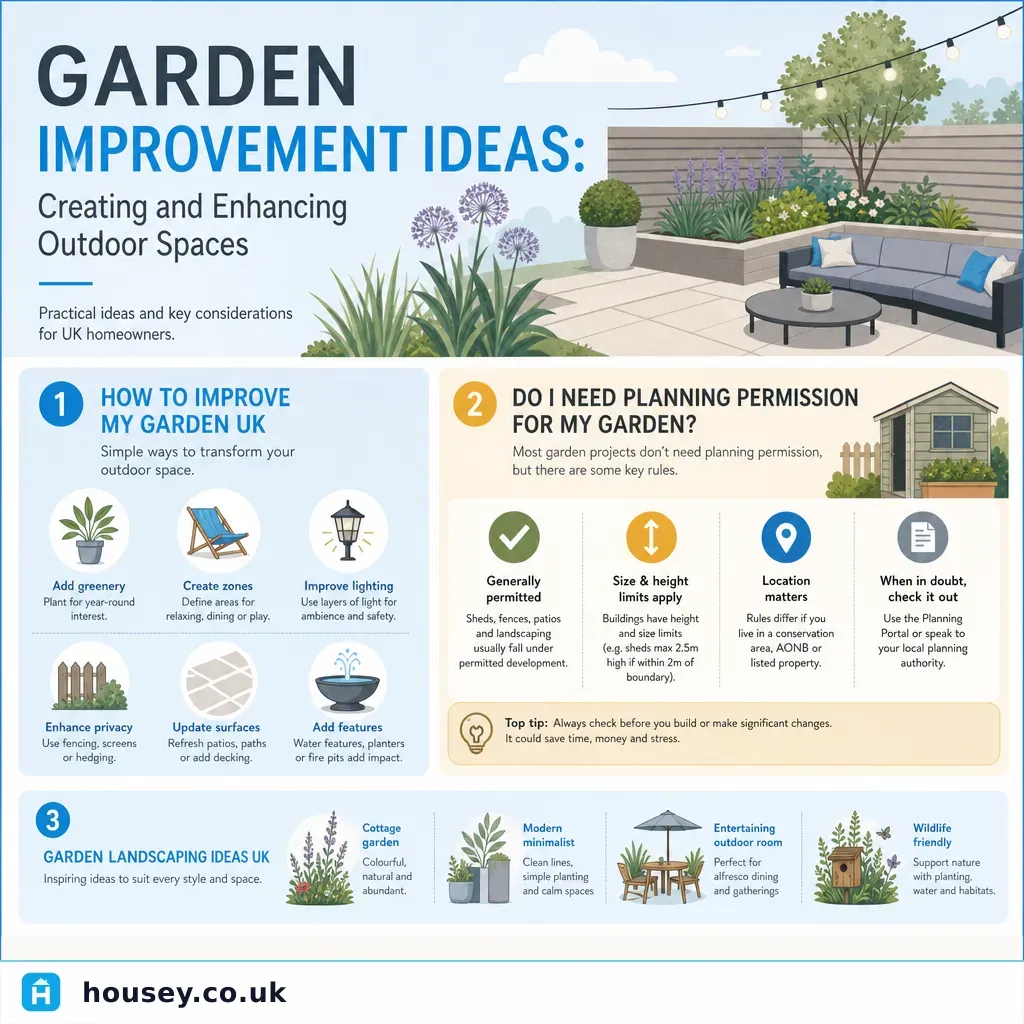 Improvement & Build
Garden Improvement Ideas: Creating and Enhancing Outdoor Spaces
Improving your garden in the UK usually starts with a clear plan covering hard landscaping, soft planting, and any structural elements.
 Improvement & Build
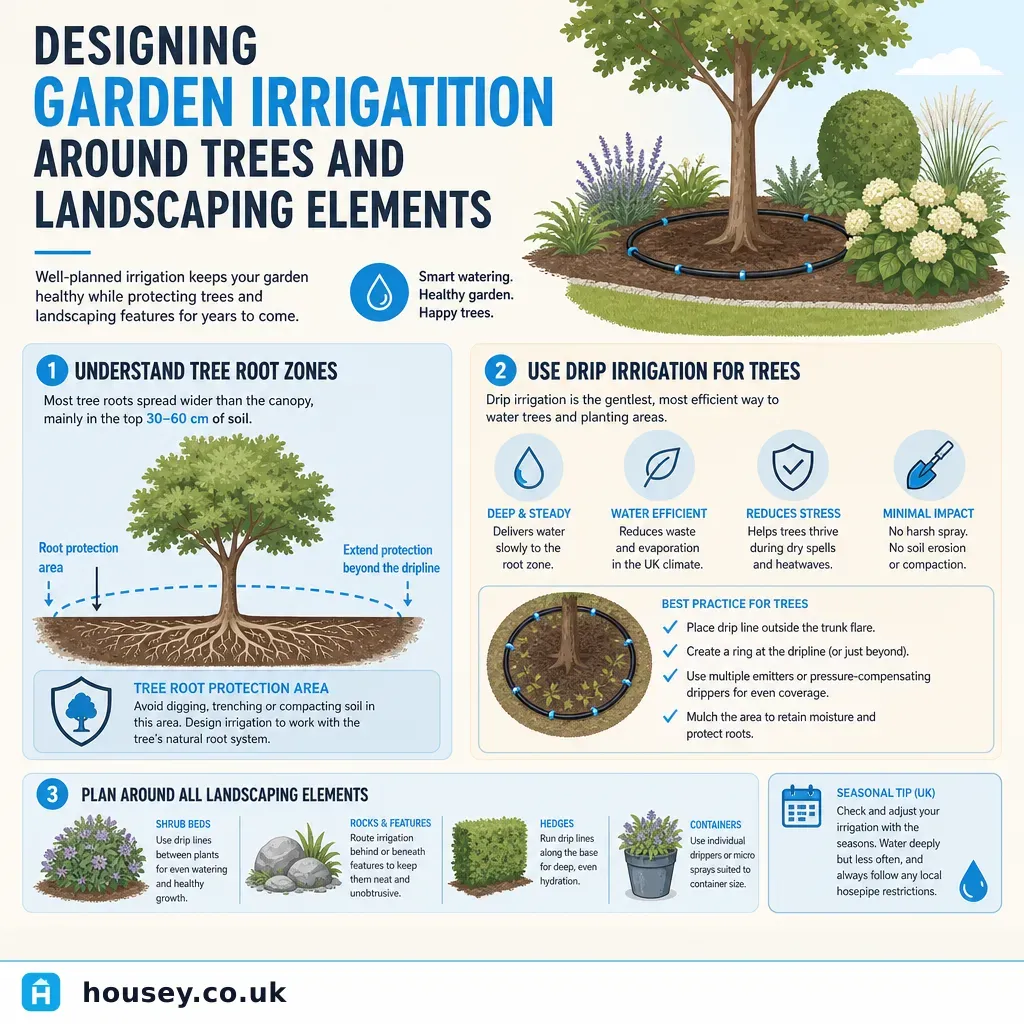
Designing Garden Irrigation Around Trees and Landscaping Elements
Design irrigation around trees by respecting the root protection area defined under BS 5837:2012, using drip or leaky pipe delivery rather than spray heads, and putting the tree zone on its own circuit.
 Improvement & Build
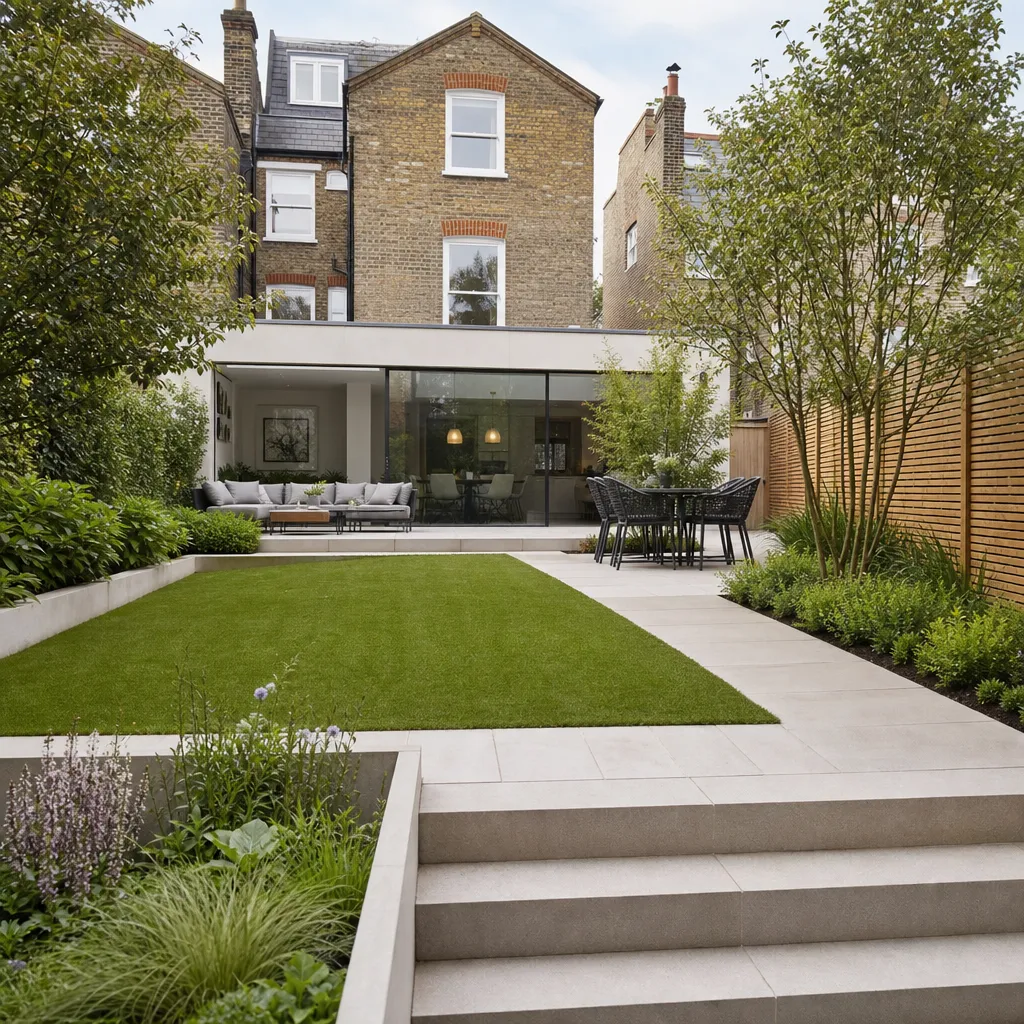
Garden Design Trends and Contemporary Landscaping Ideas
Contemporary UK garden design centres on low-maintenance naturalistic planting, multi-functional outdoor spaces, sustainable hard landscaping materials, and wildlife-friendly rewilded areas.