Pre-Sale Property Cleaning: Presentation Strategies for Home Surveys
By Housey · Last reviewed 24th of May 2026
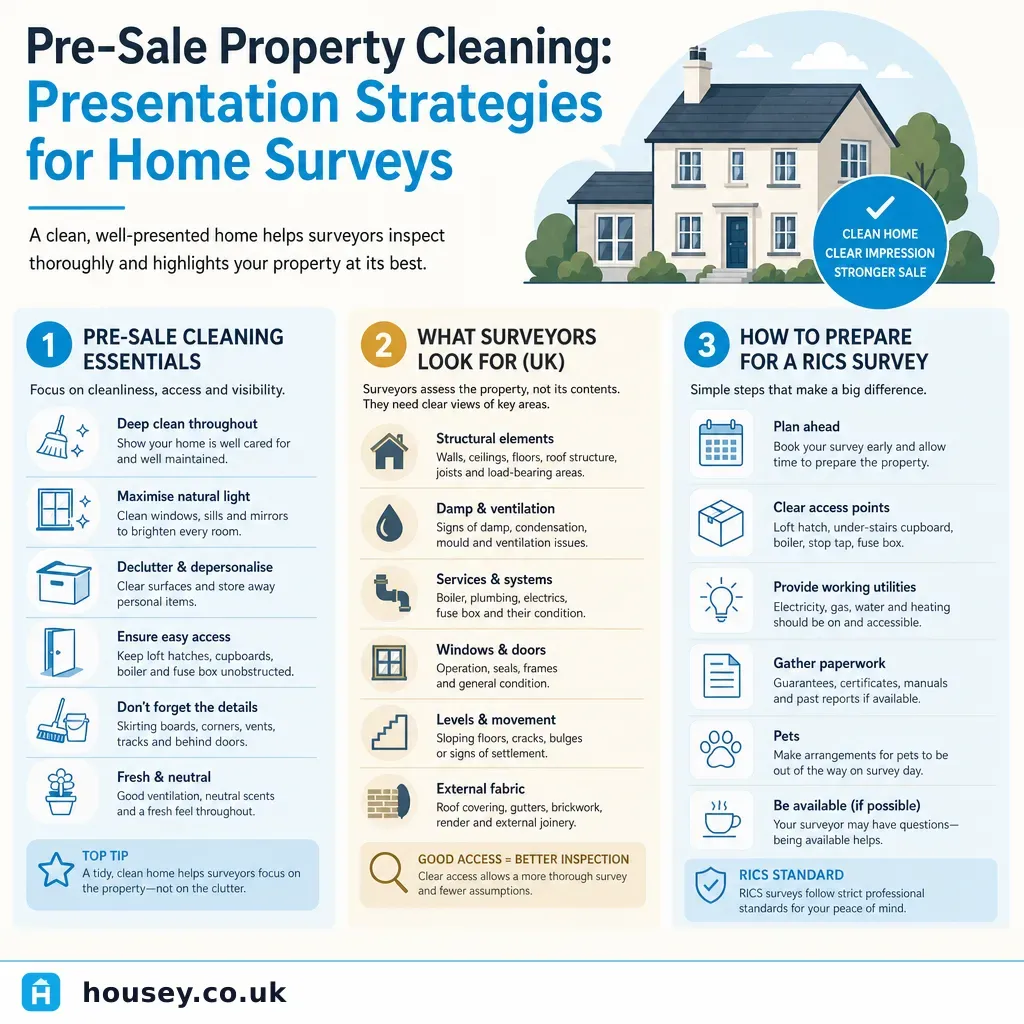
Pre-Sale Property Cleaning: Presentation Strategies for Home Surveys
When a buyer arranges a survey on your home, a chartered surveyor is not judging your housekeeping — but access, maintenance visibility, and the condition of key building elements can influence what appears in the report and how buyers respond to it. A caveated report, where the surveyor notes areas they could not inspect, can trigger unnecessary anxiety or price negotiations even when the underlying property is sound. Getting the right things in order before the survey is a practical step that smooths the sale.
Key points
- A RICS Level 2 Home Survey or Level 3 Building Survey typically takes two to four hours; the surveyor needs unobstructed access to all rooms, the loft space, the boiler and heating controls, the consumer unit (fuse board), and external areas
- Where a surveyor cannot access an area, the RICS Home Survey Standard requires them to record it as not inspected — caveated sections can prompt buyers to seek price reductions or specialist reinspections
- An Energy Performance Certificate (EPC) must be commissioned before a property is marketed for sale in England, Wales, and Scotland under the Energy Performance of Buildings Regulations
- Cosmetic decoration does not mask structural defects — surveyors use damp meters, binoculars for roof inspection, and in some cases thermal imaging cameras
- Minor maintenance completed before the survey — re-sealing a shower tray, clearing gutters, fixing a loose roof tile — can shift a condition rating from 2 (needs attention) to 1 (no action required), which carries disproportionate weight in buyer negotiations
What does a RICS surveyor actually inspect?
Understanding what a surveyor is assessing helps you prioritise your preparation. A RICS-qualified surveyor carrying out a Level 2 or Level 3 survey inspects the condition of the building — not its interior decoration or cleanliness. Key areas covered include:
- Roof structure and coverings — inspected from inside the loft and from ground level, using binoculars or a drone where safe access is not possible
- External walls — checked for cracking, movement, dampness, and pointing condition
- Internal walls, floors, and ceilings — inspected for damp, staining, cracking, and signs of movement
- Windows and external doors — checked for condition, seals, and correct operation
- Drainage — a visual inspection; a full CCTV drain survey is not usually included at Level 2
- Heating and hot water systems — a visual inspection only; not a Gas Safe commissioning test
- Electrical installation — visible components only; not an Electrical Installation Condition Report (EICR)
- Outbuildings and boundary structures — included where accessible
What matters for the survey — and what does not
What matters
Access is the single most important factor. If the surveyor cannot reach an area, they must record it as "not inspected" under the RICS Home Survey Standard. This can generate buyer concern about what might be concealed.
- Clear the loft hatch and ensure there is a safe means of access — a folding loft ladder, or at minimum a stable step
- Remove stored boxes from under-stairs cupboards so the surveyor can check for damp or structural concerns
- Ensure the consumer unit (fuse board) and gas and electricity meters are not blocked by furniture or stored items
- Unlock all rooms, outbuildings, garages, and cellar doors
Visible maintenance tasks that affect condition ratings:
- Clear gutters and fix loose downpipes — blocked guttering is one of the most common condition rating 2 items in Level 2 reports
- Re-seal around the bath and shower tray if old sealant is cracked or mouldy
- Re-fix any visibly loose roof tiles if safe roof access is possible, or note that you have reported them to a roofer
- Re-point any crumbling mortar on chimney stacks or external walls where the deterioration is obvious
Boiler and heating:
- Ensure the boiler is working and has been recently serviced; locate and keep the service record available
- Bleed radiators that are cold at the top — a fully functioning heating system presents better than a partly working one
What does not affect the survey report
- Whether every room is freshly painted or carpets are professionally cleaned
- Kitchen decluttering or garden presentation (unless a retaining wall or boundary structure is structurally concerning)
- Soft furnishings, decor choices, or staging
These elements matter for buyers' emotional response and estate agent photography, but they have no bearing on condition ratings.
Pre-sale preparation checklist
Work through this in the week before the survey appointment.
Outside:
Inside:
Document preparation list
Have these documents available on the day of the survey, or confirmed as obtainable:
Red flags that typically generate condition rating 3 in a RICS survey
These are the conditions most likely to trigger an urgent action rating or a recommendation for specialist investigation:
- Active or recent damp: water stains on walls or ceilings, soft or blown plaster, musty odour in cellars or ground-floor rooms, or visible tide marks
- Stepped cracking in brickwork: diagonal cracks running through mortar joints and bricks — may indicate subsidence, settlement, or lintel failure
- Roof problems: sagging ridge line, missing or slipped tiles, or daylight visible through the roof structure from inside the loft
- Flat roof deterioration: bubbling, cracking, or pooling on felt-covered flat-roofed extensions or garages
- Blocked or failed guttering: visible overflow marks (green algae or dark staining) on north-facing or sheltered elevations
- No boiler service history: surveyors routinely recommend further investigation in the absence of service records
If these defects are present, they are genuinely present. A good surveyor will find them. The purpose of preparation is to address items within your reasonable control to remedy cheaply before the survey, not to obscure genuine structural problems.
What not to assume
- "A tidy house gets a better survey." Condition ratings are based on the fabric of the building, not aesthetics. A freshly decorated room with active damp behind the wallpaper will still be flagged.
- "The surveyor tests everything." A Level 2 survey is a visual inspection. The surveyor is not a Gas Safe engineer, electrician, or drain specialist. They will recommend further specialist tests where warranted — but they do not carry them out themselves.
- "Fixing things before the survey is pointless if they will be found anyway." Small repairs genuinely shift condition ratings and can prevent buyers from renegotiating. That said, significant undisclosed remediation for a known serious defect can raise disclosure concerns after exchange; speak to your solicitor if you are uncertain about your obligations.
When to get professional help
If you are aware of significant defects — subsidence, Japanese knotweed in the garden, asbestos-containing materials in the fabric of the building, or previous serious roof leaks — it is usually better to disclose these proactively and obtain professional reports before marketing, rather than hoping the surveyor does not identify them. Failure to disclose known material defects can have legal consequences after exchange. Consult your solicitor if you are uncertain about your disclosure obligations.
How Housey can help
If you are buying a property and want an independent assessment of its condition before committing to exchange, Housey can connect you with a qualified RICS home surveyor who can carry out a Level 2 or Level 3 survey and provide a clear, condition-rated report.
Frequently asked questions
Should I clean my house before a surveyor visits?
General tidiness helps the surveyor move freely and access key areas, but professional deep-cleaning has no meaningful effect on the survey outcome. Focus on clearing access to the loft, boiler, consumer unit, and any rooms where damp or structural concerns might exist. A surveyor who can inspect every area thoroughly is less likely to raise caveated concerns that worry buyers during negotiations.
Can a surveyor fail a house?
A survey is not a pass/fail assessment. A RICS Level 2 Home Survey rates elements using a traffic-light system: condition 1 (no action needed), condition 2 (requires attention soon), or condition 3 (urgent action required). The report informs the buyer and may prompt renegotiation or further specialist inspections, but it does not determine whether a sale can legally proceed.
Will the surveyor check my boiler?
A RICS Level 2 or Level 3 surveyor will carry out a visual inspection of the boiler and visible heating system components, but this is not a Gas Safe service or inspection. The surveyor may recommend a Gas Safe engineer's assessment if the boiler appears old, unmaintained, or if there is no recent service record available. Having your boiler serviced before the survey is a useful step.
Do I need an EPC before a survey takes place?
An Energy Performance Certificate (EPC) is required by law before a property is marketed for sale in England, Wales, and Scotland, under the Energy Performance of Buildings Regulations. The EPC is a separate legal requirement from the survey itself. A surveyor may note whether an EPC is displayed, but their inspection proceeds regardless. Confirm your EPC is in date before listing the property.
Sources and further reading
Useful next reads
 Buying & Moving
Essential Steps to Selling Your Home Successfully
Selling your home successfully in the UK involves obtaining a valid EPC, choosing an estate agent or alternative method, instructing a solicitor or conveyancer early, and completing the Seller's Property Information Form accurately.
 Buying & Moving
Preparing Your Home for Sale: Flooring and First Impressions
Before marketing a property in the UK, flooring condition and room presentation directly affect buyer interest and offer levels.
 Buying & Moving
Preparing Your Home for Sale: Professional Staging Strategies
Effective home staging focuses on decluttering, depersonalising, and presenting each room to show its proportions and light at their best.
 Buying & Moving
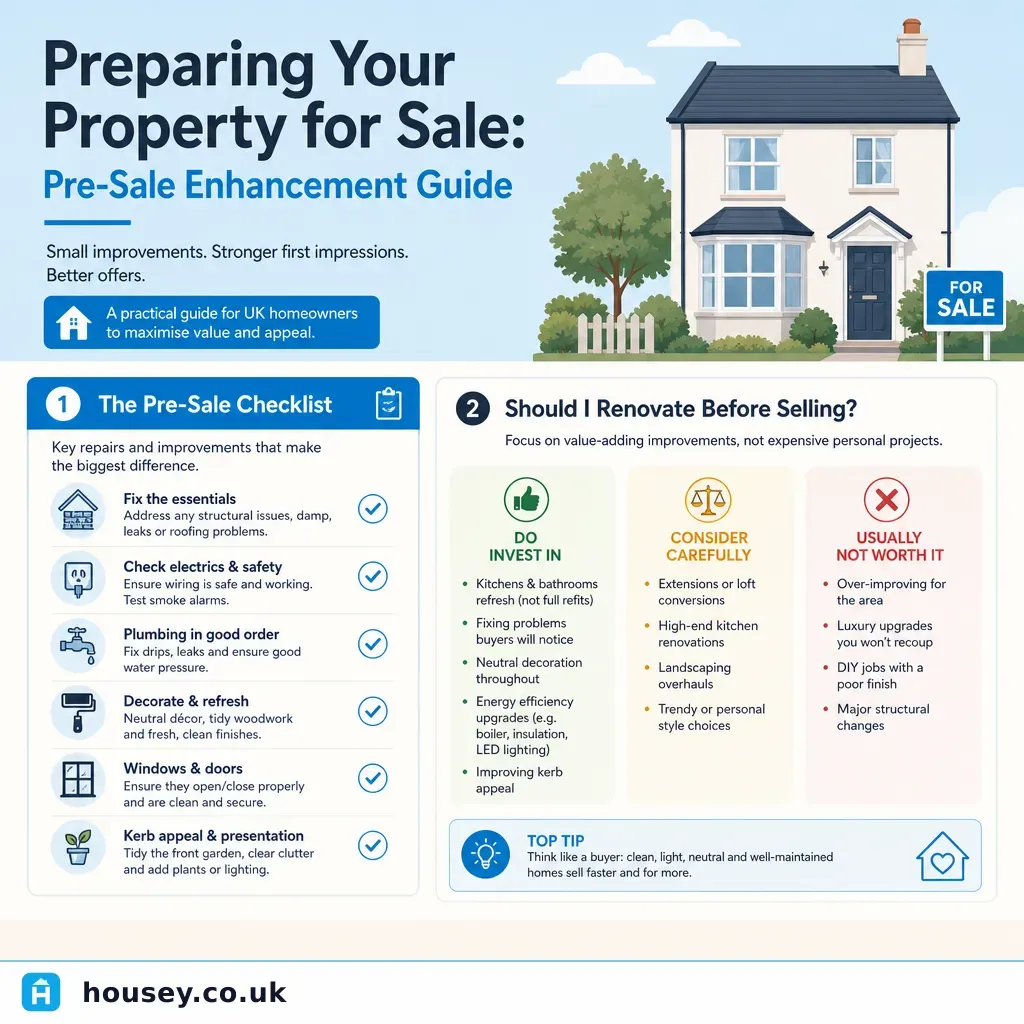
Preparing Your Property for Sale: Pre-Sale Enhancement Guide
Getting a property ready to sell usually means fixing visible defects, refreshing décor to neutral tones, improving kerb appeal, gathering documentation, and commissioning professional photography.
 Buying & Moving
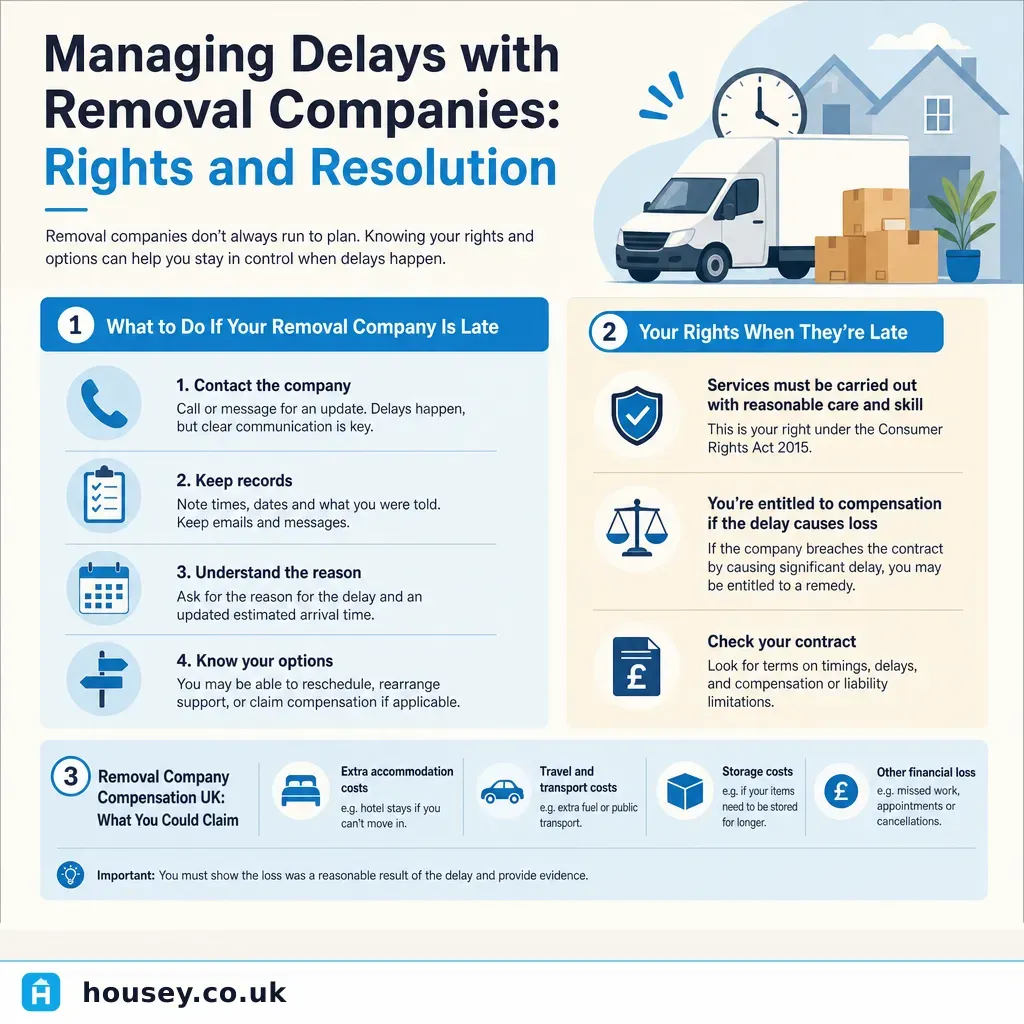
Managing Delays with Removal Companies: Rights and Resolution
If a removal company is late, your rights depend on your contract and whether the company is BAR-registered.