Preparing Your Home for Sale: Professional Staging Strategies
By Housey · Last reviewed 19th of May 2026
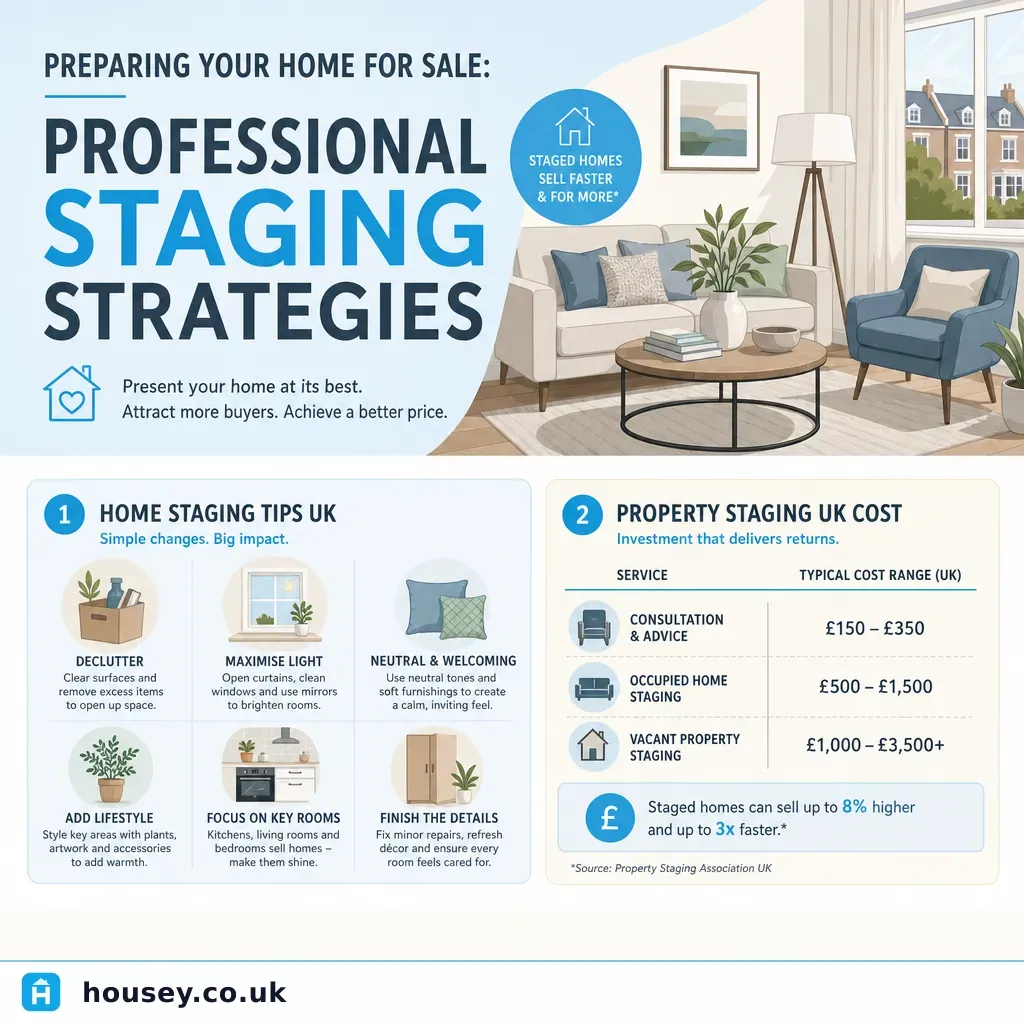
Preparing Your Home for Sale: Professional Staging Strategies
The way a property looks at viewings and in its online listing directly affects how much competition it generates and how quickly it sells. The UK's property search landscape has shifted decisively online: most buyers now shortlist homes on Rightmove or Zoopla, and the call to action — booking a viewing — is driven almost entirely by photographs. Sellers who treat presentation as an afterthought frequently find their property sitting on the market longer than comparable homes nearby, and may accept a lower offer as a result.
Key points
- Estate agent data and property portal research consistently show that listings with professional photography generate significantly more enquiries than those with smartphone images — presentation affects click-through before price does.
- Decluttering and depersonalising are the highest-return staging actions in most occupied properties: they cost little beyond time and improve every photograph and viewing simultaneously.
- Estate agents widely report that buyers form a strong first impression within the first 60–90 seconds of entering a property; the entrance hall and kerb appeal set the tone before buyers have seen any other room.
- Neutral decor — warm whites, soft greys, and natural tones — reduces buyer resistance and allows viewers to project their own taste onto the space, broadening the pool of potential purchasers.
- Professional photography and floor plans are standard practice in competitive UK markets; check what your estate agent includes in their package before instructing separate providers.
The three phases of home staging
Effective staging follows a logical sequence. Attempting to dress a room before decluttering it, or to photograph before undertaking minor repairs, wastes both time and money.
Phase 1: Declutter, depersonalise, and deep clean
This phase has the highest impact relative to cost. Work room by room:
- Remove surplus furniture that makes rooms feel smaller — a dining table with four chairs reads as more spacious in photographs than one surrounded by eight.
- Box and store personal collections, family photographs, children's artwork, and distinctive decorative items. You are selling space and light, not your belongings.
- Clear kitchen surfaces entirely; store appliances, drying racks, and accumulated paperwork.
- Check built-in storage for overflow — buyers open wardrobes and cupboards, and stuffed storage signals a lack of space.
- Deep clean thoroughly: windows (natural light is the most valuable asset in any photograph), grout lines, skirting boards, and behind appliances.
Phase 2: Remedial repairs and minor redecoration
Buyers are alert to deferred maintenance and may use visible issues as grounds for renegotiation after survey. Small repairs cost relatively little and can disproportionately affect perceived condition.
Focus on:
- Filling and painting over scuffs, holes, and marks — particularly in hallways, which take the heaviest wear
- Re-sealing around baths and showers if existing sealant is discoloured
- Repairing dripping taps, stiff door handles, and broken window catches
- Touching up garden fencing, gate hinges, and exterior paintwork
- Replacing burnt-out bulbs and ensuring all light fittings are working
Avoid over-investing in full redecoration unless the existing scheme is genuinely off-putting. A freshly painted warm white or light grey is almost always a safe choice; bold accent colours should be neutralised where possible.
Phase 3: Dress, photograph, and prepare for viewings
Once the property is clean, repaired, and depersonalised:
- Arrange furniture to show the flow and proportions of each room — remove obstructions between the door and the main window where possible.
- Add a few well-chosen accessories: fresh flowers, a bowl of fruit, folded towels in the bathroom, a dressed dining table.
- Ensure all lights are on during photography, even in daylight; warm-toned bulbs photograph better than cool ones.
- Open all blinds and curtains fully to maximise natural light.
- Remove vehicles from the driveway for exterior photographs.
- Ensure the garden is tidy: lawn mown, patios cleared, a few seasonal plants by the front door.
DIY staging vs professional staging services
Approach | Best for | Limitations | Typical cost (indicative) |
|---|---|---|---|
DIY staging | Occupied homes in reasonable condition | Requires time and objectivity; may miss issues buyers notice | Cleaning, storage, and minor repairs only |
Staging consultation (one session) | Sellers wanting expert guidance | Success depends on following through on advice | £150–£400 per session; varies by region |
Full professional staging (vacant) | Empty properties; high-value or slow-moving stock | Higher cost; includes furniture hire and installation | £1,000–£5,000+ depending on size and duration |
Professional photography and floor plans | All properties — this is the standard baseline | Does not address underlying presentation issues | Often included in agency package; standalone from £150–£500 |
Indicative UK costs, last reviewed 2026-05-19. Quotes vary significantly by location and provider.
What not to assume before selling
“Buyers will see past the clutter.” In practice, many buyers struggle to visualise a space when it is full of the seller's belongings. Decluttering removes a common mental obstacle before it has a chance to form.
“My home just needs a good tidy.” Tidying and staging are different. Staging means optimising every room for visual impact at photography scale — the two-dimensional photograph is less forgiving than an in-person viewing.
“The estate agent’s photographer will handle it.” Many agents use competent photographers, but the photographer cannot move furniture, repair scuffs, or replace wilting houseplants. Those actions are the seller's responsibility before the photographer arrives.
“I should renovate the kitchen before selling.” Major pre-sale renovations rarely recover their full cost in the sale price and may not match the buyer's taste. Minor upgrades — new door handles, fresh paintwork, updated tap fittings — typically offer better return than a full kitchen replacement.
“A show-home look is off-putting.” Evidence from property marketers consistently suggests the opposite: a clean, well-presented, lightly accessorised space appeals more broadly than a heavily lived-in one, particularly in online photography.
Home staging checklist
4–6 weeks before listing:
1–2 weeks before listing:
Photography day:
Viewings:
When to get professional help
Consider instructing a professional staging consultant if:
- Your property is vacant — empty rooms are difficult for buyers to read and often appear smaller than they are
- Your home has been on the market for more than four weeks without offers
- Viewing feedback suggests presentation is a concern
- The property is at the upper end of the local market, where staging costs are proportionate to the value at stake
For all properties, professional property photography and floor plans are worth instructing regardless of whether you undertake full staging — they are the foundation of every online listing and the first thing buyers see.
How Housey can help
Professional photography is the single most cost-effective investment before any UK property goes to market. Housey can connect you with specialists in professional property photography and floor plans who understand how to present homes at their best for online listings and printed marketing particulars.
Frequently asked questions
How much does home staging cost in the UK?
Costs range widely: DIY decluttering and minor repairs cost little beyond time, while full professional staging for a vacant property can reach £1,000–£5,000 or more depending on size and location. A one-off staging consultation typically costs £150–£400. Professional photography and floor plans are often included in estate agency packages, or cost £150–£500 if instructed separately. Indicative UK costs, last reviewed 2026-05-19.
Does home staging actually help sell properties faster?
Property marketers and estate agents broadly agree that well-presented homes attract more enquiries and stronger early offers. The effect is most pronounced for online listings, where the decision to book a viewing is driven almost entirely by photographs. Decluttering, neutral decor, and professional photography are consistently identified as the highest-impact low-cost interventions sellers can make.
Should I leave the property empty or furnished for viewings?
Furnished properties generally sell more readily, as buyers can judge room proportions and flow more easily. Vacant properties are harder to present and often benefit most from professional staging — either rented furniture or a consultation on how to create the impression of a completed space. If you have already moved out, discuss options with your estate agent before going to market.
Do I need to redecorate before selling?
Not necessarily. If the existing scheme is neutral and well-maintained, professional photography and decluttering may be sufficient. If bold colours or dated finishes are likely to put off buyers in your local market, a repaint in warm white or light grey is a relatively low-cost intervention. Full kitchen or bathroom renovations rarely recover their full cost in the eventual sale price.
Sources and further reading
- Rightmove seller guide — Rightmove
- Which? guide to selling your home — Which?
- Citizens Advice: selling your home — Citizens Advice
- The Home Staging Association UK & Ireland — Home Staging Association UK & Ireland
Useful next reads
 Buying & Moving
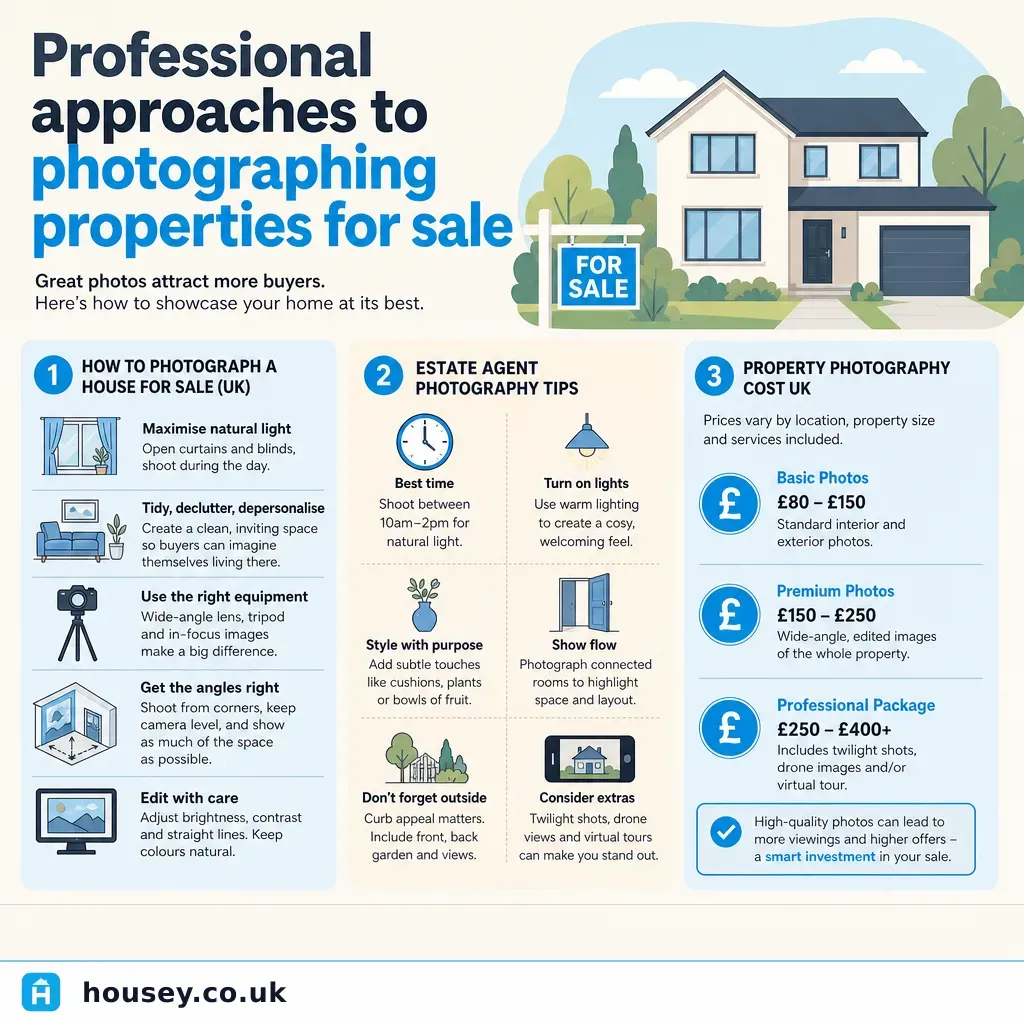
Professional approaches to photographing properties for sale
Professional property photography uses wide-angle lenses, HDR exposure blending, and careful staging to present rooms accurately and attractively.
 Buying & Moving
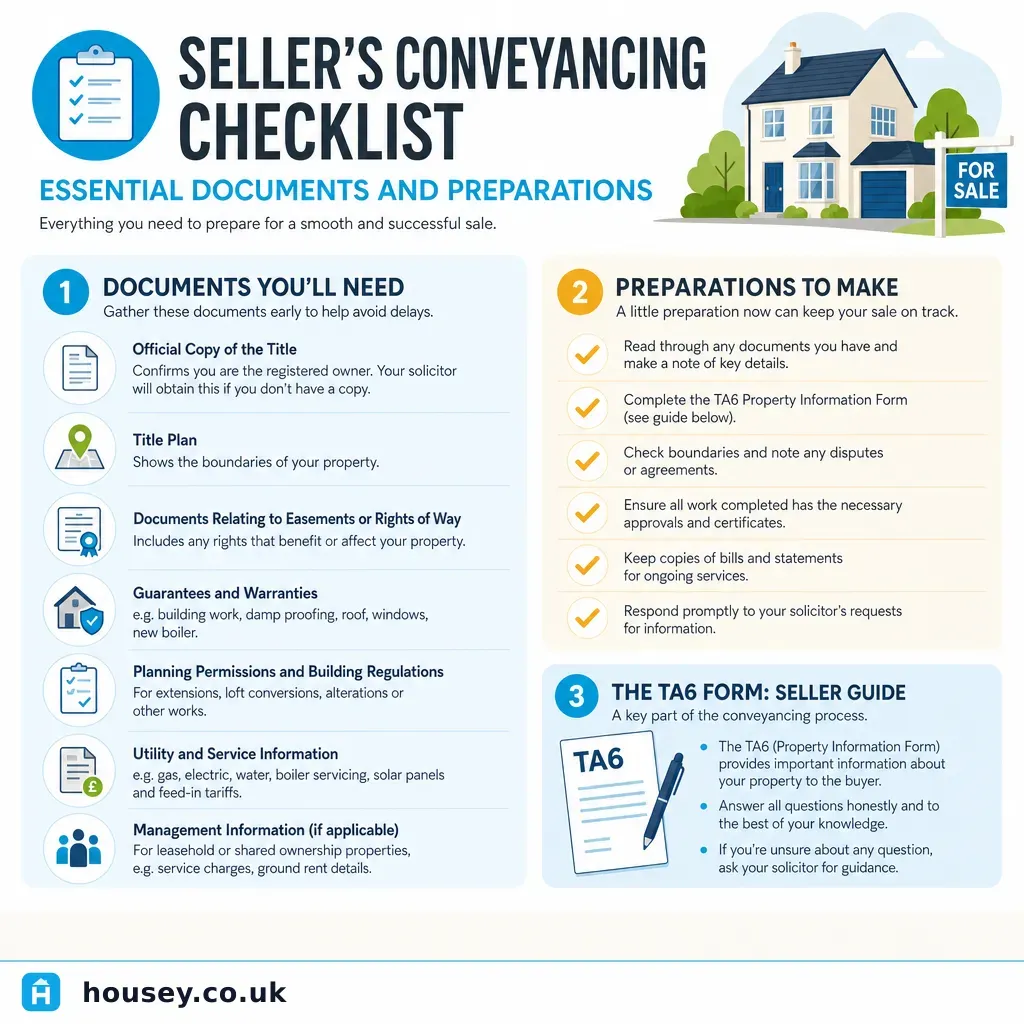
Seller's Conveyancing Checklist: Essential Documents and Preparations
Sellers need to gather title documents, completed Law Society forms (TA6 and TA10), building regulations certificates, planning permissions, and — for leasehold properties — a management information pack before or shortly after accepting an offer.
 Buying & Moving
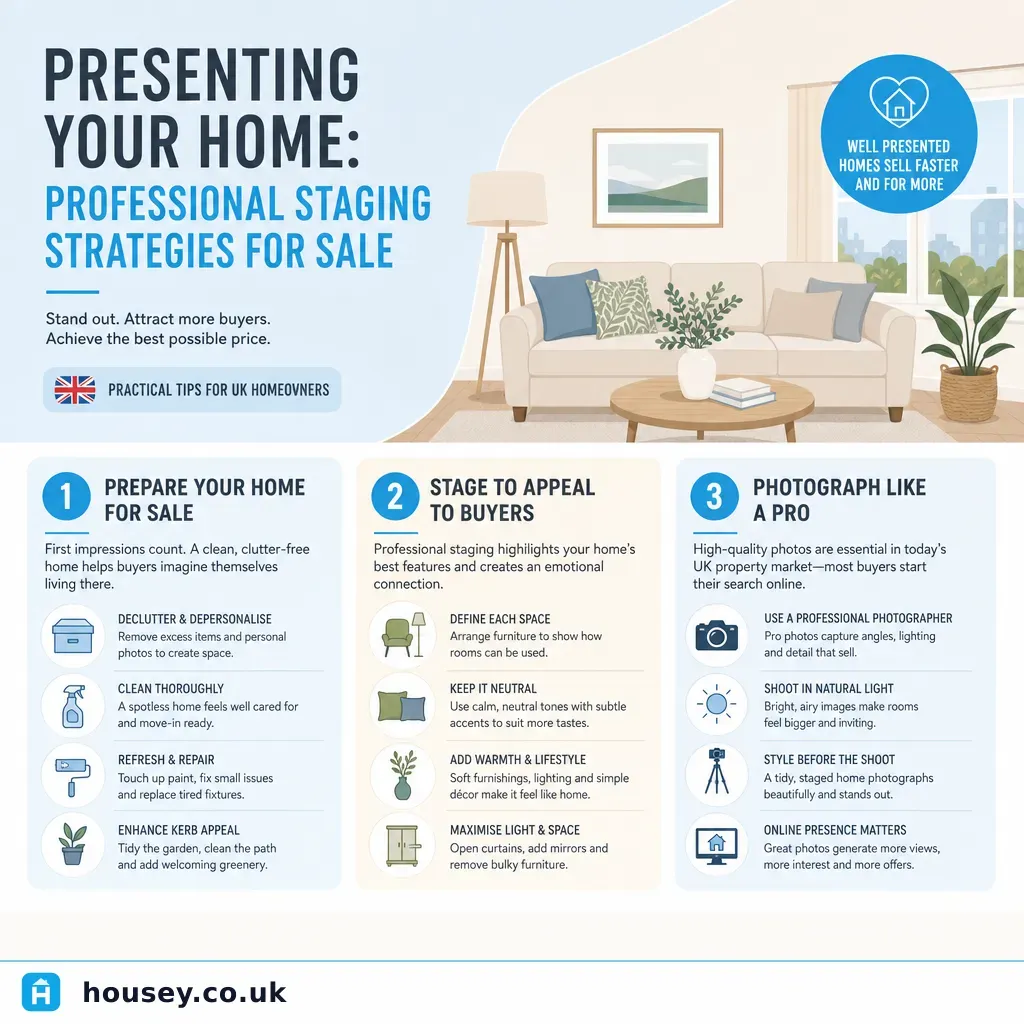
Presenting Your Home: Professional Staging Strategies for Sale
Home staging for a UK property sale means presenting each room to look spacious, neutral, and well-lit — primarily through decluttering, cleaning, and considered styling rather than expensive renovation.
 Buying & Moving
Proven Strategies for Selling Your Property Quickly and Effectively
To sell your UK home quickly, price it accurately from the outset, invest in professional photography and a measured floorplan, prepare your conveyancing documents before accepting an offer, and ensure the property presents well for viewings.
 Buying & Moving
Valuing Your Property for Rapid Sale: Strategic Pricing Guidance
Pricing a UK home for a quick sale means setting an asking price supported by recent comparable sales evidence — not significantly above it.