Valuing Your Property for Rapid Sale: Strategic Pricing Guidance
By Housey · Last reviewed 18th of May 2026

Valuing Your Property for Rapid Sale: Strategic Pricing Guidance
Setting the right asking price is one of the most consequential decisions a seller faces. Price too high and the listing stagnates, accumulating a visible price-reduction history that unsettles buyers. Price accurately — or slightly below the comparable evidence — and the property generates competitive early interest, often achieving a better final outcome even when speed is the priority. Understanding how formal valuations, estate agent appraisals, and market evidence interact is essential before deciding on a number.
Key points
- A RICS Red Book valuation (prepared in accordance with RICS Valuation — Global Standards 2022) is the only type of formal valuation accepted by mortgage lenders and UK courts.
- Estate agent market appraisals are not formal valuations — they carry no regulated accountability specific to the valuation function and are subject to commercial incentives to win an instruction.
- Properties listed significantly above comparable evidence attract fewer viewings in the first two weeks and are more likely to require a price reduction, which is flagged publicly on property portals.
- Stamp Duty Land Tax (SDLT) thresholds in England — including the standard nil-rate band (up to £250,000 as of May 2026) and the first-time buyer relief threshold (up to £300,000, subject to conditions) — can act as psychological price barriers that affect buyer pool size; check GOV.UK for current rates as they are subject to legislative change.
- Selling significantly below market value to a connected person may create HMRC scrutiny for Inheritance Tax, Capital Gains Tax, or SDLT purposes.
Important limitations
This article provides general information about property pricing strategy for UK homeowners. It is not a formal valuation, legal advice, or tax advice. Property values vary significantly by location, property type, condition, and prevailing market conditions. Regulations around SDLT, Capital Gains Tax, and RICS professional standards change over time. Obtain a formal RICS valuation, independent legal advice, and — where relevant — specialist tax advice before making a significant pricing decision.
What is market value, and who can determine it?
Market value, as defined by the RICS Red Book, is "the estimated amount for which an asset or liability should exchange on the valuation date between a willing buyer and a willing seller in an arm's length transaction after proper marketing and where the parties had each acted knowledgeably, prudently and without compulsion."
In practice, this is the price a motivated but not desperate buyer would pay a motivated but not desperate seller, given normal marketing time and full market information. Three types of opinion are commonly offered to UK sellers — but they are not equivalent:
Method | Who provides it | Regulatory status | Typical cost | Accepted by lender or court? |
|---|---|---|---|---|
RICS Red Book valuation | RICS-registered valuer | Regulated by RICS | £300–£600+ (Indicative, last reviewed 2026-05-18.) | Yes |
Estate agent market appraisal | Estate agent | Not regulated as a valuation | Free | No |
Automated valuation model (AVM) | Proptech platforms (e.g. Zoopla, Rightmove) | Not regulated | Free | No |
Probate or matrimonial valuation | RICS-registered valuer | Regulated, specific purpose | £300–£700+ (Indicative, last reviewed 2026-05-18.) | Yes (in specific proceedings) |
Pricing strategy for a faster sale
Speed of sale depends on three levers: price, presentation, and marketing reach. Pricing is the most controllable from day one.
Why overpricing backfires
Properties listed above the comparable evidence level attract fewer viewings in the first two weeks — the period of highest buyer interest on any new listing. If no acceptable offer emerges, a price reduction follows. Reductions are flagged on Rightmove and Zoopla, which many buyers interpret as a warning sign. The final sale price on a reduced property is often lower than it would have been had the property launched at an accurate price.
The price-band effect
Buyer search portals filter by price bands — "up to £300,000", "up to £400,000", and so on. A property listed at £305,000 is invisible to everyone searching "up to £300,000". Pricing just below key thresholds maximises the buyer pool. SDLT thresholds amplify this effect: first-time buyers at the £300,000 relief threshold may be particularly sensitive to the additional SDLT cost that kicks in above it.
Decision tree: choosing your pricing approach
- Choose competitive pricing (at or slightly below comparable evidence) if you need to sell within 8–12 weeks, have an onward purchase that depends on this sale, or are in a chain with time pressure.
- Choose market-level pricing (aligned to comparable evidence) if you have time to test the market and can wait for the right buyer without financial pressure.
- Consider below-market pricing only if speed is paramount — for example, repossession risk or a significant life change — you have fully understood the financial trade-off, and you have taken independent financial and tax advice.
- Instruct a RICS-registered valuer before accepting any offer significantly below comparable evidence, particularly in a falling market or for an unusual property where evidence is thin.
- Check with a tax adviser before selling below market value to a family member — even an informal arrangement can create SDLT, CGT, or IHT liabilities.
What comparable evidence actually means
Estate agents and RICS valuers both rely on comparable evidence — recent sales of similar properties in the same area. The quality of this evidence matters:
- Recency: sales within the last 3–6 months carry most weight; older evidence is discounted in a changing market
- Proximity: ideally the same street or immediate postcode area; broadly comparable micro-location characteristics
- Property similarity: same type (terraced, semi-detached, detached), approximate floor area, bedroom count, and condition
- Verified prices: HM Land Registry records actual achieved sale prices, with a 1–3 month publication lag — asking prices are not sold prices and should not be used as evidence
You can check recent sold prices yourself using the HM Land Registry House Price Index and the sold prices pages on Rightmove or Zoopla. This lets you sense-check any estate agent appraisal before your property launches and identify if a suggested asking price is unsupported by evidence.
Red flags in estate agent appraisals
Watch for these warning signs when receiving a market appraisal:
- An appraisal significantly higher than other agents' views or the comparable evidence, with no specific comparable sales to justify it
- No reference to actual recent sales — only general references to "current demand" or "the local market"
- Pressure to sign an exclusive agency agreement immediately, before you have compared appraisals from at least two or three agents
- A suggested asking price that is a round number with no supporting evidence base
- An agent who cannot or will not share the comparable sales data behind their recommendation
- A suggested price that coincidentally aligns with the agent's commission bracket rather than the evidence
What to ask a qualified professional
Before instructing a RICS-registered valuer or finalising your asking price with an estate agent:
- Which specific comparable sales are you relying on, and can I see the addresses and achieved prices?
- What is the current average days-to-sale for similar properties in this area and price band?
- What price reduction would you anticipate if we receive no acceptable offer within six weeks?
- Are there features of this property that might cause a mortgage lender's surveyor to down-value it below the asking price?
- At what asking price do you think we would be likely to generate multiple competing offers quickly?
- What is your experience of pricing similar properties for a defined sale timeline?
- If I instruct a formal RICS valuation, how do lenders use that figure, and what are the implications for a buyer's mortgage application?
When to get professional help
A formal RICS Red Book valuation is appropriate — rather than relying solely on a free estate agent appraisal — when:
- The property is unusual, listed, or in a non-standard condition that makes comparable evidence difficult to identify
- You are selling during probate, divorce proceedings, or a forced sale situation where an independent opinion is legally relevant
- A buyer's mortgage lender has down-valued the property and you wish to challenge the surveyor's figure
- You are considering selling to a connected person at a price that may differ from market value
- The property is a short-lease leasehold flat, shared ownership, or another tenure type where valuation is technically complex and estate agents may lack specific experience
How Housey can help
If you need an independent, lender-accepted opinion of value before setting your asking price, Housey can connect you with RICS-registered surveyors offering valuation surveys from RICS-registered surveyors — giving you a regulated benchmark rather than relying solely on a commercial estate agent appraisal.
Frequently asked questions
Is a free estate agent appraisal the same as a formal RICS valuation?
No. An estate agent market appraisal is an informed opinion of the price your property might achieve on the open market. It is not regulated as a valuation, carries no formal professional liability framework for the valuation function, and is subject to the agent's commercial interest in winning your instruction. A RICS Red Book valuation is prepared by a regulated professional to a defined standard and is the only type accepted by mortgage lenders and courts.
How much should I reduce my asking price to sell quickly?
There is no single correct answer — it depends on your local market, property type, condition, and urgency of sale. Pricing at or within 5% of well-supported comparable evidence while presenting the property well is generally more effective than a large undercut, which can attract low-ball offers. If speed is essential, obtain appraisals from at least three agents and consider a formal RICS valuation for an independent benchmark.
Could selling my home below market value create a tax problem?
Selling your main residence to an unconnected buyer at a genuinely market-tested price is unlikely to create a tax problem if you qualify for Private Residence Relief on any gain. However, selling significantly below market value to a family member or connected person can create Inheritance Tax, Capital Gains Tax, or Stamp Duty Land Tax complications. Always take independent tax advice before agreeing such a transaction.
Sources and further reading
- RICS Valuation — Global Standards 2022 (Red Book) — RICS
- HM Land Registry House Price Index — HM Land Registry / GOV.UK
- Stamp Duty Land Tax rates — GOV.UK / HMRC
- Capital Gains Tax on UK property — GOV.UK / HMRC
- Home buying and selling guide — Which?
Useful next reads
 Buying & Moving
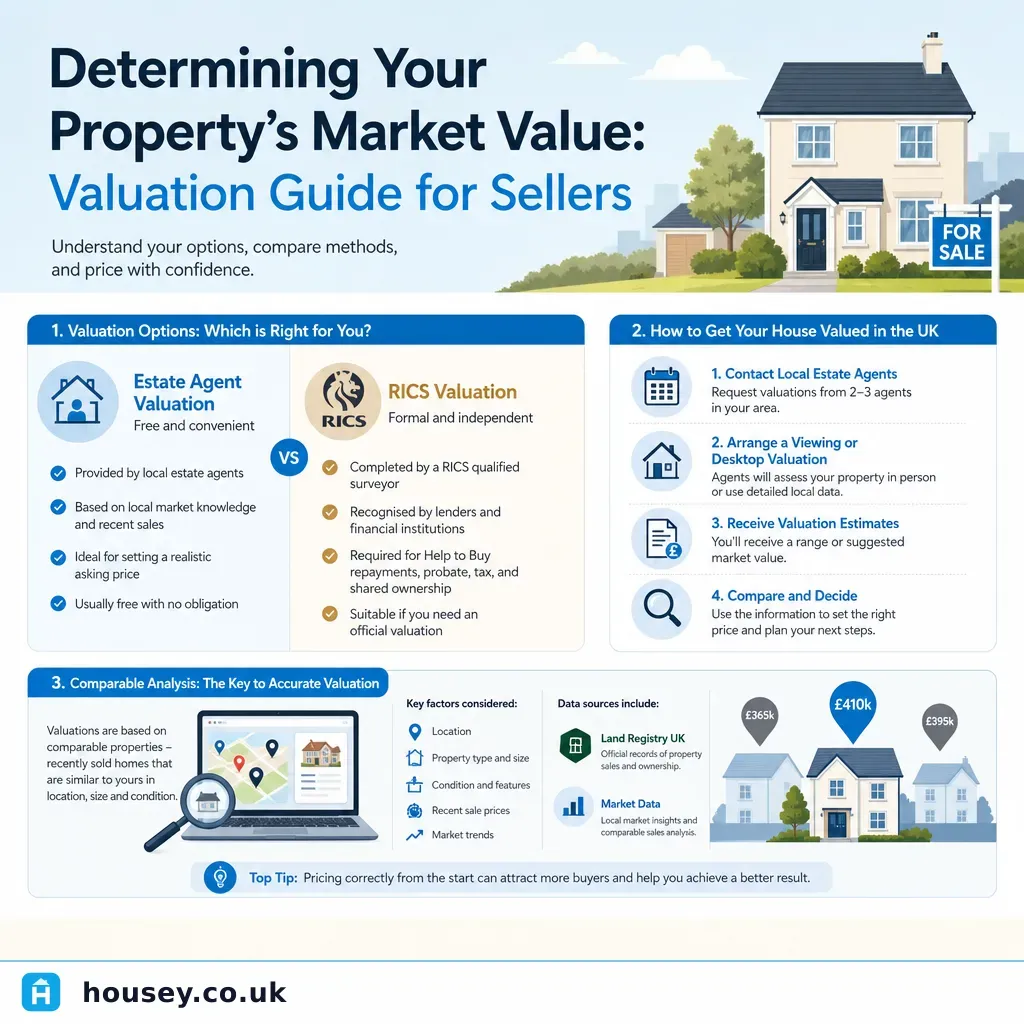
Determining Your Property's Market Value: Valuation Guide for Sellers
Market value in the UK is most reliably established by combining estate agent appraisals with your own analysis of recent sold prices on the HM Land Registry database.
 Buying & Moving
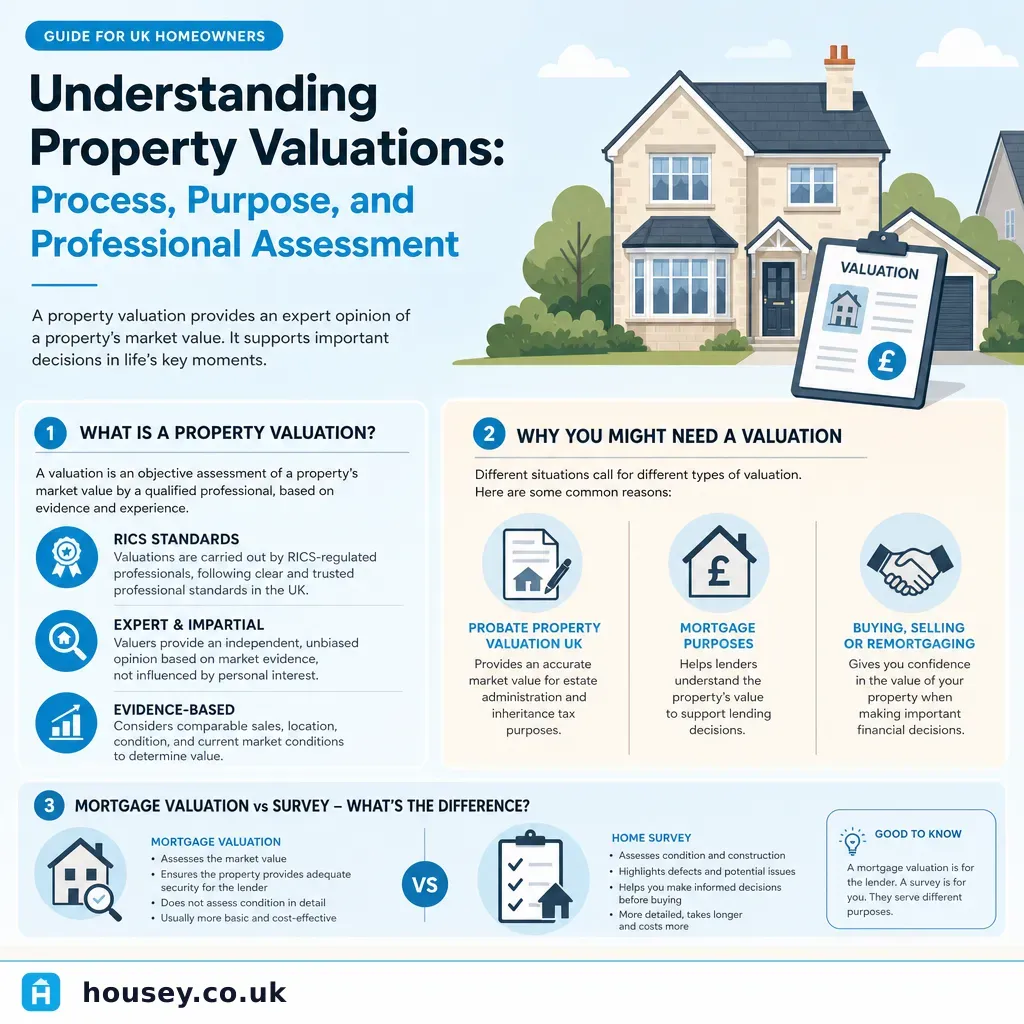
Understanding Property Valuations: Process, Purpose, and Professional Assessment
A property valuation is a professional opinion of a property's market value, carried out by a RICS Registered Valuer after a physical inspection and comparable sales analysis.
 Buying & Moving
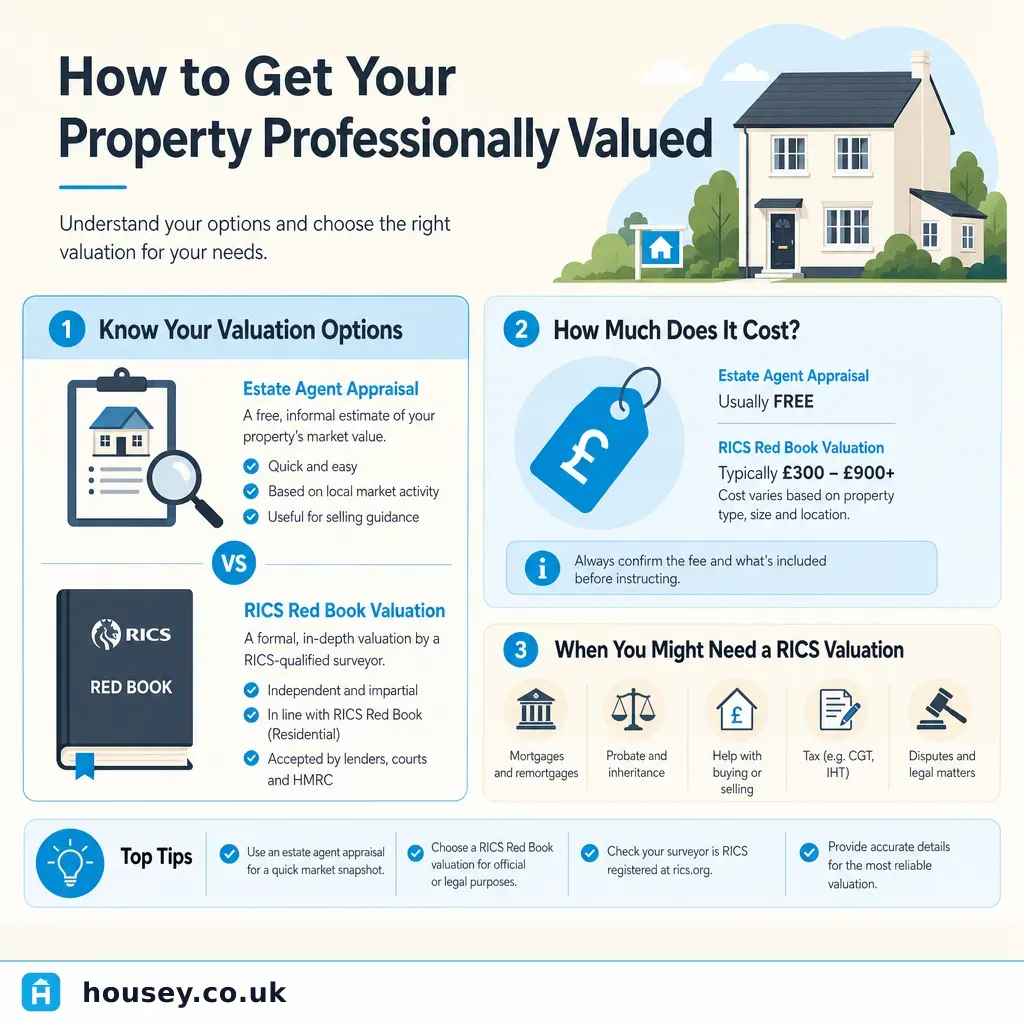
How to Get Your Property Professionally Valued
To get a professional property valuation in the UK, instruct a RICS Registered Valuer for any formal purpose — mortgage, probate, Help to Buy, or legal proceedings.
 Buying & Moving
Factors That Influence Property Valuation and Market Value
Property market value in the UK is shaped by location, floor area, structural condition, EPC rating, tenure, and recent comparable sold prices in the local area.
 Buying & Moving
Which Home Improvements Add Real Value to Your Property?
In the UK, loft conversions, single and double-storey extensions, and energy-efficiency upgrades are most reliably linked to added property value.