Seller's Conveyancing Checklist: Essential Documents and Preparations
By Housey · Last reviewed 25th of May 2026
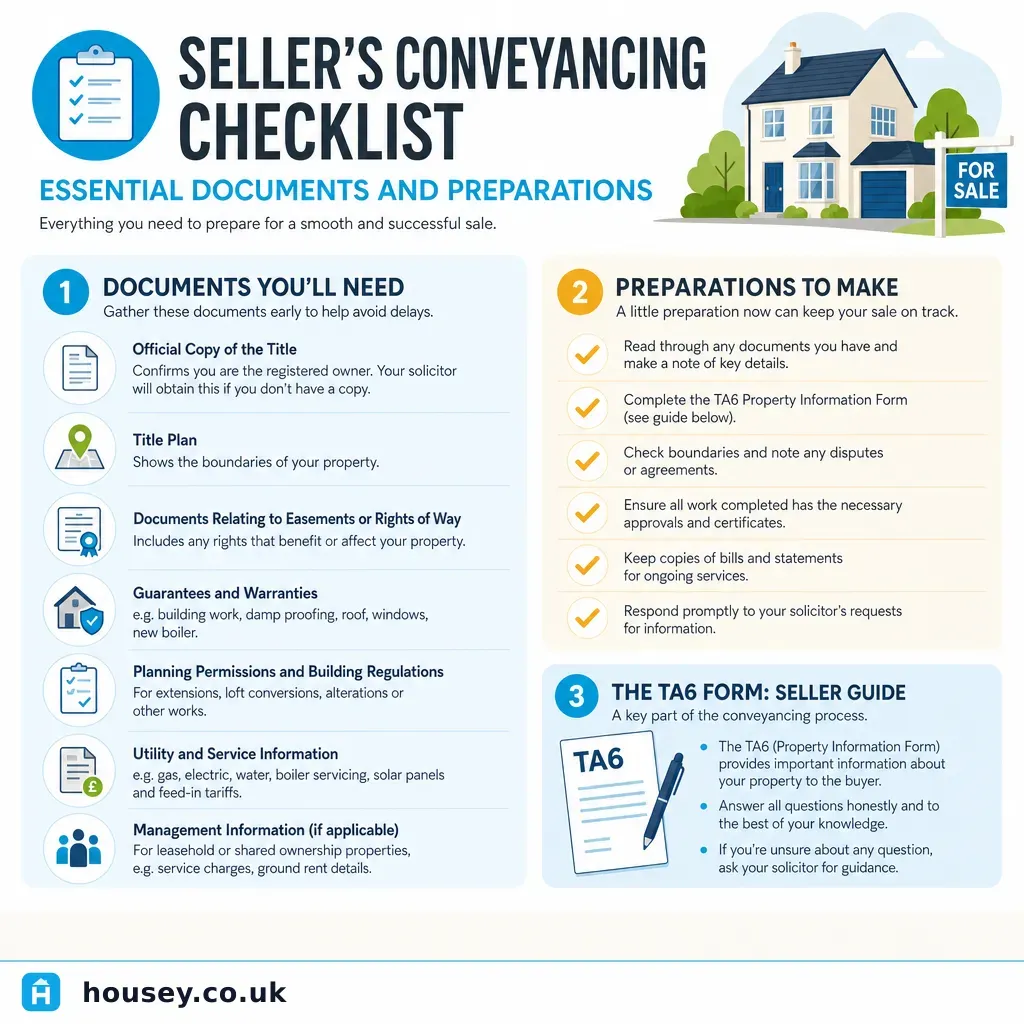
Seller's Conveyancing Checklist: Essential Documents and Preparations
Preparing for the legal side of a property sale is something many sellers underestimate until they have already accepted an offer. At that point, buyers expect momentum — and the most common reasons transactions slow down or fall through on the seller's side involve missing documents, incomplete property information forms, or title issues that could have been identified and addressed weeks earlier. Gathering the right paperwork in advance, and understanding what your conveyancer needs and when, can materially reduce the time from offer to exchange and limit the risk of a buyer withdrawing.
Key points
- Sellers in England and Wales must complete the TA6 Property Information Form and TA10 Fittings and Contents Form (standard Law Society forms) — the replies form contractual representations and must be accurate and complete.
- A valid Energy Performance Certificate (EPC) is a legal requirement before marketing a property for sale in England and Wales under the Energy Performance of Buildings (England and Wales) Regulations 2012; an EPC is valid for 10 years.
- For leasehold properties, a TA7 Leasehold Information Form is also required, plus a management information pack from the freeholder or managing agent — these packs commonly take four to eight weeks or longer to obtain.
- Building regulations completion certificates for any notifiable works carried out since the property was built should be located early — missing certificates are among the most frequent causes of buyer enquiries and delayed exchanges.
- Your conveyancer must carry out anti-money laundering (AML) identity checks before they can act; delays in providing certified ID documentation can hold up the entire transaction.
What will your conveyancer need from you?
Once you instruct a solicitor or licensed conveyancer, they will issue you a package of forms to complete and a request for documents. Responding to this promptly — ideally before an offer is accepted — can save several weeks. Your obligations as a seller fall into two categories: title documents (proving your legal right to sell) and property information (disclosing the physical and legal condition of the property to the buyer).
Document preparation list
Work through the following before or immediately after instructing your conveyancer:
Seller's conveyancing checklist by stage
Before or at the point of marketing
After accepting an offer
Between exchange and completion
Common causes of seller-side delays
Missing building completion certificates: If works were carried out without building regulations consent or the certificate cannot be located, your conveyancer will need to advise on options — retrospective building control inspection (where available), indemnity insurance, or explicit disclosure. Identifying this early gives you more choices.
Slow leasehold management packs: Managing agents and freeholders are not subject to a fixed statutory deadline for providing management information in most circumstances, though the Building Safety Act 2022 introduced new requirements for higher-risk buildings. In practice, packs routinely take four to eight weeks, and sometimes longer. Request them as soon as an offer is accepted — or before.
Inaccurate TA6 responses: Incorrect or incomplete answers on the TA6 Property Information Form can give a buyer grounds for a misrepresentation claim after completion. Take particular care with questions about disputes, planning works, and alterations, and seek your conveyancer's guidance on any question you are unsure how to answer.
Unresolved charges on title: Any charge registered against the title — mortgage, secured loan, Help to Buy equity loan, or equity release product — must be redeemed at completion. These can involve additional administrative steps and timescales. Identify all charges at instruction.
Red flags that could stall or collapse your sale
- Lease below 80 years remaining: A short lease significantly affects the buyer's ability to obtain a mortgage and may require a lease extension before or during the sale, adding months to the process.
- Restrictive covenant breaches: If works or uses have breached a restrictive covenant registered on the title, this requires disclosure and likely an indemnity policy or specialist legal advice before exchange.
- Active boundary disputes: Disclosable on the TA6 and frequently a reason for buyers to withdraw or attempt renegotiation.
- Live planning enforcement notices: Any enforcement notice affecting the property must be disclosed and may require resolution before a buyer's mortgage lender will proceed.
- Missing post-2002 window replacement certificates: Buyers' solicitors routinely request FENSA or CERTASS certificates; their absence typically requires an indemnity policy or retrospective certificate from a competent person scheme.
- Informal shared access or drain arrangements: Shared driveways, access routes, or drainage arrangements with neighbours that are not formally documented in the title deeds can make title unsatisfactory to the buyer's solicitor.
- Undisclosed occupants with a legal or equitable interest: A cohabiting partner or other occupant with a potential interest in the property may need to provide formal consent or a deed of release before the transaction can proceed.
Important limitations
This article provides general guidance on seller preparation for conveyancing in England and Wales. It does not constitute legal advice. Conveyancing is a complex legal process and the correct approach varies by property type, tenure, transaction structure, and individual circumstances. A solicitor regulated by the Solicitors Regulation Authority (SRA) or a licensed conveyancer regulated by the Council for Licensed Conveyancers (CLC) should advise on your specific sale. The position differs in Scotland (Law Society of Scotland) and Northern Ireland.
What to ask a qualified professional
Before or at the point of instruction, ask your conveyancer:
- Are there any issues on the title I should be aware of before I start marketing the property?
- Which documents are likely to be missing, and what are my realistic options for each?
- If I have carried out building works without completion certificates, what can I do?
- How long does a leasehold management pack typically take in this area, and should I request it before accepting an offer?
- What are the likely timescales from instruction to exchange, and what are the main risks to that timeline?
- Are there any restrictions, notices, or charges on the title that could delay or prevent completion?
When to get professional help
Instruct a conveyancer as early as possible — ideally before you market the property, particularly if it is leasehold, has had significant building works, or you suspect any title complications. The earlier issues are identified, the more options you have to resolve them before a buyer becomes involved. If any of the red flags above apply, seek legal advice before accepting an offer rather than after.
How Housey can help
Housey can connect you with regulated conveyancing solicitors and licensed conveyancers who can review your title, identify potential issues early, and manage your sale from instruction through to completion.
Frequently asked questions
When should a seller instruct a conveyancer?
Ideally, instruct a conveyancer at the point of listing — or at the very latest, as soon as an offer is accepted. Early instruction is especially important for leasehold properties, where management information packs can take four to eight weeks to arrive, and for any property where building works have been carried out without a clear paper trail of certificates and consents.
What is the TA6 form and why does it matter?
The TA6 Property Information Form is a standard Law Society document completed by the seller, covering disputes, planning history, alterations, building works, services, and other property-specific information. The seller's answers form contractual representations. Inaccurate or incomplete responses can expose the seller to a misrepresentation claim from the buyer after completion, so care and accuracy are essential.
Do I need an EPC before I can sell my home?
Yes. A valid Energy Performance Certificate must be obtained before marketing a property for sale in England and Wales under the Energy Performance of Buildings (England and Wales) Regulations 2012. An EPC is valid for 10 years from the date of issue. Narrow exemptions exist for some listed buildings and structures due for demolition — current requirements are set out on GOV.UK.
What happens if I have no building regulations certificate for extension work?
If a completion certificate cannot be located for notifiable building works, your conveyancer will typically advise on indemnity insurance — a policy protecting the buyer and their lender against enforcement risk by the local authority. In some cases a retrospective building control inspection may be possible for more recent works, though this is not always available. The buyer's solicitor will raise the absence as an enquiry and require a satisfactory resolution before exchange.
Sources and further reading
- Law Society: property transaction forms (TA6, TA10, TA7) — Law Society
- Buy or sell your home: EPC requirements — GOV.UK
- Building regulations: when you need approval — GOV.UK
- Search for property information — HM Land Registry / GOV.UK
- Council for Licensed Conveyancers — CLC
- Solicitors Regulation Authority — SRA
Useful next reads
 Buying & Moving
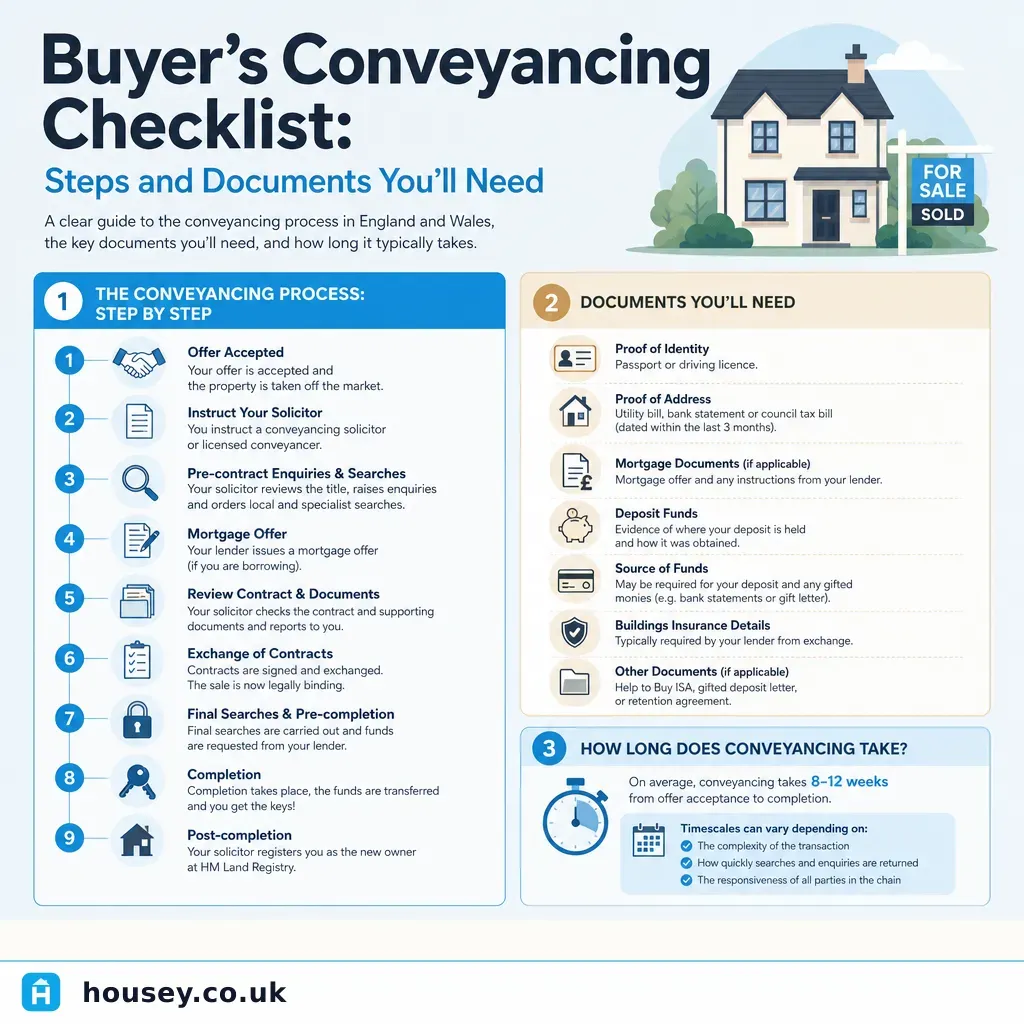
Buyer's Conveyancing Checklist: Steps and Documents You'll Need
Conveyancing for buyers in England and Wales typically takes 8–16 weeks across five stages: instruction and ID checks, searches, mortgage offer and enquiries, exchange, and completion.
 Buying & Moving
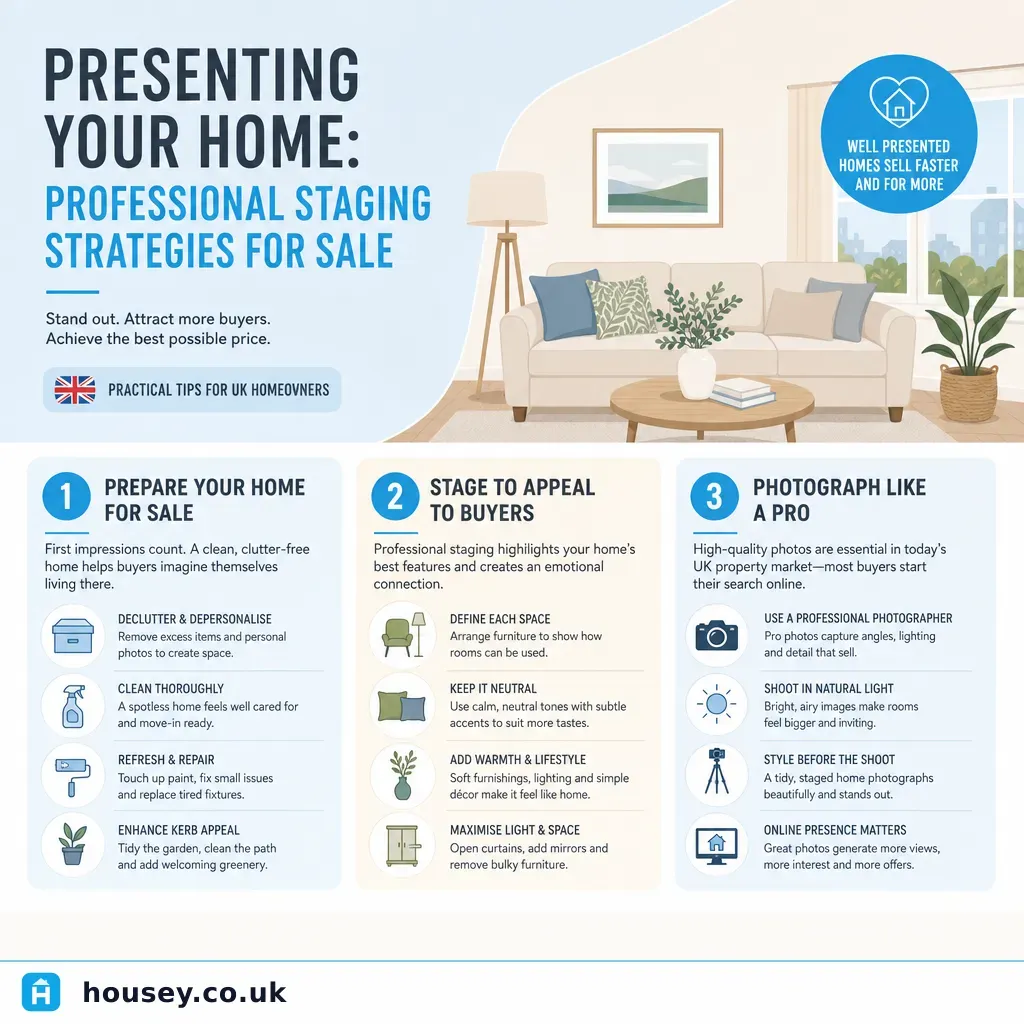
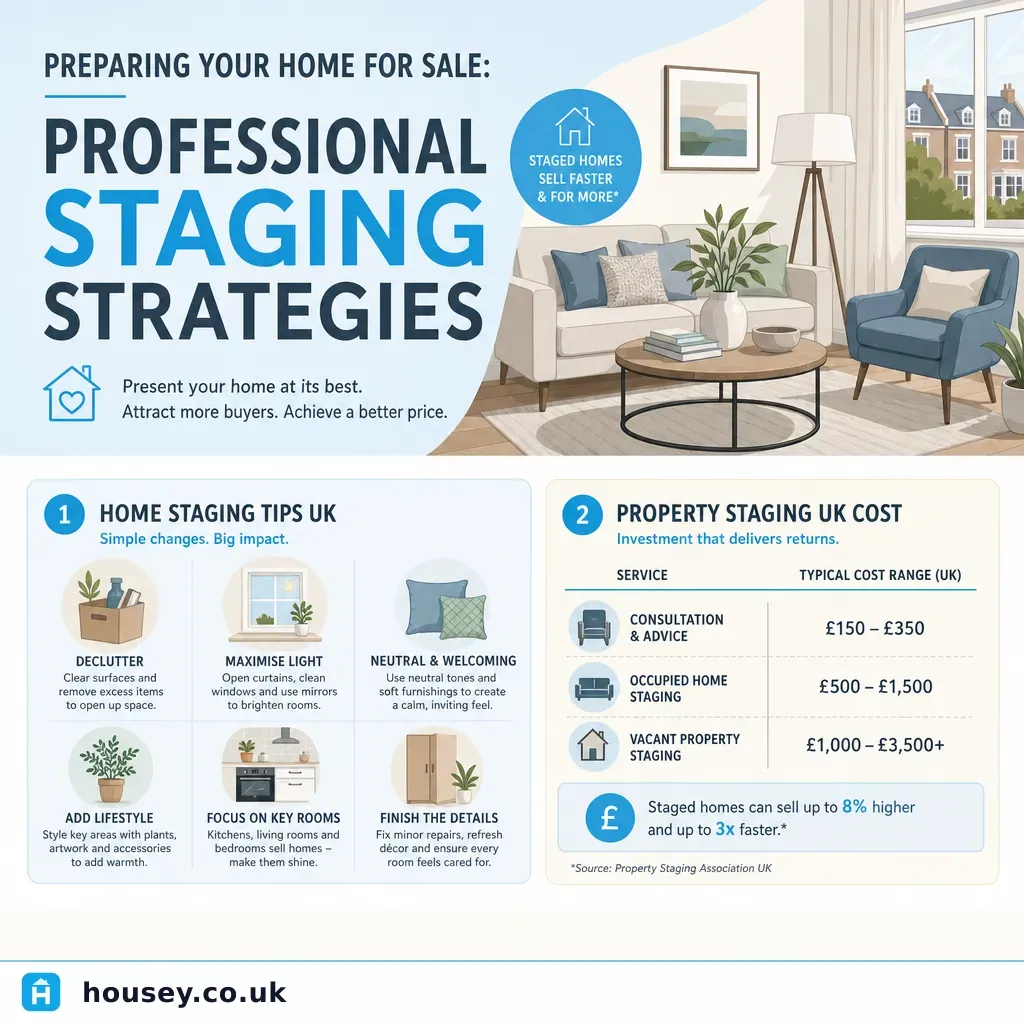
Presenting Your Home: Professional Staging Strategies for Sale
Home staging for a UK property sale means presenting each room to look spacious, neutral, and well-lit — primarily through decluttering, cleaning, and considered styling rather than expensive renovation.
 Buying & Moving
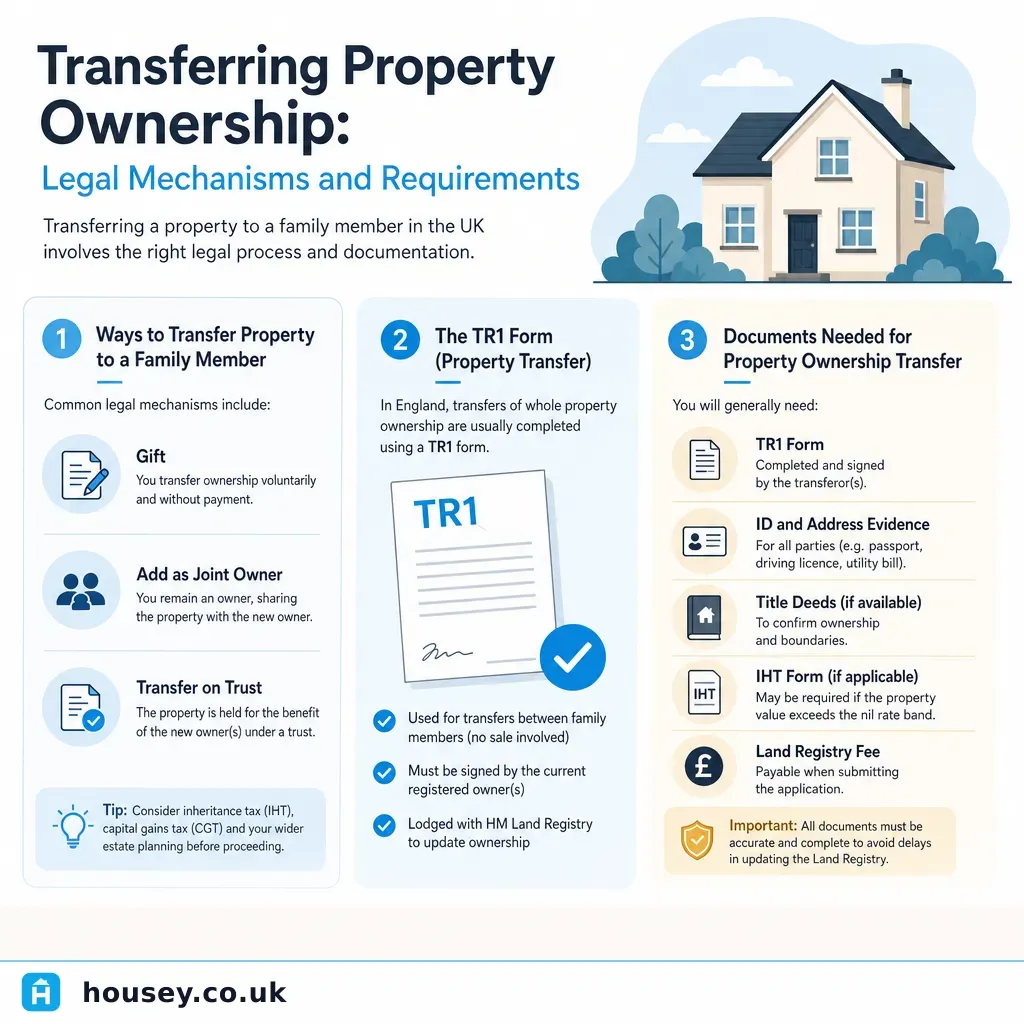
Transferring Property Ownership: Legal Mechanisms and Requirements
In England and Wales, property ownership transfers when HM Land Registry records a change of proprietor, triggered by a completed TR1 deed for full transfers or a TP1 for partial ones.
 Buying & Moving
Property Information Questionnaires: What You Need to Complete for Sale
When selling a home in England and Wales, you must complete the TA6 Property Information Form and TA10 Fixtures, Fittings and Contents form before contracts can be exchanged.
 Buying & Moving
Preparing Your Home for Sale: Professional Staging Strategies
Effective home staging focuses on decluttering, depersonalising, and presenting each room to show its proportions and light at their best.